Could foreign Daesh suspects be tried in northeast Syria?

Author: 
Tue, 2019-07-16 22:25

QAMISHLI: Months after the territorial defeat of Daesh, Syria’s Kurds are pushing for an international tribunal to try alleged militants detained in their region.

The Kurds run an autonomous administration in the northeast of Syria, but it is not recognized by Damascus or the international community.

This brings complications for the legal footing of any justice mechanism on the Kurds’ territory, and the international cooperation required to establish one.

With Western nations largely reluctant to repatriate their nationals or judge them at home, could foreign Daesh suspects be put on trial in northeast Syria?

After years of fighting Daesh, Syria’s Kurds hold around 1,000 foreign men in jail, as well as some 12,000 non-Syrian women and children in overcrowded camps.

Almost four months after Kurdish-led forces backed by the US-led coalition seized Daesh’s last scrap of land in eastern Syria, few have been repatriated.

The Kurdish authorities say they are seriously exploring how to set up an international tribunal, and invited foreign experts to discuss the idea at a conference it hosted early this month.

“We will work to set up this tribunal here,” the region’s top foreign affairs official Abdelkarim Omar told AFP afterwards.

“The topic of discussion now is how we will set up this tribunal and what form it will take,” he said.

Daesh in 2014 declared a “caliphate” in large parts of Syria and neighboring Iraq, implementing its brutal rule on millions in an area the size of the UK.

The militants stand accused of a string of crimes including mass killings and rape, and a UN probe is investigating alleged war crimes.

Mahmoud Patel, a South African international law expert invited to the July conference, said any court should include input from victims and survivors.

It should be “established in the region where the offenses happened so that the people themselves can be part of that process,” he said, preferably in northeast Syria because the Kurds do not have the death penalty.

In Iraq, hundreds of people including foreigners have been condemned to death or life in prison.

In recent months, a Baghdad court has handed death sentences to 11 Frenchmen transferred from Syria to Iraq in speedy trials denounced by human rights groups.

Omar, the foreign affairs official, said he hoped for an international tribunal to try suspects “according to local laws after developing them to agree with international law.”

The Kurdish region has judges and courts, including one already trying Syrian Daesh suspects, but needs logistical and legal assistance, he said.

A tribunal would have “local judges and foreign judges, as well as international lawyers” to defend the accused, he said.

Nabil Boudi, a French lawyer representing four Frenchmen and several families held in Syria, said the Kurdish authorities seemed determined.

“They’re already starting to collect evidence,” he said after attending the conference.

“All the people who were detained and jailed had their own phone” and data can be retrieved from them, said the lawyer, who was however unable to see those he represents.

Boudi called for “a serious investigation by an independent examining magistrate … that should take time and be far less expeditious than in Baghdad.”

Stephen Rapp, prosecutor in the trial of Liberian ex-president Charles Taylor, said the most realistic option to try foreigners in northeast Syria would be a Kurdish court.

It could have “international assistance conditioned on compliance with international law,” he said, including advice from a non-governmental organization specialized in working with non-state actors.

Main category: 

Syrian Kurds hand over 12 French orphans from Daesh familiesSyria Kurds host conference on Daesh detainees



Palestinian refugees protest Lebanese Labor Ministry restrictions

Author: 
Tue, 2019-07-16 21:35

BEIRUT: Palestinian refugees in Lebanon expressed their anger on Tuesday at the decision of the Lebanese Ministry of Labor to classify Palestinian labor similarly to illegal Syrian labor. 

The refugees carried out a general strike and protests across 12 camps.

The protests, under the slogan “Day of Anger,” paralyzed movement in the camps. Protesters closed the entrances with burning tyres. All Palestinian political forces and popular committees took part in the protests. 

The speaker of the Lebanese Parliament, Nabih Berri, received a letter from the head of the Palestinian National Council, Salim Zanoun, calling on him to “address the negative effects of the decision of the Lebanese Ministry of Labor.”

Zanoun said that Palestinians would support “Lebanon and its stability, as well as our determination to struggle together for the return of the Palestinian refugees, who have been graciously hosted by Lebanon for 71 years, and all refugees to their land and homes from which they were displaced by terrorism and the Israeli killing machine.”

Zanoun added that the decision of the Ministry of Labor has “caused great damage to human and civil rights and closed the doors of life for the Palestinian refugees.”

A source in the Lebanese-Palestinian Dialogue Committee (LPDC) said: “The protests are an expression of the deteriorating social and living conditions experienced by Palestinians in Lebanon. The decision of the Ministry of Labor inspired these protests.”

The source added: “The census conducted by the Lebanese state in cooperation with the Palestinian Authority in 2017 showed that the number of Palestinian refugees in Lebanon has reached 174,000 and the Palestinian labor force doesn’t exceed 40,000 workers. But if we repeat the census this year, we’ll find that there’s a decline in the labor force because of the quest to migrate, even if illegally, and to move to a third country in search of a better life.”

The Lebanese Parliament introduced amendments to laws 128 and 129 on labor and social security in 2010, which excludes “exclusively Palestinian refugee workers, who are duly registered in the records of the Ministry of the Interior, from the terms of reciprocity and work permit issued by the Ministry of Labor.”

The LPDC source said: “The amendment needed implementation decrees from the Council of Ministers, signed by the president, the prime minister and the minister of labor, but they’ve not been issued for nine years.”

The Palestinian labor force is present in fragile sectors such as construction and small crafts, but more problems arise among Palestinians who graduate from Lebanese universities and cannot work in their specialties because of trade union limitations. The source said that the Order of Nurses in Lebanon is the only union that allows Palestinians to work in their sector.

Alongside the protests, a meeting was held between various Palestinian factions at the headquarters of the LPDC with representatives of the General Confederation of Lebanese Workers. The Palestinian side called for “ending the measures of the Ministry of Labor regarding Palestinian refugees and not linking Palestinian labor in Lebanon with foreign labor.”

Ghassan Ayoub, a Palestinian member of the LPDC, said that the ministry’s actions “have a political impact. The Palestinian refugee isn’t a guest who has remained in Lebanon because he liked the hospitality.  He’s a forced refugee who was born in Lebanon and lives on his territory. He isn’t a foreign expatriate who came to work in Lebanon. This must be taken into account in the enforcement of the Ministry of Labor’s procedures.”

Ayoub said the situation demanded “the application of the spirit of the law and not the text of the law. There are many complications in the law in terms of obtaining a work permit and conditions for establishing a business. They’re impossible conditions for the Palestinians.”

As for the implications of applying the ministry’s procedures to the refugees in Lebanon, Ayoub said: “Ninety percent of professions are forbidden to Palestinians, which means that they’re entitled to work in only a few sectors, namely porterage and digging, which are arduous. That means you’re telling the Palestinians ‘you have 10 percent of the air to breathe.’ What do you want from the Palestinians? Where should they go? What are the alternatives?”

Palestinian refugees are not entitled to work in 72 professions in Lebanon, and are not permitted access to social security. One of the contradictions of the law is that Palestinians have the right to purchase a taxi but are forbidden to work in it. Moreover, Palestinians are only allowed to fish after obtaining a special permit.

“The plan of the ministry to combat illegal foreign labor force isn’t aimed at the Palestinians and has nothing to do with conspiracy theories,” Lebanese Labor Minister Kamil Abu Sulaiman said. 

“There’s a labor law in Lebanon. We approved a plan a month and a half ago to implement the law and gave a grace period of one month before we began inspections. The law applies to everyone and law enforcement can’t be fragmented.”

Abu Sulaiman added: “The Palestinian reaction is incomprehensible and meaningless.”

He received a call from Ashraf Dabbour, the Palestinian ambassador to Lebanon, and said he informed the diplomat of the ministry’s readiness to facilitate the affairs of the Palestinians.

In an open letter, Dabbour called on Palestinian refugees in Lebanon to avoid being “dragged into what does not serve our just cause. Our goal in the stage of our forced presence in Lebanon is to have a decent life until our return to our homeland, supported by our Lebanese brothers.”

The LPDC said that the Ministry of Labor “ignores the special case of the Palestinian refugees under the amendment of laws 128 and 129 and treats them as foreign workers.” 

The LPDC added: “The Palestinian refugees can’t return to their country, and everything that they produce inside Lebanon remains in it, which strengthens the economic cycle of the country, whether it comes from small entrepreneurs or the hard work of laborers and craftsmen.

“Lebanon also benefits from the funds flowing through the UN Relief and Works Agency for Palestine Refugees in the Near East’s $80 million budget. They also gain from the efforts of international organizations in Palestinian camps, as well as what Palestinian refugees send to their refugee families in Lebanon, which is estimated at several hundred million dollars.”

Fathi Abu Al-Ardat, secretary in Lebanon of Fatah and the Palestine Liberation Organization, said: “The Palestinian refugees in Lebanon are guests in this country and we respect its sovereignty, but we also respect the decent living of Palestinians in the camps.”

Main category: 

Palestinian refugees reject US Mideast policy as Beirut skips meetingDonors pledge over $110 million to help Palestinian refugees


Donald Trump tells Iran to ‘get out of Yemen’

Tue, 2019-07-16 19:39

WASHINGTON: US President Donald Trump said on Tuesday a lot of progress had been made with Iran and that he was not looking for regime change in Tehran, but said the US wanted the Islamic republic to “get out of Yemen.”

Trump, who made the remarks at a Cabinet meeting in the White House, did not give details about the progress, but US Secretary of State Mike Pompeo said at the meeting Iran had said it was prepared to negotiate about its missile program.

After threats from Ayatollah Ali Khamenei, Iran’s ultimate authority, to push on with breaches of the nuclear deal, Trump suggested to the Cabinet meeting that Iran wanted to talk with its archenemy.

“A lot of progress has been made. We’ll see what happens. But a lot of progress has been made,” Trump said.

Trump said the Iran nuclear pact agreed under his predecessor Barack Obama was too weak to prevent Tehran developing atomic bombs. “They can’t have a nuclear weapon. We want to help them. We’ll be good to them, we’ll work with them. We’ll help them in any way we can, but they can’t have a nuclear weapon. We’re not looking, by the way, for regime change.”

He added: “They (also) can’t be testing ballistic missiles.”

US Secretary State Mike Pompeo told the Cabinet meeting at the White House that Iran had signaled it was prepared to negotiate about its ballistic missiles.

“The Iranian regime is struggling to figure out what they’re going to do with their economy because we’ve been terribly effective,” Pompeo said.

“And the result is … frankly, I think it was yesterday, maybe the day before, for the first time the Iranians have said that they’re prepared to negotiate about their missile program. So we will have this opportunity, I hope, if we continue to execute our strategy appropriately, we’ll have this opportunity to negotiate a deal that will actually prevent Iran from getting a nuclear weapon.”

Main category: 

Iran’s Khamenei warns UK that Iran will not leave ‘piracy’ unansweredIran’s top diplomat warns US is ‘playing with fire’


France, Britain, Egypt, UAE, United States, Italy call for immediate end of hostilities in Libya

Tue, 2019-07-16 19:41

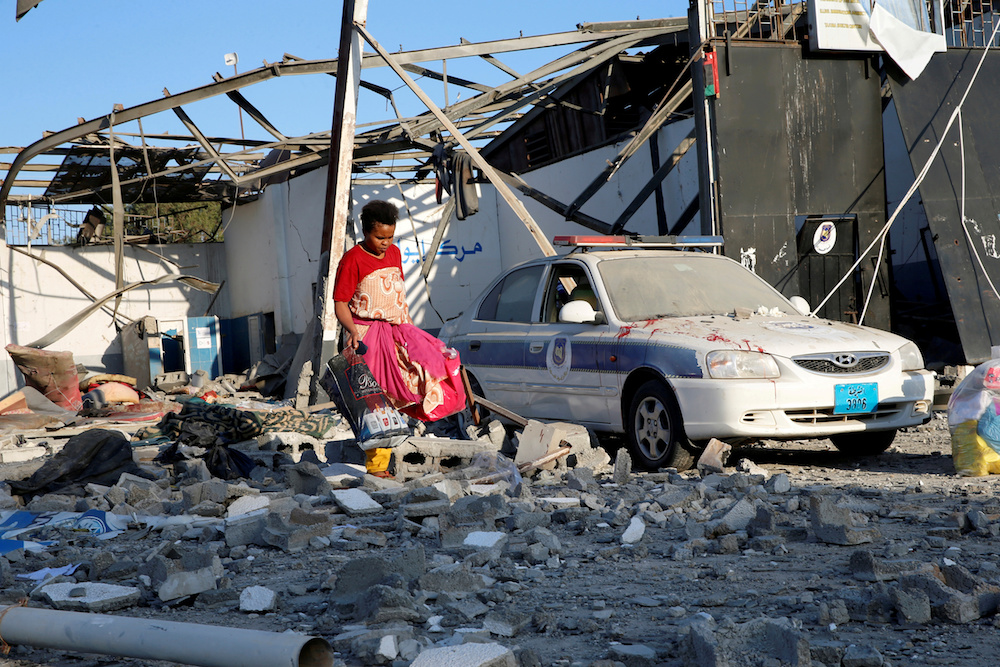
LONDON: France, UK, Egypt, the UAE, US and Italy on Tuesday called for an immediate end of hostilities around Tripoli and warned of attempts by “terrorist groups” to take advantage of the political void in Libya.

The six countries reiterated in a rare joint statement their deep concern over the ongoing hostilities in Tripoli and called for an immediate de-escalation, end of the current fighting, and urged a rapid return to the political process under the auspices of the UN. 

They warned that the fighting “has fueled a growing humanitarian emergency,” aggravating a crisis with migrants, and voiced fear that extremists would thrive in the security vacuum.

The countries “call on all parties to the Tripoli conflict to dissociate themselves from all such terrorists and individuals designated by the UN Sanctions Committee, and renew our commitment to see those responsible for further instability held accountable,” they said.

Nearly 1,100 people have been killed in the fighting.

While backing the government, Western powers earlier this year sent mixed signals, with US President Donald Trump praising Khalifa Haftar in a phone call and France and Italy welcoming him on visits.

Main category: 

Four killed as car bomb targets funeral in Libya’s BenghaziUN says death toll from Libya fighting passes 1,000


For a few Gazans, a trip to a chalet offers an alternative to the heavily polluted seaside

Author: 
Mon, 2019-07-15 22:50

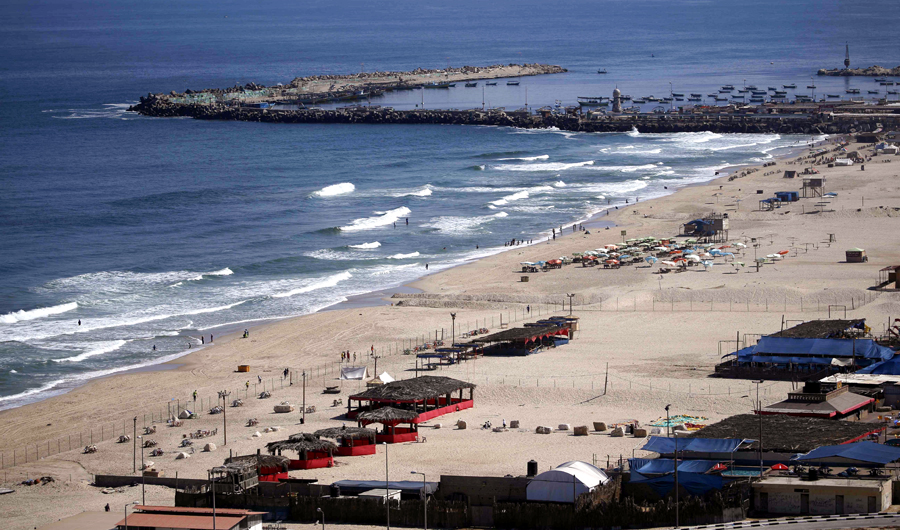
GAZA CITY: During the summer, middle-class Palestinians in the Gaza Strip head for chalets and swimming pools for a short break, rather that the seaside. The prospect of a trip to the beach is not so attractive when the waters are heavily polluted after years of raw, untreated sewage being pumped into the sea.

Demand for the chalets has been growing since that start of the siege that was imposed on the Gaza Strip in 2007, and has increased particularly sharply in the past few years as a result of the total pollution of more than 60 percent of the waters along the coast and the partial pollution of the rest, extending to about 40 kilometers offshore.

While the chalets offer relatively better-off Gazans the chance to avoid the polluted sea, the majority — who rely on relief aid to survive, as a result of high levels of poverty and unemployment — are not so lucky. For them, swimming in the filthy waters is the only option if they want a break.

Ibrahim Abu Dibaa work worked as a beach lifeguard for several years and loved it, but gave it up five years ago over fears of disease from the pollution. 

Unofficial estimates suggest that hospitals in the Gaza Strip treat dozens of people daily, children in particular, for intestinal infections and skin diseases caused by swimming in contaminated sea water.

Dibaa said he takes his family on a one-day chalet vacation so his children can play and swim safely.

“I have a lot of memories with the sea, and when I see it like this I almost cry and I deeply grieve for the thousands of Gazans who have no alternative to the sea, despite the danger of swimming in it,” he said.

Khaled Altibi, the head of the water-treatment department at the Ministry of Health, said the latest statistics, from April, revealed that 62 percent of the sea around Gaza is polluted. He added that this is better than the same time last year, as a result of efforts to ensure wastewater treatment plants can operate for longer periods.

FASTFACT

While the chalets offer relatively better-off Gazans the chance to avoid the polluted sea, the majority are not so lucky. For them, swimming in the filthy waters is the only option if they want a break.

Altibi said that pollution poses a serious danger to the health of Gazans because contaminated water contains bacteria, fungi and viruses contain or cause diseases that can be transmitted to humans easily.

Mohammed Dawoud knows this only too well. He said his family went to a section of the shore at Khan Yunis, in the southern Gaza Strip, that was supposedly safe according to a map issued by the authorities. However, his 9-year-old daughter, Alia, subsequently fell ill with fever, severe diarrhea and red blisters on her body. When he took her to a hospital, medics told him she was suffering from intestinal disease caused by swimming in and swallowing sea water contaminated by sewage. As a result, Dawoud is boycotting the sea.

“I will never risk my family and my children again,” he said. “Health is more important than the sea. If I have to swim I will go to a private swimming pool.”

Ali Abu Hajjar does not have the money to go to a private pool instead of the sea. Instead, he wants to take with his family to a seaside area believed to be largely safe north of Rafah, which was an Israeli settlement before the Israeli withdrawal from the Gaza Strip in 2005.

He is government employee who is only being paid 40 percent of his salary because of the financial crisis in Gaza. He said that the cost of hiring a chalet for a day or a night is about 350 shekels ($100), which is equivalent to about a third of his monthly salary. A few years ago, the cost of a chalet was up to $ 250, but the economic situation as forced the prices down.

Heba Abu Hamad and 12 of her friends decided to share the costs and take their children on a group trip to chalets during the summer instead of going to the seaside.

“These collective group trips, in which we share the financial cost, make them available several times during the summer without burdening us under difficult economic conditions,” she said. Such group trips cost about 50 shekels, depending on numbers.

Chalet owner Mohamed Sobh said he tries to keep his prices are affordable. They range from about $100 to $120, slightly higher on Thursdays and Fridays, and vary depending on the length of the booking and whether people stay during the night or day.

He noted that many people are joining with friends to take advantage of lower-cost group bookings.

Salah Abu Hasira, the head of the Palestinian Authority for Restaurants and Tourist Services, said there are about 300 holiday chalets in the Gaza Strip, and competition is high during the summer season to attract people who want to avoid the pollution of the sea and the difficulties that come with trying to travel to other countries. He added that the chalets have become a common “respite” for those with the financial ability to rent them.

“The spread of chalets and investment pools in Gaza is a natural phenomenon,” said Hamed Jad, economic editor of Al-Ayyam newspaper, as a result of the Israeli siege, the inability of many people to travel further afield, as well a desire to avoid the polluted sea.

Main category: 

Gazans brace for more mass border demos at anniversaryGazans defy violent response to their attempts to end Israeli blockade