Iran seizes British tanker in Strait of Hormuz, UK government calls emergency meeting

Fri, 2019-07-19 21:03

TEHRAN: Iran’s Revolutionary Guard Corps announced on Friday they had confiscated a British tanker in the strategic Strait of Hormuz for breaking “international maritime rules,” while a US official told CNN that Iran had seized a second tanker, the British-owned, Liberian-flagged MV Mesdar, according to reports.

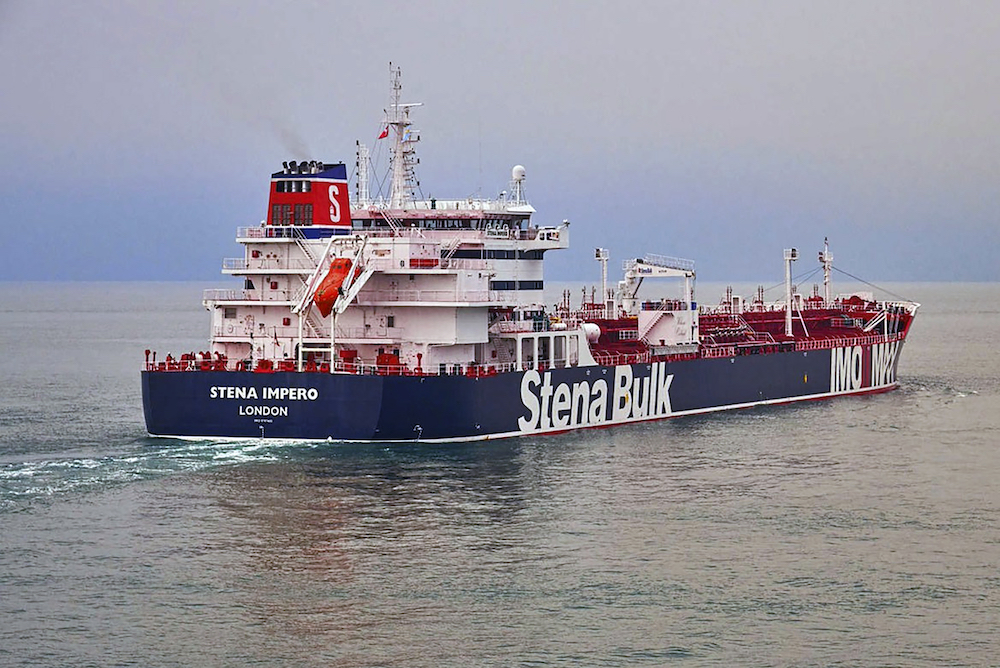
The Stena Impero tanker “was confiscated by the Revolutionary Guards at the request of Hormozgan Ports and Maritime Organisation when passing through the strait of Hormuz, for failing to respect international maritime rules,” the Guards’ official website Sepahnews announced.

The UK government convened an emergency COBRA meeting to formulate its response and a foreign ministry spokesperson said: “We are urgently seeking further information and assessing the situation following reports of an incident in the Gulf.”

Prime Minister Theresa May’s office declined to comment. 

The Foreign and Commonwealth Office relayed a statement from foreign minister Jeremy Hunt, in which he appeared to confirm the seizure of a second vessel. He said: “I’m extremely concerned by the seizure of two vessels by Iranian authorities in the Strait of Hormuz.

“I will shortly attend a COBRA meeting to review what we know and what we can do to swiftly secure the release of the two vessels – a British-flagged vessel and a Liberian-flagged vessel

“Their crews comprise a range of nationalities, but we understand there are no British citizens on board either ship.

“Our Ambassador in Tehran is in contact with the Iranian Ministry of Foreign Affairs to resolve the situation and we are working closely with international partners.

“These seizures are unacceptable. It is essential that freedom of navigation is maintained and that all ships can move safely and freely in the region.”

Arab News contacted Col. Robert Stewart, Conservative MP and former UN commander in Bosnia, who said that the UK government would have to “look at all the options” in its response to Iran’s behaviour, adding that Iran’s actions were an escalation too far, “of course.”

Refinitiv data showed the Stena Impero was a British-flagged vessel owned by Stena Bulk. It showed the vessel’s destination as the Saudi port of Jubail on the Gulf.
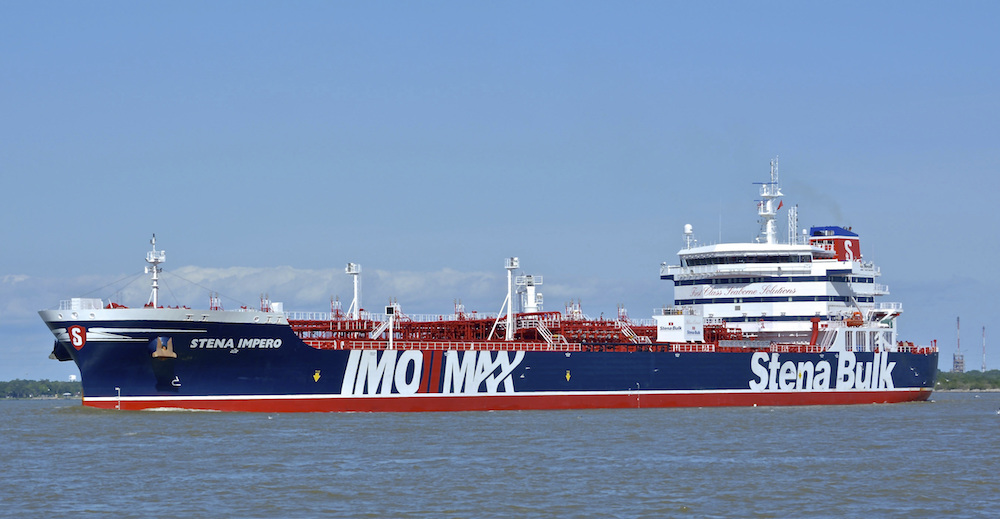

A file photo of the Stena Impero from May 2019. (Basil M. Karatzas, Karatzas Images via AP)

The map tracking the ship’s course showed it veering off course with a sharp turn north at about 15:17 GMT on Friday and heading towards the Iranian coast.

Meanwhile, the head of the UK Chamber of Shipping said on Friday that further protection must be provided for merchant vessels after the seizure.

“We condemn unreservedly the capture of Stena Impero as she transited the Strait of Hormuz earlier today,” the Chamber’s chief executive, Bob Sanguinetti, said in a statement.

“This incident represents an escalation. Whilst we call for measured response, it is also clear that further protection for merchant vessels must be forthcoming to ensure enhanced security to guarantee free flow of trade in the region.” 

The Stena company responsible for the ship also released a statement, which read: “Stena Bulk and Northern Marine Management can confirm that at approximately 1600 BST on 19th July, UK registered vessel Stena Impero (built 2018, 49,683 DWT) was approached by unidentified small crafts and a helicopter during transit of the Strait of Hormuz while the vessel was in international waters. We are presently unable to contact the vessel which is now heading north towards Iran.


“There are 23 seafarers aboard. There have been no reported injuries and their safety is of primary concern to both owners and managers. The priority of both vessel owner Stena Bulk and ship manager Northern Marine Management is the safety and welfare of the crew.

Iran’s Ayatollah Ali Khamenei earlier this month accused the UK of “piracy” after the Royal Marines and Gibraltarian police seized a tanker believed to be carrying Iranian crude oil to Syria on July 5, and the Iranian government has demanded its immediate release.

The ship was detained on suspicion it was breaking European sanctions by taking oil to Syria.

(With Agencies)
Main category: 

Gibraltar court extends detention of Iranian tanker for 30 daysGibraltar had “positive” meeting with Iran over seized Grace 1 tanker



Israel spyware firm can mine data from social media: FT

Author: 
Fri, 2019-07-19 17:29

JERUSALEM: An Israeli spyware firm thought to have hacked WhatsApp in the past has told clients it can scoop user data from the world’s top social media, the Financial Times reported Friday.
The London paper wrote that NSO group had “told buyers its technology can surreptitiously scrape all of an individual’s data from the servers of Apple, Google, Facebook, Amazon and Microsoft, according to people familiar with its sales pitch.”
An NSO spokesperson, responding in a written statement to AFP’s request for comment, denied the allegation.
“There is a fundamental misunderstanding of NSO, its services and technology,” it said.
“NSO’s products do not provide the type of collection capabilities and access to cloud applications, services, or infrastructure as listed and suggested in today’s FT article.”
In May, Facebook-owned WhatsApp said it had released an update to plug a security hole in its messaging app that allowed insertion of sophisticated spyware that could be used to spy on journalists, activists and others.
It said the attack bore “all the hallmarks of a private company that works with a number of governments around the world.”
It did not name a suspect but Washington-based analyst Joseph Hall, chief technologist at the Center for Democracy and Technology, said at the time that the hack appeared related to the NSO’s Pegasus software.
It is normally sold to law enforcement and intelligence services.
Friday’s FT report, citing documents it had viewed and descriptions of a product demonstration, said the program had “evolved to capture the much greater trove of information stored beyond the phone in the cloud, such as a full history of a target’s location data, archived messages or photos.”
NSO says it does not operate the Pegasus system, only licensing it to closely vetted government users “for the sole purpose of preventing or investigating serious crime including terrorism.”
The group came under the spotlight in 2016 when researchers accused it of helping spy on an activist in the United Arab Emirates.
NSO is based in the Israeli seaside hi-tech hub of Herzliya, near Tel Aviv. It says it employs 600 people in Israel and around the world.
Pegasus is a highly invasive tool that can reportedly switch on a target’s cell phone camera and microphone, and access data on it, effectively turning the phone into a pocket spy.
“Increasingly sophisticated terrorists and criminals are taking advantage of encrypted technologies to plan and conceal their crimes, leaving intelligence and law enforcement agencies in the dark and putting public safety and national security at risk,” the company statement said.
“NSO’s lawful interception products are designed to confront this challenge.”

Main category: 

Israel touts air defense system to South KoreaIsraeli court halts park entry ban deemed racist by Arab citizens


Egypt: At least 20 killed in airstrikes in northern Sinai

Fri, 2019-07-19 18:24

EL-ARISH: Egyptian security officials say airstrikes targeting militants are underway in the restive northern Sinai Peninsula, killing at least 20 insurgents.
Officials said that Egypt’s air force on Friday hit more than 100 mountainous hideouts of militant groups in the city of El-Arish and the small town of Bir Al-Abd. The officials spoke on condition of anonymity because they were not authorized to brief the media.
The airstrikes come on the heels of a suicide bombing attack that left two killed, including a soldier and a civilian Thursday in the northern Sinai town of Sheikh Zuweid.
A day earlier, militants beheaded four people and kidnapped a fifth in Bir Al-Abd, after accusing them of cooperating with security forces.  Daesh claimed responsibility for both attacks.

Main category: 
Tags: 

Daesh claims suicide bombing that killed 2 in Egypt’s SinaiEgypt officials say roadside bomb wounds 6 police in Sinai


US puts sanctions on Hezbollah leader suspected of masterminding Buenos Aires 1994 attack

Fri, 2019-07-19 17:00

WASHINGTON: The US on Friday imposed financial sanctions on a Hezbollah leader suspected of masterminding the 1994 bombing of a Jewish center in Buenos Aires that killed 85 people.

The US Treasury sanctions freeze any assets of Salman Raouf Salman for acting for or on behalf of Hezbollah, while the State Department is offering a $7 million reward for information on his location.

Salman “coordinated a devastating attack in Buenos Aires, Argentina against the largest Jewish center in South America 25 years ago and has directed terrorist operations in the Western Hemisphere for Hezbollah ever since,” said Sigal Mandelker, the US Treasury’s Under Secretary for Terrorism and Financial Intelligence.

The action by the Treasury Department falls on the 25th anniversary of an attack Salman is said to have coordinated on the center in Argentina’s capital. The attack killed 85 people and wounded hundreds of others. The Treasury’s action freezes all assets that Salman has within U.S. jurisdiction. The Treasury said Salman is also accused of planning other terror attacks abroad from a base in Lebanon.

On Thursday, Argentina’s government branded Hezbollah a terrorist organization and froze its assets.

Main category: 

Pence announces sanctions on Iranian-linked leaders in IraqUnidentified aircraft targets IRGC and Hezbollah military camp in Iraq


From Iraq to Yemen, drones raise US alarm over Iranian plans

Author: 
Thu, 2019-07-18 22:58

GENEVA, WASHINGTON: The increased use of drones by Iran and its allies for surveillance and attacks across the Middle East is raising alarms in Washington.

The US believes that Iran-linked militia in Iraq have recently increased their surveillance of American troops and bases in the country by using off-the-shelf, commercially available drones, US officials say. The disclosure comes at a time of heightened tensions with Iran and underscores the many ways in which Tehran and the forces it backs are increasingly relying on unmanned aerial vehicles (UAVs) in places like Yemen, Syria, the Strait of Hormuz and Iraq.

Beyond surveillance, Iranian drones can drop munitions and even carry out “a kamikaze flight where they load it up with explosives and fly it into something,” according to a US official who spoke on condition of anonymity.

Yemen’s Iranian-backed Houthis have significantly increased their UAV attacks in recent months, bombing airports and oil facilities in Saudi Arabia.

Last month, Iran came close to war with the US after Iran’s unprecedented shoot-down of a US drone with a surface-to-air missile, a move that nearly triggered retaliatory strikes by US President Donald Trump.

Trump withdrew from a major 2015 nuclear deal last year and reimposed sanctions to cut off Iran’s oil exports and pressure Tehran to negotiate over its ballistic missile program and regional policy.

The increased use of drones by Iran or its regional allies is a strategy aimed at pushing back and defending against pressure from the US, current and former security officials and analysts say. Iran now flies two or three drones over Gulf waters every day, the first US official estimated, making it a core part of Tehran’s effort to monitor the Strait of Hormuz, through which one-fifth of the world’s oil consumption flows.

The US and Saudi Arabia have accused Iran of carrying out attacks against six oil tankers near the Strait in the past two months.

The US officials, who spoke on condition of anonymity, declined to quantify the extent to which surveillance near US forces has increased in Iraq or to specify which militia were carrying it out.

“We have seen an uptick in drone activity in Iraq near our bases and facilities,” the first official said. “Certainly the drones that we have seen are more of the commercial off-the-shelf variant. So they’re obviously a deniable type UAV-activity in Iraq.”

A second official said the recent increase in surveillance was worrying but acknowledged Iran-linked militia in Iraq had a history of keeping tabs on Americans.

Reuters has previously reported that the US has indirectly sent warnings to Iran, saying any attack against US forces by proxy organizations in Iraq will be viewed by Washington as an attack by Iran itself.

In recent weeks, mortars and rockets have been fired at bases in Iraq where US forces are located but no American troops have been injured. US officials did not link those attacks to the increased surveillance.

Attempts to reach the Iranian Ministry of Foreign Affairs and the Revolutionary Guards, who are most closely linked to militant groups in Iraq, for comment were unsuccessful.

Iraqi militia groups linked to Iran began using drones in 2014 and 2015 in battles to retake territory from Daesh, according to militia members and Iraqi security officials.

These groups received training on the use of drones from members of Iran’s Revolutionary Guards and Lebanon’s Iranian-backed Hezbollah, two Iraqi security officials with knowledge of militia activities said.

“Key militia groups have the ability to launch aerial attacks using drones. Will they target American interests? That hasn’t happened yet,” said one Iraqi security official. “They used Katyusha and mortars in very restricted attacks against American interests in Iraq to send a message rather than trying to inflict damage. Using explosive-laden drones is very possible once we have a worsening situation between Tehran and Washington.”

How sophisticated are Iran’s drones?

In March, Iran boasted about a complex military exercise involving 50 drones. In a slickly edited video aired on state TV, waves of drones streak across a clear blue sky, bombing buildings on an island in the Gulf.

The show of force was intended to highlight Iran’s locally developed UAV program, which it has been building up for several years.

Douglas Barrie, a senior fellow at the London-based International Institute for Strategic Studies, however, cautioned that some of Iran’s claims were “best viewed through the prism of domestic messaging.” “That Iran has a growing capability in UAVs isn’t debatable. What is an open question is the actual levels of technology it often employs,” Barrie said, adding that Israel had the most advanced program in the region.

American technology may have been used to enhance the Iranian drone program: An advanced US RQ-170 Sentinel reconnaissance drone went down in eastern Iran in 2011, and Revolutionary Guards commanders say they were able to reverse engineer it, a claim which some security officials and analysts dispute.

“They’ve really come up with some aircraft which are looking increasingly sophisticated in terms of their ability to carry guided weapons and carry out long range surveillance missions,” said Jeremy Binnie, Middle East and Africa editor for Jane’s Defense Weekly.

US forces have shot down Iranian-made drones in 2017 in Syria, after deeming them a threat to both US-backed forces and their advisers.

Exporting drone technology

Iran has passed on its drones and technical expertise to regional allies, current and former security officials and analysts say.

The Revolutionary Guards and Hezbollah advise the Houthis on the use of drones and operate video uplinks from Tehran and Beirut to beam in technical expertise when needed, an official from the Saudi-led coalition fighting in Yemen said.

Iran has denied any role in the conflict in Yemen.

UN experts say the Houthis now have drones that can drop bigger bombs further away and more accurately than before. In May, drones hit two oil pumping stations hundreds of kilometers inside Saudi territory.

“Either the drones that attacked the pipelines were launched from inside Saudi territory or the Houthis just significantly upped their capability with satellite technology and were provided with the capability to extend the distance,” said Brett Velicovich, a drone expert and US Army veteran, about the May attack.

A commander of Kataib Hezbollah, an Iraqi militia closely linked to Iran, using the nickname Abu Abdullah, told Reuters in 2014 that Iran had provided training for operating drones, which were mostly used to target Daesh positions.

He said at the time that they had also used the drones to carry out surveillance on American military positions in Iraq and in the conflict in Syria, where Kataib Hezbollah fought in support of Bashar Assad.

Iraqi militia groups have now acquired enough expertise to modify drones for attacks, two Iraqi security officials with knowledge of the militia activities said.

Main category: 

UN envoy for Yemen says ‘very concerned’ about Houthi attacks on Saudi ArabiaPence announces sanctions on Iranian-linked leaders in Iraq