Displaced by fighting, Libyans fear ending up ‘on the street’

Author: 
Sat, 2019-08-10 22:58

TRIPOLI: Libyans who fled fighting outside Tripoli dream of returning to their homes as they prepare for the Eid Al-Adha festival with heavy hearts, worried they will end up living on the streets.
In early April, Mohamad Kreir and his family fled their home south of Tripoli as fierce clashes flared between rival forces turning the area into a battleground.
Kreir and others like him were moved into hotels paid for by a crisis committee set up by the Tripoli-based UN-recognized Government of National Accord (GNA) to cope with the influx of displaced.
The committee is now asking them to leave the hotels but has given no reason for its decision.
“A few days ago, they tell us we have to leave the hotel. What should I do? Live in the street with my family? I have nowhere to go,” Kreir said. Another man added: “My family and I are at a hotel and I don’t even have a quarter dinar in my pocket.”
They were speaking during a gathering of some 50 displaced people in a gymnasium organized by an NGO in the Libyan capital.
“I realized that the crisis they’re going through is more serious than Eid,” said Entisar Elgleib, head of a Libyan coalition of civil society organizations, who attended the gathering.
Eid Al-Adha is usually a time of festivities, but for many of the displaced families, this year’s holiday will be a frugal one, as many complain of dwindling savings due to ongoing fighting.
Kongoing Kreir recalled how he and his family fled their home near the Al-Toghar Mosque in the Swani district after Libyan eastern commander Khalifa Haftar launched in early April an assault to seize Tripoli from the GNA.
“We left in a rush without taking even the bare minimum,” he said, before the crisis committee set them up in a hotel. In his 50s, Kreir still suffers from the effects of a stroke he had a few years ago and struggles to stay upright.
Fatma Bachir, a married mother of two, lived in Khallet Al-Ferjan in southern Tripoli, one of the first areas where fighting caused residents to flee. An official at the postal service, Bachir has spent all her savings since leaving her home.
“I spent more than 7,000 dinars (around $5,000) — that is all my savings. We have nothing left, my husband and I, so we borrowed money,” she said.
“Since then, we moved from one house to another staying with relatives before going to a hotel for the month of Ramadan.”

NUMBER

1,093 – People have been killed in the fighting on the outskirts of Tripoli that also wounded 5,752 and displaced 120,000, according to a report released the UN refugee agency on Friday.

This situation is “abnormal and unbearable. We are going to end up in the street, in debt,” according to Bachir.
According to a report released on Friday by the UN refugee agency, fighting on the outskirts of Tripoli has killed 1,093 people, wounded 5,752 and displaced 120,000.
Many families who fled the violence are dissatisfied with the crisis committee’s efforts at support.
But committee member Abdel Barri Chenbar told a news conference last week that since its creation, the crisis committee has “been able to provide some solutions.”
“The GNA has allocated 10 million dinars to refurbish public buildings to house families staying in schools” since April, he said.
But Elgleib said the committee “is not close enough to the people and its response is slow” and called for authorities to meet with the families effected by the fighting.
“A displaced person doesn’t need a liter of oil or a can of tomato paste … but to be listened to,” she said.
With the lack of prospects and money, some say they prefer to return to their homes, even if these areas are still considered dangerous.
“I want to go home even though I fear for my children because of the security situation and the fighting,” Kreir said.

Main category: 
Tags: 

Libya’s Haftar, unity govt agree to UN-backed Eid truceCar bomb in Libya’s Benghazi kills two UN staff


Fierce clashes kill 55 combatants in Syria

Sat, 2019-08-10 23:20

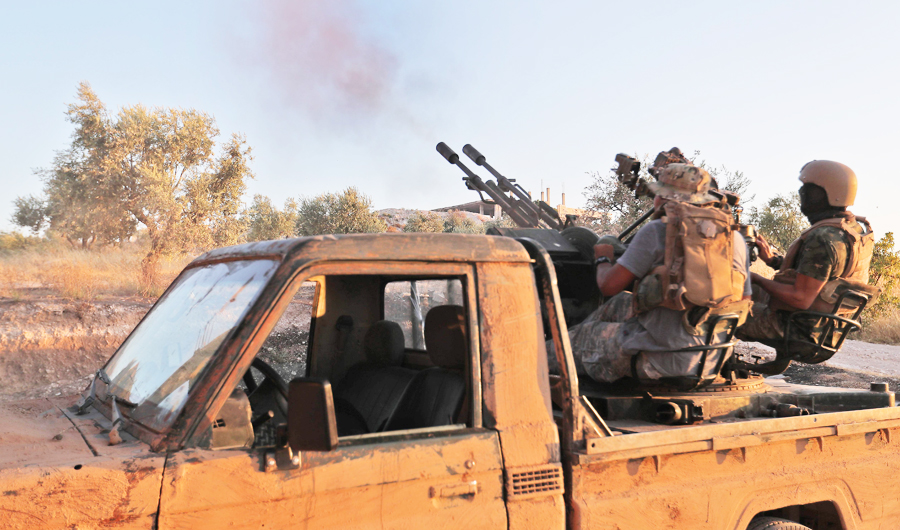
BEIRTU: Clashes between regime loyalists and insurgents in northwest Syria killed 55 combatants on Saturday, as regime forces continued to nibble away at territory held by its opponents, a war monitor said.
Hayat Tahrir Al-Sham (HTS) has since January controlled most of Idlib province as well as parts of neighboring Hama, Aleppo and Latakia provinces. Several other armed opposition groups also operate in the area.
Fighting in various parts of the region on Saturday claimed the lives of 23 pro-regime forces as well as 32 opposition and allied fighters, the Syrian Observatory for Human Rights said. The regime also launched dozens of airstrikes against northern Hama and southern Idlib, the Britain-based monitor added.
The latest violence came as forces loyal to Damascus pushed a days-long advance toward a strip straddling the provinces of Hama and Idlib, it said.
They aim to capture Kafr Zita — one of the largest towns in northern Hama — and the nearby village of Al-Latamneh from opposition fighters, said Observatory head Rami Abdel Rahman.
Both lie on the southern edge of the opposition-run bastion of Idlib, one of the last centers of opposition to Syria’s Bashar Assad after eight years of civil war.

SPEEDREAD

Fighting in various parts of the region on Saturday claimed the lives of 23 pro-regime forces as well as 32 opposition and allied fighters.

Regime forces have closed in Kfar Zeita and Latamneh over the past week, after capturing a string of nearby towns and villages, the Observatory said. They are also trying to surround the nearby town of Khan Sheikoun in order to wrest it from the opposition, Abdel Rahman said.
The latest advances come after the Syrian regime on Monday scrapped a brief three-day cease-fire for the Idlib region, accusing its opponents of refusing to abide by the truce.
The region was supposed to be protected from a massive regime offensive by a Turkish-Russian buffer-zone deal that was reached in September last year. But it has come under increasing bombardment by Damascus and its backer Moscow since the end of April.


Main category: 
Tags: 

Turkey-US deal: End to Turkish ambitions for an offensive into Syria?Lebanon demolishes more Syrian refugee shelters


Arab coalition calls for ceasefire in Aden, Yemen

Sat, 2019-08-10 23:09

JEDDAH: The Arab coalition supporting the government in Yemen called Saturday for a ceasefire in Aden where government troops and southern separatists have clashed for days.

The two forces are meant to be working as allies to defeat the Iran-backed Houthi militia, which control the capital Sanaa. 

Shortly after the coalition statement, the Saudi foreign ministry called for an emergency meeting in the Kingdom.

“The coalition is calling for an immediate ceasefire in the Yemeni interim capital (Aden)… and asserts that it will use military force against anyone who violates this,” the coalition spokesman said.


Main category: 

Clashes kill six civilians in Yemen’s AdenYemen government blames separatists for Aden clashes


WATCH: Middle East Airlines pilot praised for high-wind Heathrow landing

Sat, 2019-08-10 22:16

LONDON: A Lebanese airline pilot has been praised for calmly landing a Middle East Airlines plane in strong winds at Heathrow Airport.

A video posted by the Middle East Airlines Fan Club shows Rola Hoteit, who was the airline’s first female pilot, touching down in London in “heavy crosswinds,” according to the club’s Facebook page.

As her Airbus A330 approached the runway it lurches sidewards as its buffeted by the winds before she calmly brings the wheels into contact with the tarmac.

“If they had ever asked you about MEA pilots, then there is no need to answer them,” the Facebook post said.

The UK has been buffeted by a summer storm since Friday which has brought high winds and heavy rain.

Hoteit, a mother of two, has been a pilot with MEA for 25 years and is credited with blazing a trail for other female pilots in the country. 


Main category: 

Middle East airline profits to roar back in 2018Middle East air passenger demand up in July


Turkey-US deal: End to Turkish ambitions for an offensive into Syria?

Author: 
Fri, 2019-08-09 23:50

ANKARA: Ankara’s agreement with Washington to set up a so-called safe zone in northeastern Syria, along with a joint coordination center, has sparked debate about whether it will completely prevent a Turkish offensive into the region.

A day after the announcement of the deal, Damascus criticized it harshly, saying that it is a violation of Syria’s sovereignty and accused Ankara of “expansionist ambitions,” according to the state-run SANA news agency.

As the deal is meant to resolve Turkey’s security concerns, experts think it may lead Ankara to halt its plans for an incursion into Syria, at least for now, although no details were given about the scope of the safe zone and timetable for its implementation.

The US State Department said it welcomed the results of its recent talks with Turkey on setting up a “peace corridor” in northern Syria.

“The talks seem to me like a pretty good outcome under the circumstances. The agreement on establishing a new process buys time and space, which ideally can be used to shift from arguing over tactical steps to arguing over more substantive ones,” Dareen Khalifa, senior Syria analyst at International Crisis Group, told Arab News.

Ankara’s main priority is to push back US-allied Syrian Kurdish YPG militia from the region. Turkey’s National Security Council met last week over a possible military offensive into Syria against the YPG, which it believes is affiliated with the PKK terror group that has been waging a decades-long insurgency against the Turkish state.

According to Khalifa, the prospects for a rapprochement between Ankara and Damascus are clearly fading, especially after the statement of Syria’s Foreign Ministry.

Turkish soldiers were killed in opposition-held Idlib province by regime forces and “Ankara’s control over swaths of Aleppo and their support to the opposition are all contributing factors,” she said.

Khalifa also noted that “it is not clear that there was an agreement over permanent Turkish forces in the north east.”

In its statement, Damascus urged Syrian Kurds to align with the Assad government to prevent the implementation of the “aggressive US-Turkish project.”

Yasin Kucukkaya, a Syria expert from the Global Political Trends Center think tank in Istanbul, said Turkey preferred an “unarmed diplomacy” with the US for a certain time in northern Syria.

“I think all relevant parties, including the Syrian Democratic Forces which include the YPG, were satisfied by the outcome of the negotiations between American and Turkish delegations, because any unilateral move of Turkey would bring damage on the ground,” he told Arab News.

Ankara had blamed Washington for dragging its feet over its security concerns, and had insisted on it breaking its ties with the YPG militia, which controls a large part of northern Syria.

Kucukkaya said that the deal halted Turkey’s possible intervention into the region for now.

“Although Turkey’s target is to eradicate the YPG and its offshoots, it also prioritizes any withdrawal of the support given to this group,” he added.

However, experts are cautious in any medium-term assessment of Turkey’s plans into the region.

“It is premature to consider whether this deal has definitely ended Turkish ambitions for an offensive. The bilateral negotiations only prevented an extensive war potential on the ground,” Kucukkaya said.

Main category: 

Damascus rejects Turkey-US talks on Syria buffer zoneKurd issue deepens US-Turkey fault line in Syria