Intense bombardment continues as Syrian troops advance in Idlib

Author: 
Thu, 2019-08-15 22:02

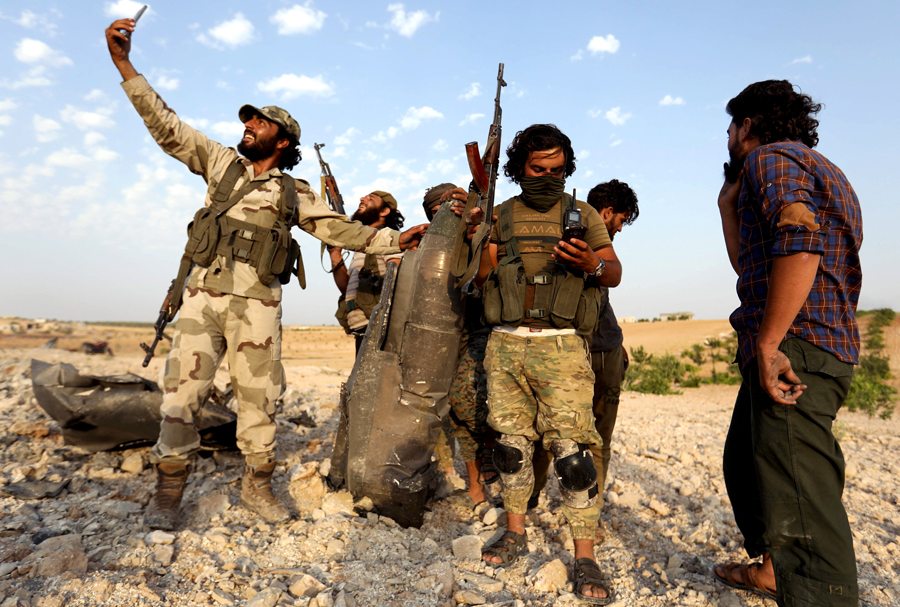
BEIRUT: Syrian forces gained more ground from insurgents in the country’s northwest on Thursday, edging closer to a major opposition-held town a day after militants shot down a regime warplane in the area.

The regime offensive, which intensified last week, has displaced nearly 100,000 people over the past four days, according to the Syrian Response Coordination Group, a relief group active in northwestern Syria.

Syrian troops have been on the offensive in Idlib and its surroundings, the last major opposition stronghold in Syria, since April 30. The region is home to some 3 million people, many of them displaced in other battles around the war-torn country.

The fighting over the past days has been concentrated on two fronts as regime forces march toward the town of Khan Sheikhoun from the east and west. The latest offensive also aims to besiege opposition-held towns and villages in northern parts of Hama province, according to opposition activists.

The town of Khan Sheikhoun is a stronghold of Hayat Tahrir Al-Sham, the most powerful group in the opposition-held areas. The town was the scene of a chemical attack on April 4, 2017 that killed 89 people.

At the time, the US, Britain and France pointed a finger at the Syrian regime, saying their experts had found that nerve agents were used in the attack. Days later, the US fired 59 US Tomahawk missiles at the Shayrat Air Base in central Syria, saying the attack on Khan Sheikhoun was launched from the base.

The Syrian regime and its Russian allies denied there was a chemical attack.

The regime-controlled Syrian Central Military Media said on Thursday pro-regime forces captured three small villages, just west of Khan Sheikhoun.

The Britain-based Syrian Observatory for Human Rights, a war monitoring group, said the villages fell in the morning hours and that the town of Khan Sheikhoun is being bombarded relentlessly.

Syrian state media confirmed that opposition fighters had downed the regime plane on Wednesday. An Al-Qaeda-linked group has released a video of the pilot in which the handcuffed man identified himself as a lieutenant colonel in the Syrian air force.

In the video, the pilot says his fighter jet was shot down when he was carrying out a mission near Khan Sheikhoun.
Main category: 

Regime forces advance toward key town in northwest SyriaSyrian rebels shoot down government warplane in northwest



20 years after deadly quake, Istanbul ill-prepared for ‘Big One’

Author: 
Thu, 2019-08-15 21:58

ISTANBUL: Twenty years after a devastating earthquake ravaged the northwest of Turkey, Istanbulites live with the knowledge that another “Big One” is unavoidable, and that their city of 16 million is not prepared.
On Saturday, Turkey will mark the anniversary of the 7.4-magnitude quake that hit Izmit — around 100 kilometers east of Istanbul — on August 17, 1999, killing at least 17,400 people, including 1,000 within the economic capital of the country.
The question for seismologists is not if another earthquake will hit Istanbul, which lies along the volatile North Anatolian tectonic plate. The only question is when.
Sukru Ersoy, a specialist at the city’s Yildiz Technical University, estimates it could come within the next decade.
“In the worst case, the quake could reach a magnitude of 7.7,” he told AFP. “Is Istanbul ready for that? Sadly not.”
According to him, such a quake would destroy thousands of buildings, leaving a “terrifying” number of dead and paralysing Turkey’s economic and tourist hub.
The former capital of the Ottoman empire has suffered many earthquakes through its long history. In 1509, the city was shaken so badly that the Ottoman authorities referred to the incident as “the little apocalypse.”
Since then, a rapid-response unit — the Disaster and Emergency Management Authority — has been created, quake-proof hospitals have been built, and systems to cut gas lines installed.
But experts say the main problem is that Istanbul has tens of thousands of poorly-built buildings, thrown up during the construction boom of recent decades with little regulatory oversight.
The 1999 quake showed how many buildings had been built using dodgy cement made from unsuitable sand dredged from the sea.
“There was a moment of reflection just after the 1999 earthquake,” said Nusret Suna, head of the Chamber of Building Engineers for Istanbul. “But with time, fatalism took over again. People said ‘It’s destiny’ and people moved on to other things.”
Although regulations have become stricter in the past 20 years, the collapse of a residential building in Istanbul this February, in which 20 people were killed, renewed fears about the solidity of the city’s infrastructure.
There have been efforts to rebuild “at-risk” buildings in sturdier fashion, but Suna said a much bigger mobilization is needed to reach basic levels of earthquake-proofing.
The new mayor of Istanbul, Ekrem Imamoglu, has vowed to fast-track a plan, including efforts to provide more green spaces — notoriously lacking in the city — that can be used to gather survivors.
In theory, each neighborhood is supposed to have an assembly point for this purpose, but many have been lost under new parkings and shopping centers.
Without rapid changes, Istanbul risks being plunged into “real chaos” by a serious quake, warned Recep Salci, head of the non-government Search and Rescue Association, which was a key first-responder in 1999.
“We cannot prevent an earthquake, but we can enormously reduce its consequences,” he said, citing the examples of Japan and Chile, which are similarly vulnerable but have taken radical measures to brace themselves.
Suna, at the chamber of engineers, said it would take 15 to 20 years to fully prepare Istanbul.
“Since 1999, 20 years have been lost. But we must not be discouraged from the task.”

Main category: 
Tags: 

6,000 migrants arrested in Istanbul crackdownTurkey to expel Syrians living illegally in Istanbul


Harassed Moroccan women shun beach for new Rabat pool

Author: 
Thu, 2019-08-15 21:44

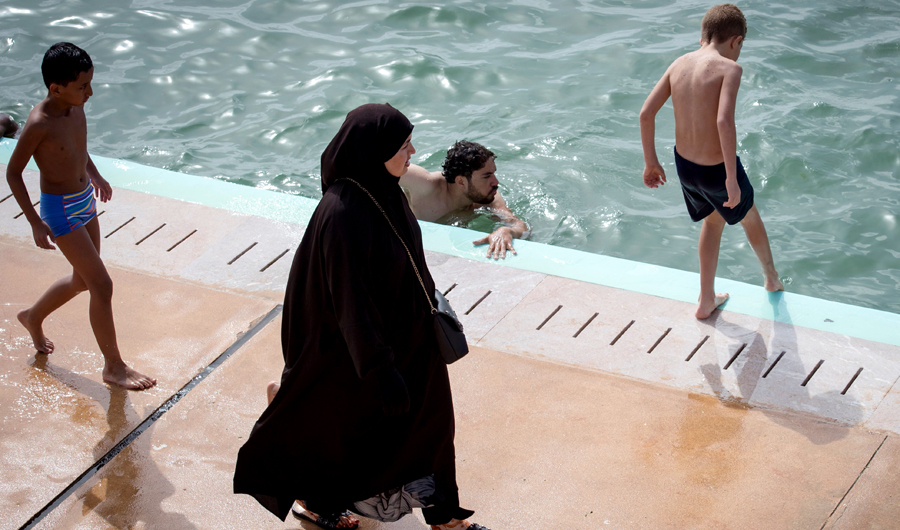
RABAT: Moroccan women seeking to escape harassment at the beach are flocking to Rabat’s vast new public swimming pool instead, but many still eschew swimsuits for fear of voyeurs and disapproving glances.

“Here, there is no harassment and even swearing is forbidden,” said Sanae, a 36-year-old mother who traveled 150 km to take advantage of the new “Grande Piscine” complex, opened on July 4.

“Bathing at the beach is no longer fun for a woman,” she said.

“I was harassed just because I was wearing a bathing suit. Fortunately my husband was there.”

Amal, an 18-year-old student, came to cool off by the pool with her girlfriends. “The beaches have become unpleasant,” she said

Thousands of people are thronging the expansive artificial pools carved into the rocky outcropping of the urban corniche in the Moroccan capital, part of a vast development project dubbed “Rabat, City of Light.”

The aquatic space of 17,000 sq. meters recorded an average of 5,000 visitors per day since its opening, according to an official on the project.

Entrance costs 10 dirhams ($1) — an affordable rate even for less advantaged families that spend summer in the city.

In an increasingly rare sight in Morocco, both young men and women swim and play in the water, while speakers blare out popular music.

It is mainly the sense of security that attracts women in particular: Some 60 security guards and plainclothes police patrol the site, ensuring decorum.

Yet even with the oversight, women are not completely at ease.

Sanae opted to wear shorts and a tank top “because there are a lot of voyeurs.”

She reserves her one-piece swimsuit “for the wild beaches in Morocco or for abroad.”

Like her, many feel “more free” at the pool than at the beach, but prefer to stay clothed and on the deck chairs while their children play in the water under the supervision of lifeguards.

Considered a key tourist asset in Morocco, the numerous beaches on the North African country’s Mediterranean and Atlantic coasts are less inviting for women.

Bathing suits, regardless of their coverage, are considered by some to be offensive, even a sign of “debauchery”.

To swim without the risk of harassment, one must get up early, seek out isolated spots or pay for access to private areas.

“The phenomenon appeared on certain Casablanca beaches in the 90s… Public opinion did not take it seriously and did not react,” sociologist Soumaya Naamane Guessous said.

For her, “it’s a regression mainly related to the spread of Salafist ideas imported from abroad”.

Last summer, a Facebook page called on men to ban women “from going out in indecent attire”.

A campaign was launched on social media to hit back, with women posting photos in bathing suits and using the hashtag #beafreewoman.

“All the men look. It’s annoying. We’re not comfortable”, said Leila, 36, who came with her friend Khadija, 50, on vacation from France.

They too had eschewed bathing suits while by the pool.

Anouar, 32, came from Tangier with his wife — who wears a veil — and his daughter.

In his opinion, it is women wearing “disrespectful attire that harass men and families”.

“The trend has become so conservative and so commonplace that women in bathing suits are subject to critical looks or even degrading comments from other women”, Guessous said.

“It’s a mentality that has to change”, the feminist activist said, adding that it’s an attitude that “affects public space in general” in Morocco.

Despite having a reputation for tolerance compared with the rest of the Arab-Muslim world, a study by UN Women in 2017 showed that, for Moroccans, “women who dress provocatively deserve to be harassed”.

The number of women professing this opinion — 78 percent — surpassed that of men, at 72 percent.

A law on violence against women adopted in February 2018 included penalties for harassment for the first time, but implementation remains rare.

In early August, a schoolteacher was arrested after he called on social media for three young Belgian women volunteers to be beheaded for wearing shorts while working in the south of the country.Turkey has repeatedly threatened to launch an assault east of the Euphrates river against the YPG, which it says is a “terrorist” offshoot of the outlawed Kurdistan Workers’ Party (PKK), which has waged an insurgency inside Turkey since 1984.

But Washington has worked closely with the YPG in the fight against Daesh.

Little is known about the size of the safe zone and how it will work, but Cavusoglu said there would be observation posts and joint patrols.

He said US President Donald Trump had previously promised it would be 32-km wide.

Turkey previously conducted two offensives into Syria, against Daesh and the YPG, in 2016 and 2018.

Main category: 

“Bittersweet victory” for Moroccan women facing domestic violence, activists saySocial media rescue Morocco’s last woman potters


Israeli police say officers kill Palestinian teenager

Author: 
Associated Press
ID: 
1565889853749934400
Thu, 2019-08-15 17:21

JERUSALEM: Israeli police say officers shot dead a Palestinian teen and seriously wounded another after they allegedly stabbed a policeman outside a flashpoint Jerusalem holy site.
Police Spokesman Micky Rosenfeld said Thursday the officer was moderately wounded in the stabbing in Jerusalem’s Old City. He said the two assailants, both minors, were shot by police officers at the scene.
The Palestinian Red Crescent said a guard from the Islamic Waqf, which manages the nearby compound, also suffered a gunshot wound and was hospitalized.
Thursday’s stabbing took place just days after Israeli police clashed with Muslim worshippers at the contested site, known to Jews as the Temple Mount and to Muslims as the Noble Sanctuary. The compound is the holiest site for Jews and the third holiest in Islam, after Makkah and Madinah.

Main category: 
Tags: 

Israeli police say officers kill Palestinian teenagerImpoverished Gazans lament stagnant livestock market


Turkish drones start operating in northern Syria, says ministry

Author: 
Wed, 2019-08-14 23:03

ISTANBUL: Turkish drones have started operating in northern Syria where Washington and Ankara have agreed to create a safe zone, Turkey’s Defense Ministry said on Wednesday.

Turkey and the US agreed last week to set up a joint operations center regarding the safe zone to be established in northern Syria. No agreement has been announced on key details such as the size of the zone and the command structure of joint patrols that would be conducted there.

FASTFACT

Turkey and the US agreed last week to set up a joint operations center regarding the safe zone to be established in northern Syria.

A six-person US delegation arrived in the southern Turkish province of Sanliurfa on Monday to work on the establishment of the operations center. The Defense Ministry said in a statement on Wednesday that work was continuing to make the joint operations center in Sanliurfa operational. Turkish drones had started carrying out work in the area where the safe zone will be created, but did not provide further information on the drones’ operations, it added.

Washington and Ankara have been at odds over plans for northeastern Syria, where US allies on the ground in the battle against Daesh militants.


Main category: 
Tags: 

Regime forces advance toward key town in northwest SyriaAssad regime forces gain ground in deadly Idlib push