Satellite photos shows burning rocket at Iranian space center

Author: 
Associated Press
ID: 
1567094118085950500
Thu, 2019-08-29 15:47

DUBAI:  A rocket at an Iranian space center that was to conduct a satellite launch criticized by the US apparently exploded on its launch pad Thursday, satellite images show, suggesting the Islamic Republic suffered its third failed launch this year alone.
State media and officials did not immediately acknowledge the incident at the Imam Khomeini Space Center in Iran’s Semnan province.
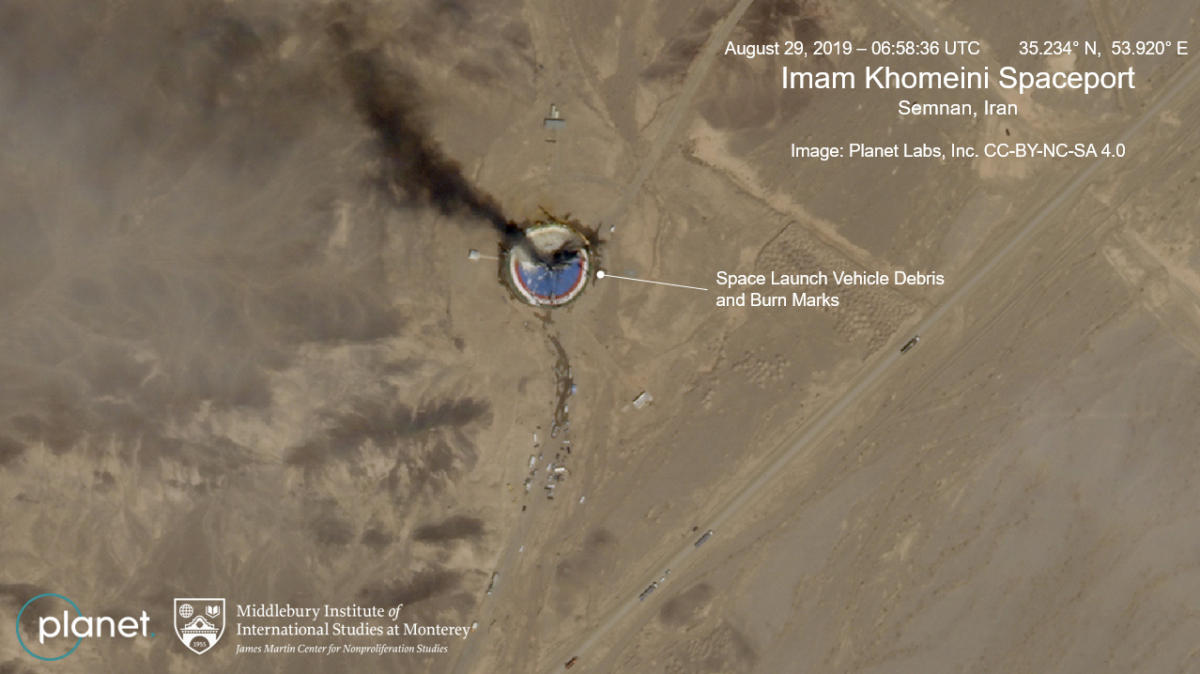
However, satellite images by Planet Labs Inc. showed a black plume of smoke rising above a launch pad there, with what appeared to be the charred remains of a rocket and its launch stand. In previous days, satellite images had shown officials there repainted the launch pad blue.
On Thursday morning, half of that paint apparently had been burned away.
“Whatever happened there, it blew up and you’re looking at the smoldering remains of what used to be there,” said David Schmerler, a senior research associate at the Middlebury Institute of International Studies.
Schmerler told The Associated Press that the images of the space center suggested that the rocket either exploded during ignition or possibly briefly lifted off before crashing back down on the pad. Water runoff from the pad, likely from trying to extinguish the blaze, could be seen along with a host of vehicles parked nearby.
NPR first reported on the satellite images of the apparent failed launch at the space center, some 240 kilometers (150 miles) southeast of Iran’s capital, Tehran.
Iranian satellite launches had been anticipated before the end of the year.
In July, Iran’s Information and Communications Technology Minister Mohammad Javad Azari Jahromi told the AP that Tehran planned three more launches this year, two for satellites that do remote-sensing work and another that handles communications.
The Nahid-1 is reportedly the telecommunication satellite, which authorities plan to have in orbit for two-and-a-half months. Nahid in Farsi means “Venus.” The satellite, which had Iran’s first foldable solar panels, was supposed to be in a low orbit around the Earth for some two-and-a-half months.
The semi-official Mehr news agency quoted Jahromi on Aug. 13 as saying that the Nahid-1 was ready to be delivered to Iran’s Defense Ministry, signaling a launch date for the satellite likely loomed. Iran’s National Week of Government, during which Tehran often inaugurates new projects, began Aug. 24.
Earlier on Thursday, Iran’s Defense Minister Gen. Amir Hatami told the state-run IRNA news agency that the country’s satellite activities were “being done in a transparent way,” responding to AP and other foreign media reporting on activity at the space center.
“Whenever activity and research bear successful results, we will announce the good news,” Hatami said. Iran at times in the past hasn’t acknowledged failed launches.
The apparent attempt to launch the Nahid-1 comes after two failed satellite launches of the Payam and Doosti in January and February. A separate fire at the Imam Khomeini Space Center in February also killed three researchers, authorities said at the time.
Over the past decade, Iran has sent several short-lived satellites into orbit and in 2013 launched a monkey into space.
The US alleges such launches defy a UN Security Council resolution calling on Iran to undertake no activity related to ballistic missiles capable of delivering nuclear weapons.
Iran, which long has said it does not seek nuclear weapons, maintains its satellite launches and rocket tests do not have a military component. Tehran also says it doesn’t violate the UN as it only “called upon” Tehran not to conduct such tests.
The tests have taken on new importance to the US amid the maximalist approach to Iran taken by President Donald Trump’s administration. Tensions have been high between the countries since Trump unilaterally withdrew the US from Iran’s nuclear deal over a year ago and imposed sanctions, including on Iran’s oil industry. Iran recently has begun to break the accord itself while trying to push Europe to help it sell oil abroad.
The State Department did not immediately respond to a request for comment.
___
Main category: 

Satellite images suggest Iran satellite launch loomsIran journalist flees Zarif delegation to stay in Sweden


Trump, Erdogan speak over telephone about trade and Syria situation

Author: 
Reuters
ID: 
1567088778265497000
Thu, 2019-08-29 14:24

WASHINGTON: US President Donald Trump and Turkish President Tayyip Erdogan spoke by phone on Wednesday on a range of issues, including trade and the humanitarian situation in Idlib, Syria, the White House said on Thursday.

Turkey’s Anadolu news agency reported the call on Wednesday, saying the two leaders agreed to cooperate to protect civilians in the Idlib region after jets believed to be Syrian or Russian struck a rebel-held city in northwest Syria.

On Thursday, Erdogan vowed Turkey would not allow the US to delay the establishment of a ‘safe zone’ in northern Syria.

Ankara and Washington earlier this month agreed after difficult talks to set up a buffer zone between the Turkish border and Syrian areas controlled by the US-backed Kurdish YPG militia.

The NATO allies agreed to set up a joint operations centre which Turkey said at the weekend was at full capacity.

“We will never allow a delay similar to that in Manbij. The process should advance swiftly,” Erdogan said, according to CNN Turk broadcaster.

Turkey and the US in May last year agreed a road map including the withdrawal of the Kurdish People’s Protection Units (YPG) from Manbij in northern Syria.

Main category: 

Erdogan says won’t allow US to delay Syria ‘safe zone’Putin, Erdogan in new deal on Idlib


Assad jets threaten Turkish troops despite deal to curb Idlib fighting

Author: 
Thu, 2019-08-29 01:00

ANKARA: Assad regime airstrikes pounded militant positions in northwest Syria on Wednesday a few meters from a Turkish military post.

The new strikes came less than 24 hours after Russian and Turkish presidents Vladimir Putin and Recep Tayyip Erdogan reached an accord during talks in Moscow to “normalize” the situation in Idlib.

There were fierce clashes on Wednesday between Assad regime forces and militant fighters 500 meters from the Turkish post in Sher Maghar village. “The conflict is taking place very close by and it is violent,” a Turkish military source said.

Clouds of smoke billowed in the air as regime airstrikes hit targets around the village, and one strike was so close to the Turkish observation post that it damaged the walls.

The airstrikes and fighting so near Turkish forces illustrated the fragility of Turkey’s presence in northwest Syria, analysts told Arab News. “The hit was unlikely to be a mistake, as some pro-Russian media have claimed,” Navvar Saban, a military analyst at the Omran Center for Strategic Studies in Istanbul, told Arab News.

“It reflects the continuing dispute between Russia and Turkey and the failure to reach a final agreement on the general situation in Idlib.”

To avoid being dragged into a direct confrontation, Ankara and Moscow may now “send messages” to each other through their proxies in the region, Saban said. “In the absence of a final agreement between Russia and Turkey, it is very likely that both countries will put more effort into strengthening their local agents.”

Military ties between Moscow and Ankara have deepened since Turkey’s purchase of the Russian S-400 missile defense system, against the wishes of the US and Turkey’s other NATO allies. Washington responded by removing Turkey from its F-35 fighter jet program, and Erdogan was observed at a Moscow air show on Tuesday gazing approvingly at Russia’s new Su-57 stealth fighter.

However, they support opposite sides in the Syrian conflict. Russian-backed Assad regime jets carried out at least 15 airstrikes in the region on Wednesday, targeting Syria’s former Al-Qaeda affiliate Hayat Tahrir Al-Sham and the Turkish-backed National Liberation Army.

Turkey has 12 military observation posts in northwest Syria, many of them at risk from Assad regime attacks. The post at Morek in southern Idlib is effectively under siege and is being protected by Russian military police.

The Assad regime welcomed Russian forces but has demanded that Turkey withdraw its troops because their presence violates Syria’s territorial sovereignty.

Main category: 
Tags: 

Syria’s Idlib clashes kill at least 60 fightersKuwait’s generosity boosts Syria’s food security


Arab states and EU pledge support for Lebanon’s stability

Author: 
Thu, 2019-08-29 00:29

BEIRUT: Kuwait’s Ambassador to Lebanon Abdel Aal Al-Qenaei said that Arab states support Lebanon’s stability and are concerned about its security. 

He confirmed support for all measures and policies Lebanon takes to protect its security, stability and territorial integrity.

Lebanese Prime Minister Saad Hariri met with Arab envoys on Wednesday as part of efforts to reduce tension following Israel’s attack in Beirut and its strike on a Popular Front for the Liberation of Palestine-General Command (PFLP-GC) base.

The meeting was attended by ambassadors from Oman, Saudi Arabia, Morocco, Algeria, Sudan, Iraq, Tunisia, Egypt, the UAE, Kuwait, Palestine, and the chargé d’affairs of the Jordanian Embassy.

Al-Qenaei said: “Hariri has presented Lebanon’s vision on the recent events, and we stressed that its stability is our demand. There is an Arab concern to ensure that Lebanon is spared all that threatens its security and stability.”

He added that the diplomats have heard Hariri state that Lebanon will request an Arab League meeting to discuss the Israeli aggression.

Ghattas Khoury, political adviser to Hariri, told Arab News: “The meeting was held at the request of Hariri to call upon Arab nations to use their influence and relations to calm the situation in the region
and restore respect for UN resolution 1701.”

He added: “The Lebanese leaders are still concerned about potential escalation. All channels are open with the US, European and Russian sides to ensure the stability of Lebanon.”

The Arab stance was preceded by a similar position announced by the EU, which affirmed its support for Lebanon’s security and sovereignty.

Maja Kocijancic, spokesperson for EU foreign affairs and security policy, said: “It is the responsibility of all parties in the region to exercise maximum restraint, comply with international law and avoid any further escalation. The EU expects all parties to fully comply with the relevant UN Security Council resolutions, especially 1701 and 1559.”

Hezbollah Secretary-General Hassan Nasrallah said during a religious meeting: “The response will not be now, so sleep comfortably. We have a specific weapon but will not waste it on drones.”

Nasrallah recalled the attack on Hezbollah in Quneitra, Syria in 2015, which killed six fighters. He said: “The atmosphere was charged at the time, and we waited 10 days. Now, we are not in a hurry at all. Let Israel remain on alert.”

Former Lebanese Prime Minister Fouad Siniora called on Hezbollah to “exercise greater insight and bear in mind what Israel can plot in the light of its current election campaign.”

He added: “We are now experiencing the consequences of Hezbollah’s actions outside Lebanon, which expose us to unforeseen risks.”

Israel continues to impose a
state of alert in areas along the Lebanese border.

Russia Today quoted DEBKAfile, an Israeli military intelligence website, that the Israeli Army had closed a 6-km strip of airspace up to the Lebanese border to civilian air traffic.

Israel’s move followed restrictions on the movement of nonmilitary vehicles in areas bordering Lebanon, in addition to the deployment of several Iron Dome anti-missile batteries.

The Times of Israel alleged that the targets of the strike on Beirut’s southern suburb were two crates of material for a Hezbollah program, which aims to turn its stock of rockets into precision-guided missiles.

It added that the targets were “a specialized industrial mixer and a computerized control unit, which is necessary for the creation of the solid fuel used in long-range missiles and was the only machine of its kind inside Lebanon.”

According to Channel 13 news: “The planetary mixer had recently been flown into Lebanon from Iran and was being held in Beirut’s southern suburb before being transferred to the factory, where the actual work on the precision missile project was being performed. The damage to the mixer rendered it unusable and is believed to have set back this aspect of Hezbollah’s precision missile program by at least a year.”

Main category: 
Tags: 

Lebanese troops fire at two of three Israeli drones aimed at south LebanonSaudi Arabian welfare service offered to Syrians in Lebanon


UN envoy warns Mideast tensions could deal huge blow to Iraq

Author: 
Wed, 2019-08-28 21:47

UNITED NATIONS: The UN envoy for Iraq is warning that tensions in the Middle East could deal “a huge blow” to efforts to rebuild a stable and prosperous country following the defeat of Daesh extremists.
Jeanine Hennis-Plasschaert told the Security Council on Wednesday that “we must spare no effort in avoiding this prospect.”
Iraq’s fragile government is walking a fine line trying to manage its alliances with both the United States and Iran amid rising tensions between the two countries.
Hennis-Plasschaert said Iraqi leaders are “engaging regional and international actors to ensure that their country is a meeting ground for stability and not a venue for proxy conflicts.”
She said she is “very encouraged by the government’s determination to bring all armed actors under state control,” but implementation will be crucial.

Main category: 
Tags: 

Iraqi PM’s government facing collapse over Israeli airstrikes: Military and political officialsIraq’s leaders condemn deadly drone attack blamed on Israel