Adrift in Iraq: Deportees from US describe fear and isolation

Author: 
Reuters
ID: 
1569343006069165100
Tue, 2019-09-24 10:08

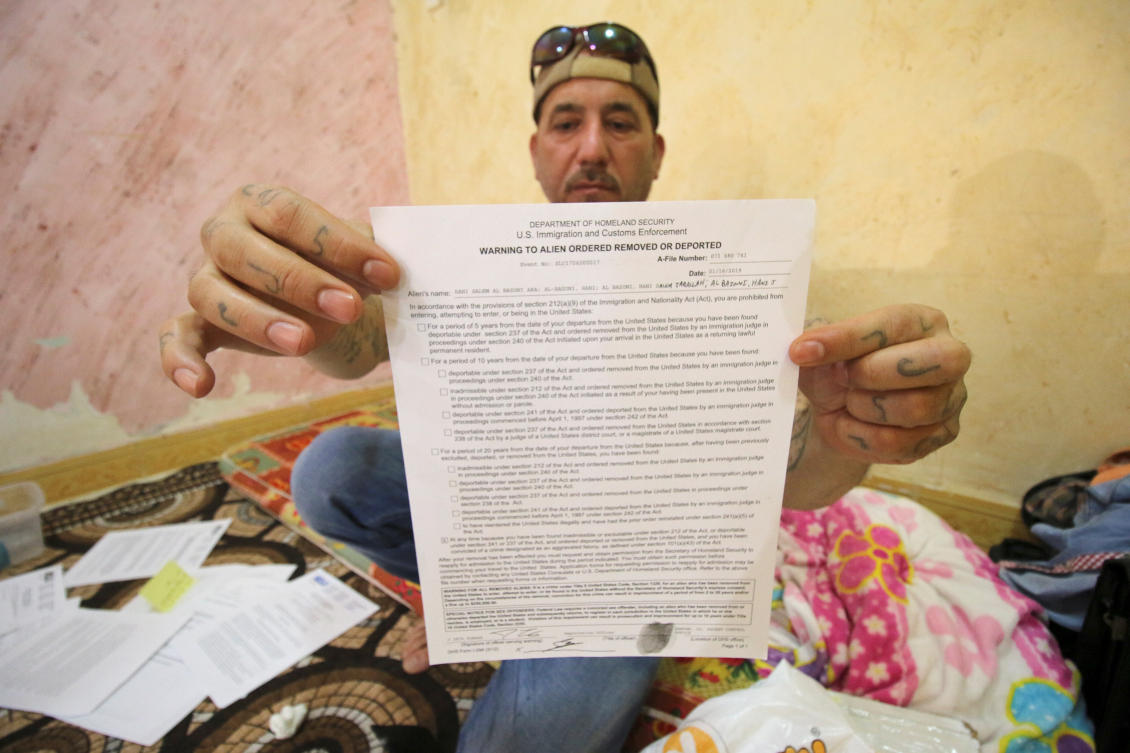
BAGHDAD: Since being deported from the United States in January, Hani Al-Bazoni has spent most of the past eight months in a small room in the Iraqi city of Basra, waiting for his sister’s daily visits.
Some days, he says, he struggles to get up from his mattress on the floor. On others, he looks at pictures of his wife and seven children, all US citizens: his eldest is a cadet in the US Marines, his youngest is three.
“I am too afraid to leave the house,” Bazoni told Reuters. “I don’t know anyone here and I don’t have any money.”
Bazoni is one of dozens of people of Iraqi origin deported from the United States since 2017, when Iraq agreed to take back its citizens with criminal convictions as part of a deal to remove itself from President Donald Trump’s travel ban targeting people from several Muslim-majority countries.
US congressmen, lawyers and human rights activists say Iraq, still riven by sectarian divisions 16 years after the US-led invasion, remains unsafe for such returnees.
As a refugee in the 1990s, Bazoni moved to the United States, where he spent time in jail on assault charges. He also worked as a translator for the military. That job leaves him vulnerable in Iraq, where influential Iranian-backed militias oppose the presence of US troops.
His family won’t let him go outside, scared that paramilitaries might round him up.
Prior to 2017, Baghdad had refused to allow such repatriations, citing political, logistical and human rights concerns.
“I never thought I’d come back to Iraq,” Bazoni said. “I lost my job, I lost my family, I lost my kids. And maybe soon, I’m going to lose my life.”
Following the 2017 deal, the US Immigration and Customs Enforcement (ICE) arrested hundreds of the 1,400 Iraqis eligible for deportation because they had criminal convictions, which would have prevented them from gaining US citizenship.
It said at the time it was arresting people with convictions for violations from homicide to drug charges who had been ordered removed by an immigration judge.
The American Civil Liberties Union (ACLU) sued on their behalf. Though initially successful in stalling deportations, the case was overturned after appeals, and deportations picked up in April.
ICE said 61 Iraqis were deported in the year to Sept. 30, 2017, and 48 in the following 12 months. The ACLU said it had been told by ICE that 30 Iraqis have been deported so far in 2019. Many of the more than 370 arrested since 2017 now await deportation.
“Deportees are treated with immediate suspicion, simply caused by their association with America,” said Daniel Smith, a human rights researcher who has been an expert witness in dozens of deportation cases.
Some arrive in a country they haven’t seen in decades, with no network, no identity documents and little Arabic. Their vulnerability leaves them open to accusations of spying, kidnapping for ransom and harassment from militias, Smith said.
Neither the authorities in Baghdad nor the White House responded to requests for comment for this story. The State Department referred questions to the Department of Homeland Security. The DHS and ICE did not respond to requests for comment.

’PERSECUTION, TORTURE OR DEATH’
In interviews with Reuters, nine men sent back to Iraq described their struggle to reintegrate. Separated from families and jobs, they said they were depressed, suicidal and feared for their safety.
Several claim mistreatment by ICE, which they said coerced them into signing deportation orders or stole money they were arrested with. ICE did not comment.
One of the men, Nash, 55, who asked Reuters not to use his full name, said he spent two days sleeping on a bench in Baghdad airport with nowhere to go after his deportation, until a stranger lent him a phone so he could find a place to stay.
He found a roommate, Jimmy Aldaoud, a fellow deportee from Michigan. Both were from minority Christian communities, which the Trump administration has said it wants to protect.
Aldaoud was born in a Greek refugee camp to Iraqi parents and had never been in Iraq before his deportation. The 41-year-old had mental health issues and diabetes. He died last month because he couldn’t get access to care in Iraq, his family has said. He was buried in Michigan two weeks ago.
“There will be more Jimmy Aldaouds if this continues,” said Congressman Andy Levin, a Democrat from Michigan who says the deportations violate US law and is seeking bipartisan support for a bill to stall them.
Levin’s district has the highest number of Iraqi-born residents in the country, eight of whom have been deported since April, his office said. Most deportees committed their crimes young, and signed plea deals they hadn’t understood would get their green cards revoked, Levin said.
“Most of these people they don’t speak Arabic, they were never in Iraq or haven’t been since childhood. They’re totally Americanized,” Levin said. “You’re basically sending them back to persecution, torture or death. Our policy doesn’t allow that.”
Nash, who worked as a roofer, was convicted in 1989 on a petty drug charge. An immigration court found him deportable in 1994, and his green card was revoked. He earned several stints in prison in the ensuing years for non-violent, drug-related charges.

’NO IDENTITY’
Levin, lawyers and human rights activists argue that if deportations can’t be halted, the US and Iraqi governments should at least give deportees proper documents.
Most no longer have their original Iraqi papers and said their US documents were taken by ICE in detention. Iraq allows them to be deported on one-way travel documents, which last six months.
“These are not considered by local authorities to be an adequate proof of identity,” said Smith, which he said meant they were left vulnerable to arrest by Iraqi authorities.
Iraq’s Embassy in Washington referred Reuters to the ministry of foreign affairs in Baghdad, which did not respond to requests for comment.
Obtaining Iraqi documents is difficult. Some deportees have waited weeks, months and in one case more than a year.
Nash has hit multiple dead ends in getting a new ID. The travel document that allowed his return to Iraq expired last month, and his birth certificate was stolen 40 years ago.
“According to Iraq, I have no identity,” said Nash. “But I was Iraqi enough to be deported.”
He said his efforts to obtain documents had involved digging through the rubble of his childhood home in Baghdad, tracking down relatives around the world on Facebook and trying to find his father’s grave in Baghdad.
He’s running out of options.
“I am 55 years old, I spent 40 years in Michigan, I never left: how much more American can I be?” he said. “I made a mistake when I was a kid, and I got locked up before I got citizenship, so fine I get it.
“But if I can’t be an American, at least let me be Iraqi.”

Main category: 

For Kurdish Iraq’s women entrepreneurs, persistence pays offIraq detains suspect in deadly bombing that killed 12


Combat drones usher in era of ‘war by remote’

Mon, 2019-09-23 22:10

ABU DHABI: It is a new chapter in Middle East warfare. Experts say “war by remote” is a growing trend in the region. And most countries are insufficiently prepared to deal with the growing security challenge posed by high-tech, remote-controlled unmanned aerial vehicles (UAVs) or combat drones.

A combination of widespread availability, increasing technological sophistication and falling costs of drones is injecting a new dose of geopolitical uncertainty into the Middle East and North Africa.

Bigger armies with more lethal weaponry are finding themselves increasingly vulnerable as weaponized drones turn into a critical element of asymmetric warfare.

Michael Knights, a senior fellow at the Washington Institute, has been following warfare in the Middle East for the last 20 years.

According to him, the region is now “seeing players from all sides using drones — whether they are a very small group such as (Daesh) terrorists or a group with Iranian support” such as Yemen’s Houthi militias, who have claimed responsibility for repeated attacks on Saudi civilian infrastructure.

The Houthis have claimed responsibility for the Sept. 14 attacks on the Saudi Aramco oil-processing facilities in Abqaiq and Khurais, which caused damage that halved the crude output of the world’s top oil exporter. However, a US official has said the strike originated from southwestern Iran.

FASTFACT


60% – Israel’s estimated share of global unarmed UAVs market

Saudi Arabia has said 18 drones, along with seven missiles, were used in the attacks. Iran has denied any involvement, but it is widely suspected of having armed its regional proxies, notably the Houthis, Hezbollah in Lebanon, and Shia paramilitary groups in Iraq, with combat drones.

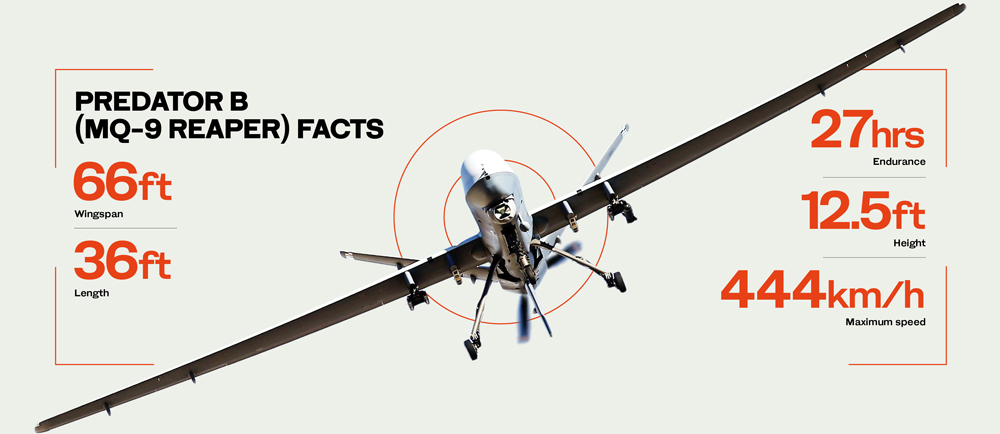
UAV refers to all types of small and mid-sized devices with no pilot in them. They can be controlled remotely by a ground-based pilot or can fly following a pre-defined flight plan.

Advanced drone models use GPS signals from satellites to connect as well as communicate their location to the pilot.

A UAV can be used for anything from simple photography, to surveillance, to carrying payloads including explosives and missiles.

The Reaper model, for instance, can carry more than 1.5 tons of ordnance and can be operated from by a ground-based pilot stationed hundreds of miles away.

The threat has been growing over the years, says Knights. “Almost everywhere you look nowadays, drones are being used for surveillance or for crashing into targets, drones that have explosives on them, or drones — the most recent versions — that drop bombs and are reusable.”

The Houthi militias have been using UAVs in combat since the start of the Yemen war. They first appeared to be elementary, off-the-shelf models, but later ones have been nearly identical to Iranian-designed UAVs.

Targets have included the holy city of Makkah, airports, royal residences, oilfields and pipelines, oil installations and desalination plants.


An Iranian Army Air Defense Force drone is unveiled during a ceremony in the capital Tehran. Iran is suspected by the US of being behind the drone attacks on Saudi Aramco facilities in the Kingdom on Sept. 14, 2019. (AFP)


UN investigators have suggested that the Houthis’ new UAV-X drone may have a range of up to 1,500 kilometers, which means they would be able to reach Saudi Arabia and the UAE from Yemen.

In mid-May this year, drone warfare grabbed the headlines when oil tankers and pipelines were targeted by remote-controlled bombs that forced Saudi Aramco briefly to suspend pipeline operations.

The UN said the Houthis were using small and medium-sized UAVs for reconnaissance, surveillance and attacks.

Incidentally, the country that was the first to create a national drone program in its military was Israel.

Companies such as Elbit Systems, Israel Aerospace Industries, Rafael, UVision and Aeronautics have been developing new technologies for both waging drone warfare and countering UAV attacks.

For decades now, Israel has invested in drone technology as part of its defense-arsenal mix. The strategy has proven its usefulness for a highly security-conscious country with multiple borders.

Israel has used combat drones to track and strike targets far beyond its geographical borders instead of sending manned aircraft deep into enemy airspace.

“Israel has dozens of drones. Some drones have range as short as 10,000 miles. Others can travel from 20,000 miles to hundreds of thousands of miles,” Knights said.

Yossi Mekelberg, a professor of international relations at Regent’s University London, said the Middle East is “seeing more and more unmanned vehicles” on the battlefield.

“The thing is, drones are cheaper — you don’t risk pilots by using them as it’s all remote-controlled,” he told Arab News.

“It is high-tech, it is precise and, in many ways unfortunately, it will become the preferred option where possible.”

The most advanced users of drones by far are Iran and Iranian-backed groups such as the Houthis in Yemen.

Israel’s defense industry produces drones such as the Heron TP, which can fly more than 1,000 kilometers for 30 hours, to monitor threats from Hamas in the Gaza Strip and Hezbollah in Lebanon and Syria.

Drones such as the SkyStriker and Harpy, which are equipped with warheads and can launch precise long-range strikes, belong to the category known as “loitering munitions.”

The most advanced users of drones “by far are Iran and Iranian-backed groups such as the Houthi militias in Yemen,” said Knights.

As examples, he cites airborne drones and stealth amphibious drone boats, such as nine Houthi explosive boats designed to target international shipping off Yemen’s Red Sea coast that were destroyed by airstrikes carried out by the Saudi-led military coalition.

“A drone boat guides itself using an electrical eye,” he said. “I have been on one. You can hear it try and turn the rudder of a ship. So the Iranians have provided the Houthis with really advanced capabilities: Drones that can hit and destroy with great precision.”

In this context, Yemen has been a testing ground for Iran-backed forces. “Basically, it is like a battle laboratory where Iran can test out these new capabilities. That is what Yemen is to them,” Knights said.

According to Knights, drones have been in play for more than two decades — a lot longer than most people think.

“They were used in the Iran-Iraq War while the Americans used drones as far back as the Vietnam War,” he said. “But drone use is now really starting to accelerate.”

According to Knights, Daesh, while fighting wars in Iraq and Syria, was the first to start using drones “extensively … both for surveillance and bomb-dropping.”

The battle for Mosul — a huge military operation to recapture Iraq’s second-largest city from Daesh — was a “real turning point” in the use of drone warfare.

“This was when ISIS (Daesh) really upped the ante,” Knights said, adding that Daesh used helicopter drones to both “look around the neighborhood” and to spread fear.

Other militant groups have not been far behind. A UN Security Council report said the most commonly used UAV in the Houthi arsenal for “loitering munitions” was Qasef-1, which had a lot in common with the Iranian made Ababil-2/T UAV, which has been used in Yemen since 2016.

The UN investigators found that the new UAVs are characterized by distinctive V-shaped tail fins and a more powerful engine.

One of them, the Samad 2/3 UAV, carries a warhead with 18 kilograms of explosives mixed with ball bearings.

Hezbollah too is developing its drone technology. The Lebanese militia has been using combat drones based on Iranian designs since 2004, flying them into or near Israeli airspace.

Hezbollah is also said to have used drones in Syria to support the regime of President Bashar Assad.

Knights said all this is happening because drone technology is relatively simple. “As a result, particularly for small drones made of fiberglass and used by remote control and with nothing particularly complicated by it, anyone can pretty much operate them,” he said.


These images from a video broadcast by Iran’s Islamic Revolutionary Guard Corps (IRGC) on July 19, 2019, reportedly shows footage obtained from an IRGC drone flying above an aircraft carrier in the Strait of Hormuz before it was shot down by the US Navy.  (AFP)

“What the Iranians have done is they have developed a good formula. You only send to Yemen, for example, the specific electronic program.

“Inside Yemen, there are drone-making workshops using stuff you can legally buy off the open market, such as fiberglass.

“Iranians have learned to go low-tech and this has allowed groups in Yemen to use drones. It might seem very high-tech but it’s actually quite low-tech.”

From all accounts, Knights says, Israel’s dominance in drone warfare is being challenged by Iran and its regional allies and proxies.

Experts say drones are useful in an important way: deniability. For example, Israel is widely suspected to have been the source of the drones that were deployed in Iraq and Lebanon in recent weeks, but the Israeli government saw no reason to own up.

“You don’t risk pilots in doing this,” said Knights, adding “you can deny you are behind any attack, which means it might sometimes be tempting for decision-makers to use it in their war and deny using it or to create battlefield ambiguity.”

None of this is to say weaponized drones do not have their downsides. Knights said that once detected, drones can be destroyed instantly.

“You can send a signal to blow itself up and zap it once it gets closer to its target,” he told Arab News.

“You can shoot it down using a number of weapons, from an expensive missile to guns, sniper rifles, or even guns that fire nets, and snare it.”

A drawback about a drone guided by GPS, according to Knights, is “you can know exactly where it started if it is still intact.”

He pointed to an incident of a drone boat captured by Saudi authorities. The GPS coordinates and images, released by the US, pointed the finger at the Islamic Revolutionary Guard Corps (IRGC) in Tehran.

“In the camera … you could see all the IRGC members bored in their lavatories, taking pictures of themselves. It was almost laughable,” said Knights.

“Drones, if captured intact, leave a digital footprint. Deniability is not perfect with these things.”

Additionally, as Mekelberg points out, drone warfare is not risk-free, citing the incident earlier this month when Hezbollah downed an Israeli unmanned aircraft outside a southern Lebanese town.

“It (drone use) brings a danger — when in Lebanon it didn’t go exactly to plan — it created tensions which could have led to a much bigger round of tensions between Hezbollah and Israel,” he said.

Furthermore, he says, with drones showing their growing value on the battlefield, more and more terror groups are turning to unmanned aircraft.

With the growing threat, Mekelberg said more countries need to step up their airspace security platform that detects, classifies, and mitigates all drone threats.

“Some countries have anti-drone systems, but drones are getting more advanced and sophisticated and lots of countries are not equipped to deal with it,” he said.

If recent developments are any guide, the world has yet to see the full capability of combat drones in the sprawling Middle East war theater.

Main category: 

Saudi Arabia’s Defense Ministry displays Iranian drones, cruise missiles used in Aramco attacksSuspected drones disrupt Dubai flights


After Saudi Aramco attack, UK’s Boris Johnson proposes new negotiation on Iran nuclear deal

Author: 
Reuters
ID: 
1569269484412425600
Mon, 2019-09-23 19:42

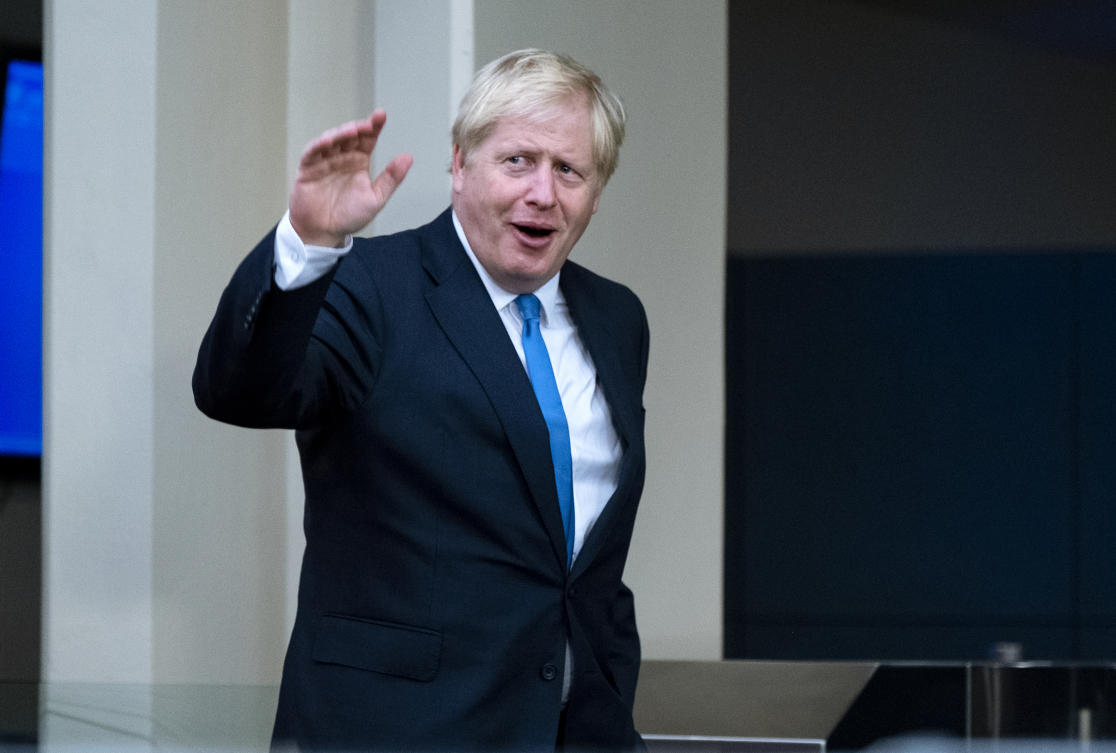
NEW YORK: British Prime Minister Boris Johnson pushed for a new negotiation beyond a 2015 nuclear between Iran and world powers after attacks on Saudi Arabia’s oil facilities, bringing his country closer to US calls for a tougher deal with Tehran.

European leaders have struggled to dampen a brewing confrontation between Tehran and Washington since US President Donald Trump pulled out more than a year ago from a deal that assures Iran access to world trade in return for curbs on its nuclear program.

The US reimposed sanctions on Iran last year and tightened them sharply this year. Iran has responded by breaching some of the limits on nuclear material in the deal and has set an October deadline to reduce its nuclear commitments further unless the Europeans keep their promises to salvage the pact.

The European powers party to the deal — France, Britain and Germany — have until now remained united despite pressure from Washington. But an attack on Saudi Arabia’s oil facilities on Sept. 14, which Riyadh and Washington have blamed on Iran, is testing that unity. Iran denies responsibility for the attack on Saudi Arabia.

Yemen’s Iran-aligned Houthi movement, which has been battling a Saudi-led military coalition that includes the UAE, has claimed responsibility for the strikes.

“How do we respond to what the Iranians plainly did? What the UK is doing is trying to bring people together and de-escalate tensions,” Johnson told Sky News as world leaders gathered at the United Nations in New York.

“Whatever your objections to the old nuclear deal with Iran, it’s time now to move forward and do a new deal.”

A government spokesman later clarified that Johnson still supported the 2015 pact and wanted to find a way to bring Tehran into compliance.

Johnson was already at odds on Monday morning with French President Emmanuel Macron over who to blame for the attack, blaming Tehran directly.

Those words were in stark contrast to Macron, who has been extremely cautious not to point the finger directly at Tehran, fearing that it could increase tensions.

Macron has led a European push over the summer to find a compromise between Washington and Tehran and wants to use the UN meeting as an opportunity to revive diplomacy.

His efforts have stalled in recent weeks, with Iran reducing its commitments to the nuclear accord, and the United States refusing to ease sanctions that have strangled its oil exports, a mainstay of the Iranian economy.

Slim hopes for diplomacy
The attack on Saudi oil facilities has complicated matters. Hopes at the end of August that Trump and Iranian President Hassan Rouhani could meet at the United Nations now seem slim.

“We haven’t received any requests this time, yet, for a meeting and we have made it clear a request alone will not do the job,” Iranian Foreign Minister Mohammad Javad Zarif told reporters in New York. “A negotiation has to be for a reason, for an outcome, not just for a handshake.”

He said there are prerequisites for a meeting — Iran has demanded the United States lift all sanctions — and then there could be a meeting between Iran, the United States, France, Britain, Germany, Russia and China — the original parties to the nuclear deal — but there would be no bilateral meeting. Macron on Monday also appeared to distance himself from the nuclear deal saying he was not “obsessed” with it.

“France is trying to put together proposals to avoid an escalation,” he told reporters.

He reiterated previous ideas that any framework for future negotiations needed to focus on keeping a system in place to monitor Iran’s current nuclear program, discuss Iran’s post-2025 nuclear activities, its ballistic missile program and its regional influence.

“We need with our allies, regional actors and Iran to sit round the table and advance on these four points,” Macron said.

Trump has criticized the earlier deal, negotiated under then-US President Barack Obama, for “sunset” clauses under which some of its provisions expired as well as for its failure to address Iran’s missile program and regional activities.

“He does want a new deal because the other deal was ready to expire — very short number of years left,” Trump said in response to Johnson’s comments.

A senior Iranian official told Reuters that demands to change nuclear deal with world powers were unacceptable and if the US wanted to ease tensions, it should lift sanctions.

Macron, Johnson and Angela Merkel are due to meet on Monday to coordinate their Iran strategy ahead of likely meetings with Trump and Rouhani.

A senior Gulf official, speaking on condition of anonymity, said Gulf countries, the United States, the Europeans and others needed to engage in “collective diplomacy” to defuse tensions.

Main category: 

Merkel urges return to Iran nuclear deal to defuse Middle East tensionsIran’s chief envoy defends planned new steps away from nuclear deal


Iran claims legal steps for British tanker’s release completed

Author: 
Mon, 2019-09-23 23:06

DUBAI: An Iranian government spokesman said on Monday that all legal steps had been completed for the release of the detained British-flagged tanker Stena Impero but that he did not know when the vessel would be released, Iranian media reported.

The July 19 seizure of the ship, two weeks after Britain detained an Iranian tanker off Gibraltar, cranking up tensions in the region in the wake of attacks on other merchant vessels that Washington blamed on Tehran.

Iran denied responsibility for those attacks, which took place along a vital international oil shipping route.

“The legal work and administrative procedures for the release of the English tanker have been completed but I have no information on the time of the release,” said government spokesman Ali Rabiei, according to semi-official news agency ILNA.

The semi-official Fars news agency quoted Rabiei as saying: “The legal work for the oil tanker is over … and the oil tanker can move, and the decisions indicate the end of the detention.” 

Relations between the US, its allies and Iran have been gradually more strained since Washington withdrew last year from a global pact aimed at reining in Tehran’s nuclear program and imposed sanctions on it aimed at shutting down Iranian oil exports.

As world leaders gathered in New York for the UN General Assembly, French President Emmanuel Macron held out hope of a breakthrough in the dispute between Iran and the US.

But Macron admitted that the attack — widely blamed on Iran — that hit a Saudi oil complex on September 14 had heightened instability in the Middle East.

Macron was expected to hold meetings with US President Donald Trump and Iranian President Hassan Rouhani in the coming days.

But a meeting between Trump and Rouhani appeared unlikely.

“If the US is ready to end sanctions and come back to the conditions of the nuclear agreement, the way would be open for us to make a decision,” Iranian government spokesman Ali Rabiei said on Monday.

“One of these decisions could be negotiations.”

Main category: 
Tags: 

UK calls on Iran to immediately release ‘illegally seized’ tanker Stena ImperoIran to release seven crew members of detained British tanker


Palestinian jailed for life for murder of Israeli

Author: 
AFP
ID: 
1569263325982012100
Mon, 2019-09-23 17:52

JERUSALEM: An Israeli military court Monday sentenced a Palestinian to life imprisonment for a 2015 shooting in the occupied West Bank that killed an Israeli and wounded three others, the army said.
Fayiz Hamed was found guilty of voluntary homicide and attempted murders.
The four Israelis were in a car when they came under fire at a crossroads near the settlement of Shvut Rachel on June 29, 2015, the army said in a statement.
The military accused the Palestinian Islamist movement Hamas, which controls the Gaza Strip, of carrying out the gun attack.
Hamas praised the attack without claiming responsibility.

Main category: 

Israel’s Lieberman ‘not backing anyone for PM’Israeli president Reuven Rivlin begins talks to form new government