‘Enemies seek to sow discord’ between Iran and Iraq: Khamenei
Author:
AFP
ID:
1570428170646683300
Mon, 2019-10-07 05:59
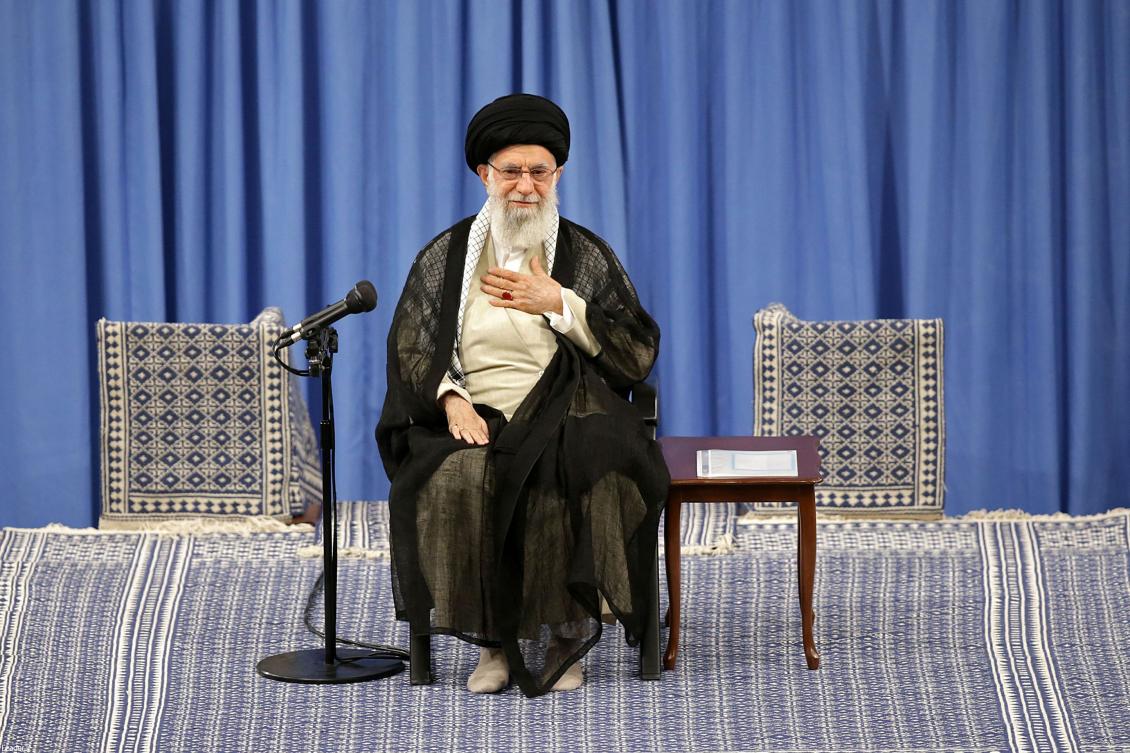
TEHRAN: Iran’s supreme leader Ayatollah Ali Khamenei said “enemies” were trying to drive a wedge between Tehran and Baghdad in a tweet on Monday following deadly unrest in neighboring Iraq.
“#Iran and #Iraq are two nations whose hearts & souls are tied together … Enemies seek to sow discord but they’ve failed & their conspiracy won’t be effective,” Khamenei was quoted as saying on his office’s Twitter account.
State news agency IRNA said the supreme leader was reacting to recent violence in Iraq.
More than 100 people have been killed in Iraq since clashes erupted last week between protesters and security forces, the majority of them demonstrators struck by bullets.
The Iraqi authorities have accused “saboteurs” and unidentified snipers of targeting the protesters.
Iran has urged its citizens planning to take part in a major Shiite pilgrimage in Iraq to delay their travel into the country over the violence.
Tehran has close but complicated ties with Baghdad, with significant influence among its Shiite political groups.
The two countries fought a bloody war from 1980 to 1988 and Iran’s influence in the country grew after the US-led invasion of Iraq toppled veteran dictator Saddam Hussein in 2003.
UAE says Khamenei meeting proves Houthis are Iran’s proxyIran to consider talks with US only if sanctions lifted and Khamenei permits: minister
Qatar’s Al-Ghufran tribe fights for justice — and right to citizenship
Sun, 2019-10-06 22:29
JEDDAH: In June, 1995, Qatar’s then Crown Prince Sheikh Hamad bin Khalifa Al-Thani deposed his father, Sheikh Khalifa Al-Thani, the ruling emir, in a bloodless coup.
Sheikh Khalifa was outside the country when the overthrow took place, and the crown prince quickly gained the allegiance of other Al-Thani family leaders and key tribes in order to secure his position.
However, in February the following year, supporters of the emir joined a counter-coup in a bid to reinstall the deposed leader. It failed because the emir was unable to return to Doha airport in the agreed time.
Immediately afterward, the government arrested scores of Qataris, who were held in isolation before being stripped of their citizenship and deported.
That is also what happened with 6,000 members of the Al-Ghufran tribe, who have been forced from their homeland, and accused of masterminding the coup and attempting to assassinate Sheikh Hamad.
The Al-Ghufran tribe is a branch of the semi-nomadic Al-Murra group, one of the largest tribes in Qatar with more than 10,000 members, according to unofficial estimates. Most live in Qatar, and in the east and south of Saudi Arabia. It consists of several branches, including Al-Buhaih, Al-Fuhaidah, Al-Jaber and Al-Zaidan.
According to several members of the Al-Ghufran, the Qatari authorities’ persecution of the tribe dates back to June 25, 1995, when Sheikh Hamad deposed his father in a bloodless coup. The Qatari people were shocked at TV news of the overthrow, which took place when Sheikh Khalifa was on a trip abroad.
TIMELINE
Qatar Chronology:
June 27, 1995 – Sheikh Hamad bin Khalifa Al-Thani deposes his father
Feb. 14, 1996 – Sheikh Khalifa stages counter-coup. Members of more than 17 Qatari tribes join the failed coup; more than 300 suspects arrested
1997 – Trial of 121 accused, including 21 members of the Al-Ghufran tribe, begins
2001 – Trial ends
2004 – Withdrawal of Al-Ghufran citizenship begins
2010 – Saudi King Abdullah intervenes to free 21 of those involved in the coup
After less than seven months, Qatari authorities announced they had foiled a counter-coup against Sheikh Hamad led by his father who had tried to return to Qatar. An arrest warrant was subsequently issued against Sheikh Khalifa through Interpol.
Rashed Al-Amrah, an Al-Ghufran tribe member and former Qatari police officer, was stripped of his citizenship by the Qatari government after the failed 1996 counter-coup.
“Some of us did not believe what happened, especially that the son perpetrated the coup against father since the father has great stature in the Islamic religion and, specifically, in Gulf communities,” he told Arab News.
“We have seen a number of citizens and a number of the Al-Thani family members pledge allegiance to the new sheikh as emir of Qatar.
“There was hearsay and statements made by Sheikh Khalifa that he will return to Qatar and reinstall the deposed emir. People were confused: Do they support Sheikh Hamad or stand with their former legitimate ruler? Many Qataris protested against the coup, asserting that Sheikh Khalifa is the rightful ruler of Qatar.”
Jaber Al-Kahla, an Al-Ghufran tribe member, was serving in the Emiri Guard on the night of the counter-coup. “I was 23 when my citizenship was revoked and working as a special agent of the guard of Crown Prince Sheikh Hamad,” he told Arab News.
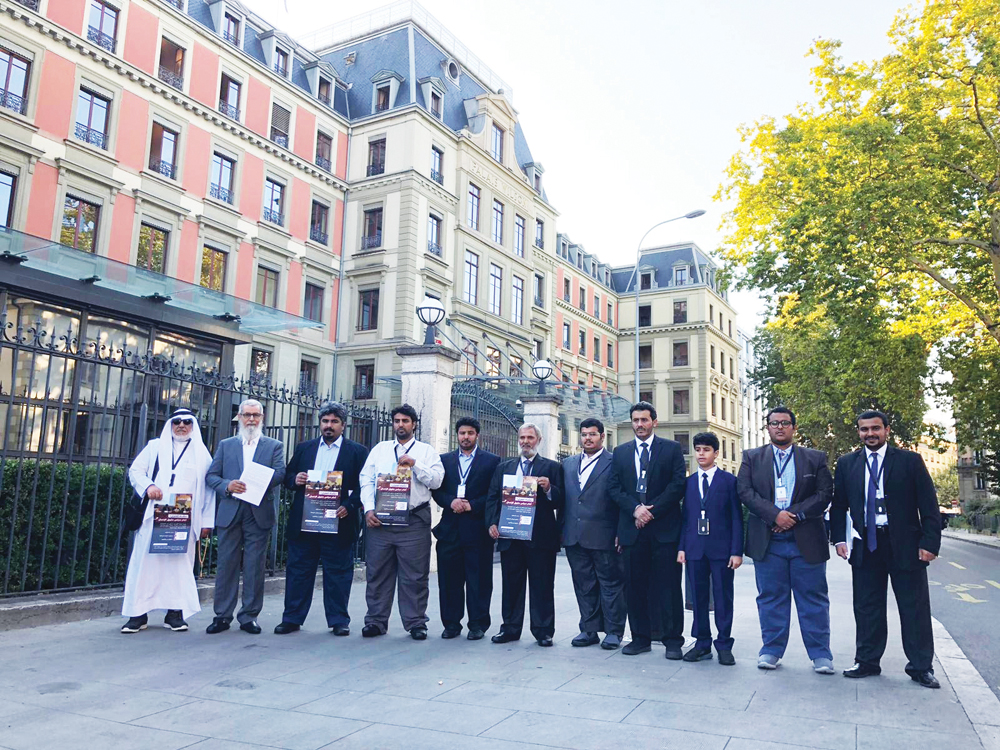
Al-Ghufran members appeal to the UN in Geneva. (WAM photo)
“The night of the so-called coup, I was summoned to the service to carry out my military and national duty. A few days later, the commander of the tank, unit, Hazzaa bin Khalil, who is now the guard commander, summoned me and asked me: ‘Are you member of the Al-Ghufran tribe?’ I said yes. He listed some names of the same unit, who were my relatives and asked me if they also belonged to the tribe? I told him yes. He then said that we were suspended from work until further notice.”
It was a confusing time for many, as Al-Amrah recalls. “The Qatari people lived under the rule of the new emir, Sheikh Hamad, and I was an officer in the Qatari police,” he told Arab News.
“On Feb. 14, 1996, Sheikh Khalifa had told a number of his close relatives and supporters at home that he decided to return to Qatar via Doha military airport on the 27th of Ramadan, asking his supporters to receive him at the military airport.
Opinion
This section contains relevant reference points, placed in (Opinion field)
“Everyone was ready for the return of the legitimate ruler, but the Qataris, including a number of the sons of Sheikh Khalifa, such as Sheikh Jassem bin Khalifa, the-then chief of staff Sheikh Mubarak bin Abdulrahman, and a number of Qatari tribes, including Al-Ghufran, did not know how Sheikh Hamad would react.
“In the event, Sheikh Khalifa could not return because his aircraft was prevented from taking off in France,” he said.
“Sheikh Khalifa then went to the UAE, specifically to Abu Dhabi, in the hospitality of Sheikh Zayed bin Sultan Al-Nahyan.
“At the time, I had traveled to Saudi Arabia for the Eid holidays and to visit relatives,” Al-Amrah said.
“After the failed coup, the Qatari authorities began to investigate and search for those who were supporting Sheikh Khalifa, a large number of whom were Qatari tribesmen and dignitaries belonging to the Al-Ghufran, Al-Kaabi, Al-Suwaidi, Bani Hajjar, Al-Abdullah, Al-Mouhannadi, Al-Kuwari and Al-Thani clans.
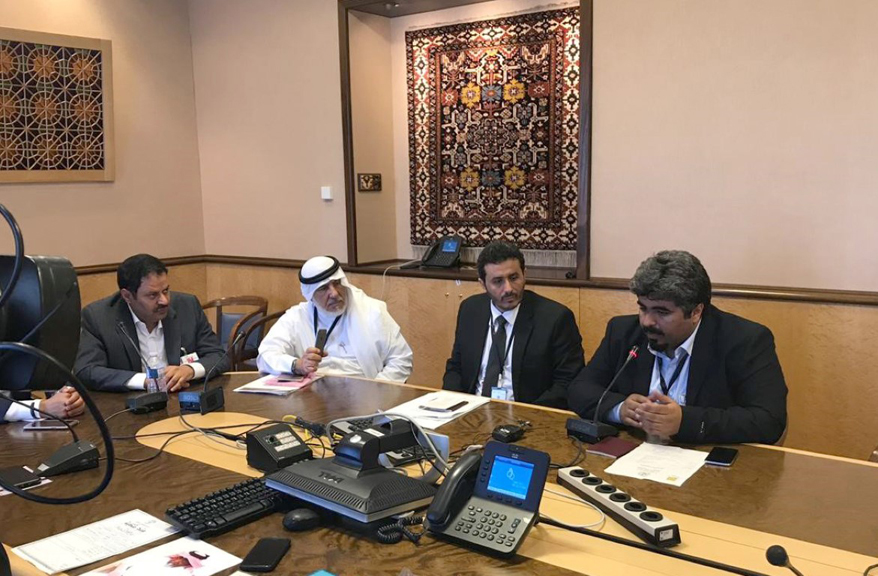
Leaders of the Al-Ghufran clan talk with the media to explain their plight. (WAM photo)
“Many members of the Al-Ghufran tribe who were in the security or armed forces were arrested and imprisoned, including Brig. Bakhit Marzooq Al-Abdullah, who was alleged to be the leader of the so-called coup,” he said.
“After Eid, we knew that there were orders to arrest and imprison all members of the Al-Ghufran clan attempting to return to Qatar. I was afraid for myself and my family, so I decided not to return until things were cleared up.
“We also knew that any Qatari outside Qatar who could not return to his country for fear of what would happen could go to Sheikh Khalifa in Abu Dhabi where he would be welcomed.
“Indeed, I headed to Abu Dhabi, where we were housed at the InterContinental Hotel and received a salary from Sheikh Khalifa. I stayed in Abu Dhabi for four years,” Al-Amrah said.
Qatari authorities charged a total of 121 people over the failed counter-coup. Trials (some in absentia) were held between November 1997 and May 2001.
Charges issued by the prosecutor general’s office included “attempting to depose Qatar’s emir by force,” “holding arms against the state of Qatar,” “disclosing military secrets” and “cooperating and conspiring with foreign countries.”
Hamad bin Jassem bin Jaber Al-Thani, then Qatar’s foreign minister, and Abdullah bin Khalifa Al-Thani, the prime minister, attended the trials as witnesses. At the end of the hearings, 19 alleged perpetrators were sentenced to death and 20 to life in prison, while 28 were acquitted.
None of those sentenced to death was executed.
Saleh Jaber Al-Humran, an Al-Ghufran tribe member, said: “I worked as a guard with Sheikh Khalifa’s guard unit. Before the events, I was absent from work for two consecutive months, so I was put in detention for a whole month.
“Once my detention ended, I wanted to visit my sick mother. On the same day I got out, the so-called coup took place and I was accused of taking part in it. My name was put on checkpoints without any guilt by my part, as I did not know what was going on outside my workplace.”
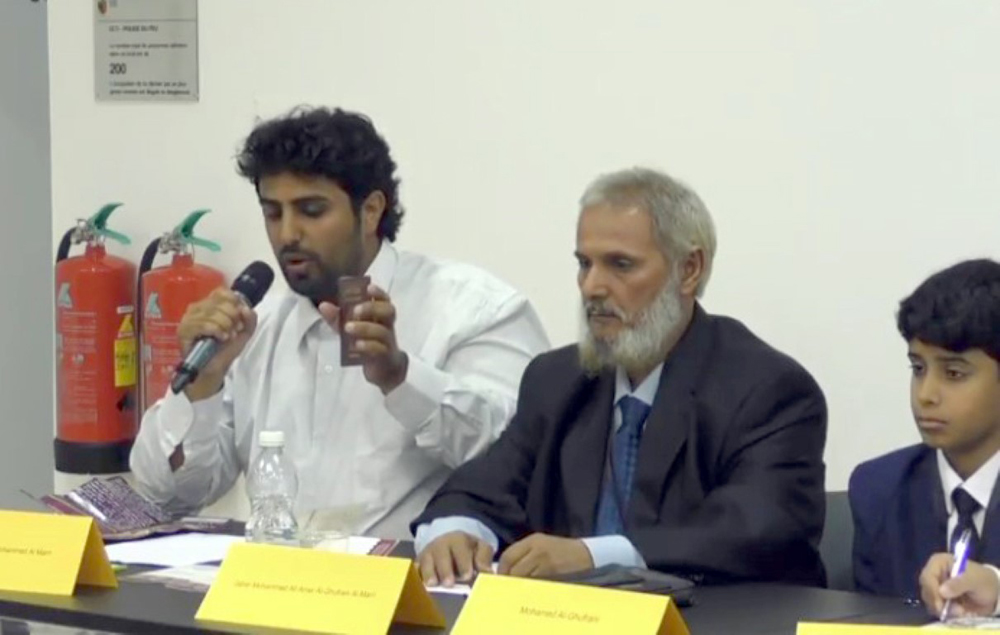
Al-Ghufran clan members attend a press conference to explain their plight. (WAM photo)
“This is what confuses us the most,” said Al-Kahla, who served in the Emiri Guard. “The Qatari government is still refusing to tell us the reasons behind revoking our citizenship, although it is its duty to justify such a decision.
“From 1996 and until 2019, the government failed to state the true reasons behind revoking our citizenship. The only answer we were given was that Al-Ghufran clan members have dual nationality.
“When I took part in the Human Rights Council in Geneva a few months ago, a media report broadcast about me said that my father took part in the coup. However, the government did not declare this,” Al-Kahla said.
“This is the real reason: We are accused of participating in the coup. My conclusion is that the revocation of citizenship was a reaction to the participation of 21 members of Al-Ghufran tribe in the attempted coup which was perpetrated by as many as 121 individuals, representing 17 Qatari tribes.
“There is nothing surprising in this, even if the justice system was not fair. Some of the accused were released several years later after announcing their innocence, but 6,000 innocent people were targeted without any accusation by the government,” Al-Kahla said.
In 2010, Saudi King Abdullah intervened to get 21 Al-Ghufran tribe members freed from prison, sending Prince Mutaib to secure their release.
Prince Mutaib flew the tribe members, who were still clad in prison outfits, to Jeddah, where they received new clothes and shoes before meeting the king.
Al-Ghufran families ‘arbitrarily stripped of Qatari citizenship’: HRW report“The Unforgiven”: Arab News investigates the plight of Qatar’s Al-Ghufran tribe
Young Lebanese step up street rallies over spiraling economic woes
Author:
Mon, 2019-10-07 01:16
BEIRUT: Hundreds of young protesters took to the streets across Lebanon on Sunday for the second consecutive week, blocking roads and voicing their anger at deteriorating economic conditions in the country. Tires were set ablaze on major roads in the capital Beirut, while crowds chanted “Down with capitalism” and “Leave!” as they marched near Lebanon’s Parliament amid heightened security. Protesters called for the overthrow of the government over its fiscal policies and failure to reduce the soaring cost of living. The demonstrations began with dozens of people gathering in Martyrs’ Square in downtown Beirut, but the number quickly grew to several hundred.
Children carried loaves of bread bearing the word “revolution,” while young women raised placards calling for the formation of a new government of technocrats and the return of funds looted from the state treasury. “We want to live with dignity. If MPs, ministers and all the ruling class don’t want to give back what they stole, they should at least stop stealing so the people can live,” one protester said Economist Louis Hobeika told Arab News that the protests were “legitimate, necessary and reflect the anger of the people.”
He said that although the number of demonstrators was not large, “it showed that people can still make a difference.” “Those who did not take to the streets are not yet convinced that this can lead to change in state policies,” Hobeika said. Hobeika said that it is “essential to exert pressure on the government to amend its policies related to electricity, water and waste management.” After a preliminary gathering in Martyrs’ Square, demonstrators marched to Riad El-Solh Square, near the Prime Minister’s office and the Lebanese Parliament. Police, including the anti-riot squad, set up security barriers to prevent demonstrators reaching the Prime Minister’s office.
One woman voiced her anger to TV cameras next to the Prime Minister’s office, saying her two young daughters “had not been admitted to school as she could not afford to pay their tuition fees.” Security forces, army intelligence and the anti-riot squad mobilized reinforcements after protesters headed toward the headquarters of the Association of Banks in Lebanon.
Demonstrators were cut off at a nearby crossroads for a few minutes before it was reopened by security forces.
One activist, who declined to be named, said: “We will keep moving from one street to another because we want the people to sense the importance of taking to the streets to put pressure on the authorities.”
HIGHLIGHT
The demonstrations began with dozens of people gathering in Martyrs’ Square in downtown Beirut, but the number quickly grew to several hundred.
Independent deputy and activist Paula Yacoubian, who took part in the protest, said that “the political authorities are a failure.”
“We have reached the end of the president’s midterm, but have not witnessed any reforms or change,” she said. “We will remain on the street until we change this miserable situation in which the people live.”
Deputy Nazih Najm, a member of the Future Movement bloc in the Lebanese Parliament, said the country’s dire economic situation is due to “Hezbollah’s weapons and US pressure on Lebanon because of that.” In Baalbek, dozens gathered in Seray Square in protest at poor living conditions in the city. One protester, Mohammed Deeb Othman, said: “We have become slaves of a corrupt political authority that has bypassed all limits in humiliating its own people. “There is no water, electricity, education or medical care. We only hear of these during elections.”
Will Gulf states buy Lebanon’s Eurobond?US sanctions squeezing Iran-backed Hezbollah in Lebanon
In Morocco, heroin addiction sweeps cannabis corridor
Sun, 2019-10-06 22:15
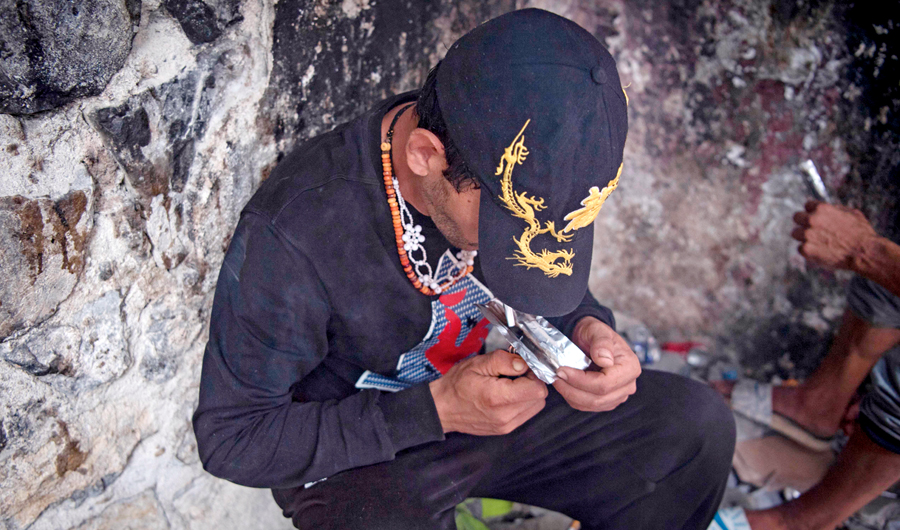
TETOUAN, MOROCCO: In a filthy squat in a beach town in northern Morocco, drug users inject and smoke heroin, a relatively recent scourge plaguing a region long known for cannabis and contraband.
Rachid says he does nothing with his life, except heroin.
“I shoot up four or five times a day,” the 34-year-old said, breathing raggedly.
He shows his arms, scarred from a decade of injecting, before taking a sniff of glue to “prolong the high.”
Half-a-dozen others are shooting up or smoking heroin alongside Rachid in the squat, located behind a police station in Mediek, a Mediterranean resort near the city of Tetouan.
A dose of the powerful opiate they heat on aluminim foil sells for between €2.8 and €6.5 ($3-7) for a tenth of a gram.
Every week, a team from the Association for the Fight Against AIDS (ALCS) comes to the squat to hand out syringes to prevent the spread of diseases like HIV and hepatitis.
The sale and consumption of heroin is illegal in Morocco, but thanks to the efforts of ALCS in Tetouan, “it is very rare that users are arrested for their own personal consumption,” said Dr. Mohamed El-Khammas.
He runs the harm reduction program launched by ALCS in 2009, which combines awareness raising, distribution of materials like clean needles and screening.
“The idea is not to moralize, but to help the user to reduce negative effects,” Al-Khammas said.
In this region, known worldwide for its hashish produced in the Rif mountains, heroin use is a relatively recent development that is growing exponentially, experts say.
“It’s a public health priority, especially as the heroin being sold is very bad quality: It is mixed with talcum powder, paracetamol and glue,” Al-Khammas said.
The typical user is a “single man, aged 30-35 with little or no education who has never worked or works on an occasional basis,” according to a 2014 report from the National Observatory on Drugs and Addiction (ONDA).
The northern urban centers of Tetouan, Tangier and Nador are Morocco’s worst affected areas.
The spread of heroin is facilitated by the “great population mobility” between southern Europe and northern Morocco, and the increased use of “well-established cannabis routes” by traffickers from Latin America to smuggle cocaine and heroin to Europe, ONDA said.
Those drug barons also barter heroin for cannabis in the Rif, according to ALCS staff.
The number of heroin users in Morocco is unknown.
According to ALCS, there are likely several thousand heroin users in Tetouan alone, a city of 380,000 people, which was once the seat of the Spanish administration under the dictator Francisco Franco.
Hassna, a 46-year-old ALCS caseworker, distributes clean drug paraphernalia from her backpack to users gathered in the Mediek squat.
“We urge them not to share syringes, we accompany them to health centers and we try to convince them to take care of themselves,” she said.
Rachid said he is “incapable of quitting.”
But he does want access to methadone: “That’s all we ask,” he said.
This opioid substitute is distributed by addiction treatment centers in Tetouan, but in “insufficient amounts,” Rachid said.
“Withdrawal is terrible, you have cramps, anxiety,” said his companion Mohamed, a waxen-faced 24-year-old with a syringe buried in his tattooed arm.
Every evening, an ALCS medical vehicle is parked in a different location, with a doctor, nurse and field workers on hand.
Once a week, the team parks near a cemetery overlooking Tetouan, a common spot for users. One of them, a 56-year-old named Said, said he “lost everything” because of heroin.
“I am at rock bottom,” he said.
“The hardest part is on the social level,” 37-year-old Abdelilah said.
“I lost 30 kilos because of this crap. When an old friend sees me in the street, he looks away.”
Morocco journalist gets 1-year jail for ‘illegal abortion’Morocco’s king suffers from acute viral pneumonia
Palestinian president says to discuss elections with Hamas, factions
Author:
Sun, 2019-10-06 21:49
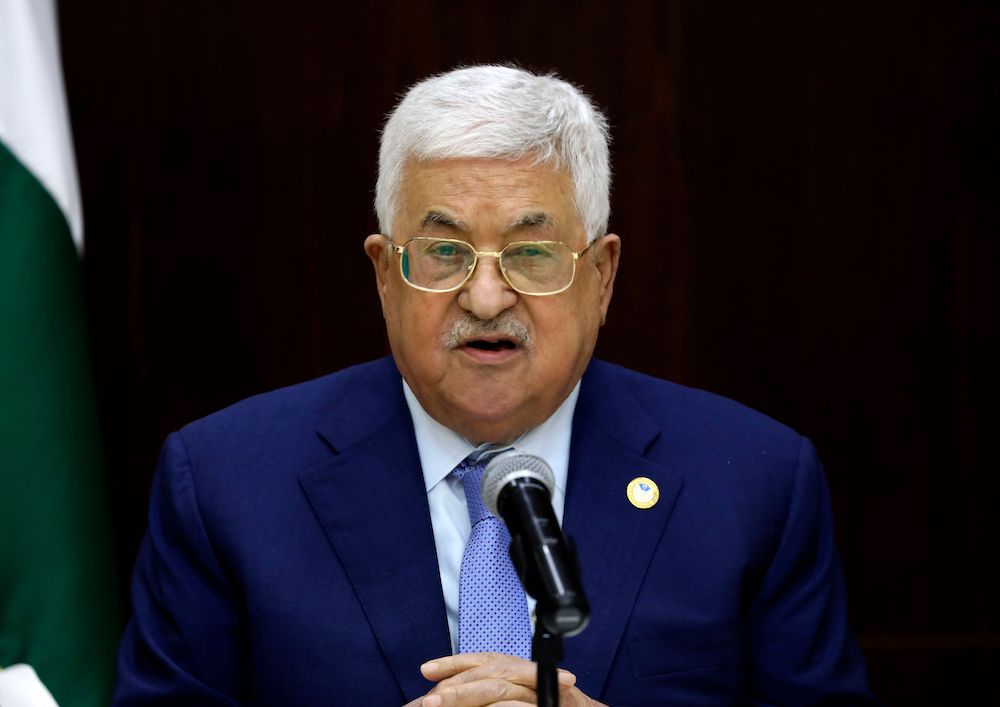
RAMALLAH: Palestinian president Mahmoud Abbas said Sunday he would discuss plans for new parliamentary elections with all factions, including longtime rivals Hamas.
Meeting with senior Palestinian leaders in Ramallah in the occupied West Bank, Abbas renewed a pledge to hold the polls — the first since 2006 — but without giving a timeframe.
He announced they had formed committees to “communicate with the election commission and factions such as Hamas and all factions, as well as with the Israeli authorities.”
He said any elections should take place in “the West Bank, Jerusalem and the Gaza Strip.”
Hamas and Fatah have been at loggerheads since 2007, when they seized Gaza and threw out Abbas’s forces, which retained control of the internationally recognized Palestinian government based in the West Bank.
No parliamentary elections have been held since 2006, with the two sides trading blame.
Multiple attempts at reconciliation have failed and analysts say new elections are impossible without improved relations.
Hamas said in a statement Saturday it didn’t “know what Abu Mazen means by general election,” using the common nickname for Abbas.
The movement said it had already committed itself to elections.
Abbas has previously pledged on multiple occasions to hold elections but without any results.
Meanwhile, Abbas also confirmed the Palestinian Authority (PA) had received on Sunday $1.5 billion shekels ($430 million) from Israel — representing taxes that had been withheld from the Jewish state.
Israel in February decided to withhold around $10 million per month from revenues of some $190 million per month it collects on the behalf of the PA, triggering Abbas’s fury.
The money comes from customs duties levied on goods destined for Palestinian markets that transit through Israeli ports and constitutes more than 50 percent of the PA’s revenues.