Why Erdogan wants to remake northeast Syria’s demographics

Sat, 2019-10-12 23:43

ERBIL, Iraqi Kurdistan: Turkey’s incursion into northeast Syria has given rise to fears that its military will commit another major atrocity against the war-torn country’s Kurdish minority.

The UN has warned that 1.7 million people in northeast Syria are at risk as a result of Operation Peace Spring, and that up to 300,000 could soon be displaced, which would create a new humanitarian crisis.

Turkey has targeted urban centers with airstrikes and shelling, sending civilians fleeing en masse from their homes.

Ankara has said its military operation is justified since the Syrian-Kurdish People’s Protection Units (YPG) group has links to the Turkish Kurdistan Workers’ Party (PKK), which Ankara has been fighting since 1984 in a conflict that has killed more than 40,000 people. The US and the EU have also designated the PKK as a terrorist organization.

But the YPG has not sent its forces to help the PKK in its operations in either southeast Turkey or Iraqi Kurdistan, instead focusing its efforts on the war against Daesh in Syria.

HIGHLIGHTS

64,000 – People displaced in NE Syria

300,000 – People likely to be displaced

40,000 – Number of SDF fighters

$300 million – Fall in US humanitarian aid to Syria from 2017 to 2019

3.6 million – Syrian refugees in Turkey

After the US military partnered with the YPG, which later formed the larger, multi-ethnic Syrian Democratic Forces (SDF), against Daesh in 2014, Ankara said Washington was making a mistake by using “one terror group to eliminate another.”

Nevertheless, the SDF proved the only capable and reliable ally the US had on the ground in its campaign against Daesh in Syria.

Today, Turkish President Recep Tayyip Erdogan has not concealed his goal for the future of northeast Syria.

Besides insisting that the YPG must be completely neutralized, he has outlined his goal of resettling millions of Syrian refugees currently residing in Turkey in Syria’s Kurdish-majority areas.

“We intend to establish initially a peace corridor with a depth of 30 km and a length of 480 km, and enable the settlement of 2 million Syrians there with the support of the international community,” Erdogan told the UN General Assembly on Sept. 24.

He intends to do this through a $27 billion project to build new cities and towns in Syrian Kurdistan that will be repopulated with Syrian refugees currently residing in Turkey.

Ossama Muhammad, a Syrian-Kurdish interpreter and translator, lamented the situation in a Facebook post, writing: “Now families of those who were killed to defend the world, will keep behind alone to wait for new genocide and demographic change, the Kurds will never trust the humanity or the world or human rights again.” Muhammad was referring to the immense sacrifices made by Kurds to stop Daesh in Syria.

Erdogan has also threatened to send millions of Syrian refugees to Europe if it opposes the settlement project or criticizes the military operation.

This would not be Turkey’s first assault on the Syrian Kurds. In early 2018, it entered the northwestern enclave of Afrin with the help of the Free Syrian Army (FSA).

At the time, Erdogan openly spoke of returning Afrin to its “rightful owners.” By this, he meant resettling non-Kurds in a Kurdish-majority region.

Opinion

This section contains relevant reference points, placed in (Opinion field)

Before Turkey’s invasion, Afrin stood out as an oasis of stability that had welcomed displaced Syrians regardless of ethnicity from across the war-weary country.

After the invasion, which displaced well over 100,000 Kurdish civilians, the FSA rapidly sought to resettle displaced Syrians in the enclave, encouraging them to occupy vacated Kurdish homes, and even giving them Turkish-issued residency permits, in a clear bid to cement the demographic changes caused by the invasion. Many groups within the FSA have destroyed symbols of Afrin’s Kurdish and Yazidi cultural heritage. The FSA has also committed human rights violations against Afrin’s civilian population.

Amnesty International said these violations included “arbitrary detentions, enforced disappearances, and confiscation of property and looting to which Turkey’s armed forces have turned a blind eye.”

The YPG has also been accused of human rights violations in northeast Syria. In August 2018, Human Rights Watch (HRW) criticized the group for recruiting children into its ranks from displaced-persons camps. The SDF promptly issued a decree to end this practice, which was welcomed by HRW. 
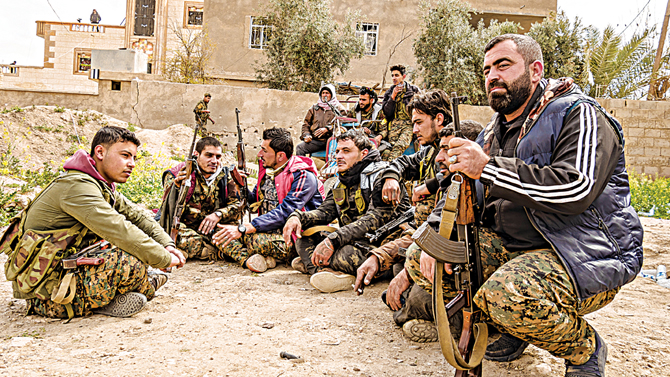

The Syrian Democratic Forces proved the only reliable ally the US had in the fight against Daesh in Syria. (Shutterstock)

In 2015, Amnesty International reported that the YPG destroyed entire villages that it had captured from Daesh.

The report said there was no justification or military grounds for destroying these Arab villages. 

Amnesty suspected that the YPG was motivated by a desire to collectively punish civilians from villages previously occupied by Daesh, or to settle land disputes with Arabs going back decades.

Kurds fear that Turkey will carry out a large-scale campaign of ethnic cleansing in its current operation. 

They feel betrayed by US President Donald Trump for countenancing the Turkish invasion, because the SDF was the predominant ground force in Syria that destroyed Daesh’s “caliphate.” The SDF says it sacrificed approximately 11,000 men and women in that fight.

Mohammed Salih, a Kurdish journalist and doctoral student at the University of Pennsylvania’s Annenberg School for Communication, sees the latest Turkish foray into Syria as Erdogan’s “final solution of the Kurds.”

Salih told Arab News: “Erdogan and his Syrian jihadi proxies are planning and interested in nothing less than ethnic cleansing of not only the Kurdish people in northeast Syria, but based on what we’ve seen in Afrin, of Christian and Yazidi populations there as well.”

He said: “This isn’t a matter of conjecture and speculation. The ongoing example of Afrin supports these fears without a shred of doubt.

“Turkish government officials have unequivocally made clear that they plan to resettle … non-Kurdish Syrian refugees in the narrow strip of land populated by the Kurds.

“The world needs to act and stop Erdogan’s genocidal designs.”

Main category: 

Turkey’s Syria offensive ‘invasion’ of Arab land: Arab League chiefAbul Gheit: Turkish attack on Syria incites regional hostility



Yemeni minister hails Saudi backing against Houthis

Sat, 2019-10-12 00:19

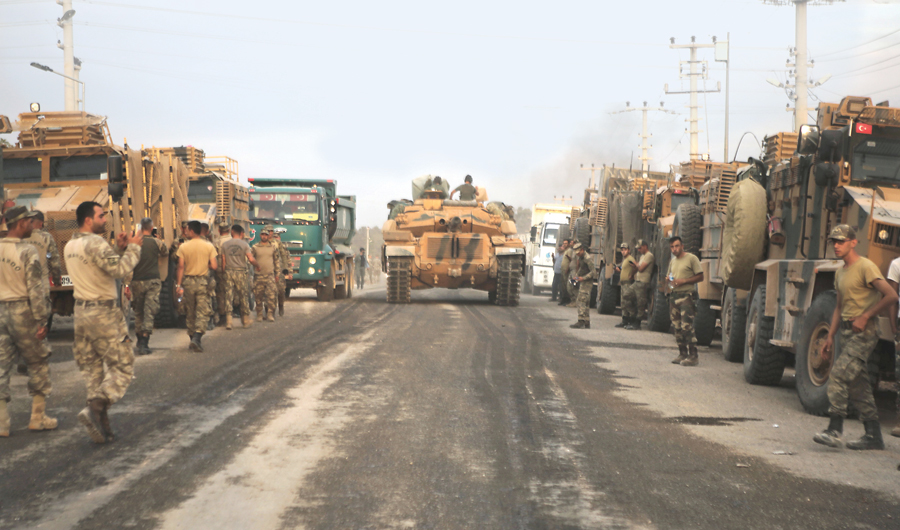
MARIB: Yemeni Defense Minister Lt. Gen. Mohammad Ali Al-Maqdashi hailed Saudi Arabia’s support in the fight to restore security and stability to his country.
He said the Kingdom’s stance was helping toward rebuilding Yemen following the coup by Iran-backed Houthi militias, the Saudi Press Agency reported.
Al-Maqdashi highlighted the sacrifices made by Saudi and Yemeni armed forces to combat threats to the security and stability of Yemen and the region.
His comments came during a meeting  with heads and directors of various bodies and departments of the Yemeni Ministry of Defense. They discussed ways of coordinating the work of ministerial departments in contributing toward rebuilding Yemen’s military institutions. 

Main category: 
Tags: 

Houthis killed in clashes with Yemeni army Saudi humanitarian organization continues to provide aid to flood victims in Yemen


Abul Gheit: Turkish attack on Syria incites regional hostility

Author: 
Fri, 2019-10-11 23:14

CAIRO: Arab League Secretary-General Ahmed Abul Gheit said that the Turkish attack on Syria will incite “uncontrollable hostilities” in the region which could have negative repercussions.
Abul Gheit said that foreign intervention in Arab affairs by regional powers fueled further crises and made the possibility of settling them harder. He added that the latest Turkish attack on Syrian lands would complicate the situation.
He expressed alarm over Ankara’s plans and current preparations to carry out a military operation deep inside Syria.
Abul Gheit said the Arab League views Ankara’s military operation as a clear violation of sovereignty that would threaten Syria’s unity and would open the door for more deterioration in security and the humanitarian situation.
He called on Turkey to withdraw its troops from all Syrian lands.
Assistant Secretary-General and Chief of Staff of the Arab League Hossam Zaki said: “Turkey should not carry out such military operations.”
On efforts by the Arab League to prevent a military attack on northern Syria, Zaki said it “was not involved in the Syrian issue from 2011, when Syria’s membership was suspended. It does not have the effective tools to be involved in the crisis.”

SPEEDREAD

• Arab League views Ankara’s military operation as ’a clear violation of sovereignty that would threaten Syria’s unity.

• An emergency meeting of the Arab League Council at  the level of foreign ministers will be held on Oct. 12.

He pointed out that regional and international consultations are usually held between groups of states, adding that the Arab League is excluded from such talks.
Zaki said that since Abul Gheit assumed his post three years ago, he has been seeking to involve the Arab League in regional and international efforts with regards to the Syrian crisis.
“However, we have not achieved our aspired success so far. Hence, when the crisis of military operations in northern Syria erupts, the Arab League can only express a political stance. We cannot say that we would be active in this crisis or that we can influence Turkey, a country threatening the sovereignty of a member state.”
Zaki confirmed that an emergency meeting of the Arab League Council at  the level of foreign ministers will be held on Oct. 12 after Egypt called for it. The meeting, to be held in consultation with Iraqi Foreign Minister Mohamed Ali Alhakim, will discuss Turkish aggression in Syria.

Main category: 
Tags: 

Council of Arab League opens to discuss political developmentsInternational community must help stop Israeli aggression against Al-Aqsa: Arab League


EU slams Turkey for ‘weaponizing’ refugees

Author: 
Fri, 2019-10-11 23:08

ANKARA: As the Turkish ground and air offensive in northeastern Syria continues, Turkish President Recep Tayyip Erdogan has threatened to send millions of Syrian refugees to Europe if the EU calls Turkey’s military offensive “an invasion.” “We will open the gates and send 3.6 million refugees your way,” he said on Thursday.
The statement is considered by some a move to “weaponize” the refugees who have been in Turkey since the beginning of Syrian civil war, and to use them as a leverage.
European institutions harshly criticized Turkey’s military operation into northeastern Syria against Kurdish-led Syrian Democratic Forces (SDF), which Turkey considers a terror group.
“Turkey must understand that our main concern is that their actions may lead to another humanitarian catastrophe, which would be unacceptable. Nor will we ever accept that refugees are weaponized and used to blackmail us. That is why I consider yesterday’s threats made by President Erdogan totally out of place,” Donald Tusk, president of the European Council, said on Oct. 11 after his meeting with President of Cyprus Nicos Anastasiades.
Under heavy artillery and airstrikes, more than 60,000 residents in Syrian towns have reportedly fled their homes since the beginning of the operation.
Ankara says it wants to create a “safe zone” along its border and to help the return of about 1 million Syrian refugees back to their country. However, the project is criticized by some as a move of “demographic re-engineering” that would forcibly settle families and change the social realities of the region.
In the framework of 2016 Turkey-EU refugee deal, the EU allocated about 97 percent of the €6 billion ($6.6 billion) of funding.
Russian President Vladimir Putin warned on Friday that Daesh captives could potentially escape from prisons in Syria over Turkey’s incursion amid the chaos.
“Not sure if Ankara can take control of the situation,” he said to the Sputnik news agency.

NUMBER

60,000 – residents — under heavy artillery and airstrikes — have reportedly fled their homes in Syrian towns since the beginning of the operation.

Western countries have expressed their disapproval of Turkey’s operation. France announced sanctions against Turkey will be “on the table” at next week’s European summit, while Norway and Finland decided on Thursday to suspend their arms exports to Turkey.
US President Donald Trump tweeted on late Thursday: “We have one of three choices: Send in thousands of troops and win militarily, hit Turkey very hard Financially and with Sanctions, or mediate a deal between Turkey and the Kurds!”
According to Kenneth Roth, executive director of Human Rights Watch, Erdogan’s statement equals treating Syrian refugees as pawns to be manipulated for political purposes.
Roth thinks that a stated reason for the operation is to force 1 million or more refugees to a zone along the border that Erdogan pretends will be “safe” but has no capacity to secure.
“Then, when others criticize this illegal scheme, he threatens to uproot refugees from the lives they have been building in Turkey and send them off to Europe,” he told Arab News.
Although experts say a threat of such a scale is not particularly credible, it will ring alarm bells in some European countries, especially Greece at the doorstep of the illegal migration route. Turkey hosts 4 million refugees, 3.6 million of them Syrians.

Main category: 

Putin warns jailed Daesh militants may escape amid Turkey’s Syria operationHow will Syrian border towns react to Turkey’s Operation Peace Spring?


Party activists storm Lebanon’s Parliament over failing economy

Author: 
Fri, 2019-10-11 23:00

BEIRUT: Opposition party protesters broke into Lebanon’s Parliament on Friday demanding new parliamentary polls and voicing their anger at the country’s failing economy.
The Sabaa Party activists breached a security cordon outside the Parliament and stormed the main assembly hall. Once inside, protesters denounced the government as a “failed regime” and condemned what they described as the “corruption and looting” of public funds.
One activist, Baria Al-Ahmar, read from a statement, saying: “The party wishes to deliver a message from within the Parliament to the Lebanese and the entire world. In this chamber, the constitution has been violated dozens of times.”
Al-Ahmar described the presidential election as “illegal” and criticized the failure to change the Parliament speaker, saying: “In this chamber, the worst sectarian quota governments have been formed that have led us to failure.” “This civil resistance is against a corrupt and failed regime that has ruined the most beautiful country in this region,” she said.
The Parliament’s security team arrested four activists and prevented the media from taking photographs of the intruders. However, activists shared footage of Al-Ahmar’s speech inside the chamber on social media. Parliamentary Speaker Nabih Berri, who was not present at the time of the protest, told security forces to issue a warning to the activists and release them.
Sabaa has hundreds of independent activists who describe their party as “the opposite of all other traditional Lebanese parties, and the only real national and cross-sectarian platform.”

“This civil resistance is against a corrupt and failed regime that has ruined the most beautiful country in this region.”

Baria Al-Ahmar, an activist

Sabaa’s protest coincided with a demonstration by Communist Party activists, who broke into the headquarters of the General Confederation of Lebanese Workers (CGTL).
One activist read out a statement telling the CGTL leadership that “the workers’ weapon is their voice in the midst of authority’s attack on them.”
A protesters’ spokesman criticized the “Lebanese Banks Association, where banks are accumulating the people’s money looted by the destructive alliance between the troika of banks, the Lebanese central bank and the political power.”
CGTL said that “the storming of the union’s headquarters is irresponsible because its doors are open for all those who wish to demand their rights.”
The protests come amid Lebanon’s deteriorating economic situation and a crisis regulating dollar currency in banks that has created a scarcity of dollars.
Riad Salameh, Bank of Lebanon governor, said during a ICC FraudNet conference in Beirut that “dollar bills are available in the market, the monetary situation is stable, and a mechanism will be adopted to facilitate the process of importing essential supplies such as medicine, wheat and fuel.”

Main category: 
Tags: 

Celebratory gunfire: How to stop Lebanon’s stealthy killerLebanon’s Hussein Bazaza fuses storytelling, fashion design