Scramble for Syria after US withdrawal

Author: 
Reuters
ID: 
1571027625208521400
Mon, 2019-10-14 01:50

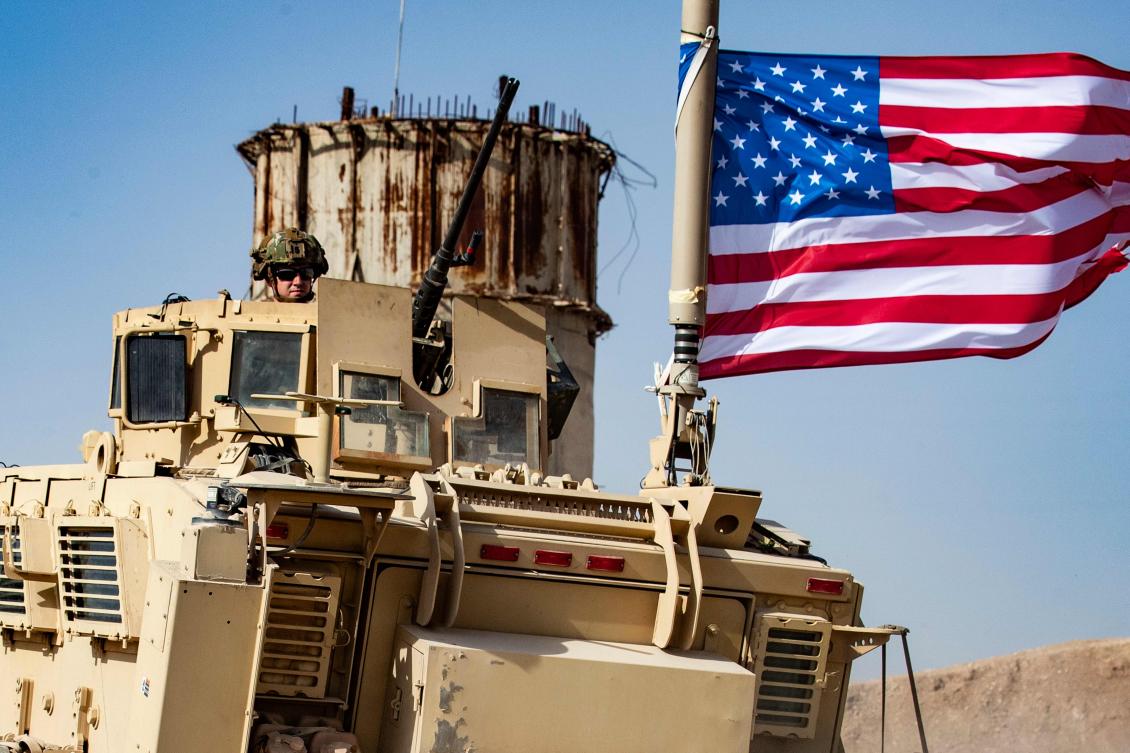
ANKARA: As Ankara pressed on with its offensive in northeastern Syria amid international criticism, Washington announced some 1,000 soldiers were withdrawn from the zone.

With the US departure, the attention turns to how the regional actors, especially Turkey and Syria, will operate in their zones of influence in the war-torn country where the possible escape of Daesh fighters from prisons could result in more chaos.

Some experts claim that with the US decision to withdraw its forces, the territorial claim of northeastern Syria by the Kurdish YPG militia and its political wing, the Syrian Democratic Forces (SDF), has finished.

Turkey considers the SDF and YPG to be terrorists allied with the PKK, who have been involved in a bloody campaign for autonomy against Turkish states for decades. The PKK is listed as a terror group by Turkey, the EU and the US.

But, whether some 50,000 YPG fighters will be integrated into the Syrian Army or will try to maintain their autonomy is still a matter of concern.

Mazloum Abdi, commander-in-chief of the SDF, recently wrote for Foreign Policy that the Kurds are finally ready to partner with Assad and Putin.

Yury Barmin, an analyst at the Russian International Affairs Council, said: “Damascus and the SDF struck a deal at the Russian base in Hmeymim to let the Syrian Arab Army (SAA) enter the Kurdish-controlled area in the northeast and deploy at the Syrian-Turkish border. The SAA is set to take control over Manbij, Kobane and Qamishli.”

However, Barmin told Arab News that a deal between Damascus and the SDF would greatly contribute to a buffer zone that Turkish President Recep Yayyip Erdogan intends to create in northern Syria, allowing Kurds to take some areas along the border without directly antagonizing Ankara. This policy, Barmin added, would be unacceptable to Moscow.

“There are now lots of moving targets and the goal of the Syrian Army — whether it will take some strategic cities or control the whole border along Turkey — is unclear for now. As Russian President Vladimir Putin is on his official visit to Saudi Arabia, his decision for Syria will be clearer when he returns home,” he said.

HIGHLIGHT

Some experts claim that with the US decision to withdraw its forces, the territorial claim of northeastern Syria by the Kurdish YPG militia and its political wing, the Syrian Democratic Forces (SDF), has finished.

Barmin also noted that Russia let Erdogan operate the Adana agreement to a certain extent, under which Turkey has the right to conduct cross-border operations.

“But now, Russia would like to show Turkey its own red lines in the region,” he said.

However, Navvar Saban, a military analyst at the Omran Center for Strategic Studies in Istanbul, said that the Syrian regime is not capable of striking a deal without being backed by Russians, and that Moscow would not want to lose its relationship with Ankara.

“Russians always talk about the Adana agreement. We are now talking about a renewal and reactivation of the agreement with new specifications to allow Turkey to go deeper into Syrian territories. In this way, the Russians will have a bigger chance to allow the Syrian regime and Turkey to communicate. It is something that will open the diplomatic channels,” Saban said.

Meanwhile, US President Donald Trump tweeted: “Big sanctions on Turkey coming! Do people really think we should go to war with NATO Member Turkey? Never ending wars will end!”

Joe Macaron, a resident fellow at the Arab Center in Washington, said that if the US is completely out of the way, Russia and Turkey will have to either agree or contest each other to take over the US territorial control in northeast Syria. He added that this might be the most crucial race in the coming weeks.

Concerning the diplomatic channels between Damascus and Ankara, Macaron thinks that the channels were and will remain open between Moscow and Ankara since they have common interests beyond Syria.

“If Turkey had no other option, it might have to settle for controlling a few border towns, but this means Erdogan can no longer effectively implement his plan to return Syrian refugees, most notably without funding from the international community. Ankara is more likely to succeed in striking such a deal with Moscow than with Washington,” Macaron told Arab News.

Many experts agree that the Syrian chessboard will be determined predominantly by Russian moves.

“Assad has no say in what will happen next, Russia is the decision maker and there is little the Syrian regime can do unless Iran forcefully intervenes to impact the Russian-Turkish dynamics in the northeast,” Macaron said.
Main category: 

Turkey and proxies advance deep into SyriaFrance, Germany halting arms exports to Turkey over its offensive against Kurds in Syria


Kais Saied wins Tunisia presidency by ‘significant margin’

Author: 
AFP
ID: 
1571073107731571500
Mon, 2019-10-14 16:40

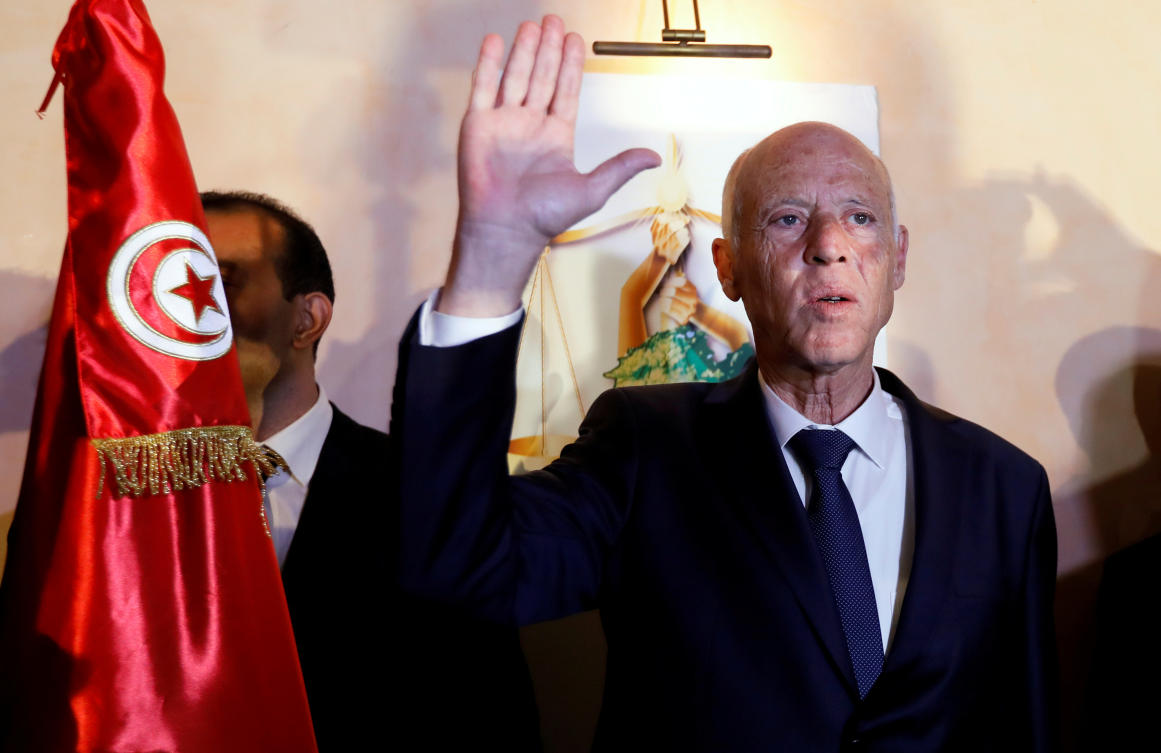
TUNIS: Tunisia’s election commission said a preliminary count shows conservative law professor Kais Saied has won the country’s presidential election by a significant margin.
The commission reported Monday that Saied, who hasn’t held elected office before, received 72.71% of the vote. His opponent, media mogul Nabil Karoui, got 27.29%.
The results confirm exit polls from Sunday’s election.
Nabil Bafoun, head of the electoral commission, said “by looking at the result … and knowing that it represents an absolute majority for this second round of the presidential elections, we, the Tunisian electoral commission, declare Mister Kais Saied winner of the presidential elections.”
The commission said that Saied got a majority of the votes in each of the 33 electoral districts. He exceeded 90% in six traditionally very conservative southern districts.
The 61-year-old Saied is an independent outsider but has support from moderate party Ennahdha, which won Tunisia’s parliamentary election last week.
He has promised to overhaul the country’s governing structure to give more power to young people and local governments.
Karoui, 56, told supporters Sunday the race wasn’t over because his legal team would explore options. He was arrested Aug. 23 in a corruption investigation and released with only two days left to campaign.
French President Emmanuel Macron congratulated Saied for his election in a phone call Monday and wished him “success for Tunisia.”
Macron stressed the Tunisian people’s “democratic mobilization” over the past several weeks. He told Saied that he intends to pursue and enhance the partnership between the two countries.
Egyptian President Abdel-Fattah El-Sisi congratulated the Tunisian people and the elected president in a written statement.
If no legal action is taken to challenge the results, the electoral body is set to announce the definitive vote count on Thursday. Tunisia’s parliament will then hold an extraordinary session during which the newly elected president will be sworn in and will formally start his five-year term.
The presidential vote was held early following the July death in office of President Beji Caid Essebsi.

Main category: 

Tunisian election gives few clues to shape of next governmentHeart of Tunisia party claims victory in parliamentary election


Sudan’s government, rebel leaders start peace talks in Juba

Author: 
By SAMY MAGDY | AP
ID: 
1571058586750305500
Mon, 2019-10-14 13:00

CAIRO: Sudan’s new transitional government met with rebel leaders on Monday, kicking off peace talks aimed at ending the country’s yearslong civil wars.

The peace initiative was built into a power-sharing deal between Sudan’s army and its pro-democracy movement. That deal was reached after the overthrow of longtime autocrat President Omar Al-Bashir in April. The transitional authorities have six months to make peace with the s, according to the agreement.

South Sudan’s President Salva Kiir is hosting the talks in its capital, Juba, where some rebel groups signed a draft agreement last month that detailed a roadmap for the talks, trust-building measures and an extension of a cease-fire already in place.

South Sudan gained independence from the north in 2011 after decades of civil war. But in the 2000s, Sudan was most known for Al-Bashir’s brutal repression of an uprising in the western Darfur region.

Achieving peace is crucial to the transitional government in Sudan. It has counted on ending the wars with rebels in order to revive the country’s battered economy through slashing the military spending, which takes up much of the national budget.

Sudanese authorities have introduced good-will signals. They dismissed death sentences against eight rebel leaders and released more than a dozen prisoners of war. They have also delayed the formation of the parliament and the appointment of provincial governors to allow time for the rebels to come on board.

The government delegation, led by Gen. Mohammed Hamadan Dagalo, a member of the Sudan’s sovereign council, arrived in Juba late Sunday. Rebel leaders arrived earlier this month.

Rebel leader Malik Agar of the Sudan Revolutionary Front, an alliance of Darfur rebel groups, told The Associated Press that they would start “the official opening” of the talks Monday in Juba.

Gen. Abdel-Fattah Burhan, head of Sudan’s sovereign council, also arrived in Juba to attend the opening session, along with other African leaders including Egypt’s Prime Minister Mustafa Madbouly and Ethiopia’s Prime Minister Abiy Ahmed, according to the official SUNA news agency.

Ethiopia and the African Union mediated the power-sharing agreement in August which ended months of violence and faltering talks between Sudan’s generals and protesters following the uprising against Al-Bashir.

On Sunday, Sudan’s newly appointed top judicial officials were sworn in before Burhan.

Neamat Kheir, a veteran female judge, took the oath as chief of the judiciary. She’s the first woman to rise to Sudan’s highest judicial post. Taj Al-Ser Al-Hebr, a lawyer, was sworn in as the country’s public prosecutor.

Last month, thousands of Sudanese took to the streets demanding the two original appointees be sacked. Those two were chosen by the military council that ruled Sudan after ousting Al-Bashir.

Protesters had insisted that independent judges be appointed before prosecuting members of the old regime, as well as those responsible for a deadly crackdown on protesters in June.

Unlike many judges, Kheir was not known to compromise her integrity to serve the interests of Al-Bashir’s government. However, she was widely criticized for not having supported the Sudanese uprising since its inception.

Main category: 

Egypt, Sudan, Ethiopia fail to reach agreement on Nile damSouth Sudan rebel leader in Juba in bid to salvage peace deal


Kurds ‘may be releasing’ Daesh prisoners in Syria to get US involved: Trump

Author: 
AFP
ID: 
1571055388710043900
Mon, 2019-10-14 12:14

WASHINGTON: President Donald Trump suggested Monday that Kurdish fighters may be releasing imprisoned Daesh group militants to force the United States to remain involved in northeastern Syria.
“Europe had a chance to get their Daesh prisoners, but didn’t want the cost. ‘Let the USA pay,’ they said…” Trump tweeted, using an alternate acronym for the Daesh group.


“… Kurds may be releasing some to get us involved. Easily recaptured by Turkey or European Nations from where many came, but they should move quickly.”


Main category: 

Will European arms ban impact Turkey’s Syria operation?France, Germany halting arms exports to Turkey over its offensive against Kurds in Syria


Will European arms ban impact Turkey’s Syria operation?

Author: 
Mon, 2019-10-14 01:11

ANKARA: With an increasing number of European countries imposing weapons embargoes on Turkey over its ongoing operation in northeastern Syria, Ankara’s existing inventory of weapons and military capabilities are under the spotlight.

More punitive measures on a wider scale are expected during a summit of EU leaders in Brussels on Oct. 17.

It could further strain already deteriorating relations between Ankara and the bloc.

However, a EU-wide arms embargo would require an unanimous decision by all the leaders.

Turkish President Recep Tayyip Erdogan warned last week of a possible refugee flow if Turkey “opened the doors” for 3.6 million Syrian refugees to go to Europe — putting into question the clauses of the 2016 migration deal between Ankara and Brussels.

“The impact of EU member states’ arms sanctions on Turkey depends on the level of Turkey’s stockpiles,” Caglar Kurc, a researcher on defense and armed forces, told Arab News.

Kurc thinks Turkey has foreseen the possible arms sanctions and stockpiled enough spare parts to maintain the military during the operation.

“As long as Turkey can maintain its military, sanctions would not have any effect on the operation. Therefore, Turkey will not change its decisions,” he said.

So far, Germany, France, Finland, the Netherlands and Norway have announced they have stopped weapons shipments to fellow NATO member Turkey, condemning the offensive.

“Against the backdrop of the Turkish military offensive in northeastern Syria, the federal government will not issue new permits for all armaments that could be used by Turkey in Syria,” German Foreign Minister Heiko Maas told German newspaper Bild am Sonntag.

Following Germany’s move, the French government announced: “France has decided to suspend all export projects of armaments to Turkey that could be deployed as part of the offensive in Syria. This decision takes effect immediately.”

While not referring to any arms embargo, the UK urged Turkey to end the operation and enter into dialogue.

Turkey received one-third of Germany’s arms exports of €771 million ($850.8 million) in 2018. 

According to Kurc, if sanctions extend beyond weapons that could be used in Syria, there could be a negative impact on the overall defense industry.

“However, in such a case, Turkey would shift to alternative suppliers: Russia and China would be more likely candidates,” he said.

According to Sinan Ulgen, the chairman of the Istanbul-based EDAM think tank and a visiting scholar at Carnegie Europe, the arms embargo would not have a long-term impact essentially because most of the sanctions are caveated and limited to materials that can be used by Turkey in its cross-border operation.

“So the arms embargo does not cover all aspects of the arms trade between Turkey and the EU. These measures look essentially like they are intended to demonstrate to their own critical publics that their governments are doing something about what they see as a negative aspect of Turkey’s behavior,” he told Arab News.

Turkey, however, insists that the Syria operation, dubbed “Operation Peace Spring,” is undeterred by any bans or embargoes.

“No matter what anyone does, no matter if it’s an arms embargo or anything else, it just strengthens us,” Turkish Foreign Minister Mevlut Cavusoglu told German radio station Deutsche Welle.

Main category: 

Turkey and proxies advance deep into SyriaTurkish army says 31 soldiers killed in Syria operation