Ankara accuses Tehran of betrayal: Is the alliance of convenience collapsing? 

Tue, 2019-10-22 23:53

ANKARA: Recent developments on the ground in Syria may be proof of the demise of the already fragile partnership between Turkey and Iran, the two guarantor states of the Astana process alongside with Russia. On Monday, Iranian Foreign Ministry spokesman Abbas Mousavi announced that Iran rejected any move from Turkey to establish military posts inside Syria, and emphasized that the integrity of Tehran’s key regional ally should be respected.
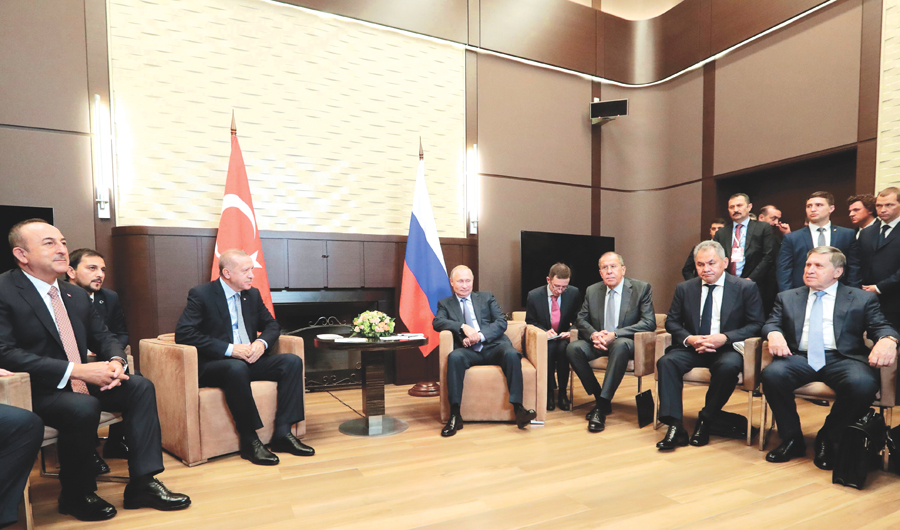
Prior to departing for Sochi, to meet with his Russian counterpart Vladimir Putin, President Recep Tayyip Erdogan said: “I condemn Iran’s stance on Operation Peace Spring. Unfortunately, there are splintering voices rising from Iran. This situation disturbs my colleagues and myself.”
Erdogan also accused Iran of betraying the consensus between the two countries, after Tehran condemned Turkey’s ongoing operation in northern Syria against Syrian Kurdish forces and demanded “an immediate stop to the attacks and the exit of the Turkish military from Syrian territory.”
The statements are considered by experts another sign that the alliance of convenience between the two regional competitors is ending, with their regional interests beginning to conflict.
Iran has always been a close ally of Syrian President Bashar Assad, and has been keen to engage Syrian Kurds, Assad’s government and Turkey in dialogue following Ankara’s offensive into northern Syria, within the framework of the Adana Agreement as a legal framework to establish security along the border.
Tehran also held surprise military drills near the Turkish border on the same day Turkey launched its operation into northern Syria.
Dr. Michael Tanchum, senior fellow at the Austrian Institute for European and Security Studies, said: “With the removal of US troops in northern Syria, which both Ankara and Tehran opposed for different reasons, Turkey and Iran’s conflicting strategic interests are now naturally coming to the forefront.”
Moreover, according to Tanchum, Iran has already fought elements of the paramilitary forces now that are now partnering with Turkey.
“Tehran is distressed that such elements are being empowered. While Iran needs Turkish cooperation in the face crippling US sanctions, Iran needs Russia’s cooperation much more,” he told Arab News.

HIGHLIGHTS

• Iranian Foreign Ministry spokesman Abbas Mousavi says Iran rejected any move from Turkey to establish military posts inside Syria, and emphasized that the integrity of Tehran’s key regional ally should be respected.

• Iran has already fought the elements of the paramilitary forces that are now partnering with Turkey.

However, Tanchum thinks that the idea Tehran would triangulate between Ankara and Moscow as a way of preserving its own position in Syria seems quite unlikely.
“If Iran has to choose between Turkey and Russia in Syria, it will choose Russia. In this sense, the previous dynamics of the Astana process are no longer in place,” he said.
However, Dr. Bilgehan Alagoz, lecturer at Istanbul Marmara University’s Institute for Middle East Studies, said that rumors about the death of the Iranian-Turkish alliance in Syria may be a bit exaggerated, at least for now.
For Alagoz, Iran is hesitant about cooperation between Turkey and the US, which has the possibility of creating a confrontation against Iran’s interests in Syria.
“On the other hand, Iran is uncomfortable with the US military presence in Syria. Therefore, Iran is facing a dilemma,” she told Arab News.
According to Alagoz, at this point Iran needs to pursue diplomacy with both Turkey and Russia.
“Thus, I do not think that the Iranian statements against Turkey will continue for a long time,” she added.
With the civil war now in its eighth year in Syria, Assad’s forces have gradually gained control of strategic cities in northwestern Idlib province, like Khan Sheikhoun, with Russian and Iranian support. The Syrian regime also attacked Turkish military observation posts in the region over the summer.
In the meantime, in a surprise decision on Monday evening, Turkey appointed former Halkbank executive Hakan Atilla, who was sentenced to prison in the US over Iranian sanctions breaches, as the new CEO of the Istanbul Stock Exchange.
Main category: 

From the virtual world to the real world: How Lebanese youth’s online revolution powered street protestsErdogan hails ‘historic agreement’ with Putin over Syria


From the virtual world to the real world: How Lebanese youth’s online revolution powered street protests

Author: 
Najia Houssari
ID: 
1571773039811108300
Tue, 2019-10-22 22:39

BEIRUT: The Lebanese youth revolt against tax increases and corruption began on social media with protests about a proposed levy on WhatsApp, bringing dissent from the virtual world to the real world.

For the first five days of the demonstrations, television images transmitted live to the Lebanese public provided the incentive for people to take to the streets.

On the sixth day, activists reconsidered social media, and WhatsApp has become the most-used platform to transmit live images.

The objection of Lebanese army soldiers to motorcyclists holding the flags of Amal and Hezbollah led to the protest rally in Riad Al-Solh Square in central Beirut on Monday night. This reassured those who were still apprehensive about taking to the street.

The “electronic revolution” is parallel to the revolution on the streets. It is mostly comprised of young people aged 12 and above.

Politicians should talk to these young people using modern means, which is what Prime Minister Saad Hariri has done. On his Twitter account, Hariri tweeted part of his speech after the cabinet meeting: “I will not allow anyone to threaten young demonstrators. Your voice is heard, and if your demand is an early election to make your voice heard, I am with you. You have returned the Lebanese identity to its right place outside any sectarian restriction.”

Activists leading the protests have been devising various forms of electronic attraction to motivate people to take to the street, including a video with the signature “Do you know why?” It includes songs about how to defy injustice, recounting the reasons for the revolution and filing “preliminary” demand papers summarizing the demands of people speaking on the street and in front of the cameras.

The hashtag #down_with_Bank_governor coincided with the move by some activists on Tuesday to the Central Bank of Lebanon to protest against the policy of its governor Riad Salameh. However, the response came through the same electronic means and other applications defending the governor.

Many rumors are circulating on social media, including that the president summoned the TV media for consultation and that there is a fear that the aim is to pressure the owners of the TV stations to stop transmitting live demonstrations to prevent protesters from expressing their opinion.

The most well-known action was that of the sister of the Free Patriotic Movement leader Gebran Bassil resorting to social media to defend President Aoun and her brother.

Dr. Iman Eliwan, a professor of modern media, said that young Lebanese view social media as their “only platform of expression, and touching it ignited the first spark of the protests. And resorting to it during the protests aimed at activating ‘networking’ to prevent any possibility of laxity and to remain united using one language.”

And whether the absence of a unified reference for the movement is caused by this “networking,” she said: “It is possible that there may be group leaders on social media, and they consider these platforms as their strength.”

Eliwan added: “These young people express deep anger and this happens at their age. We used to say that they belonged to the Sofa Party. But they went down to the streets. They control the streets. Maybe they are marginalized in their homes and in their communities.”

Asked if these online revolutions have achieved any results, she said: “It has not reached anywhere in the experiences that we have seen in the Arab world. It can ignite the spark and activate the movement, but the horizon of this movement is deadlocked.”

Main category: 

PM Hariri’s office says foreign governments back Lebanon reform goalsCitizens accuse Lebanon’s Hezbollah of aiding government to ‘rob their livelihoods’


Chemical weapons watchdog checking Kurdish allegations in Syria

Author: 
AFP
ID: 
1571761054739954000
Tue, 2019-10-22 15:40

THE HAGUE: The UN’s chemical weapons watchdog said Tuesday it was checking Kurdish allegations that Turkish forces fired non-conventional weapons in northern Syria, but emphasised it had not launched a formal investigation.
“OPCW experts are engaged in the process of assessing the credibility of allegations concerning the situation in Northern Syria,” the Organisation for the Prohibition of Chemical Weapons (OPCW) said in a statement.
The Hague-based body added however that “the OPCW has not launched an investigation” into charges by Kurdish authorities in northeastern Syria that Turkey has used banned weapons such as napalm and white phosphorus munitions since it launched an offensive there on October 9.
Ankara has denied the charges.
OPCW specialists continue to collect information “with regard to any alleged use of chemicals as a weapon,” the watchdog group said.
The Syrian Observatory for Human Rights, which has a network of Syrian sources, has said it could not confirm the use of chemical weapons.
Kurdish fighters suffering from burns had reached a hospital in Tal Tamr, near the border town of Ras al-Ain that was bombarded by pro-Turkish forces,, the observatory said.
The use of chemical weapons, including substances similar to napalm and phosphorous has been alleged many times since the Syrian conflict began in 2011.
Kurdish authorities posted images on social media that showed children suffering from burns that a local doctor said might have been caused by chemical substances.
Turkish Defence Minister Hulusi Akar has told reporters that Turkish forces have not resorted to using “chemical weapons.”

Main category: 


Egypt arrests 22 for planned protest over grisly murder case

Author: 
Associated Press
ID: 
1571759436379821600
Tue, 2019-10-22 15:25

CAIRO: Egypt says it has arrested nearly two dozen people for allegedly trying to incite protests over a grisly murder that’s shocked the country.
Earlier this month, a teenage boy fatally stabbed another boy who was defending a girl from sexual harassment.
The killing of Mahmoud el-Banna has stunned Egypt. Surveys indicate that a vast majority of Egyptian women feel insecure in the streets.
Egypt’s interior ministry says the 22 arrested people intended to provoke a riot outside a courthouse in the Nile Delta. That’s where the murder trial began earlier this week.
The ministry said Tuesday that the arrested men and women are all members of the banned Muslim Brotherhood group.
It says they had “inciting posters and weapons,” but didn’t specify when or where the arrests took place.

Main category: 

Oxford University probes ‘sale’ of ancient Bible fragments originally from EgyptUK lifts flight ban to Egypt’s Sharm El-Sheikh


Syria’s Al-Assad vows support for Kurds against Turkey assault

Author: 
AFP
ID: 
1571757291759681900
Tue, 2019-10-22 14:12

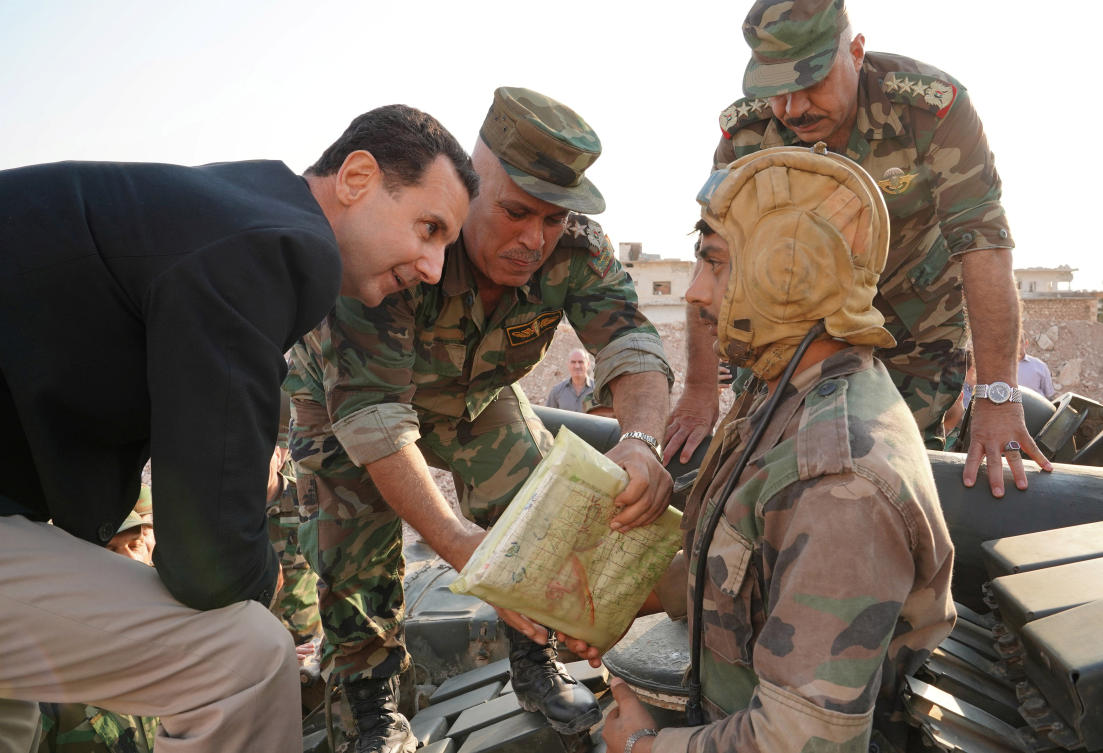
DAMASCUS: Syrian President Bashar Al-Assad on Tuesday said the regime would support Kurdish fighters in the northeast of the war-torn country against Turkish soldiers and their Syrian allies.

“We are prepared to support any group carrying out popular resistance against the Turkish aggression,” he said in a video shared by the presidency.

“This is not a political decision… We are not taking any political decisions now,” he told government troops on the frontline in the province of Idlib.

“It is a constitutional duty and a national duty,” he said.

Turkey and its Syrian allies on October 9 launched a cross-border attack against Kurdish fighters in northeastern Syria after an announced US military pullout.

Turkey wants to set up a buffer zone in Syrian soil along the length of its southern frontier to keep Kurdish forces it views as “terrorists” at bay.

Under a US-brokered truce deal announced last week, the Kurds have until late Tuesday to pull out their fighters from a 120-kilometer (70-mile) long strip along the frontier that it has largely overrun during the operation.

The Kurdish-led Syrian Democratic Forces have been a key ally of the United States in the battle against Daesh group in Syria, at the cost of 11,000 fighters.

The US pullout has largely been seen as a betrayal of Syria’s Kurds, who have spent most of the country’s civil war working toward autonomy.

Damascus has previously accused Kurds of treason over their alliance with Washington.

The Turkish attack forced the Kurds to seek aid from the regime and make a deal to deploy Assad’s forces in some northeastern areas for the first time in years.

The regime has since deployed in the border town of Kobani as well as the town of Manbij further south, without clashing with Turkish forces.

Al-Assad has repeatedly said he would eventually restore government control over all parts of Syria, driving out rebels and extremists.

Main category: 

Turkey, Kurds trade accusations even as Syria truce takes holdErdogan accuses the West of ‘standing by terrorists’ in Syria