Arab News-YouGov study reveals new Arab perceptions of Japan

Sun, 2019-10-27 02:26

RIYADH: Arabs rank Japan higher than any member of the Middle East Quartet (the US, UN, EU and Russia) as a neutral mediator between Palestinians and Israelis, a new survey suggests.

The Arab News-YouGov poll of Arabic speakers in 18 countries indicates that Japan, a non-military nation that applies the principles of peace and stability, commands enormous soft power in the region.

A large majority of those surveyed, 56 percent, considered Japan the most neutral mediator of any Israel-Palestine peace deal. Japan was also chosen by 87 percent as a country they would like to visit. 

Arabs associate Japanese people with positive attributes such as being hardworking (61 percent), organized (54 percent) and punctual (42 percent).

The overall impression of Japan is positive, and becomes more so with age. 

Opinion

This section contains relevant reference points, placed in (Opinion field)

Younger generations have a more dynamic understanding based on cars, technology and anime. Saudis and Emiratis in particular consider the relationship between Japan and the Arab world to be a positive one.

Overall, Japan was ranked number one for the quality of its products. Sony was the most recognizable Japanese brand (60 percent), followed by Muji (32 percent). Toyota was the favorite Japanese car brand among Arabs, chosen by 35 percent.

In general, Japan is perceived in a positive light and regarded as a trusted partner in the Arab world. 

Coverage of the Arab News-YouGov survey continues today and tomorrow, in print and online.


Main category: 
Tags: 

Japan is Arabs’ favored Middle East peace mediator, poll findsPoll reveals Japan as the land of rising soft powerArabs’ interest in Japan is an untapped economic potentialArab consumers associate Japan with high quality


Most Arabs familiar with UAE’s space partnership with Japan

Sun, 2019-10-27 02:05

DUBAI: The Arab world has a high level of awareness about the UAE’s space partnership with Japan, according to a YouGov online poll of 18 countries designed to gauge Arabs’ perception of Japan on various topics.

In the survey, which asked 3,033 Arabic speakers from the GCC, North Africa and the Levant, aged 16 or above, two-thirds correctly identified the UAE as the Arab country “currently working with Japan’s space program.”

Unsurprisingly, most Emirati respondents (81 percent) gave the correct answer.

“Space has become a huge field in the UAE,” said Mariam Alshehhi, an Emirati who is studying space in the UAE. “It will play a large part in the future of our country, so it is only right that we, as the youth, get acquainted with the topic in detail and are aware of what we are doing in this field.”

The UAE is leading the region in the field, having just sent its first astronaut, Hazza Al-Mansoori, to space, where he conducted 16 scientific experiments in cooperation with international space agencies, including the Japan Aerospace Exploration Agency (JAXA).

Some of the experiments he conducted on board the International Space Station (ISS) concerned the effects of microgravity. The results of two phases of experiments will be compared to contribute to supporting the UAE curriculum with new scientific materials.

In 2016, JAXA and the United Arab Emirates Space Agency signed an agreement to strengthen cooperation in exploration for peaceful purposes.

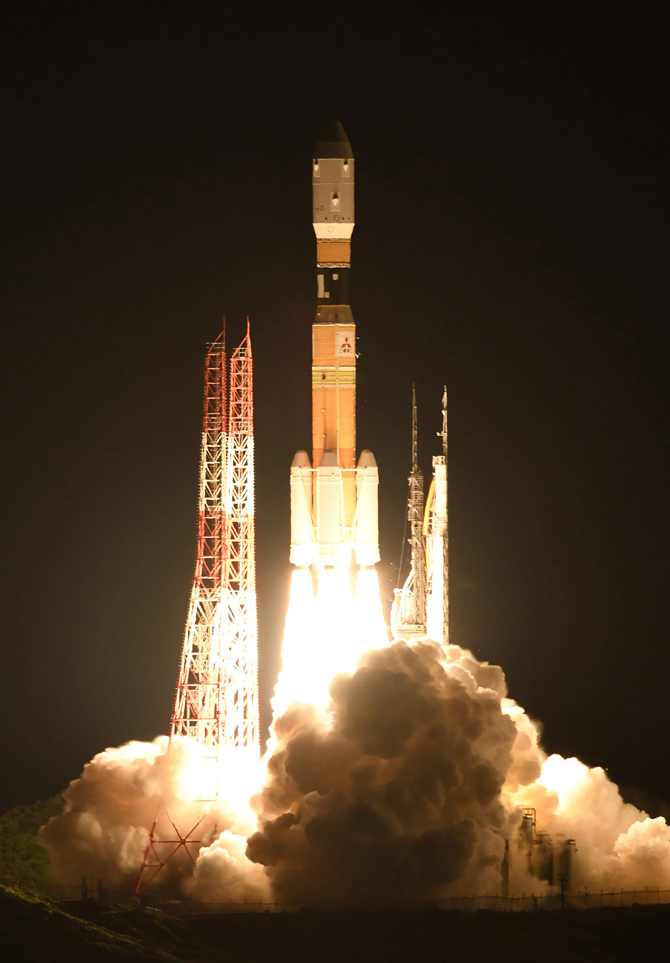
In October 2018, KhalifaSat, the first UAE-made high-quality, remote-sensing Earth observation satellite, was successfully launched from the Tanegashima Space Centre in Japan.

The satellite’s role is to beam images to a ground station in Abu Dhabi. The pictures are said to help governments and private companies across the globe in climate change, disaster relief and urban planning.

“It is widely known that both the UAE and Japan have a vision to become innovative countries. Space development is one of the areas where we have invested heavily in recent years,” a senior Japanese diplomat based in the Gulf region told Arab News.

Amer Al-Sayegh, the KhalifaSat project manager, says the mission has helped the UAE form partnerships with Japanese colleagues, not only in technical work but as two teams and cultures working together for the same vision.

In addition, the Arab world’s first mission to Mars, an unmanned exploring probe named Hope, is due to be launched from the Tanegashima Space Centre in 2020. 

“These are only a few examples of our collaborative work between the two countries,” the Japanese told Arab News, referring to the Emirates Mars Mission. “We hope our cooperation will be developed even further in the future.”

In 2003, Japan’s government created JAXA as an independent administration agency through the merger of three organizations. 

JAXA focuses on asteroid sampling, as demonstrated by two major programs.

First, in 2009, the unmanned cargo transporter Konotori resupplied the ISS. In 2010, the Hayabusa probe returned to Earth after collecting samples from the asteroid Itokawa. This year, there have been two landings of Hayabusa2 on the asteroid Ryugu to gather samples.

“JAXA’s program is quite specialized and reflective of the Japanese approach to space and the future of space mining,” said Theodore Karasik, senior advisor at Gulf State Analytics in Washington DC.

“The symbolism of the UAE’s effort is meant to inspire innovation and capture the imagination. Moreover, the UAE plans to put a colony on Mars in 2117 for new generations. The idea is to have a shift in mindset towards education and innovation, whereby other Middle Eastern countries can participate in scientific projects that help propel more innovation and space travel.”

For Hamdan Alrashidi, an Emirati who is interested in studying space, the opportunities in the field are endless. “We want to be able to support our country however we can, and space has always been a fascinating topic for me,” said the 21-year-old.

“There is so much for us, as Emiratis, to learn from countries who have experience in the field, and Japan is definitely one of them.”

Arab consumers associate Japan with high qualitySurvey shows Japanese martial arts to be a big hit with ArabsPoll reveals Japan as the land of rising soft powerPoll reveals a crowded list of Arabs’ favorite Japanese car brands


Syria army reaches border area, deploys around Turkish zone

Author: 
Sun, 2019-10-27 01:24

QAMISHLI: Syrian troops reached a key area near Turkey’s border on Saturday after sending further reinforcements to the region, in what a war monitor said was its largest deployment there in years.
Syrian regime forces entered the provincial borders of the town of Ras Al-Ain, state news agency SANA said.
The regime forces entered the area, which was taken by Turkish forces following a weeks-long offensive against Syria’s Kurds.
Troops also deployed along a road stretching some 30 km south of the frontier, SANA added.
Turkey and its Syrian proxies on Oct. 9 launched a cross-border attack against Kurdish-held areas, grabbing a 120-km swathe of Syrian land along the frontier.
The incursion left hundreds dead and caused 300,000 people to flee their homes, in the latest humanitarian crisis in Syria’s brutal eight-year war.
This week, Turkey and Russia struck a deal in Sochi for more Kurdish forces to withdraw from the frontier on both sides of that Turkish-held area under the supervision of Russian and Syrian forces.
On Saturday, the Britain-based Syrian Observatory for Human Rights said some 2,000 Syrian troops and hundreds of military vehicles were deploying around what Turkey calls its “safe zone.”
In the army’s “largest deployment” in the area in years, regime forces were being accompanied by Russia military police, the Observatory said.
Moscow has said 300 Russian military police had arrived in Syria to help ensure Kurdish forces withdraw to a line 30 km from the border in keeping with Tuesday’s agreement.
Despite Saturday’s deployment, the Observatory said that Kurdish fighters and Ankara’s Syrian proxies traded artillery fire in the region.
There were no immediate reports of casualties.
Under the Sochi deal, Kurdish forces have until late Tuesday to withdraw from border areas at either end of the Turkish-held area, before joint Turkish-Russian start patrols in a 10-km strip there.
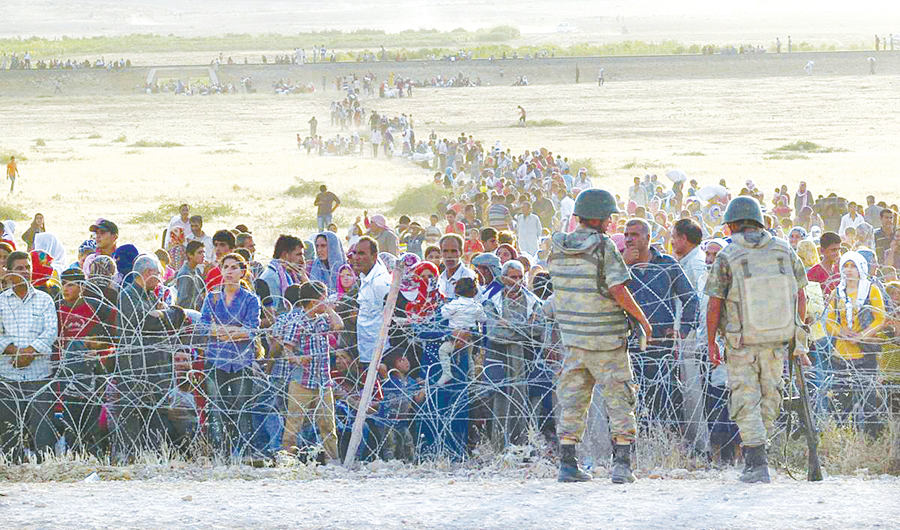
Ankara eventually wants to set up a buffer zone on Syrian soil along the entire length of its 440-km-long border, including to resettle some of the 3.6 million Syrian refugees currently in Turkey.
The Kurdish-led Syrian Democratic Forces has objected to some provisions of the Sochi agreement and it has so far maintained several border posts.
Turkish President Recep Tayyip Erdogan warned on Saturday that Ankara would “clear terrorists” on its border if the Kurdish forces, which his country view as an offshoot of its own banned insurgency, did not withdraw by the deadline.

Main category: 
Tags: 

Rights group calls on Turkey to stop deporting Syrians to war-torn countryCrowds swell as protest leadership concerns grow


Arabs’ interest in Japan is an untapped economic potential

Sun, 2019-10-27 01:10

DUBAI: Experts see untapped tourism potential following a YouGov survey of Arabs’ perception of Japan that revealed widespread interest and appreciation of the East Asian country.

The survey interviewed 3,033 people from the Gulf Cooperation Council (GCC) countries, the Levant and North Africa, aged 16 and up. 

Although very few respondents had been to Japan, the general understanding, curiosity and appreciation levels were high.

“I have never been to Japan but it’s on my bucket list for next year,” Sheikha Al-Nuaimi, a 28-year-old Emirati based in Abu Dhabi, told Arab News “My friends and I have been talking about going for a while because we’ve heard so many incredible things about the country. (Japanese culture) is very popular among us in the GCC.”

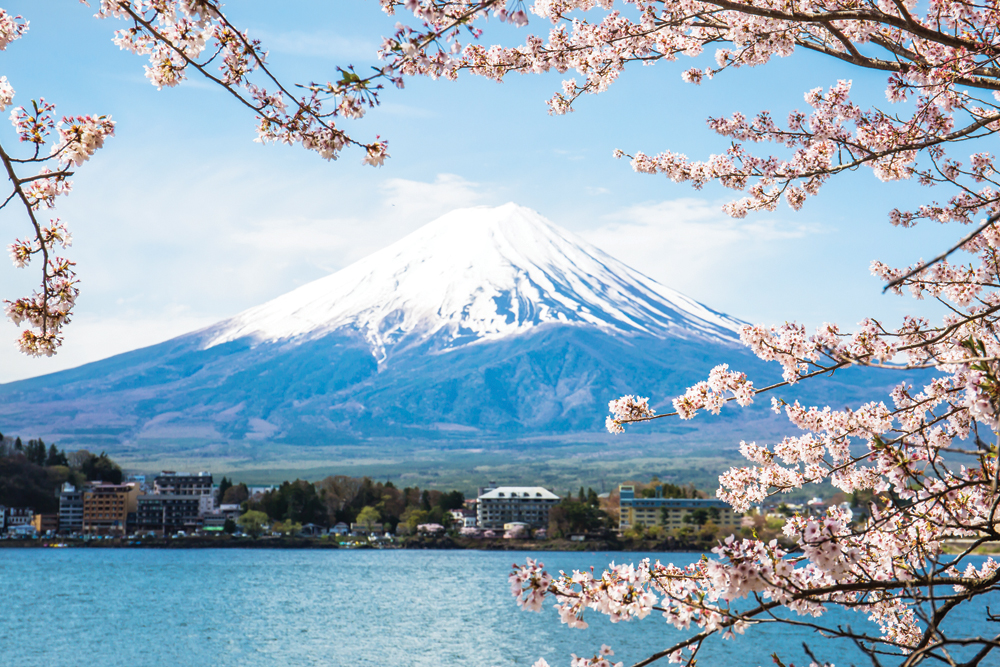
Al-Nuaimi said she was planning her trip around the spring cherry blossom season. “I haven’t met anyone, especially from this region, who does not like Japan. From the food to the landscape, there is just so much to see and learn and I’m really looking forward to it.”

Theodore Karasik, a senior advisor at Gulf State Analytics in Washington D.C., said two-way tourism between Japan and the Middle East, including the Gulf, was a growth story.

“Japan is increasingly becoming a travel destination for Arab businessmen and families who are seeking to understand better what Japan is all about,” he told ARAB NEWS.

“In order to satisfy demand and bring more tourists, Japanese companies are increasingly offering halal offerings in terms of hotels and food options.”


Luxury and wonder in Japan, such as the natural beauty of the Katsura river in Arashiyama, are part of Japan’s appeal. (Shutterstock)

He said the survey findings showed that Japan gave the impression as a far-off land from the way it was portrayed to Arab viewers through television, film, documentaries and entertainment.

“The history of Middle Eastern tourism is only a recent phenomenon, with the numbers of Arab travelers to Japan increasing. Not too many people in the region previously considered Japan a likely holiday destination. But in recent years the cherry blossom festivals in spring and maple leaves in autumn, plus several World Heritage lists, have been sparking interest. The mystique of Japan as a society is also attractive.”

The Japan National Tourism Organization (JNTO) is looking to build on the 31 million visitors it welcomed in 2018.

While the majority of visitors – nearly 24.34 million – are from neighboring Asian countries, Tsutomu Shimura, JNTO’s executive vice president, said the objective was to attract more affluent visitors, with luxury and authenticity as key promotional messages.

The JNTO says there has been an 8.7 percent rise in tourist arrivals year-on-year, with the Japanese government setting a target of 40 million visitors next year. “Research that we conducted last year shows the Middle East, especially the UAE, is a potentially lucrative market with positive impressions of Japan,” Shimura told ARAB NEWS. “We have identified the Middle East market as an important one for travelers seeking unique luxury experiences.”

JNTO has a strong global presence through its 21 overseas offices, which will soon reach 22 as it plans to open an office in Dubai before Expo 2020.

“JNTO’s office will help to facilitate travel expansion,” Karasik said. “With Emirates and other airlines from the Gulf flying to Japan with increasing frequency, tourists will grow, especially with the 2020 Summer Olympics in Tokyo.”

Japan ranked fourth in the world for travel and tourism competitiveness. It is famous for its cuisine, shopping, hot springs, sightseeing and theme parks. It has been drawing large numbers of visitors through a relaxation of visa requirements, an expansion of its tax-free program and faster immigration procedures.

“The number of visitors and tourists from Gulf countries to Japan is still too small to appear significantly on the statistics, in spite of the huge interest and curiosity about Japan among people in the Gulf countries,” a senior Japanese diplomat based in the Gulf told ARAB NEWS.

“JNTO participated in the Arabian Travel Market 2019 Dubai and actively engaged in promotional activities. It was a learning experience.”

The diplomat cited manga and anime as good ways to introduce the younger generation to Japan. “We have more and more unique destinations, not only physical destinations but also cultural, social and historical destinations. Some holistic programs and a variety of logistical resources are necessary to achieve our objectives. JNTO’s new office in Dubai will help a great deal in this regard.”

Arab consumers associate Japan with high qualityPoll reveals a crowded list of Arabs’ favorite Japanese car brands


Rights group calls on Turkey to stop deporting Syrians to war-torn country

Sun, 2019-10-27 01:14

ANKARA: With the Syrian conflict recently taking another turn, after the cease-fire process in the north following the Turkish invasion of the region, efforts to establish a safe zone along the Turkish-Syrian border have sparked debate about the fate of Syrian refugees: Will they be forcibly deported to their homeland? According to a report from Human Rights Watch (HRW), Turkish authorities in Istanbul and the southern province of Antakya randomly arrested and expelled many refugees into northern Syria, specially into Idlib governorate, between January and September 2019.
The report, based on the statements of deported Syrians, claims that the refugees were forced to sign forms without reading them in advance or seeing a lawyer, and in some cases were beaten or threatened before being transported.
The watchdog released its reports days after Turkey concluded its two week-long cross-border operation into northern Syria aimed at creating a so-called “safe-zone” to settle up to 1 million refugees currently living in Turkey.

FASTFACT

HRW shared its findings with Turkey’s Interior Ministry but has not received a response.

Sheltering 3.67 million Syrians, Turkey currently seeks to use territories formerly held by the Kurdish-led YPG militia. Once settled, the security of the safe zone will be ensured by joint patrols of Turkish and Russian troops. However, HRW says, “safe zones” established during other conflicts have rarely been safe, and establishing one cannot justify forcibly returning refugees.
“HRW would argue forcefully against any deportation of Syrian refugees from Turkey to what Turkey might call a ‘safe zone’ in the northeast of the country, where too many warring parties with too many interests in that area would make such a zone unsafe,” Gerry Simpson, associate crisis and conflict director at HRW, told Arab News.
On Oct. 15, HRW shared its findings with Turkey’s Interior Ministry but has not received a response.
“We imagine that any attempt to round up Syrian refugees in Istanbul, Ankara, Izmir, Hatay or any other provinces that host refugees would result in attempts to leave the country. Whether or not Turkey would allow them to get on boats to head to Greece or Bulgaria is another question,” Simpson said.
According to HRW, “The recent deportations from Istanbul show that any Syrian forcibly returned from Greece would face a risk of onward transfer to Syria,” while the refugee deal inked between Turkey and the EU in March 2016 maintains that Turkey is a safe country for the return of Syrian asylum seekers from European countries.
The EU provided about €55 million to Turkey to support immigration reception and detention centers between 2011 and 2015.

NUMBER

1m – Syrian refugees whom Turkey currently seeks to resettle to a planned safe zone in territories formerly held by the Kurdish-led YPG militia in northern Syria.

Turkey’s General Directorate of Immigration Management denied the claims in the HRW report in a statement published on Friday, and insisted that the claims are untrue.
“The claim that Syrians are deported in an unlawful manner doesn’t reflect the reality on the ground,” it said.
The international principle of nonrefoulement forbids the return of anyone to a place where there is a real risk of persecution, torture or ill-treatment, including threat to life.
So far, 364,663 Syrian refugees have returned voluntarily from Turkey to their homeland. Turkey claims that those refugees went back to places with decent living standards with health, security and other necessary infrastructure.

In its report, HRW also called on Turkey’s Interior Ministry to “ensure that police officers and immigration officials do not use violence against Syrians or other detained foreign nationals and should hold any officials using violence to account.”
The group also insisted that Turkey allow the UN high commissioner for refugees “to freely access removal centers, monitor the process of obtaining Syrians’ permission to return them to Syria to make certain it is voluntary, and observe interviews and removal procedures to ensure that police or immigration officials do not use violence against Syrians or other foreign nationals.”
Turkey’s new policy states Syrian refugees should return to their province of first registration by Oct. 30. Since the summer, Turkish forces have been carrying operations in big cities to enforce this rule.

Main category: 

Crowds swell as protest leadership concerns growJapan is Arabs’ favored Middle East peace mediator, poll finds