Turkey drafting law to restrict powers of Istanbul municipality 

Author: 
Fri, 2019-11-01 01:28

ANKARA: The Turkish presidency is drafting a law that will remove power from the opposition-held Istanbul metropolitan municipality. Many suspect that the motive behind the legislation is retaliation against Istanbul Mayor Ekrem Imamoglu, the Nation Alliance candidate who won office in a landslide victory in June against Binali Yildirim, the candidate from the ruling Justice and Development Party (AKP).

According to local press reports, the new law —  currently being prepared by the Ministry of Environment and Urban Planning —  will shift jurisdiction over development along the Bosporus from the Istanbul metropolitan municipality to a “Bosporus presidency” whose members will be appointed by President Recep Tayyip Erdogan, and will also restrict the municipality’s power to make amendments to development plans in the city, allowing the Bosporus presidency to assign the city’s “green areas” —  effectively allowing it to decide where construction can or cannot take place in Istanbul.

“The unilateral transfer of powers to the presidency illustrates just how imbalanced Turkey’s division of power is,” Nate Schenkkan, director for special research at US NGO Freedom House, told Arab News.

Turkey’s once-booming construction sector, which is seen by many as one of the main factors behind the AKP’s uninterrupted electoral success, has come to a grinding halt in recent months, mainly due to the collapse of the Turkish currency. A number of planned urban-redevelopment projects, slated to run into billions of dollars, are now in need of government subsidies to remain viable.

For 2019, Erdogan had promised to start the construction of a 43-km canal near Istanbul, along with a number of new towns along its banks. The opening of Istanbul airport last year was also seen as a megaproject intended to back the ailing construction sector. 

Supporters of the new draft law say it will resolve confusion about overlapping authorities and help combat illegal housing in the city.  

But Imamoglu has strongly criticized the draft law, telling Euronews that the municipality will “claim its rights” if the law passes. 

Schenkkan believes that is likely. “The judicial system is also under strong presidential influence, which grows by the month as the president has more opportunities for appointments,” he said. “So successfully challenging (it) in the courts is a difficult task.

“Under the new constitution, the president can essentially transfer powers to himself and then dare other institutions to have it overturned in the courts. Combined with the continued use of trustees to replace mayors in the southeast, this shows the limits of the opposition’s success at the local level in this year’s elections,” he continued.

In mid-August, trustees were appointed to four pro-Kurdish HDP municipalities in Turkey’s southeast, because of the areas’ alleged links to terrorism. The mayors of Diyarbakir, Mardin and Van, all from the HDP, were suspended over suspected terror links, and there is mounting speculation that Imamoglu could also be removed from office.

According to Seren Selvin Korkmaz, cofounder and executive director of the independent IstanPol Institute in Istanbul, the government’s attempts to centralize power and remove responsibilities from local municipalities is typical of the AKP.

“The ruling AKP has followed a neo-liberal populist agenda combined with increasing nepotism and clientelism,” she told Arab News. “It is (obvious) that the loss of major cities including Istanbul, Ankara, and İzmir is a major blow for AKP’s rent-seeking economy.”

Korkmaz also added that the ruling party had been in charge of the country’s largest cities and central government for almost two decades, and had used urban space and municipality services to establish rent mechanisms that best suited it.

“Commodification of land, urban transformation projects and clientelist redistribution mechanisms created a chain of patronage relationships which ensure continuous support (for the AKP),” she said, adding that the AKP’s losses in recent local elections meant that chain’s “flawless mechanism” had been broken.

Korkmaz said that while the Bosphorus area is clearly an attractive proposition for developers looking to construct high-yield rental accommodation, the government’s plans could backfire if it continues to remove power from local non-AKP authorities —  a move that could strengthen the opposition’s “victimized position” and unite supporters of the opposition parties.

“That always has the potential to turn the vote in Turkish politics,” she said. “Also, it may compel the opposition to be more creative in its strategies for reaching voters.”

Main category: 
Tags: 

Turkey releases 18 Syrian soldiers captured in SyriaTurkey summons US ambassador, condemns House resolutions



Frontline clashes ebb and flow as Libya’s war hits impasse

Author: 
Fri, 2019-11-01 01:22

On the outskirts of Tripoli, days of silence are broken by bursts of heavy artillery fire. Fighters camped out for weeks in abandoned houses watch for movement on enemy lines. A drone buzzes overhead and strikes, causing brief panic.

The nervy ebb and flow of the battle for Libya’s capital shows no sign of changing soon.

Nearly seven months after Commander Khalifa Haftar launched an offensive against the city, the war has reached an impasse that foreign support on both sides has failed to unlock.

Thousands of people have been killed in sporadic fighting since 2014 between factions in the east and west. The violence has allowed militants and migrant smugglers to flourish, hit Libya’s oil industry and divided the country’s key institutions.

Leaders on both sides appear to be ruling out compromise.

FASTFACTS

• Battle for Tripoli began in April, upending peace push.

• Frontlines beyond buffer zone have rarely shifted.

• Both sides dependent on foreign drones.

For those in Tripoli, Haftar must withdraw to his stronghold in the east before any cease-fire.

“We hope this war ends today, but the political leadership clarified that for talks on a cease-fire the invader should return to where he came from,” Osama Al-Juweili, a top military commander of forces aligned with the internationally recognized government in Tripoli, said in an interview.

Haftar has said he is willing to seek a political solution but only once the capital is rid of the armed groups that provide the Tripoli government with its core support.

Lacking momentum to bring local groups to his side, Haftar may be playing a long game, waiting for splits among previously fractured forces fighting against him, said Tarek Megerisi, a policy fellow at the European Council of Foreign Relations.

“The state of war that they’re in is becoming more normalized,” he said. “That makes further wars more likely.”


Shifting alliances

Forces on both sides are drawn from locally based armed groups that have made up Libya’s shifting alliances since the NATO-backed uprising that overthrew Muammar Qaddafi in 2011.

Those fighting with the Government of National Accord (GNA) in Tripoli were often at odds before this year’s war mobilized them against Haftar, whom they accuse of seeking to return Libya to one-man rule.

Haftar’s Libyan National Army (LNA) has extended its reach through tenuous local alliances, and struggled to control parts of the east despite support from abroad.

UN experts said much of that backing came from the United Arab Emirates and Egypt, and Haftar has been received on official visits by both. The UAE and Egypt have either not responded to UN requests for information or denied material support.

Reluctant to engage in full-blown combat and risk heavy casualties, both sides have looked to foreign backers to turn the tide in their favor around Tripoli by deploying drones with precision-guided missiles.

Turkey has provided and operated Bayraktar drones for the Tripoli government, while the LNA uses Chinese-made Wing Loon drones operated by the UAE, analysts and diplomats say.

Emirati and Turkish officials did not immediately respond to requests for comment.

Mobilizing for a major operation is made harder because of the threat from the air, said Megerisi.

A drone strike witnessed by Reuters reporters earlier this month hit close to a checkpoint in south-eastern Tripoli, on the edge of a buffer zone where most civilians have been evacuated.

Men in military uniforms near a burning vehicle frantically waved people away for fear of a follow-up strike as ambulances rushed to the scene, but within an hour nearby streets had returned to normal.


Civilian casualties


Life in central Tripoli continues largely as before, though the fighting has strained a city worn down by years of turmoil.

More than 100,000 people have been displaced from the city’s outskirts.

Scores of civilians have been killed and maimed as both sides try to pick off targets in residential areas, often using inaccurate, decades-old rockets and artillery, rights group Amnesty International said in a report last week.

Wary of foreign meddling, many Libyans have lost hope the conflict can be resolved internally.

“Libyans don’t understand each other,” said Mariam Ali, a 26-year-old teacher walking with a friend in the city center. “There’s no solution in Libya.”

The offensive by Haftar, a former general under Qaddafi who lived in the US and gained citizenship there before returning to Libya in 2011, upended a diplomatic peace push.

He launched his campaign on April 4, but its slowing momentum has raised questions over his military capability and future, analysts and diplomats say.

Path to peace unclear

Juweili said private military contractors from Russia had been killed in a recent, failed attempt to cut the road to Azaziya in southern Tripoli. Their journey into Libya and to the frontline by air and through Syria had been tracked, he added.

An LNA spokesman denied the presence of Russian fighters in its ranks, and the use of any foreign aircraft.

Haftar’s forces have expressed confidence that they can still achieve a swift victory.

Tripoli commanders counter that they have centralized their military operations, and could mobilize thousands of extra fighters if needed.

If Haftar took Tripoli, “he would be left in charge of a raging insurgency and insurrection,” said a senior US diplomat. “I think even a number of his patrons have great concerns about what it would actually mean for him to ‘win’.”

The path to political negotiations is unclear.

An international conference on Libya is expected in Germany, though preparations have been slow and no date has been announced.

Western diplomats say the aim is limited to trying to persuade the UAE, Egypt and Turkey to deescalate the conflict.

“I’d say the dynamic is to get people to act in the spirit of enlightened self-interest, and there’s nobody in a position to bludgeon anybody into changing their behavior right now,” the US diplomat said.

Main category: 
Tags: 

Rival Tripoli government restricts Libya’s oil revenues: Benghazi-based PMLibya coast guard intercepts dozens of Europe-bound migrants


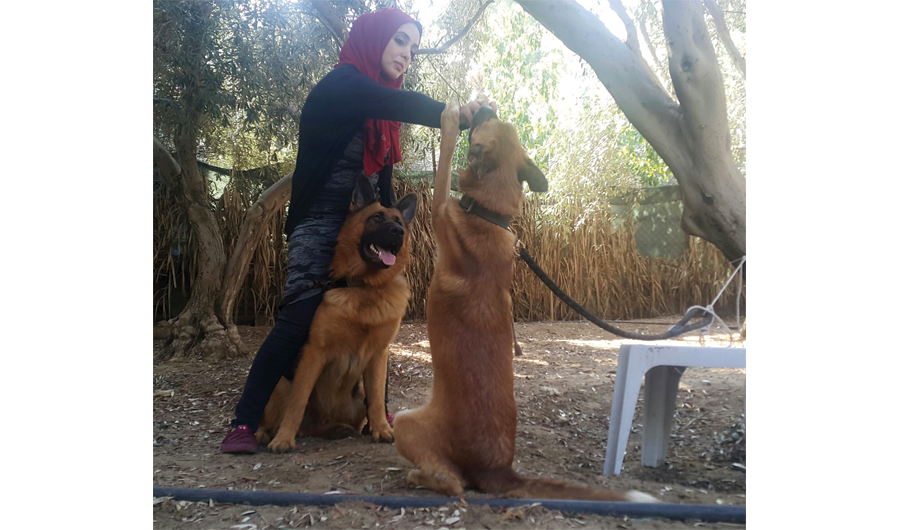
How theft at home turned Thabet into first dog trainer of Gaza

Fri, 2019-11-01 00:50

GAZA: When Talia Thabit decided to raise a guard dog following a theft at her family home, she did not know that she would become the first dog trainer in the Gaza Strip.

Thabit, 33, a psychologist, lives in Nussirat camp in the center of the strip, where dog breeding and training are not common. But recently, there has been a growth in dog ownership among young people.

“My family decided to raise a guard dog after we were repeatedly targeted by thieves,” Thabit said.

“At first I had no knowledge of how to deal with dogs, but my mother’s death has made me retire from public life and spend most of my time with the dog.”

She added: “I was not content with one dog, so I now have a number of them. I make sure to wake up early to train, feed and reassure them.

“They have helped me get back to life and remove negative emotions.”

Thabit became the first dog trainer in Gaza and a reference for kennel enthusiasts, who ask her for advice through a Facebook page.

“Dog breeding needs a lot of attention, especially in terms of health and hygiene, in order to get the best qualities, the most important of which is innate guarding,” she added.

But training dogs is harder than raising them. Training is based on understanding the dog’s psychology and the way they think.

“I joined groups on Facebook selling dogs during my journey to find my second dog, which is a German Shepherd,” she said. “I was gradually gaining knowledge of breeds, behavior and attributes.

Unemployment in the Gaza Strip is high among youth and reaches 90 percent among young women, according to UN statistics.

Thabit now has the ability to train dogs in guarding and searching for weapons and explosives.

Though she has become famous in Gaza, Thabit does not see herself as a professional and hopes to deliver a training course on the psychological and military aspects of dog training.

She is concerned about the lack of veterinary laboratories and animal medicine in Gaza, and hopes that there will be a surge to change this. “We suffer a lot when dogs, our loyal friends, are sick and many die from the wrong medication,” she said.

Thabit went to international organizations concerned with animals and their rights, asking them to send veterinarians to Gaza “instead of turning our animals into an experimental field for different types of medicines and antibiotics.”

The Four Paws Association normally transports animals from the Gaza Strip to Jordan, South Africa and Israel as zoo owners are unable to care for them.

Dog breeders in Gaza say they have to use human laboratories to analyze urine and blood samples and try human medicines on their dogs because of the lack of veterinary laboratories and animal medicines.

Thabit advises anyone to research before deciding to acquire a dog, so that they can be properly reared according to their physical and psychological needs.

She has a lot of support from her family and neighbors, and is proud that as a girl her name has become associated with breeding and training dogs. 

“Even street children stop me to ask me about dogs, they ask me to watch my training, and I teach them the culture of dealing with animals,” she said.

Main category: 
Tags: 

Man’s best friend: The dogs who sniff out explosives in KabulDoggy-do study points to canine ‘inner compass’


Turkey releases 18 Syrian soldiers captured in Syria

Author: 
By ZEYNEP BILGINSOY and SARAH EL DEEB | AP
ID: 
1572551197438903200
Thu, 2019-10-31 19:43

ISTANBUL: The Turkish military released 18 Syrian government soldiers captured in northeastern Syria by its forces, the Syrian Observatory for Human Rights said Thursday. 
Turkish Defense Minister Hulusi Akar said earlier that the soldiers were captured during Turkish reconnaissance operations southeast of Ras Al-Ayn but didn’t say when. 
Turkey agreed to a cease-fire brokered by Russia in which Kurdish fighters would withdraw 30 kilometers (19 miles) away from the Turkish border. As part of the deal, Syrian government forces would take positions along the frontier.
Akar spoke during a visit to Turkish troops at the border with Syria. His comments were carried on the official ministry website.
A Syrian Kurdish official said the soldiers were captured Tuesday during an intense battle between Syrian government forces and Turkey-backed fighters. Kurdish fighters were fighting alongside the Syrian troops. The official spoke on condition of anonymity because he was not authorized to brief reporters.
In another sign of the changing battleground, US forces said the first batch of mechanized armored vehicles arrived in southeast Syria on Thursday, where they are to take part in securing oil fields and fighting remnants of Daesh. US-led Coalition spokesman Col. Myles Caggins said the first batch of Bradley armored infantry carriers arrived in Deir Ezzor Province and will provide infantry with maneuverability and firepower. He said the deployment is “de-conflicted” with other forces operating in the region.
The province is home to some of Syria’s largest oil fields. It is also where Daesh militants continue to wage an insurgency and where they lost their last territory in March.
US President Donald Trump ordered the troop withdrawal from the north ahead of a Turkish military offensive there earlier this month. He said he wanted out of America’s “endless wars” but would leave US troops in the region to secure oil facilities.
Turkey is pushing to have Kurdish fighters moved away from its borders. Ankara views the Syrian Kurdish fighters as an extension of the decades-long Kurdish insurgency in southeastern Turkey. But Washington has partnered with those Kurdish-led forces to fight Daesh over the last five years, putting in a difficult spot between its NATO ally and battleground partners.
The Kurdish forces leaned on Russia and the Syrian government to protect them against the advancing Turkish forces. But Turkey seized a stretch of land across the border before the US negotiated an initial cease-fire.
Turkey has offered financial and logistical backing for the Syrian opposition that worked to bring the government of President Bashar Assad down. Ankara has also carried out three military operations into Syria and now controls territory in northwest and northeast Syria to push Daesh militants and Kurdish fighters away from its borders.
Turkey then agreed to a cease-fire brokered by Russia on Oct. 22, under which Kurdish fighters would withdraw to 30 kilometers (19 miles) away from the Turkish border. Under the deal, Syrian government forces would take positions along the frontier and joint Turkish-Russian patrols are due to begin Friday.
But the truce has been marred by accusation of violations from both sides.
For days now, Turkey-allied fighters have been fighting Kurdish forces near Abu Rasein, a village between Ras Al-Ayn and Tal Tamr, despite the deployment of Syrian government forces. Syrian state media also reported some government soldiers clashed with the Turkey-backed forces.
The Kurdish official said the Syrian government soldiers were captured in the area. He said the forces then withdrew after their soldiers were captured.
A war monitor group, the Syrian Observatory for Human Rights, also reported that Syrian troops pulled out from the Tal Tamr area on Wednesday, amid a Turkish-backed advance with air cover. The area is home to Syria’s dwindling Christian Assyrian community. The commander of the Kurdish-led Syrian Democratic Forces, Mazloum Abdi, warned that Turkey-backed fighters began entering Christian villages and are attempting to break into the main town.
The Syrian withdrawal left empty the border post in Darbasiyeh, west of Ras Al-Ayn, which Kurdish forces had handed over just days before, according to the Rojava Information Center, an activist group. Later on Thursday, the Observatory said government and Kurdish forces were deploying into the town of Tal Tamr.
Separately, a car bomb went off in a town administered by Turkey-backed forces in northwestern Syria, killing at least eight people.
Turkey’s official Anadolu news agency said another 14 people were wounded in the attack in a vegetable market in Afrin. It said the explosives were packed into a refrigerator truck.
Turkish-led forces captured Afrin from Syrian Kurdish fighters early last year. The area is controlled by Syrian fighters allied with Turkey, who have been accused by rights groups of seizing land and property . The area sees sporadic attacks and other violence.
Syria’s state-run SANA news agency also reported the attack, saying nine people were killed and 20 wounded. It said the blast ignited a nearby patrol station and caused damage to surrounding homes and shops.
No one has claimed the attack.

Main category: 
Tags: 

Car blast kills 8 in northwest Syria as US redeploys near Turkish borderTurkey detains 43 suspected Daesh members, foils plot: police


Ivanka Trump to promote women’s prosperity in Morocco

Fri, 2019-11-01 01:38

WASHINGTON: Ivanka Trump is getting ready to promote her women’s economic development program on an upcoming trip to Morocco.

It will be her third overseas trip this year to promote the Women’s Global Development and Prosperity Initiative, which was launched in February to benefit women in developing countries.

US President Donald Trump’s daughter and senior adviser will visit the North African country in early November, the White House said. Specific dates for her travel were not released.

In a statement to The Associated Press, Ivanka Trump said the kingdom of Morocco is a valued US ally that has “taken strides” under King Mohammed VI to promote gender equality.

In August, she tweeted her support to the Moroccan government after it began the process of amending its inheritance laws, which say women should receive half as much as men.

Ivanka Trump will travel with Sean Cairncross, CEO of the Millennium Challenge Corp., an independent US foreign aid agency that provides grants to developing countries to help promote economic growth, reduce poverty and strengthen institutions.

They will meet with government officials and local leaders in Morocco’s capital, Rabat, and in Casablanca to discuss how to help women in the region gain a measure of economic independence.

The Women’s Global Development and Prosperity Initiative has a goal of helping 50 million women in developing nations advance economically over the next six years.

It’s a US government-wide effort that involves the State Department, the National Security Council and other agencies. It aims to coordinate existing programs and develop new ones to help women in areas such as job training, financial support and legal or regulatory reforms.

Ivanka Trump traveled to Ethiopia and Ivory Coast , in sub-Saharan Africa, in April and to Argentina, Colombia and Paraguay , in South America, in September to promote the initiative.

Main category: 
Tags: 

Ivanka Trump among possible World Bank nomineesDemocrats to probe Ivanka Trump’s private email use for gov’t work