Demos continue to paralyze Iraq as political factions look for a way out

Author: 
Fri, 2019-11-08 01:38

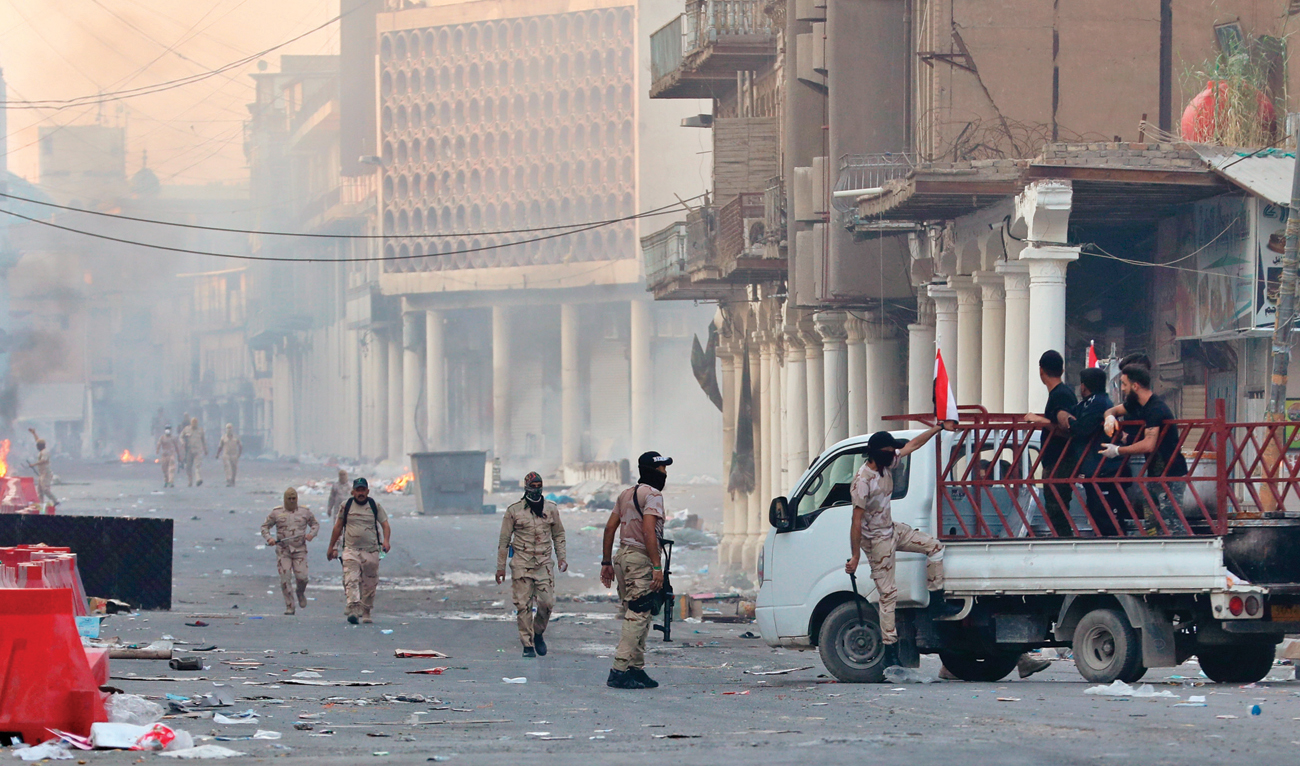
BAGHDAD: Political parties in Iraq resumed their meetings on Thursday in an attempt to resolve the current crisis and end the public protests. Meanwhile, the demonstrations continued to paralyze daily life in Baghdad, where bridges have been blocked and government institutions disrupted for more than a week.

The country’s leading political forces have been trying to find ways to break the impasse and appease protesters that are acceptable to all parties. 

The demands of the demonstrators include the dismissal of the government, amid accusations that Prime Minister Adel Abdul Mahdi and his allies authorized the use of lethal force in an attempt to suppress the protests when they began last month, leaving more than 300 people dead and 12,000 injured. 

They also want new election laws, early parliamentary elections, amendments to the constitution, and the appointment of a new members of the Independent High Electoral Commission.

“There is no gap between the demands of the demonstrators and the initiatives of the political forces,” said Mohammed Al-Sudani, a prominent Shiite politician and former minister, who added that talks were continuing to find compromises that are acceptable to both sides.

“Regarding the dismissal of the government or the prime minister, a legal and official request to question the prime minister has been made by Al-Nassir bloc and others, which is supported by the majority of the parliamentary blocs. This means that we are about to change the government,” he said, adding that the only uncertainty is about the timing and mechanisms for doing so.

“The problem now is that there is no clear leadership among the demonstrators that can negotiate for them, so they must appoint leaders or ask one of the parties they trust to represent them,” said Al-Sudani.

Abdul Mahdi has been trying to calm the protesters’ anger by providing them with job opportunities daily in various ministries, and by speeding up the resolution of financial and administrative corruption cases involving politicians and officials.  

On Thursday, the Integrity Commission banned the governor of Babil and the former governor of Basra — both facing corruption charges — from traveling, while the Supreme Judicial Council sentenced in absentia a former bank manager to seven years in prison for wasting public money.

The political system in Iraq has been based on political quotas since 2004. No administrative, ministerial or constitutional amendments can be made without a consensus among the Shiite, Kurdish and Sunni political forces, regardless of the number of parliamentary seats each holds.

Abdul Mahdi’s allies mostly come from Iranian-backed Shiite and Sunni political factions, along with the Kurdistan Democratic Party (KDP), which is led by the influential Masoud Barzani.

The Sunni factions have been the most weakened political force since the areas they controlled were taken over by Daesh in 2014 and then recaptured by Iraqi forces and Shiite factions backed by Iran. 

Most of them subsequently joined forces with Shiite factions to become part of the larger Alliance Towards Reform coalition led by influential Shiite cleric Moqtada Al-Sadr, or the Iran-backed Al-Binna’a alliance, both of which joined Abdul Mahdi’s government in Oct. 2018.

Kurdish parties were fragmented after the 2018 parliamentary election as a result of competition between them and political dissent. 

The KDP remains the largest and most influential, especially in the autonomous northern Kurdish region, where it controls the regional government, its finances and its share of the federal budget.

The KDP is also the most prominent Kurdish political ally of Al-Binna’a and one of the strongest objectors to the dismissal of Abdul Mahdi, early elections and constitutional amendments.

“Barzani is against any change to Abdul Mahdi’s status or the constitution because he benefits from the current situation,” said a senior Kurdish leader and a governmental adviser. 

“Abdul Mahdi gave him facilities he (Barzani) never dreamed of, especially with regard to oil contracts and the region’s share of the annual budget.

“Any alternative to Abdul Mahdi means the application of constitutional and legal articles with respect to the budget, disputed areas, oil contracts and oil exports by the Kurdish region, and this would mean very significant losses for the KDP.”

While keen to find a way to end the current crisis, Iraq’s political factions remain determined to preserve their own interests and keep any individual losses or concessions to a minimum, politicians involved in the ongoing crisis talks told Arab News.

“They will definitely block the dismissal of Abdul Mahdi when voting,” said a prominent Shiite politician. “They (the political coalitions) will introduce a new election law and a new electoral commission and will stall … before they agree to early elections.

“Maybe they will agree to hold an early election but it should takeplace after a year or so. Already the preparations will need more thanthis amount of time.”
Main category: 

Iraq’s main port blocked by protesters hours after reopeningUN chief condemns live fire at Iraqi protesters as ‘disturbing’


Is it the end of US nukes in Turkey?

Author: 
Fri, 2019-11-08 01:20

ANKARA: The recent free fall in relations between the US and Turkey has sparked speculation over the future of American nuclear weapons currently stationed on Turkish territory.

“Turkey is not the place to host US nuclear arms,” Steven Pifer, from the American Brookings Institution research group, wrote in a report.

Following US President Donald Trump’s recent public confirmation of the weapons’ presence on Turkish soil, the two countries have found it difficult to reach a quiet deal on their potential withdrawal.

As the nuclear leftovers of the Cold War strategy, Turkey is part of a group of five NATO members — along with Germany, Italy, Netherlands and Belgium — hosting US nuclear weapons as an “open secret.”

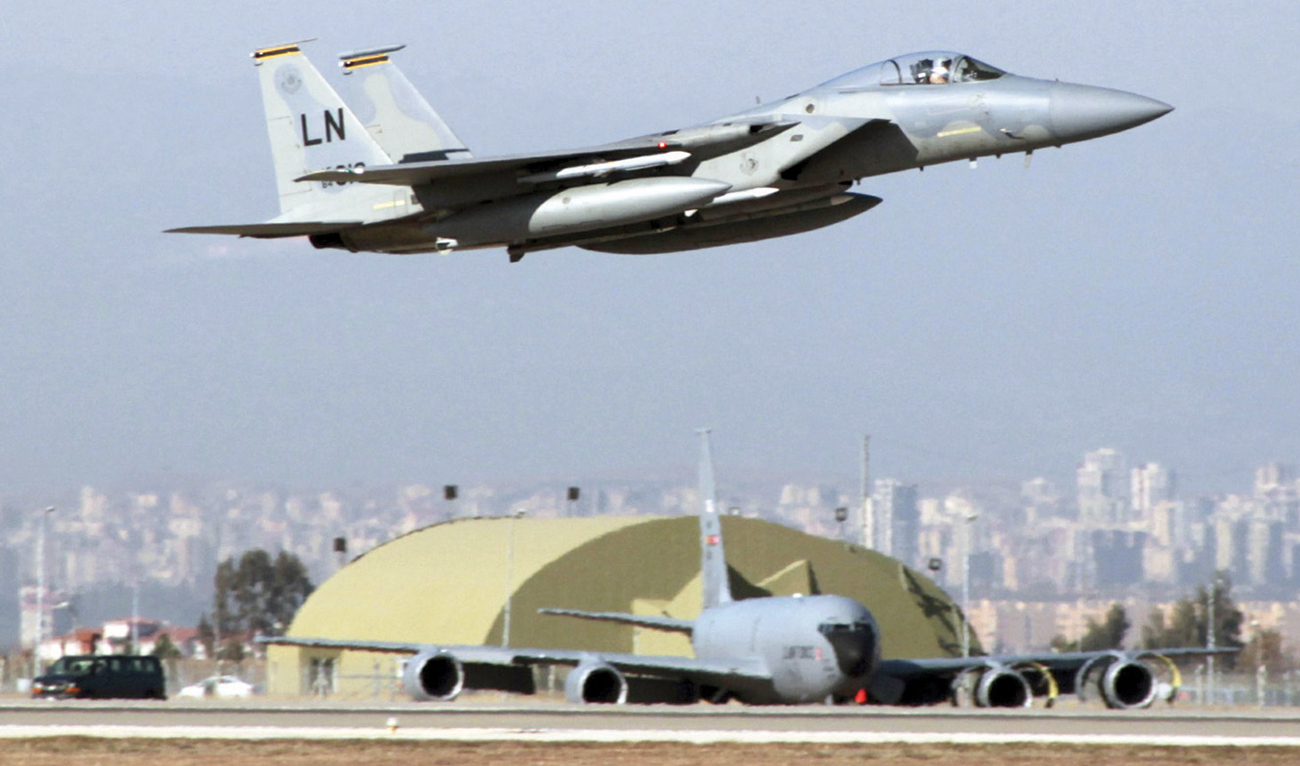
Some 50 B61 nuclear gravity bombs — designed to be dropped by US fighter aircraft — are reportedly stationed in underground vaults at the southern Incirlik air base, about 160 to 240 km from the Syrian border.

HIGHLIGHT

As the nuclear leftovers of the Cold War strategy, Turkey is part of a group of five NATO members — along with Germany, Italy, Netherlands and Belgium — hosting US nuclear weapons as an ‘open secret.’

Pentagon officials are also reportedly reviewing plans to find alternative homes for US “personnel and assets” currently stationed at Incirlik. In 1963, the US removed nuclear missile batteries from Turkey during the Cuban missile crisis to avoid atomic war with the Soviet Union.

But experts are divided about the possible repercussions of physically removing nuclear weapons from Turkey considering its strategic location for the defense of Europe and the Middle East.

Eric Edelman, a former US ambassador to Turkey and senior Pentagon official, recently said that pulling the atomic arsenal from the country would be risky, and he believed the weapons were safe and secure there.

“I’m not in favor of taking any actions that would potentially accelerate Turkey’s thinking about pursuing its own independent nuclear deterrent,” he added.

The arrangement of hosting US nukes was part of NATO’s greater policy of deterring mass infantry movements from the USSR with the presence of a small number of nuclear weapons on European soil, and as an ally Turkey was part of the strategy.

Meanwhile, Ambassador James Jeffrey, the US special representative for Syria engagement, will lead a delegation to Turkey on Nov. 8-9 to discuss issues of mutual concern. Turkish President Recep Tayyip Erdogan’s Nov. 13 trip to Washington, DC to meet Trump has also been confirmed.

Azime Telli, a nuclear energy expert from Turkey’s Mersin University, said talk of withdrawing US weaponry was part of political maneuvering related to Turkey’s recent purchase of the Russian S-400 missile system that is incompatible with the air-defense system of the NATO alliance.

“However, even if this decision is taken, it cannot be quickly implemented because we are part of the NATO alliance and it wouldn’t be so easy to break this strategic relationship,” she told Arab News.

The US recently removed Turkey from its F-35 Joint Strike Fighter program, claiming the combat aircraft project could not coexist with the Russian system. The F-35 is US’ most sophisticated warplane and Turkish companies were producing about 937 of its parts.

“Along with economic and diplomatic sanctions from the US, closing Incirlik air base was always at the table as a bargaining chip to increase the tension between the two countries. The removal of the nukes will also be used as a negotiation tool during the Trump-Erdogan meeting on Nov. 13,” Telli said.

Some experts fear a US nuclear withdrawal from Turkey would create regional instabilities.

“The presence of these nukes was providing Turkey with a kind of immunity against all neighboring countries having nuclear capabilities, not only Russia but also Iran,” Telli added.

During a meeting of his governing party in September, Erdogan raised the nuclear issue, and said: “Some countries have missiles with nuclear warheads, not one or two. But we can’t have them. This, I cannot accept.”

His comments were interpreted by many as a warning that Turkey would not stand idly by if its neighbors become nuclear-armed states.

Selim Sazak, an expert on nuclear nonproliferation from Brown University, in Providence, Rhode Island, told Arab News: “NATO tactical nuclear weapons in Europe are not much more than relics of the Cold War whose significance is more symbolic than anything else. 

Their removal has been a rallying point for the European nonproliferation community.”

He said the military value of the weapons, which are currently based at six sites in Europe, was still uncertain. “And some of these host countries were pioneers in the efforts toward a tougher and more activist stance on nuclear disarmament, which was most recently recognized with the Nobel-winning ban treaty.

“So, theoretically, a few of them might support the removal of these weapons at the London Summit and Trump, one of whose pet peeves is the US’ NATO expenditures, might claim this as another instance of America made great again,” he added.

Sazak also thinks the debate on removing nuclear weapons will not remain with Europe which the allies know. “So, do the nuclear-armed allies — especially Italy, which has been as aggressive as the Turks on keeping the nukes — just shrug? Are we ready for a denuclearization of Europe? I think not,” he said.

Some analysts believe that if a withdrawal did happen it would signal a de facto end to the Turkish-American alliance as well as Turkey-NATO ties, and would push Ankara closer to Moscow.

However, Sazak said: “I don’t think we’re there yet. I think there is a lot riding on 2020 and election years are mostly about keeping a steady ship. Regional security is less about Russia and more about the alliance’s stability.

“Removing nukes from Turkey will most certainly be an intra-alliance crisis. Does NATO want it? Need it? That’s the question.”

He added that the political impact of any removal of US atomic weapons from Turkey would be a far greater crisis than their actual physical withdrawal. And where would they go?

Sazak said the most likely option would by one of the other existing US nuclear weapon sites at air bases in Aviano and Ghedi-Torre in Italy, Kleine Brogel in Belgium, Volkel in the Netherlands, and Buechel in Germany. Romania and Greece have also been mooted as possible stores but Sazak added: “You would have to revamp these facilities — spend money — to make them nuke suitable.”

Main category: 
Tags: 

Iran starts enriching uranium at Fordow amid reports UN nuclear inspector detainedTurkey captures sister of slain Daesh leader Baghdadi in northern Syria


Lebanese students join Beirut protests

Author: 
Fri, 2019-11-08 01:20

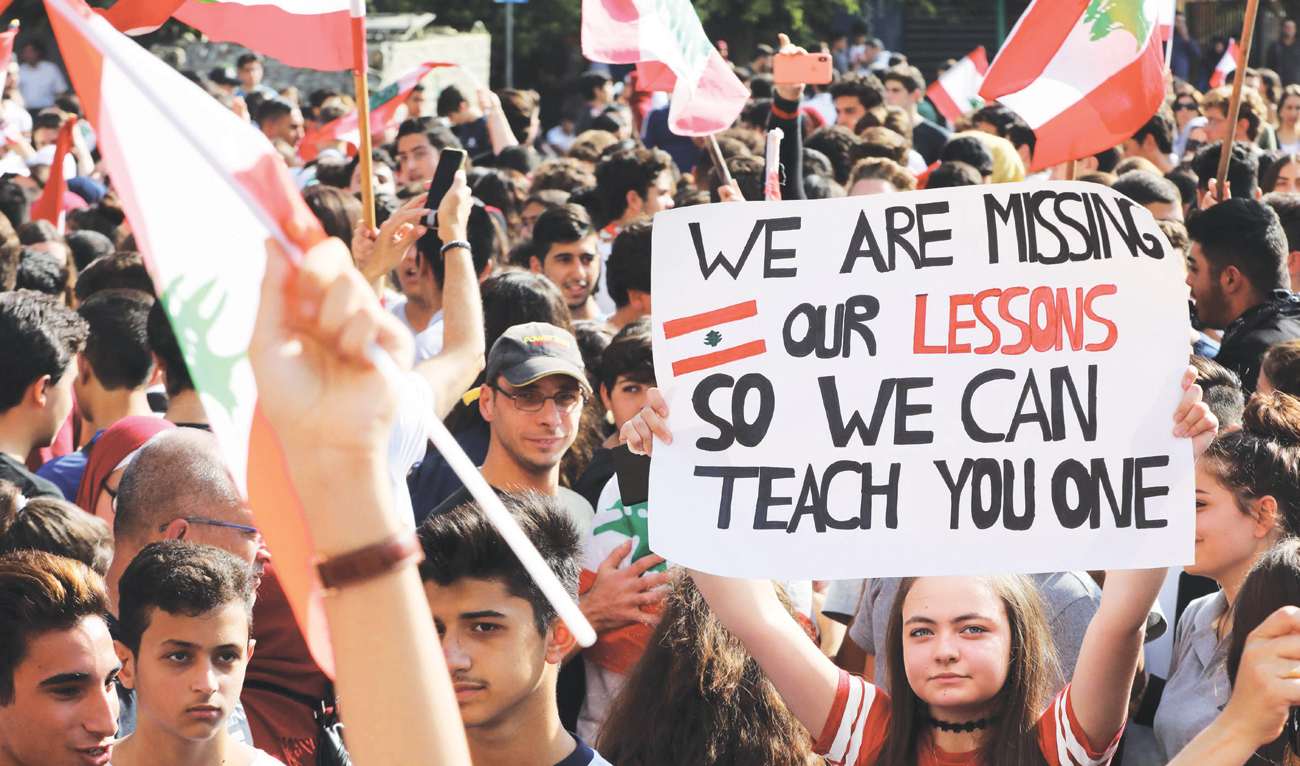
BEIRUT: The students of the Lebanese University known as “the university of the poor” joined public protests in their 22nd day. 

It is a state university and most of its students are from the poor and middle classes. According to its administration, its students make up 35 percent of the total number of the country’s university students.

Students chanted as they headed to Riad Al-Solh Square to demand basic services at their university. They spoke of the ambiguity of their professional future in the light of the domination of favoritism over the employment process. Their colleagues in other faculties complained about them on social media as the administration and teachers prevented students from leaving lecture halls to join the movement.

Students from public and private universities and schools took to the streets across Lebanon chanting “revolution.” They included students from Saint Joseph University, Haigazian University, Antonine University and the Lebanese American University.

Some groups focused on public institutions and prevented employees from entering, while others gathered in front of Zouk Thermal Power Plant to protest pollutant emissions.

Chants were accompanied by banging on pots and metal ware. This practice started on Wednesday night when people went to their balconies in Beirut, Sidon and Tripoli and banged on pots as a sign of their support for the protests.

The people of Beirut last used this method in 1916 during the famine that hit Lebanon under Ottoman rule.

The protests have not yet caused any responses from the authorities except for the resignation of the government. The president has not yet set a date for the binding parliamentary consultations to appoint a new prime minister, pending behind-the-scenes consultations with his political allies and outgoing Prime Minister Saad Hariri.

There is a possibility of forming a technocratic political government with a mixture of political ministers and experts, while protesters insist on a fully technocratic government that works to hold early parliamentary elections.

In the context of reviewing corruption cases, the financial prosecutor, Judge Ali Ibrahim, listened to the testimony of former Prime Minister Fouad Siniora at the Palace of Justice. The hearing lasted about three hours and “focused on the case of the $11 billion that was spent when Siniora was Prime Minister between 2006 and 2008,” according to the National News Agency.

Ibrahim also filed a lawsuit against the Director-General of Customs Badri Al-Daher for “wasting public funds.”

The Attorney General Judge Ghassan Oweidat referred a complaint presented by a number of lawyers against all ministers in successive governments since 1990 to attorney Ghassan Al-Khoury for “embezzling and wasting public funds for personal and material benefits, exploiting power and authority and seriously harming the Lebanese people,” in order to initiate investigations and take all necessary measures.

Main category: 

Women and students are at the heart of Lebanon’s protestsWorld Bank ready to support Lebanon, urges quick formation of new cabinet


International artists give colorful makeover to Egyptian fishing village

Author: 
Fri, 2019-11-08 01:17

CAIRO: An Egyptian fishing village has been given a colorful makeover by local and international artists as part of a burgeoning annual festival.

Buildings and boats in the coastal community of Borg El-Borollos have been transformed into vibrant artworks with decorative drawings produced by 45 volunteers from 22 countries.

The annual symposium sees bland streets, walls and objects turned into elaborate and colorful displays in a project masterminded by local Abdel-Wahab Abdel-Mohsen, who said the event had put the “charming” village on the tourist map.

“The symposium also contributes in developing society, enhancing cultural and artistic sense and boosting the perception of beauty among residents, especially after many preparatory and high school students took part in the gathering,” he added.

Many of the paintings are inspired by the natural surroundings of the area, as well as depicting fishing boats with their crews and nets.

Abdel-Mohsen said dozens of art students from Alexandria, Mansoura, and Kafr El-Sheikh had taken part along with youth from centers in Kafr El-Sheikh governorate, and people with special needs from Al-Shams Group.

“This year we expanded the scope of participation due to the rising number of artists and volunteers from around the world,” he added. Painters came from countries including India, China, Saudi Arabia, Croatia, France, Greece, Rwanda, Yemen, and Sudan.

The initiative was launched in 2014 by the Abdel-Wahab Abdel-Mohsen Foundation for Culture, Arts and Development out of its founder’s desire to decorate the city.

Since then, artists from around the world have been making the annual trip to Borg El-Borollos to join the carnival of color. “The residents are certainly happy with the change,” Abdel-Mohsen added.

Last year, the UN Population Fund (UNFPA) collaborated with the foundation for the event. Abdel-Mohsen, a prominent artist in his own right, said the UNFPA had development goals that it tried to achieve through platforms such as seminars and conferences to raise awareness on reproductive health issues.

However, the fund had adopted a different approach in recent years, using art as a way to promote its messages.

UNFPA representative in Egypt, Aleksandar Bodiroza, said the Borg El-Borollos symposium “paves the way for opening various discussions with the city’s residents, where ideas from countries meet.”

Bodiroza added that the event was not only a festival of color but a tool for developing society.

During last year’s collaboration the UNFPA chose to talk about youth in general, meeting with the artists before they started their work, however, this year the theme was social-based gender discrimination. 

“We thought that early marriage should be our message,” Bodiroza said.

Sayed Clip, a local resident, said every year more houses were painted. “The city’s residents are happy to see their homes painted in vibrant colors. So, they become part and parcel of the whole scene whenever they look out of their windows or lean on the walls.”

Adel Hameed, one of the painters participating in the symposium, told Arab News: “Each artist expresses his or her feelings about the Mediterranean city. Thus, the color blue takes over the walls to give the city’s residents the warmth and security they are constantly searching for.”

Main category: 
Tags: 

The spectacular sculpture of 90 year-old Egyptian artist Adam HeneinPharaonic influences on display at Egypt art show


MENA startups inject tech savvy into Saudi Arabia’s entertainment scene

Fri, 2019-11-08 00:00

CAIRO: While the Middle East and North Africa (MENA) region has always been a popular destination for business and entertainment events, a host of startups are taking the industry to the next level through the power of technology.

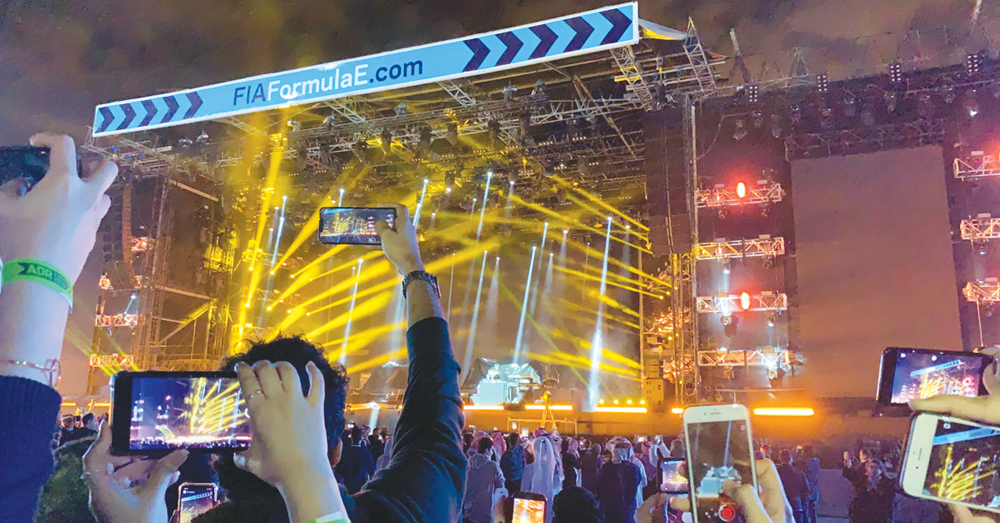
Earlier this year, Saudi Arabia’s General Entertainment Authority announced a new strategic plan to revamp the local entertainment sector. There are more than 5,000 events on the calendar for 2019, with investments projected to exceed $64 billion over the next decade.

The plan is part of a broader push to diversify the Kingdom’s economy away from oil by 2030. 

Events and entertainment tourism are expected to play a key role in this ambitious economic reform.

However, this sector boom is nothing new to the region. The UAE has established itself as a leading destination for business events and entertainment tourism, while more of MENA’s major economies are implementing economic plans that incorporate the thriving events industry in one way or another.

Startups in the region are capitalizing on the evolution of this space by developing a digital ecosystem which allows event organizers to deliver an experience living up to the expectations of their attendees.

Whether it is making ticket purchases easier, streamlining event check-in, or addressing a whole host of other challenges regional events organizers have historically faced, these startups are leveraging technology to raise the standards of event management.


A new generation of startups are leveraging technology and tourist entertainment. (Supplied)

“After all, it is not enough to have great performers when the rest of the experience that comes with attending events is below par,” says Farrukh Bandey, a user experience research manager at UXBERT Labs, the digital experience design company behind event planning and discovery app HalaYalla.

Launched in early 2014 by Bandey and Nadeem Bakhsh, the Saudi-based venture came to dominate the country’s entertainment scene after becoming the official ticketing app for the Jeddah Season series of events. HalaYalla provides a full suite of event-management features together with live event analytics and reporting for organizers. It also worked with local authorities to let international event attendees apply for a tourist visa while buying their tickets through the platform.

While gaining the trust of the government was a huge milestone for the company, it was also a challenge. The team’s abilities were first put to the test when they handled the registration for Saudi Arabia’s first-ever Baloot Championship, a card game popular in Gulf Cooperation Council countries.

Held in October 2018, the event saw more than 85,000 players register to compete.

Considered by many as one of the earliest disruptors in MENA’s event space, Eventus was founded in 2012 by Egyptian duo Mai Medhat and Nihal Fares. The company was backed by multimillion-dollar investment rounds from prominent local and
international venture capitals.

The market need Eventus excelled at addressing was providing event organizers with a customized event app. The execution was a great hit for forums such as the Startup Grind’s Global Conference, an annual gathering for a community that supports 2 million entrepreneurs in more than 125 countries.


 This report is being published by Arab News as a partner of the Middle East Exchange, which was launched by the Mohammed bin Rashid Al Maktoum Global Initiatives and the Bill and Melinda Gates Foundation to reflect the vision of the UAE prime minister and ruler of Dubai to explore the possibility of changing the status of the Arab region.


Main category: 

A social entrepreneur seeks to reduce stigma of disabilities in PalestineSaudi girls’ school launches pioneering project to produce business entrepreneurs of future