Strikes on Syrian medical facilities appear deliberate: UN
Author:
Sat, 2019-11-09 01:16
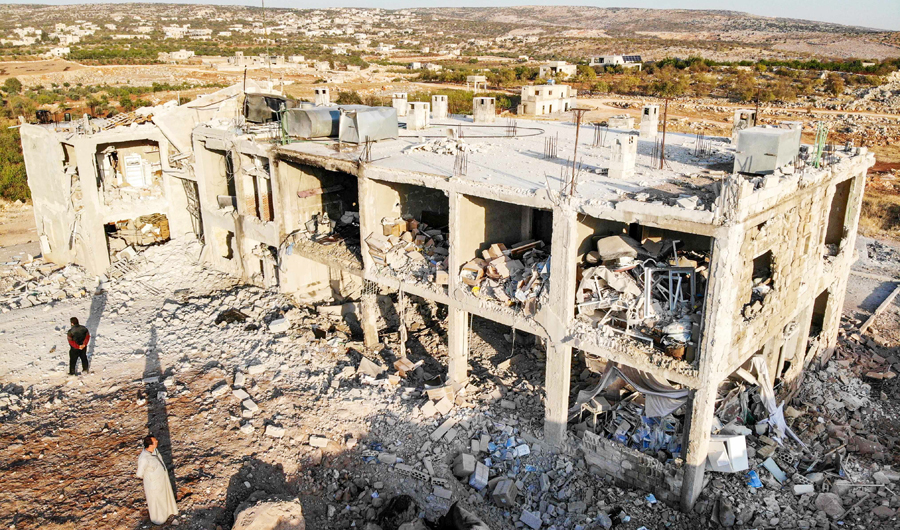
IDLIB: More than 60 medical facilities have been hit in Syria’s Idlib province in the past six months, including four this week, and appear to have been deliberately targeted by government-affiliated forces, a UN rights spokesman said on Friday.
Idlib in Syria’s northwest, the target of a Russian-backed offensive launched this summer to capture it and surrounding areas, is part of the last major rebel bastion in Syria’s 8 1/2-year war.
Since April 29, 61 medical facilities have been hit there, including some that were struck several times, UN human rights spokesman Rupert Colville told journalists.
“We can’t determine if every single attack is deliberate but the large scale of these attacks … strongly suggests that government-affiliated forces conducting these strikes are, at least partly, if not wholly, deliberately striking health facilities,” he said at a Geneva news briefing.
“They can’t possibly all be accidents,” he told Reuters later. He said that, if it is proven that any or some of these were deliberate, they would amount to war crimes.
Damage was reported at the Kafr Nobol hospital on Nov. 6 — which had also been hit in May and July — and two air strikes also directly hit the Al-Ikhlas hospital in southern Idlib, incapacitating it this week, Colville said.
BACKGROUND
Idlib in Syria’s northwest, the target of a Russian-backed offensive launched this summer to capture it and surrounding areas, is part of the last major rebel bastion in Syria’s 8 1/2-year war.
Syria’s war has claimed the lives of hundreds of thousands and forced 13 million people from their homes, half of whom have left their wrecked country.
Since a Turkish-led offensive across Syria’s northern border a month ago to push out Kurdish YPG fighters, at least 92 civilians have been killed in northern and northeastern Syria, Colville added.
That offensive displaced 200,000 people, of whom nearly half of them remain displaced are dispersed across camps and shelters, Najat Rochdi, Senior Humanitarian Adviser to the UN Special Envoy for Syria, said on Friday.
A UN-backed panel is meeting in Geneva this week, with delegates from the government, opposition and civil society, in what the United Nations says is an important step in the long road to political rapprochement in Syria.
Turkish-Russian patrols pelted by residents in north SyriaTurkish patrol kills protester amid shaky truce in northeastern Syria
Turkish-Russian patrols pelted by residents in north Syria
Author:
Sat, 2019-11-09 00:52
IDLIB/TURKEY: Local residents on Friday pelted with shoes and stones Turkish and Russian troops who were conducting their third joint patrol in northeastern Syria, under a cease-fire deal brokered by Moscow that forced Kurdish fighters to withdraw from areas bordering Turkey. The patrols are aimed at allowing Turkey to ensure that the Syrian Kurdish groups have evacuated the border zone. The agreement with Russia — and a separate one with the US — halted the Turkish invasion of Syria last month that targeted groups it considers a security threat for their links to a Kurdish insurgency inside Turkey.
The pelting of the Turkish-Russian patrol occurred east of the border town of Qamishli, according to the Britain-based Syrian Observatory for Human Rights, an opposition war monitor, and the Kurdish Hawar news agency. Videos from the area showed men, women and children pelting armored vehicles as they drove near a cemetery before speeding away.
There was no immediate comment from the Russian or Turkish military about the incident that appears not to have caused damage to the vehicles.
Turkey’s Defense Ministry said the troops were patrolling a region between Qamishli and Derik, east of the Euphrates River. It said the patrols were being supported by drones, but provided no further details.
NUMBER
92 – civilians have died so far as a result of Turkey’s incursion into northern Syria, according to the UN.
An Associated Press journalist saw four Turkish armored personnel carriers cross into Syria to join the Russian forces.
Mutafa Bali, a spokesman for the Kurdish-led Syrian Democratic Forces (SDF), tweeted that Turkish troops fired tear gas on protesters in Derik, injuring 10 people. The town is controlled by SDF and American forces, but the Turkish troops were passing through on the patrol.
Turkish President Recep Tayyip Erdogan complained this week that Syrian Kurdish fighters were still present in areas along the border, despite the separate agreements with Russia and the US.
Erdogan also said Turkish troops were being attacked by some Syrian Kurdish fighters from areas they had retreated to, adding that Turkey would not “remain a spectator” to these assaults.
The UN said on Friday that 92 civilians have died so far as a result of Turkey’s incursion into northern Syria. Rupert Colville, a spokesman for the UN human rights office, said the death toll was based on “verified incidents” that included to Nov. 5.
Also in northern Syria, the Observatory and the Thiqa news agency, an activist collective, said on Friday a suicide attacker detonated a truck outside a police station in the northern town of Rai that is controlled by Turkey-backed opposition fighters.
The Observatory said the blast killed three people, while Thiqa reported two civilian deaths.
Bombings in areas held by Turkey-backed opposition fighters in northern Syria are not uncommon. Last week, 13 people were killed in a blast in the town of Tal Abyad, which Turkish troops and opposition fighters they back captured last month.
Daesh-linked Albanian child arrives home to Italy from Syria campTurkish patrol kills protester amid shaky truce in northeastern Syria
Lebanon facing ‘major health disaster’ as economic, political crisis deepens
Author:
Sat, 2019-11-09 00:49
BEIRUT: Experts on Friday warned of a pending “major health disaster” in Lebanon with hospitals turning away patients and stocks of medicines and medical supplies predicted to run out in one month.
The alert came a day after international confidence in Lebanon’s crisis-hit economy was dealt another serious blow after credit rating company Moody’s downgraded the country’s top three banks.
As anti-government protests entered their 23rd day with no sign of political moves to start the process of forming a new Lebanese administration, the news plunged the debt-ridden nation into further financial meltdown.
A joint statement issued on Friday from a syndicate of Lebanese hospitals, doctors, and medical equipment dealers, said: “Hospitals are no longer able to receive patients due to a shortage of financial liquidity caused by delays of payment by guarantor institutions.
“The current stock of medicines and medical supplies is sufficient for one month, and we might head toward a major health disaster if the situation is not immediately rectified through facilitating the transfer of funds for dealers to US dollars. Within one week, hospitals will stop receiving patients except for emergency cases,” the statement added.
A report by Moody’s, published by Reuters on Thursday, said Lebanon’s “poor creditworthiness” was behind the agency’s decision to downgrade its ratings for Audi, Bloom and Byblos banks to the higher risk level of Caa2.
Economist Issam Jurdi told Arab News: “Lebanon is sick and suffering. There is no money in the state’s treasury or budget, and the Banque du Liban (Lebanon’s central bank) has exhausted its free reserves. It can no longer support the lira (Lebanese pound) or fund strategic items such as fuel, hydrocarbons, medical supplies, and wheat.”
Moody’s downgrade also meant Lebanon would not be able to obtain foreign credits at the same interest rates, he added.
Meanwhile protesters continued to stage demonstrations throughout the country against political corruption and the imposition of new taxes.
Former Lebanese Prime Minister Fouad Siniora and ex-Minister of Interior Nohad Machnouk were among the demonstrators’ targets for abuse, and protests were held outside the Ministry of Interior offices and the home of caretaker Energy Minister Nada Boustany. Crowds also headed to the home of Walid Jumblatt, leader of the Progressive Socialist Party (PSP) and one of the Lebanese politicians sharing power.
Despite the recent resignation of Lebanon’s Prime Minister Saad Hariri, efforts to form a rescue government have run into a political block.
Development expert, Dr. Nasser Yassin, said: “Lebanon needs an immediate government that can give back confidence through trustful personalities that could elaborate plans to salvage the economic situation.”
Jurdi said: “The central bank has absorbed all US dollars available in the local market and is treating it as if it is its own free reserve, while in reality it is the Lebanese peoples’ deposits.
FASTFACT
The alert came a day after international confidence in Lebanon’s crisis-hit economy was dealt another serious blow after credit rating company Moody’s downgraded the country’s top three banks.
“The danger lies in the fact that there are state financial benefits and deposits tied to a year. If depositors want to withdraw their US dollars at maturity, they are asked by the bank to procure this from the market or convert their deposits into US dollars and freeze them in the bank. This means that 20 days ago we were transformed into a bound economy.
“The crisis is due to the $17 billion deficit in the balance of payment, and the trade deficit in the trade account which is estimated at 25 percent of the Lebanese GDP. The budget deficit for 2019 was estimated at 7.6 percent, while the 2020 deficit would rise due to the current crisis, especially as Lebanon did not prepare its 2020 budget within the constitutional deadline,” he added.
“In the 1970s and 1980s, during the civil war there was a financial surplus in Lebanon as the war was funded by foreign powers. Now Lebanon is left to rely on the Gulf countries and the international community.
“We need to pray, as there are no miracles in economy, however there could be miracles in politics. We need internal and external rescue plans.”
Jurdi claimed that the on-going crisis in Lebanon was “an attempt to circumvent the people and put down their revolution.”
Yassin said: “At the beginning of the current crisis, people withdrew their bank deposits due to a loss of confidence in the state. The total amount withdrawn was estimated at around $1 billion. No one would dare to invest a dime in Lebanon at a time when politicians are still negotiating partaking power.”
He added that protesters in Lebanon would “not accept the return of old faces to power, nor th e old way of running state affairs. Prompt measures are needed to regain trust. We do not have the luxury of time.”
Lebanon pupils skip school for third day to demand changeWomen and students are at the heart of Lebanon’s protests
Abu Dhabi project eyes breakthrough in energy-storage tech
Sat, 2019-11-09 00:52
ABU DHABI: One of the biggest challenges facing humanity as it grapples with global warming caused by greenhouse gas emissions is how to supply clean, renewable energy at a competitive cost where and when it is needed.
Fortunately, a renewable form of energy such as solar, which is generated only during the day, can now be converted into electricity non-stop. In theory, at least, this opens up the possibility of boundless energy for the 1.2 billion people living in societies along the Earth’s so-called sunshine belt.
Through efficient exploitation of renewable energy sources such as solar and wind, coupled with state-of-the-art energy storage systems, many countries can not only power their everyday lives in a way that was impossible before, but can also reduce their dependence on fossil fuels.
A small but significant step was taken recently in the Middle East when Azelio, a Swedish solar-energy company, entered into a partnership with the Abu Dhabi Future Energy Company (Masdar) and Khalifa University of Science and Technology to run a pilot project evaluating new technology in power storage.
“The technology is important in order to have access to energy, which builds growth and wealth,” Azelio’s CEO, Jonas Eklind, said.
INNUMBERS
1.2 BILLION – People in the world have no electricity
2.4 BILLION – People connected to grid that fails to deliver sufficient energy
27.3 GIGAWATTS – Saudi Arabia’s combined target of solar and wind energy by 2024
40% – Percentage of Kingdom’s electricity produced by burning oil in 2016
400 MEGAWATTS – Capacity of Dumat Al-Jandal, Saudi Arabia’s first and the Middle East’s biggest wind farm
“Without electricity, you cannot be part of the modern world. If you don’t have it and you wait for a centralized solution, you might wait 40 to 50 years. With our solution, you can have it next week.”
The Abu Dhabi unit aims to test and demonstrate Azelio’s Stirling engine systems and “integrated thermal energy storage” solution for projects that use solar energy and wind energy, or projects that provide off-grid solutions.
Testing will determine if the technology can be included in current as well as future renewable energy projects.
“What we are doing is a technology to store renewable energy in a wide sense, and it can be any type of renewable energy coming from any source,”
Eklind said.
“We store a lot of energy and then convert that stored energy to electricity on demand. Consumers can then control when they want electricity.”
Azelio said that this “distributed base load” can be built in smaller-sized units close to consumers, which removes the need for a complex national grid system. The company also says that by adding an ingenious storage innovation to its Stirling engine, it makes electricity generated by a renewable source accessible at all hours of the day.
“It can be a local system that services, for instance, one factory, one village, one hotel or one desalination unit with whatever they need, 24 hours a day,” Eklind said. “We have worked with the technology for some years at more of a demonstration level and we have a unit in Sweden.
“We are also providing a reliable way forward for countless enterprises in remote locations around the world. Renewable electricity in its purest form is readily available exactly when it is needed. The opportunity for sustainable growth has never been greater.”
The Stirling engine efficiently converts thermal energy into mechanical movement to generate electricity. (Supplied)
Given that 1.2 billion people still have no electricity today and about 2.4 billion are connected to an electricity grid that cannot provide them with enough power, Azelio’s partnership with Masdar and Khalifa University of Science and Technology could not have been more timely.
“So for all these people, we could be a solution to give them a base load system instead of waiting 35 years for someone to build a national grid,” Eklind said.
As things stand, communities that are not connected to a stable grid are often forced to use generators, which entails burning diesel to generate electricity.
Azelio says that its system can replace a lot of the diesel burning, which benefits the climate and the environment. According to the company, the system is also less than half the price of conventional methods.
The company has installed a verification project of the technology for a state-owned firm in Morocco that is expected to be operating before the end of this year.
The Abu Dhabi unit will be Azelio’s second abroad.
Yousef Baselaib, executive director of sustainable real estate at Masdar, said: “With Masdar City established as the natural home for innovation in sustainable urban development and clean technologies, we are delighted to be working with Azelio and Khalifa University to help validate the commercial feasibility of their project.”
The pilot will be installed at the Sustainable Bioenergy Research Consortium site on the Masdar City campus of Khalifa University. Power generated from the project will be used to drive the air-conditioning for the project’s office and storage units.
“It’s general verification for the technology, but it is also special because Masdar wants to verify our technology to be a part of their projects. They build a lot of renewable energy projects and they need to have a source, especially in solar, which you don’t have at night,” Eklind said. “So we can essentially deliver solar energy in the middle of the night.”
Khalifa University will provide research support and expertise for the two testing periods, and the data collected by the researchers will be compared with findings from existing “dispatchable technologies.”
“As a research-intensive academic institution, Khalifa University offers one of the most suitable platforms for testing and demonstration of new technologies and solutions, especially in clean energy,” said Arif Sultan Al-Hammadi, executive vice president of the university.
Eklind said that even in the developed countries of northern Europe, electricity grids face challenges as a result of local electricity production with wind and solar.
Residents produce electricity with their own solar panels during the day, then use up the energy at night charging their cars, with no production during that period. “So they have a huge demand on electricity,” Eklind said, adding that the grid systems are not designed to cope with such types of fluctuation.
By contrast, Azelio’s technology builds stability and prepares the grid for new challenges, he said.
Referring to the partnership with Azelio, Al-Hammadi said: “Masdar Institute at Khalifa University will continue to serve as the research location for leading and cutting-edge scientific exploration in clean energy-related areas, including energy storage, biofuels, renewable energy mapping, advanced power and nuclear energy.
“As a research institute, it will continue to set fresh milestones while obtaining new solutions in clean energy and advanced sustainable technologies.”
Dimming sunlight to slow global warming may harm crop yields, says studyStudy: Asia’s glaciers face massive melt from global warming
Israeli farmers to quit Jordanian lands as 25-year lease expires
Author:
Sat, 2019-11-09 00:44
JERUSALEM: A deal dating from Israel’s historic 1994 peace treaty with Jordan allowing Israeli farmers to lease two sites along their common border runs out Sunday but the tenants say that nobody has told them what happens the day after.
In the peace negotiations, Jordan agreed to lease the lands to Israel for a 25-year renewable period, with the Hashemite kingdom retaining sovereignty.
One of the sites is Naharayim, a spit of land where the Jordan and Yarmuk rivers meet, which is called Baqura in Arabic.
The other location, deep in the Negev desert south of the Dead Sea, is known in Hebrew as Tzofar and in Arabic as Ghumar.
Notification
In October last year, Jordan’s King Abdullah said his country had notified Israel that it wants to take them back.
Now with the deadline only hours away, Idan Grinbaum, head of the Israeli regional council for the Jordan Valley, says Jordanian officials have told him that as of Saturday night, the Naharayim site will be out of bounds.
“As of this time no Israeli official has met with us or issued a letter on the topic,” he said in a statement to AFP.
Grinbaum said that since Abdullah’s October declaration “there were enough opportunities to change the decree but unfortunately that didn’t happen.”
The change would affect members of two agricultural communities who have been working the lands at hand for 70 years, “and feel that Israel has abandoned them,” he said.
“It’s very unfortunate that this is how we’re departing from the Island of Peace,” he said of Naharayim.
Asked by AFP for details, the Israeli Foreign Ministry sent the reply, “the agreement will expire on November 10th,” without elaborating.
1994 treaty
Since the heady days of the 1994 treaty, which made Jordan only the second country after Egypt to make peace with Israel, relations with Amman have been strained.
Opinion polls have repeatedly found that the peace treaty with Israel is overwhelmingly opposed by Jordanians, more than half of whom are of Palestinian origin.
In 2017, an Israeli Embassy security guard in Amman killed two Jordanians.
Three years earlier, an Israeli soldier at a border crossing killed a Jordanian judge he deemed a threat.
Just last month, Amman recalled its ambassador from Israel over the prolonged detention without trial in the Jewish state of two Jordanians.
Israel has not commented on the reasons for their imprisonment, though Israeli media have said they were detained on suspicion of security-related offenses.
They were freed and returned to Jordan on Wednesday and Israeli Prime Minister Benjamin Netanyahu’s office said the Jordanian ambassador would return shortly.
Private television station Channel 13 reported on Thursday that Netanyahu’s national security adviser, Meir Ben-Shabbat, had met on Monday in Amman with Jordanian Foreign Minister Ayman Safadi who told him there would be no extension to the Naharayim and Tzofar leases.
Citing “senior sources” in Jordan, it said Safadi instead suggested that compensation be paid to the Israeli farmers for crops remaining at the sites after the handover.