Ayat Oraby: Anchor of intolerance

Sun, 2019-11-10 01:23

DUBAI: With more than 1 million followers on Facebook, Ayat Oraby blurs the lines between reporting and hate speech.

She blatantly expresses her opinions in her articles and videos, which range from anti-Christian rhetoric to support for a religious scholar believed to be the inspiration behind some terrorist groups to allegations against individual politicians for supporting Israel.

A whole section on her personal website calls for the economic boycott of Christians in Egypt, whom she accuses of plotting against Muslims and trying to form their own Coptic state.

Oraby explained in a video posted on YouTube how and why she came to that conclusion, with stories dating back to the times of French colonization.

According to Oraby, Egyptian Christians helped France take over the country, betraying the Muslim populations.

“This is the reason for the call for an economic boycott against them. To tell you the truth, I have been postponing this call for a long time, but now I am asking for all Muslims who are zealous for their religion to heed this call,” she said.

Her Facebook posts contain material targeting Coptic Christian popes in Egypt, such as Shenouda III of Alexandria and Tawadros II.

Oraby called Tawadros a “criminal” and an “arch-killer,” and accused Shenouda of having a sexual relationship with his personal driver.

She also publicly spoke against the celebration of Christmas in Egypt, because some aspects of the festivity are financed by taxpayers, who are a Muslim majority in Egypt.

“You are in a Muslim country with over 95 million Muslims, so why is the TV celebrating Christmas?” she asked in a YouTube video.


BIO

Name: Ayat Oraby

Nationality: Egyptian

Place of residence: New York, US

Occupation: Journalist 

Legal status: Emigrated to the US from Egypt in 1993

Medium :YouTube, Twitter, Facebook, Instagram and her website www.ayatoraby.com


Oraby supports her anti-Christian rhetoric with claims that the military controls the church and uses it to store weapons.

She also accuses Christians in Egypt of waging a war against Islam and believes that they are planning to betray the Muslim populace “again.”

Oraby spreads her messages mainly via Twitter and Facebook, where she enjoys followings of more than 540,000 and 1 million, respectively.

The activist’s rhetoric appeals to some people for a variety of reasons, according to Johannes Van Gorp, assistant professor at the American University of Sharjah.

It could be a reactionary political act, trying to bring back lost glory, or to unite against perceived targeting and attacks, Van Gorp said.

Her ideas sound radical and problematic, but she is able to express them because she lives in the US. As long as the speech does not result in clear and present danger, “it is protected under the First Amendment,” Van Gorp said.

Oraby first moved to the US about a year after starting her career as an anchor on Egyptian TV’s Channel 3 in 1992. A few years later, in 1996, she left home to co-host the famous Good Morning Egypt show on Channel 1.

Opinion

This section contains relevant reference points, placed in (Opinion field)

In 1999, she returned permanently to the US and worked as a foreign correspondent for Egyptian TV. During her stay, she founded and chaired Noon Al-Niswa, the first Arab women’s magazine in the US.

Oraby supports the Muslim Brotherhood and openly adheres to Sayyid Qutb’s ideology.

His ideology, sometimes called Qutbism, is believed to have inspired several radical groups, including Al-Qaeda.

The academic John Calvert explores Qutb’s influence in his book “Sayyid Qutb and the Origins of Radical Islamism.”

“Given the dire condition of the world, Qutb said that Muslims had a duty to reactivate the principle of jihad (literally, ‘striving’) against the jahili forces responsible for humankind’s ‘misery and confusion’,” Calvert said.

Qutb was also a member of the Muslim Brotherhood, which he joined in the 1953.

Oraby’s stance on Egyptian authorities has transformed over the years, from support to extreme hostility. She uses a cover image of ousted President Muhammad Mursi on Facebook and often publishes posts attacking Egyptian leader Abdel Fattah El-Sisi.

In earlier reports, the US-based journalist accused Egyptian soldiers killed in a fire fight with militants of being paid by El-Sisi to murder unarmed Muslims during the “Rabaa massacre.”

But her accusations against the national army do not end there. She nicknamed it the “Misraeli army,” alluding to an allegiance with Israel, and has repeatedly called for it to be dismantled.

Oraby attacked several heads of states and political leaders, such as Turkish President Recep Tayyip Erdogan and former Saudi King Faisal, accusing some of propagating a false image of Islam and others of giving away Palestine to Israeli occupation.


Main category: 

Preachers of Hate: Arab News launches series to expose hate-mongers from all religionsPreachers of Hate: How Tariq Abdelhaleem spreads bigotry from the comfort of CanadaAnjem Choudary: UK TV’s favorite hate preacherQaradawi and Qatar: the hate preacher who became Doha’s spiritual guide


Lebanese fear economic chaos

Author: 
Sun, 2019-11-10 00:50

BEIRUT: Lebanese worries rose on Saturday as economic chaos began to seep into the country’s life cycle. The dollar crisis is resurfacing. Lebanese banks closed on Saturday and will  be closed next Monday for the Prophet’s birthday. Over the past two days, the banks witnessed pressure from depositors to withdraw funds for commercial purposes both in dollars or Lebanese pounds, but the banks were reluctant to pay them on the pretext of lack of liquidity. Social media reported many arguments between bank employees and customers.
The financial situation was the focus of a meeting between caretaker Prime Minister Saad Hariri and Lebanese Central Bank Governor Riad Salameh on Friday night. It was also the focus of a meeting between President Michel Aoun and Governor Salameh on Saturday, Chairman of the Association of Banks Salim Sfeir and members of the board of directors of the association.
According to information distributed after the Hariri-Salameh meeting, Governor Salameh refuted with figures and facts the temporary measures taken by the banks “to protect the depositors and their money and maintain the stability of the lira’s fixed exchange rate (1,507 against the dollar) with the support of the great potential possessed by the Banque du Liban.” He stressed the necessity of accelerating the formation of a government that “rebuilds confidence and contributes to the restoration of things to the right level to relieve monetary and banking pressures.”
Salameh described what has been happening as “a state of confusion resulting from the loss of confidence and fears of the development of political matters to the extent of unrest.”
Sfeir assured the Lebanese that “things are under control and there is no need for fear or concern for the citizens on their deposits and their money. Despite precautionary measures that protect their deposits and protect the Lebanese pound, banks continue to serve their clients.”

FASTFACT

The financial situation was the focus of a meeting between caretaker Prime Minister Saad Hariri and Lebanese Central Bank Governor Riad Salameh on Friday night.

Fady Gemayel, president of the Association of Lebanese Industrialists, met with Governor Salameh and complained to him about “the suspension of facilities, stopping transfers and the scarcity in hard currency, which does not allow the provision of basic raw materials necessary for the industry.” After the meeting, Gemayel said: “This puts the industrialists on the brink of collapse for reasons unrelated to them, and this collapse will first affect the banks.”
However, the reassurances did not alleviate the confusion and concern of the Lebanese. Protests were held in Tripoli in front of money exchange bureaus, which closed their doors. Money exchange bureaus in Lebanon are pricing the dollar differently from the official dollar pricing. The dollar reached 2,000 Lebanese pounds on the black market because of low volumes.
Many fuel stations in Beirut and the region were closed due to the lack of stock, while other stations rationed the distribution of fuel. Fadi Abu Shakra, the representative of the companies and distributors of fuel, said the reason for this was that “the owners of the stations are struggling to get the dollars to buy fuel and that the stations are currently closing one by one because of running out of stock.”

Things are under control and there is no need for fear or concern for the citizens on their deposits and their money.

Salim Sfeir, Chairman of the Association of Banks

Two laboratories that produce vaccines told hospitals on Saturday that any hospital that was late in paying the laboratories would not get vaccines until it paid in cash, Al Markazia news agency (CNA) said.
The Order of Nurses in Lebanon warned that “some hospitals have begun procedures to affect the salaries of nurses, on the grounds that hospitals did not receive their dues from the state treasury and guarantors, and the Order will be forced to take ominous escalatory measures because the nursing sector can no longer tolerate more prejudice.”
The street protests remained unchanged on the 24th day of the civil movement. The protest groups targeted the Foreign Ministry because “the ministry is not a public facility to serve the minister and his group,” amid heavy security deployment.
The political discussions on the issue of scheduling binding parliamentary consultations to appoint a new prime minister did not make any progress due to the preconditions for forming a government.
Asked whether the street protests are in a dilemma because economic concerns have overridden the anger of young protesters, Dr. Kholoud Kassem, a political sociologist, told Arab News: “We must not forget that what moved people on the street was the economic situation and people were not thinking about politics. People just want to live. The street uprising may have taken a second facet that is related to politics. But people are not taking into consideration the specificity of the Lebanese structure.”
Dr. Kassem added: “After this time, the revolution must monitor the daily reality and how it should move accordingly. What is happening now in the country puts the revolution in a dilemma if it is not directed by people who are known for their competence and lack of political affiliation. People need to be realistic. The structure in Lebanon that people want to change is not just ministers, deputies and presidents. It is a complex system in the Lebanese structure.”
Dr. Qassem stressed that “the revolution has attained an achievement represented by monitoring and accountability. This was not available before, but there is an urgent need now for competent figures who follow this monitoring and follow-up what people have achieved.”

Main category: 

Lebanon’s grand mufti calls for protesters’ demands to be metSyrian, Turkish forces reignite clashes near border town


Will Turkey abandon S-400? Trump meeting will give answer

Author: 
Sun, 2019-11-10 00:45

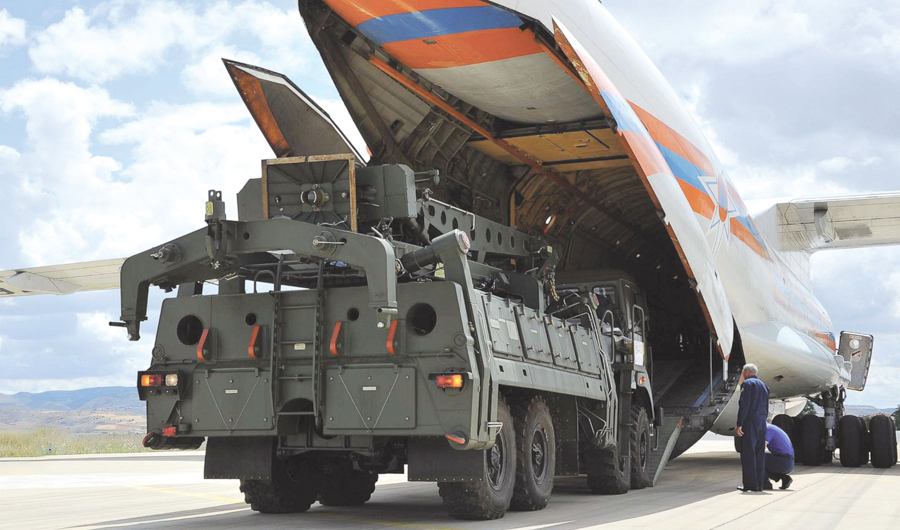
ANKARA: During his meeting next week in Washington, Turkish President Recep Tayyip Erdogan announced that he will discuss Patriot systems, F-35s and the Russian air defense system S-400 with US President Donald Trump.
“The only thing that would make Erdogan’s visit to Washington worthwhile to either side would be a breakthrough on the S-400 and F35 question,” Ozgur Unluhisarcikli, Ankara office director of German Marshall Fund of the US, told Arab News.
“If Turkey could find a way to keep the S-400 nonoperational in return for being readmitted to the F35 program and acquiring Patriot batteries, this would be a big step toward improvement of US-Turkey relations and putting Ankara back on a Western track,” he also added.
Turkey’s Defense Industry Directorate recently announced that delivery of a second batch of S-400 systems to Turkey may be delayed beyond the planned timeline, which is 2020. The reason of the delay is believed to be about talks on technology sharing and joint production.
For Washington, the S-400 system, which is not compatible with the NATO defense system, brings a threat to its F-35 fighter jets. As Turkey started receiving its first batch of S-400s in July, Washington removed Ankara from the F-35 program, where Turkey was a significant manufacturer and buyer.
Russia offered to sell its SU-35 fighter jets to Turkey as an alternative to F-35s. Ankara is still evaluating the offer’s strategic and financial repercussions.
On the other hand, if there is no such deal on the table, Erdogan’s visit to Washington will have an unnecessary public relations cost for both leaders, Unluhisarcikli thinks.
Ali Cinar, a US-based foreign policy expert, thinks Turkey has a legitimate air defense need, however it has also been made clear by both the Pentagon and NATO officials that the Russian S-400 system is a direct security threat to the F-35 stealth fighter jets, which serve as the core air defense system for NATO.
“With Turkey purchasing the S-400 and the US imposing sanctions on Turkey for doing so, it is clear that policymakers on both sides downplayed the severity of the situation. Now, leaders of both nations must come back to the table and look for a way forward which would include Turkey taking part in the F-35 program, receiving an acceptable Patriot missile system offer and working to deactivate the S-400 system,” he told Arab News.
Cinar also noted that this is the expectation from the US side that Ankara keeps the S-400 but deactivates the system.

FASTFACT

For Washington, the S-400 system, which is not compatible with NATO defense system, brings a threat to its F-35 fighter jets.

“Even Republican Senator Lindsey Graham has indicated that this would be acceptable to Congress. Turkey is very clear to use S-400 from now on; however, it is open to purchasing Patriot missiles as well,” he said.
According to Cinar, the result of the meeting between the two presidents will depend on which side will give up or convince the other side.
But, Joe Macaron, a resident fellow at the Arab Center in Washington, thinks that Erdogan wants to acquire these Patriot missiles while keeping the S-400 deactivated, and is betting that Trump’s inclination to make lucrative deals will override the Pentagon’s veto.
“Ankara is offering both carrots and sticks to Washington, either a Patriot deal or deepening military ties with Moscow, which reflects how Erdogan has the upper hand in the relationship with Trump,” he told Arab News.
Therefore, Macaron added, if Erdogan pulls this through, it remains to be seen what preconditions the Pentagon will be able to force on this deal to make sure the S-400 is never operational.
“With US troops remaining in Syria for now based on a fragile US-Turkish cease-fire, an emboldened Erdogan has a bargaining card to use in his White House meeting next week,” he said.

Main category: 

Russia deploys S-400 missile defense systems in ArcticNew Delhi to receive S-400s in 18-19 months


Iran’s top Al-Quds officials in Baghdad to support Abdul Mahdi

Author: 
Sun, 2019-11-10 00:40

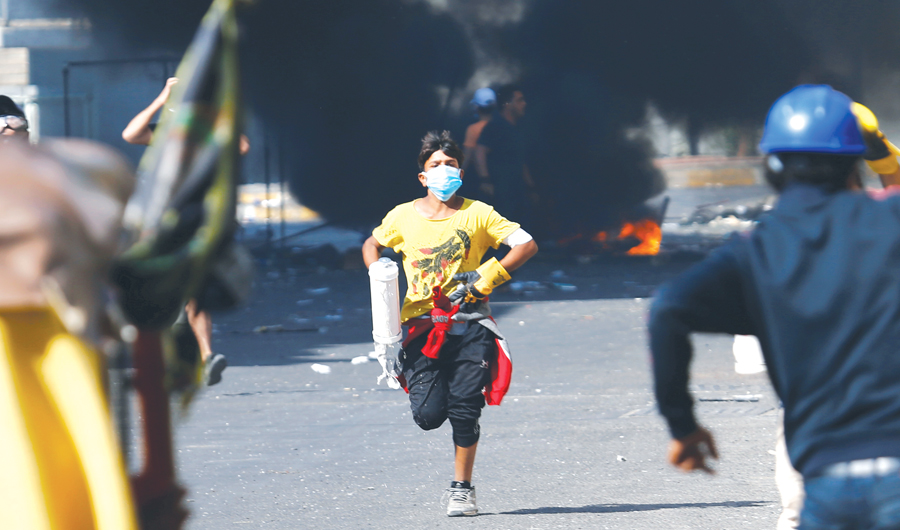
BAGHDAD: Qassim Suleimani, the commander of Iran’s Quds Force and field commander in charge of Iran’s operations in Iraq, has been in Baghdad for 11 days to manage the crisis and provide direct support to Iraqi Prime Minister Adel Abdul Mahdi, two of Suleimani’s associates told Arab News on Saturday. Baghdad and nine southern Shiite-dominated provinces have witnessed anti-government mass demonstrations since Oct. 1. More than 300 demonstrators have been killed and 15,000 wounded, mostly in Baghdad, with tear gas and live bullets used by Iraqi forces to quell the protests, while scores of activists and journalists have been arrested.
Suleimani and his deputy, Maj. Gen. Hamed Abdollahi, are in Baghdad “to provide the necessary moral and logistical support” to Abdul Mahdi, whose dismissal has become the first demand of the protesters, a prominent Shiite leader told Arab News.
The general, or Abu Duaa, as his closest allies call him, attends almost daily meetings in Baghdad with leaders of Iranian-backed political forces in an attempt to dismantle the crisis and prolong the time Abdul Mahdi remains in office.
“Abu Duaa has been in Baghdad for 11 days. He is here to provide the necessary support to Abdul Mahdi,” one of the top Iraqi Shiite leaders told Arab News.
“The demonstrations will end soon in one way or another. There is money spent generously to get some engines (organizers of demonstrations) out of the scene, at the same time there are other means (arrests and kidnapping).
“The carrot and stick policy has been operational for weeks and is beginning to bear fruit.”
The dismissal or resignation of Abdul Mahdi, which has become one of the most important demands of the demonstrators, is not put forward as one of the solutions for Suleimani and his allies, and the military solution is also not on the table.
Suleimani’s ally said some Iraqi military leaders were demanding military intervention to end the demonstrations, especially in Tahrir Square where most demonstrators are gathering in Baghdad.
“They demanded the intervention of the Popular Mobilization Forces (PMU), but Suleimani rejected this option in principle.
“He clearly said that this is an American trap to drag the PMU factions to clash with the demonstrators and then demand their dissolution.”

NUMBER

300 – demonstrators have been killed and 15,000 wounded, mostly in Baghdad.

The PMU factions have not intervened as combat troops, “but that does not mean it (PMU) did not intervene as intelligence or security support,” the ally said.
Suleimani’s ally said that the solutions offered do not include the dismissal or resignation of Abdel Mahdi, although everyone knows that the cause of the current problem is him and his private office manager Abu Jihad.
“Our problem with the Americans, Sadr and Najaf is caused by Abu Jihad,” he said.
“Adel Abdul Mahdi has not taken any real decision since he became prime minister and all the decisions were made by Abu Jihad.
“Those two (Abdul Mahdi and Abu Jihad) are protected and their protector (Suleimani) insists that there is no real problem worth sacrificing them.
“He (Suleimani) does not deal with Iraq as a single country, but rather as part of a system that includes Iran, Syria, Lebanon, Yemen and Palestine, so any suggested solutions that exclude Adel or Abu Jihad are not acceptable (by Suleimani).
“The Iranians are not like Americans. They do not give up their ally easily, so they will continue to support Abdul Mahdi until the very last moment.”
The solutions proposed by Suleimani and agreed by the majority of key political players include a ministerial change involving more than half of the Cabinet, and to gradually vote on a number of important laws, accelerate the adoption of constitutional amendments to be ready for a referendum in April, vote to reduce the number of members of the Parliament to half, the abolition of the provincial councils, “which represent the vicious circle of corruption in the provinces,” change the election law “to allow the rise of individuals and small lists” and change the High Electoral Commission, the source said.
Changing the system from parliamentary to presidential may be included in the constitutional amendments but will not be passed as the Kurds, Sunnis and Najaf reject this system “because it is the key to sliding into dictatorship.”
“Now we are worried about Najaf (Grand Ayatollah Ali Al-Sistani) because it is really upset. This is really our last chance. (If not taken) then people will come out in an armed revolution,” Suleimani’s ally said.
“I’m not optimistic because the tools are the same. Real solutions mean big losses and no one is willing to take any losses.
“The situation will calm down and people (demonstrators) will return to their homes, but they will return to the street later.”

Main category: 
Tags: 

Iran able to enrich uranium up to 60%, says atomic energy agency spokesmanPetrol pumps shut down in protest-hit Lebanon over dollar shortage


Iran able to enrich uranium up to 60%, says atomic energy agency spokesman

Sat, 2019-11-09 20:51

TEHRAN:  Iran has the capacity to enrich uranium up to 60 percent, a spokesman for the Atomic Energy Organization of Iran (AEOI) said on Saturday, far more than is required for most civilian uses but short of the 90 percent needed to make nuclear bomb fuel.
“The organization has the possibility to produce 5 percent, 20 percent and 60 percent, and has this capacity,” AEOI spokesman Behrouz Kamalvandi said during a news conference at the underground Fordow nuclear plant, the official IRIB news agency reported.
“At the moment, the need is for 5 percent,” he added.
Iran’s highest political authority, Ayatollah Ali Khamenei, said last month that the country had never pursued the building or use of nuclear weapons, which its religion forbids.
Iran said on Thursday it had resumed uranium enrichment at Fordow, stepping further away from its 2015 nuclear deal with world powers after the United States pulled out of it.
The pact bans production of nuclear material at Fordow, a highly sensitive site that Iran hid from UN non-proliferation inspectors until its exposure in 2009.
Inspectors from the International Atomic Energy Agency (IAEA) will visit Fordow on Sunday, Kamalvandi said.
Since May, Iran has begun to exceed limits on its nuclear capacity set by the pact in retaliation for US pressure on Tehran to negotiate restrictions on its ballistic missile program and support for proxy forces around the Middle East.
Iran says its measures are reversible if European signatories to the accord manage to restore its access to foreign trade promised under the nuclear deal but blocked by the reimposition of US sanctions.

Main category: 
Tags: 

Pompeo slams Iran’s ‘intimidation’ of IAEA inspector as ‘outrageous’Fearing for her life, Iranian beauty queen granted asylum remains at Manila airport