Turkey’s Erdogan called out for endangering ‘US national security’

Wed, 2019-11-13 00:25

ERBIL, DUBAI: In a humiliating rebuke to Turkish President Recep Tayyip Erdogan in the lead-up to his visit to Washington, members of the Foreign Affairs Committee of the US House of Representatives have written a strong letter urging US President Donald Trump to withdraw the White House invitation.

The letter says Erdogan’s “decision to invade northern Syria on Oct. 9 has had disastrous consequences for US national security, has led to deep divisions in the NATO alliance, and caused a humanitarian crisis on the ground.”

The Congress members said: “Turkish forces have killed civilians and members of the Syrian Democratic Forces (SDF), a critical US partner in the fight against (Daesh), and displaced over one hundred thousand people from their homes in northern Syria.”

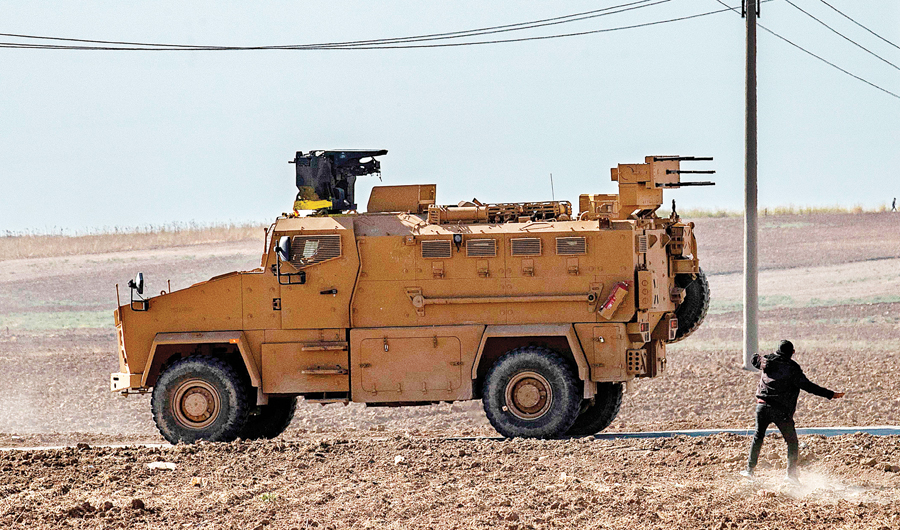
The committee’s concerns are well founded. After weeks of instability and violence following the Turkish incursion, the situation in northeastern Syria remains tense despite the implementation of a ceasefire and an agreement between Russia and Turkey that compelled Kurdish-led SDF troops to withdraw from the border.

According to multiple sources, residents of this part of Syria are fearful for their future and the humanitarian situation is a cause for concern.

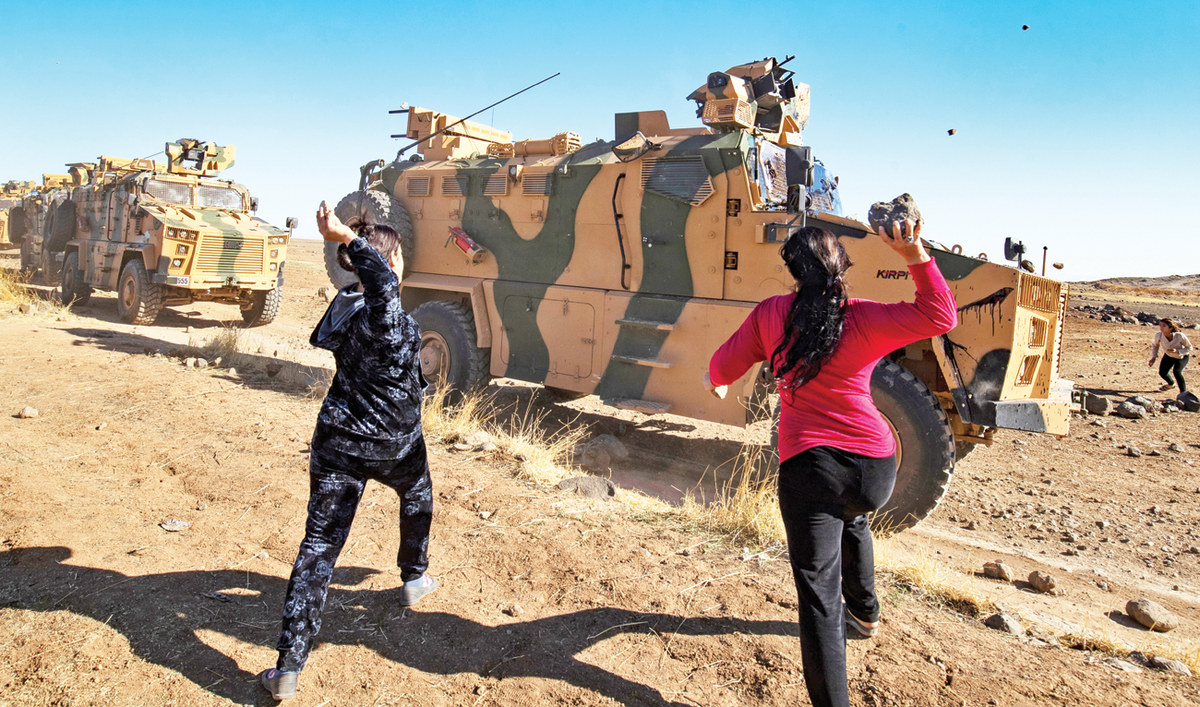
Since Turkey launched its assault, shortly after the US troop withdrawal from the border, approximately 180,000 Syrian civilians, primarily Kurds, have been displaced from their homes.

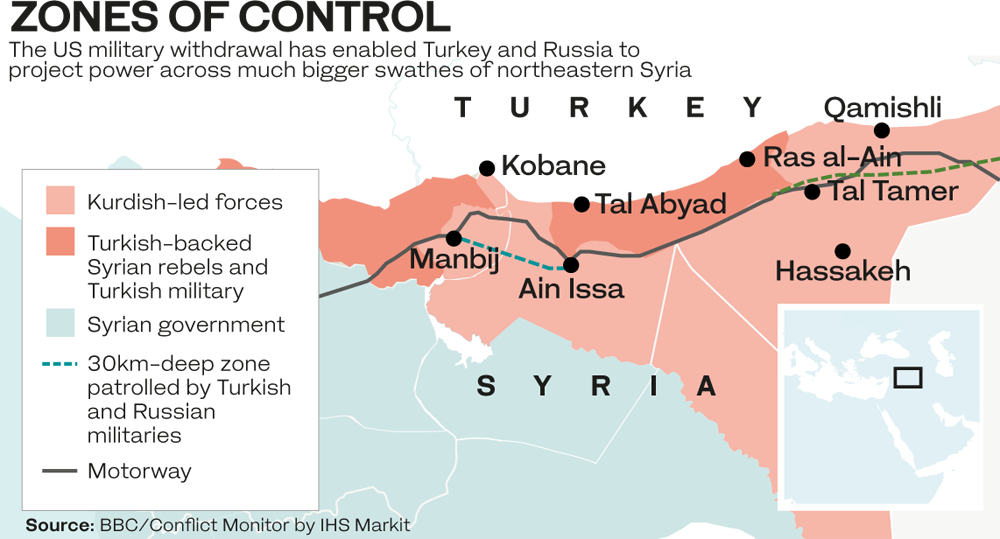
Turkey, with the help of its Syrian militia proxies, has carved out a large swath of territory — about 120 kilometers wide — that extends from Tal Abyad to Ras Al-Ayn (known by Kurds as Serekaniye).

On Oct. 31 at a gathering in Istanbul, Erdogan boasted that the “safe zones” were the most peaceful and livable places in Syria today. “We did not provide all these services with any expectation, but as our human and moral responsibilities,” he said, adding “when we look around, we see only humans, souls and life.”

Most Kurds of northeastern Syria see the situation very differently. In their view, what Erdogan has undertaken in the name of resettling millions of Syrian refugees in the so-called safe zone is a giant demographic-engineering exercise.
What has reinforced their suspicions have been incidents of Turkish-backed Syrian militias looting civilian homes and businesses, clips of which have flooded social media since the first days of the Turkish invasion.

Sounding a direct warning via Twitter, Mazloum Abdi, the SDF’s general commander, said: “There are efforts by Turkey to achieve its demographic-change goals in Northeast Syria through international organizations. The UN head’s willingness to form a team to study the proposal and engage in discussions with Turkish authorities on the issue is deeply worrying and dangerous.”

Dr. Nemam Ghafouri heads the charity Joint Help for Kurdistan, which is distributing humanitarian aid in the region, and said the humanitarian situation could not be worse.

She said that because northeastern Syria has been practically under an embargo for years: “It’s very hard to find even the most basic items in significant quantities. Even finding and buying simple clothing for the displaced is very difficult and expensive.”

Ghafouri has talked to many people displaced from different areas. Some spoke of how they tried to return to their homes but the presence of the militias, whose roadside executions of Kurds have been filmed and posted on the web, acted as a deterrent.

Among the displaced Syrians Ghafouri spoke to were a pharmacist and a doctor from Ras Al-Ayn who tried to return to their homes.

“They told me about another pharmacist they knew who was arrested along with his son by these militias, who demanded a large ransom for their release,” she said. After being detained for eight hours, both were released without the ransom being paid. Instead, the militiamen “stole everything they could find in their home and their pharmacy.”

The general atmosphere, as inferred by Ghafouri, is one of “suffering and hopelessness.”

Alluding to the resettlement of Arabs on confiscated Kurdish land by Syrian President Hafez Al-Assad back in the mid-1970s, she said: “This is not the first time efforts have been made to change demographics.”

Ghafouri said that even today, on the road from Hasakah to Derik, “you can see where Arab villages have been built on the best agricultural lands in the region.”

On Oct. 24, in an interview to Turkey’s state broadcaster TRT, Erdogan came close to making the case for ethnic cleansing. “What is important is to prepare a controlled life in this enormous area, and the most suitable people for it are Arabs,” he said. “These areas are not suitable for the lifestyle of Kurds … because these areas are virtually desert.”

In actual fact, northeastern Syria, where the country’s largest Kurdish-majority areas are located, is also where Syria’s best agricultural lands happen to be. The region is often referred to as the country’s “breadbasket.”

Ghafouri believes the events of the past several weeks are “all about destroying the landscape and demography of the Kurdish regions for good,” adding: “It has been partially accomplished already.”

Besides Turkey, Russia and the Syrian regime have also sent troops to the Turkey-Syria border, but locals Ghafouri spoke to “don’t see the Russian deployment as a cause for hope.”

She said: “Despite feeling betrayed by America, people I’ve talked to there trust Russia even less. It seems that with Russian support, the Syrian regime has achieved what it wants — namely the ‘Arabization’ of predominantly Kurdish areas with the help of Turkey.”

In recent weeks, more than 14,000 Syrians have fled the conflict in the country’s northeast to neighboring Iraqi Kurdistan, which already hosts a huge refugee population.

Jotiar Adil, a spokesperson for the Kurdistan Regional Government (KRG), said the KRG “does not have the capacity to handle and care for a new wave of refugees coming across the border on its own.
“Therefore, we ask the international community to take a serious stance on this and assist us in sheltering and providing for these refugees.”

While the Russian-Syrian deployment along the border in northeastern Syria is expected to lessen the likelihood of a total Turkish takeover, the agreement with Russia permits Turkey to retain forces in Syrian territories under its control and states: “Joint efforts will be launched to facilitate the return of refugees in a safe and voluntary manner.”

Nevertheless, Joshua Landis, a Syria expert and head of the Middle East department at the University of Oklahoma, believes: “Erdogan’s resettlement plan is dead. The Russians will fight it and so will the Syrians. There may be some resettlement around Tal Abyad and Ras Al-Ayn, but beyond that, it is hard to imagine that right now. Even in this area, it is doubtful there will be any large-scale refugee resettlement.

“The situation will not be like in Afrin, where the Kurdish population could be chased out to make way for Arab refugees.”

However, the US lawmakers who have called on the White House to disinvite Erdogan believe “his calamitous actions in Syria follow a long list of disconcerting steps”.

Reminding Trump about the resolutions passed last month by the House warning of sanctions against Turkey, the statement said: “Given this situation, we believe that now is a particularly inappropriate time for President Erdogan to visit the US, and we urge you to rescind this invitation.”

Main category: 

Erdogan to tell Trump: US has not met Syria cease-fire obligationsErdogan to meet Trump in Washington on Nov. 13


Turkey plays the Daesh card over potential EU sanctions

Wed, 2019-11-13 00:24

ANKARA: With Turkey beginning the deportation process of Daesh captives held in its prisons back to Europe on Monday, the issue is brought back to the bilateral agenda between Ankara and EU, whose relations have been strained since the recent military incursion in northern Syria.  The policy of deportation is likely to result in a new diplomatic fault line with Ankara’s allies in Europe.
On Tuesday, Turkish President Recep Tayyip Erdogan weaponized Daesh and the refugee issue again over the draft plans in Brussels to sanction Turkey over its drilling activities in the Mediterranean.
Erdogan implicitly threatened to release all Daesh prisoners it holds and send them back to Europe.
“Beware EU, we have 4 million refugees, we have Daesh terrorists in custody in Turkey and Syria. We can even stop the accession negotiations suddenly. EU should be careful,” he warned, adding: “Some countries have started panicking after we began the repatriation process of foreign Daesh terrorists. Turkey has been worrying about this issue for years, let others worry now.”
The EU’s sanction package intends “to sanction individuals or entities responsible for, or involved in, unauthorized drilling activities of hydrocarbons.”
The deportation wave from Turkey began with three Daesh prisoners, a German, a Dane and an American. The 28-year-old Dane citizen had been arrested on his arrival in Copenhagen, while the German ex-fighter had been also expelled. The American member has been stuck in no-man’s land between Turkish and Greek borders since Monday as Greek authorities refused him entry.
Dozens of others who fought in the militant group are also expected to be deported in the coming days. Among them are French, German and Irish ex-fighters.
The fate of foreign fighters from Daesh has been a controversial issue since the defeat of the group in Syria and Iraq. UN Secretary-General Antonio Guterres on Tuesday called for further international cooperation to resolve the issues related to foreign fighters.
Turkey has some 2,500 militants in its prisons. According to international standards, Ankara should repatriate Daesh members who were seized in Turkish territories, while those who were captured in Syria in territories beyond Assad control pose judicial problems.
However, Ankara put the blame on European countries of being too slow to reclaim their citizens who had joined Daesh.

FASTFACTS

• According to international standards, Ankara should repatriate Daesh members who were seized in Turkish territories, while those who were captured in Syria in territories beyond Assad control pose judicial problems. 

• The deportation process marks another rupture in Brussels-Ankara relations.

Although some European countries like Germany, Denmark and the UK have stripped citizenship from their nationals who joined Daesh to prevent their return, Ankara is determined to send even those Daesh suspects who have had their citizenships revoked.
Turkish Interior Minister Suleyman Soylu recently said that “Turkey was not a hotel for foreign jihadis” even if they are legally stateless.
Ankara and Paris have strict bilateral protocols for deportation procedures, which allows the French authorities to repatriate terrorists.
However, Nihat Ali Ozcan, a retired major now serving as a security analyst at Ankara-based think tank TEPAV, said: “It is usually challenging to prove in a trial that Daesh members committed any crimes because convictions do not usually have supporting evidence.”
The average sentence for fighters returning to European countries has been about five years of imprisonment, which generates serious domestic security threats if the returned European nationals cannot go through an efficient rehabilitation process.

The irony of Turkey’s partial invasion of northeastern Syria is that Ankara now finds itself in the same situation as the very Syrian Kurdish YPG militia that it has been fighting.

Paul T. Levin, Director of the Stockholm University Institute for Turkish Studies

In recent weeks, Turkey arrested many people close to the former Daesh leader Abu Bakr Al-Baghdadi, who recently died during a US raid.
Erdogan is expected to discuss the fate of Daesh fighters during his meeting with his US counterpart Donald Trump in Washington on Wednesday.
The deportation process marks another rupture in Brussels-Ankara relations as last month some European countries launched an arms sales embargo to Turkey over its military incursion into northern Syria.
“The irony of Turkey’s partial invasion of northeastern Syria is that Turkey now finds itself in the same situation as the very Syrian Kurdish YPG militia that it has been fighting. Now both are stuck with a number of Daesh fighters and their families in custody, calling for Europe and countries elsewhere to take their citizens back,” Paul T. Levin, director of the Stockholm University Institute for Turkish Studies, told Arab News.
Levin said Turkey has an understandable concern over the refusal of European states to take responsibility for “their” Daesh fighters.
“Since these countries have not been willing to do much to help either Turkey or, more acutely, the YPG, there is a legitimate need to press the issue. And Turkey has some support in international law to demand that sender states take their citizens back,” he said.
Levin added that it is also especially problematic that the threat to send Daesh fighters to Europe comes as a response to EU sanctions against Turkey on an entirely separate issue.
“It suggests that he may be less interested in a joint solution to the problem of captured Daesh fighters than in being able to use them as leverage in foreign policy disputes,” he said.

Main category: 

Israeli public opinion warms toward Turkey, shows surveyTurkey and Qatar on course to clash over Levant basin drilling


Israeli public opinion warms toward Turkey, shows survey

Wed, 2019-11-13 00:18

ANKARA: Despite the decline in Turkish-Israeli relations over the past decade, Israeli public opinion is increasingly supportive of an improvement in ties between the two countries.
According to the 2019 Israeli Foreign Policy Index by the Mitvim Institute of Israel, 53 percent of Israelis believe that Israel should try to improve relations with Turkey, compared to 32 percent who disagree.
This points to an almost 10 percent increase compared to the previous year, in which 42 percent of respondents said that Israel should work to improve its relationship with Turkey and 45 percent said it should not.
The respondents were also asked whether Israel should prioritize developing relations with democratic countries or should not take regime type as a criterion; both choices were indicated by 40 percent of participants. It is the seventh edition of the survey.
In an exclusive interview with Arab News, Nimrod Goren, head of the Mitvim Institute, said the fact that a majority of Israelis stated in the annual poll that they would like it to improve relations with Turkey is in contrast to the policies of Prime Minister Benjamin Netanyahu’s government and the rhetoric of his main opposition party.
“This is surprising, as the poll findings reveal that on most issues the public accepts the framing provided by the Israeli leadership on foreign policy issues,” he said.
According to Goren, the findings may reflect a “realpolitik” tendency by the Israeli public to seek better relations with countries that project power and influence in the region, even if there are differences in values and policies.
“The finding also reflects the resilience of Israel-Turkey ties. Despite deep political tensions and public grievances, there is still a basic positive attitude toward Turkey as a country, which can be leveraged,” he said.

HIGHLIGHT

The respondents were asked whether Israel should prioritize developing relations with democratic countries or should not take regime type as a criterion; both choices were indicated by 40 percent of participants.

Historically, bilateral relations between the two countries have been at their peak when they perceived a common threat or had a common ally — such as in the 1990s over similar concerns about the existential threat from Iran, when Turkey and Israel cooperated in joint military exercises and training of officers. But ties hit a low in May 2010 after a raid on the Gaza Freedom Flotilla in international waters by Israeli Defense Forces commandos, which killed 10 Turkish citizens.
A reconciliation followed after Netanyahu apologized for the incident. Although diplomatic relations were restored in 2016 to the ambassadorial level, Turkey dismissed Israeli’s ambassador after its security forces killed dozens of Palestinian protesters in Gaza in May 2018. But, for Goren, relations between Israel and Turkey should not be viewed only through the prism of relations between their current leaders.
“The business community and civil society also play a role, and a more positive one than the political level. It is noteworthy that among the Israeli public, the largest support for improving ties with Turkey is found among Israel’s Arab citizens,” he said.
Accordingly, 68 percent are in favor of improving ties with Turkey, while 10 percent are against, compared to 50 percent in favor and 37 percent against among Israel’s Jewish population.
Despite the diplomatic stalemate, trade between the two countries exceeded $8 billion in 2018. Turkish Airlines operates 10 daily flights on the Tel Aviv-Istanbul route, with growing demands for tourist destinations in Turkey such as Antalya.
Esra Cuhadar, an expert on conflict resolution and political psychology from Bilkent University in Ankara, said that social and cultural bonds develop independently from bilateral diplomatic relations, and can sometimes trigger grassroots change in perceptions about another country.
“Israel and Turkey are located in the same geographic region, and the people from two countries have various avenues for social contact which decreases inevitably the stereotypes and the bias,” she told Arab News.
Cuhadar, however, said that any improvement in bilateral relations is closely connected with who is ruling in both countries.
To have social rapprochement translated into improving diplomatic channels, it is necessary that the governments in both countries do not use bilateral disagreements to whip up nationalistic sentiment and consolidate its national constituencies.
The picture is less rosy on Turkish side. In a survey conducted last year by Istanbul Bilgi University, “Dimensions of Polarization in Turkey,” 14 percent of Turkish respondents considered Israel as the second largest threat after the US (54.3 percent).

Main category: 
Tags: 

Court says EU states must label Israeli settlement productsEgypt working to calm Israel-Gaza fightingEU sanction on Turkey over Cyprus drilling may disrupt talks: Erdogan


Lebanon president calls on protesters to go home

Tue, 2019-11-12 22:21

Lebanese President Michel Aoun called on protesters to go home, saying their demands had been heard, and warned of a “catastrophe” if they stay in the streets.

In a televised interview, Aoun also urged the Lebanese not to rush to the banks to withdraw their money, which he said was safe.

Aoun alos said he supports the formation of a government made up from both politicians and technocrat.

The interview was the latest attempt by the president to address the protesters who took to the streets last month. The demonstrations were initially against tax increases but soon turned on the countries leaders, who they accuse iof corruption, and the sectarian political system.

They forced the resignation of Prime Minister Saad Hariri and have led the country into its worst economic crisis since the civil war.

“If you continue in this way, you will strike Lebanon and your interests … I am placing you in front of this choice,” Aoun said. “We are working day and night to get the situation in order. If they keep going, there is a catastrophe. If they stop, there is still room for (us) to fix things.”

The UN has4 urged Lebanon to form a competent new government better able to seek international aid.
Indicating no breakthrough in talks over the next government, Aoun said he was still waiting for answers before calling formal consultations with MPs to designate the next prime minister.
“A technocrat government cannot define the policy of the country…and I back forming a government that is half political and half technocrat,” Aoun said. “I met Hariri and I found him hesitant between yes and no.” 

With Reuters

Main category: 

Aoun tells thousands of supporters Lebanon must unite behind reformsPresident Aoun calls for merit-based Lebanese government and shift away from sectarian system


In their mother’s country, Lebanon protesters clamour for citizenship

Tue, 2019-11-12 22:10

BEIRUT: Draped in the Lebanese flag, 22-year-old Dana is bursting with pride at taking part in Lebanon’s “revolution” — even if her home country refuses to give her nationality.
Standing among other demonstrators in the capital, she explains she was born in Beirut to a Lebanese mother and has spent all her life in the country.
But like thousands of others in Lebanon, her father is a foreigner and, with Lebanese women unable to pass down their nationality, she has been deprived of citizenship.
“My parents divorced before I was even born. I grew up with my mother,” Dana told AFP.
“I see myself as Lebanese, but they don’t want to recognize my identity,” she added.
The politicians who do not want to change the century-old law, she says, are “patriarchal” and “racist.”
The right to citizenship is one of many long-standing demands to have found new life in the mass protests sweeping Lebanon since October 17.
The unprecedented show of cross-sectarian anger in the street brought down the government last month — but many other of the demonstrators’ demands remain unmet.
Outside the seat of government, 17-year-old Omar said he’d only ever been to Syria once, but was consistently suffering the consequences of his father’s nationality.
Each year, he has to make his way to General Security headquarters to renew his residency permit — like all other non-Lebanese.
“They treat us like foreigners. It’s humiliating,” he said, holding the Lebanese red-green-and-white flag.
Last year, Human Rights Watch (HRW) strongly denounced the law, noting that Lebanon lags far behind some other countries in the region on the issue.
Algeria, Egypt, Morocco, Tunisia and Yemen all provide equal citizenship rights to the children of both women and men, while Iraq and Mauritania confer nationality to those born in the country, according to HRW.
At a Beirut protest, Samer stood in a small crowd, raising his fist and chanting against political leaders he sees as inept and corrupt, the majority of whom have been in power since the end of the country’s 15-year civil war in 1990.
“But we need it (citizenship) to work, to sign up our children at school and receive social security,” said the 33-year-old, whose father is Palestinian and who is himself the father of three.
Despite activists campaigning to amend the 1925 nationality law, Lebanese authorities have been reluctant to do so.
In this small multiconfessional country of around 4.5 million, the political system relies on a fragile balance of power between communities.
Authorities fear that changing the law would open the door — especially through marriages of convenience — to the naturalization of some of the majority-Sunni 1.5 million Syrians and around 174,000 Palestinians living in the country, according to official estimates.
Last year, then foreign minister Gibran Bassil suggested amending the law to allow for Lebanese mothers to pass on their nationality — but only if the father was neither Palestinian nor Syrian.
“It’s racism,” said Randa Kabbani, coordinator of the “My Nationality, My Dignity” campaign demanding citizenship for children of Lebanese women.
Of the 10,000 impacted households identified by the campaign, some 60 percent are Syrian, 10 percent Egyptian, and just seven percent Palestinian, Kabbani said.
Others are Jordanian, Iraqi, American or hold European nationalities, she added.
Around 80 percent are Muslim and 20 percent Christian.
Samer said those pushing for reform are not demanding the naturalization of all Palestinians living in Lebanon, “but only those born to a Lebanese mother. It’s a natural right.”
Kabbani said she was delighted the issue had gained new momentum in the ongoing protests.
“Before the movement, women were almost ashamed to speak up about it. But today they’re clamouring loud and clear,” she said.
On Sunday, hundreds of protesters took part in a march organized by “My Nationality, My Dignity” in the capital.
Volunteers with the campaign have erected a tent in the square by the office of the now deposed cabinet to discuss the issue.
When she is not protesting, Dana — the university student — helps spread the word among other protesters so they too can join in her fight.
But the young student says she is under no illusions.
Whether or not a new cabinet includes independent experts as demanded, the key to her finally obtaining her Lebanese citizenship will boil down to political will.
“The day decent leaders take power, the legal amendment will fly through,” she said.

Main category: 

Wikipedia the latest battleground in Lebanon’s protests‘Sister protests’: Lebanon, Iraq look to each other