Egypt oil pipeline fire kills six

Author: 
AFP
ID: 
1573678793364446100
Wed, 2019-11-13 20:43

CAIRO: Six people were killed and 15 injured when a leaking oil pipeline caught fire in Egypt’s northern province of Bahira on Wednesday, officials said.
The head of Egypt’s oil pipelines authority, Abdelmoneim Hafez, said the leak was the work of “thieves” syphoning off oil.
The fire broke out on the pipeline near Itay Al-Baroud, a village half-way between Cairo and Alexandria, health ministry spokesman Khaled Mugahed said in a statement.
The wounded were taken to a nearby hospital, while the blaze was put out and the leak fixed.

Main category: 
Tags: 

Egypt working to calm Israel-Gaza fightingEgypt’s sovereign wealth fund to raise authorized capital five-fold up to $62.15 billion


Emirati soldier in Arab coalition fighting in Yemen killed in Najran

Wed, 2019-11-13 23:09

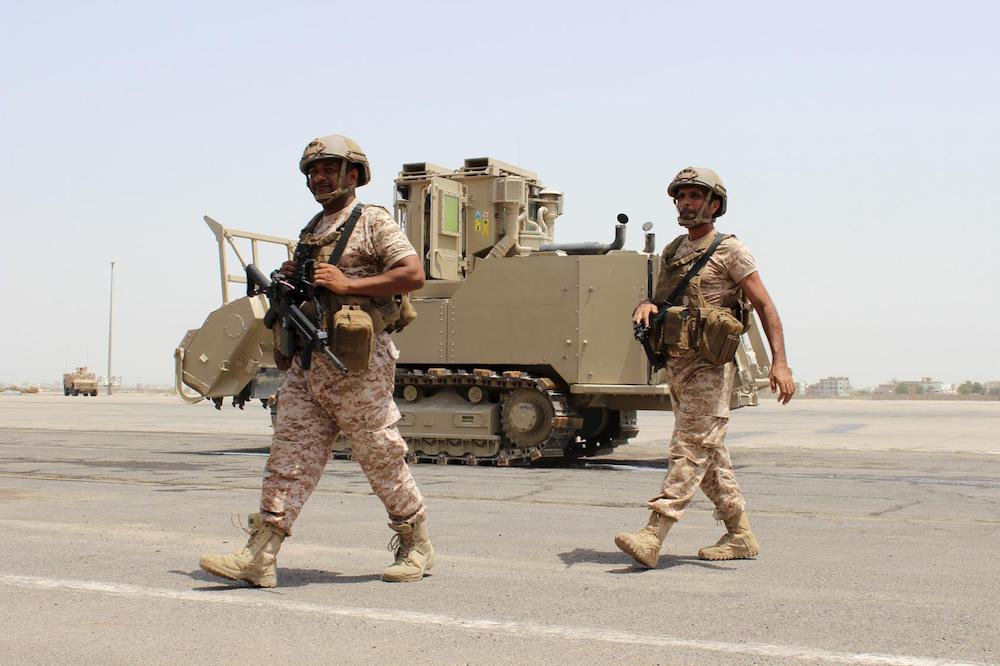
RIYADH: An Emirati soldier was killed in Saudi Arabia near the border with Yemen on Wednesday. 
Corporal Tariq Hussein Hassan Al-Baloushi was serving with UAE forces as part of the coalition supporting the Yemeni government against Houthi militants.
The UAE General Command of the Armed Forces said the soldier died “performing his national duty in Najran as part of our forces’ participation in “Operation Decisive Storm” and “Operation Restoring Hope,” state news agency WAM reported.
No further details about his death were provided.
The general command extended its condolences and sympathy to the families of the soldier.
The Arab coalition, which includes Saudi Arabia, the UAE and Bahrain intervened in the war in Yemen to restore the internationally-recognized government after it was ousted by the Iran-backed Houthi militia in 2015.
Saudi Arabia’s border areas near Houthi held territory have faced constant attacks from rockets and missiles fired from inside Yemen.

Main category: 

UAE’s first astronaut urges climate protection on EarthUAE calls on Iran to seek new deal with world powers, region


Iraq protests swell as UN presses Baghdad to ‘step up’

Wed, 2019-11-13 20:24

BAGHDAD: Iraqi officials must “step up” to respond to mass demonstrations, the UN representative in Baghdad told AFP on Wednesday as anti-government rallies swelled in Iraq’s capital and the country’s south.
Protests demanding an overhaul of the political system have rocked Baghdad and the Shiite-majority south for weeks — the crowds unmoved by government pledges of reform and undeterred by the deaths of more than 300 demonstrators.
Washington and the United Nations have called on the government to respond seriously to the protests, with the world body’s representative Jeanine Hennis-Plasschaert saying the country’s authorities must “step up to the plate and make things happen.”
“They are elected by the people, they are accountable to them,” the head of the UN’s Iraq mission (UNAMI) told AFP in an exclusive interview.
US Secretary of State Mike Pompeo, for his part, has said he told Iraqi Prime Minister Adel Abdel Mahdi that he “deplored the death toll” and to address the popular movement’s “legitimate grievances.”
The protests had slowed for a few days following a deadly crackdown by security forces in Baghdad and major southern cities but flared again Wednesday with demonstrations by striking students and teachers.
“We’re here to back the protesters and their legitimate demands, which include teachers’ rights,” said Aqeel Atshan, a professor on strike, in Baghdad’s Tahrir (Liberation) Square, the epicenter of the protest movement.
In the southern port city of Basra, around 800 students returned to camp outside the provincial government headquarters, days after they had been pushed out by riot police.
Schools were also shut in the protest hotspots of Diwaniyah and Nasiriyah.
Protesters have felt emboldened since the country’s top Shiite religious authority Grand Ayatollah Ali Sistani said they “cannot go home without sufficient reforms.”
“Students, boys and girls alike, are all here for a sit-in,” another demonstrator in Tahrir told AFP.
“If Sistani gave the orders for mass civil disobedience, everything would close — the government, the oil companies, everything. That’s how we’ll have a solution.”
The UN has put forward a phased roadmap, backed by Sistani, calling for an immediate end to violence, electoral reform and anti-graft measures within two weeks.
Hennis-Plasschaert, the UN envoy, discussed the plan with lawmakers during a parliamentary session on Wednesday afternoon.
“Now is the time to act, otherwise any momentum will be lost — lost at a time when many, many Iraqis demand concrete results,” she told them on the sidelines of the parliamentary meeting.
At the session’s opening, speaker of parliament Mohammed Al-Halbussi pledged to work on laws to respond to protesters’ demands including electoral reform.
Parliament has received a draft law for electoral reform but has yet to discuss it.
Lawmakers also set dates to interrogate two ministers, which could indicate the first steps of a cabinet reshuffle announced by Abdel Mahdi.
Oil-rich Iraq is ranked the 12th most corrupt country in the world by Transparency International, and youth unemployment stands at 25 percent.
Demonstrations erupted on October 1 in fury over a lack of jobs and corruption, initially fracturing the ruling class.
Populist cleric Moqtada Sadr then called on the government to resign and President Barham Saleh suggested early elections, while other factions stood by Abdel Mahdi.
But after a series of meetings led by Iran’s influential Major General Qassem Soleimani, a consensus emerged at the weekend over the government remaining intact and both Saleh and Sadr appear to have changed their tunes.
Sadr, who is reported to be in Iran, took to Twitter on Wednesday to call on parliament to enact reforms and for “a general strike, even for one day,” but did not demand the premier step down.
Saleh, too, appears to have dropped the idea of early elections.
The agreement brokered by Soleimani appeared to have paved the way for a crackdown on demonstrations last weekend that sent the death toll amid the unrest to well over 300.
Iraq has faced growing criticism over its response to rallies, with rights defenders accusing authorities of shooting live rounds at protesters and curtailing freedom of expression with an Internet blackout and mass arrests.
Also on Wednesday, the president of autonomous Iraqi Kurdistan, Nechirvan Barzani, was in Baghdad to meet with the premier, president and speaker of parliament.
Barzani and Abdel Mahdi are believed to have good personal ties, and the Iraqi Kurdish authorities have backed the current government.
But they have worried that any amendments to Iraq’s 2005 constitution as part of a reform process could infringe on Kurdish rights.

Main category: 

Iraqi PM says needs more time to tackle corruptionUN: Top Iraqi Shiite cleric backs reforms to resolve unrest


Tunisia’s parliament picks Ennahda leader as speaker

Wed, 2019-11-13 19:57

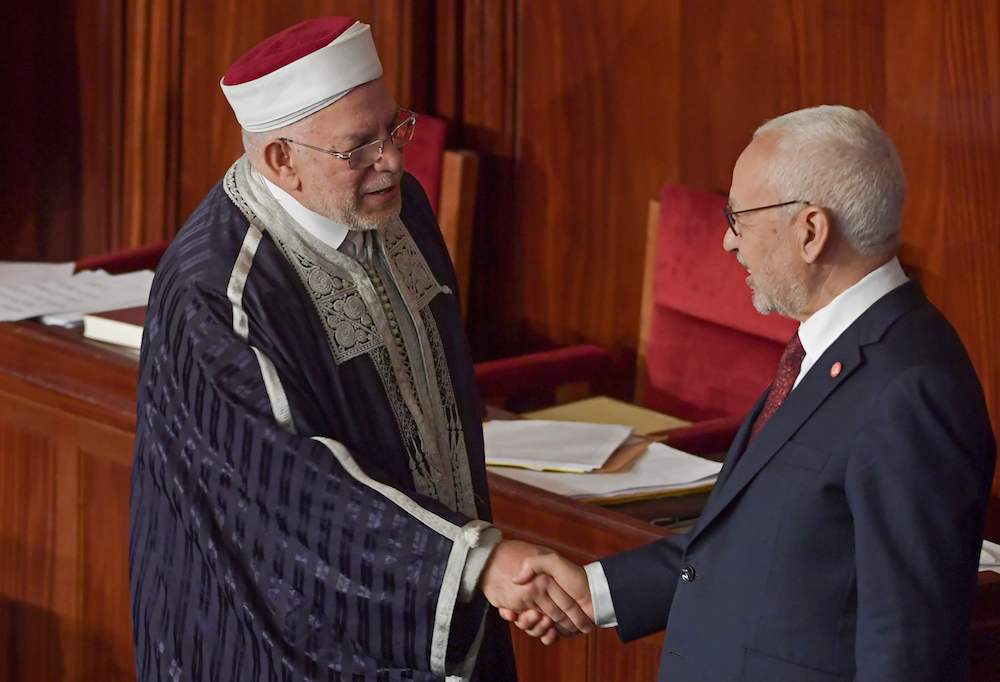
TUNIS: Tunisia’s new parliament on Wednesday elected Rached Ghannouchi, leader of the moderate Islamist Ennahda party, as its speaker after the rival Heart of Tunisia party backed him, opening the way for a possible coalition government between them.
Ennahda came first in last month’s election, but took only 52 of 217 seats in a deeply fragmented parliament, forcing it to compromise to win majority support for its preferred candidates for speaker and for prime minister.
However, its efforts to build a coalition with several rival parties have so far come to nothing and Tunisia continues with a caretaker government under the existing prime minister, Youssef Chahed.
Wednesday’s election for speaker represented a big test for Ennahda, which was banned before Tunisia’s 2011 revolution but has since played a big role in several coalition governments.
Its veteran leader Ghannouchi, 78, had faced competition from two rival politicians for the post of speaker. It is his first official post since he returned to Tunisia from exile in London after the 2011 revolution.
It was not immediately clear what price, if any, Heart of Tunisia asked for supporting Ghannouchi as speaker but the party led by media magnate Nabil Karoui now appears likely to join a coalition government with Ennahda.
“The party decided to vote for Ennahda after an agreement,” said Ridha Charfeddine, a Heart of Tunisia lawmaker.
It and Ennahda have presented themselves as ideological rivals and have both previously ruled out entering into coalition.
The Attayar and Achaab parties, which had previously been in negotiations with Ennahda over Ghannouchi’s candidacy, did not back in Wednesday’s vote.
Ennahda, as the biggest party in parliament, has until Friday to name its nominee for prime minister, starting the clock on a two-month process for that person to form a government. It is not yet known whom it will nominate.
Tunisia’s post-revolution constitution splits power between the newly elected President Kais Saied and a government that passes legislation through the parliament.

Main category: 

Tunisia’s Islamist-inspired party wants leader to be house speakerNew Tunisia president sworn in after upstart poll win


Turkish policy sees Erdogan playing a dangerous diplomatic double game

Wed, 2019-11-13 18:38

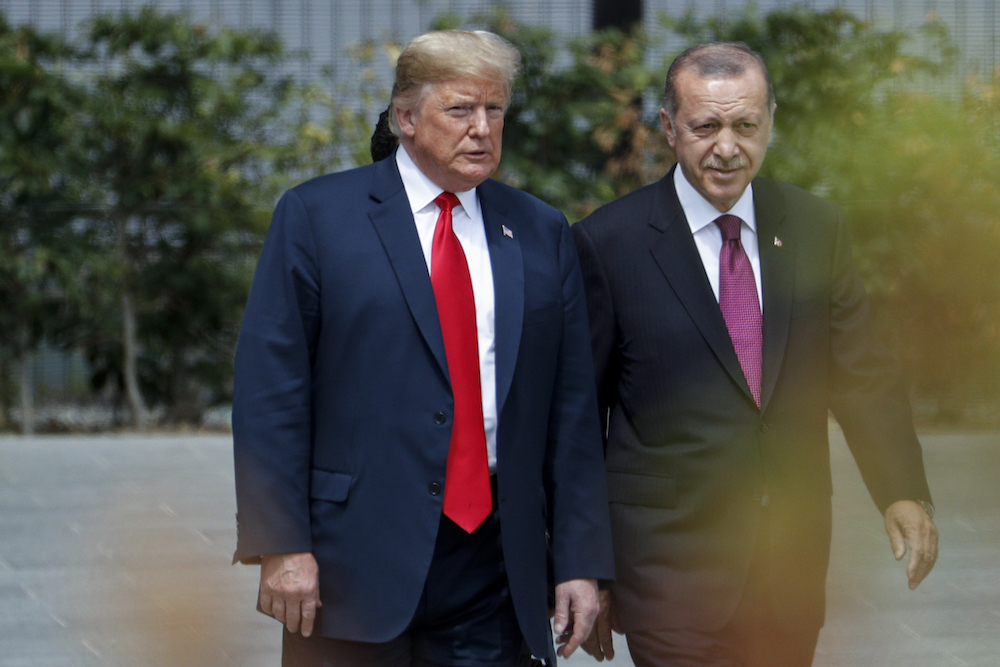
MISSOURI: The vast majority of US policymakers, legislators, officials and even American citizens do not look favorably upon Turkish President Recep Tayyip Erdogan’s official state visit on Wednesday. The honor of the White House invitation strikes many in the US as inappropriate and badly timed.

This, along with US President Donald Trump’s Oct. 6 capitulation to Erdogan and his surprise announcement of an immediate withdrawal of US troops from the Syrian border, stands out as perhaps the only major issue to cause bipartisan opposition to Trump.

Even as Erdogan meets with Trump on Wednesday, the US Congress is pushing forward with more sanctions against Turkey for its invasion of Syria disguised as a military operation — “Operation Peace Spring” — against “Kurdish terrorists.”

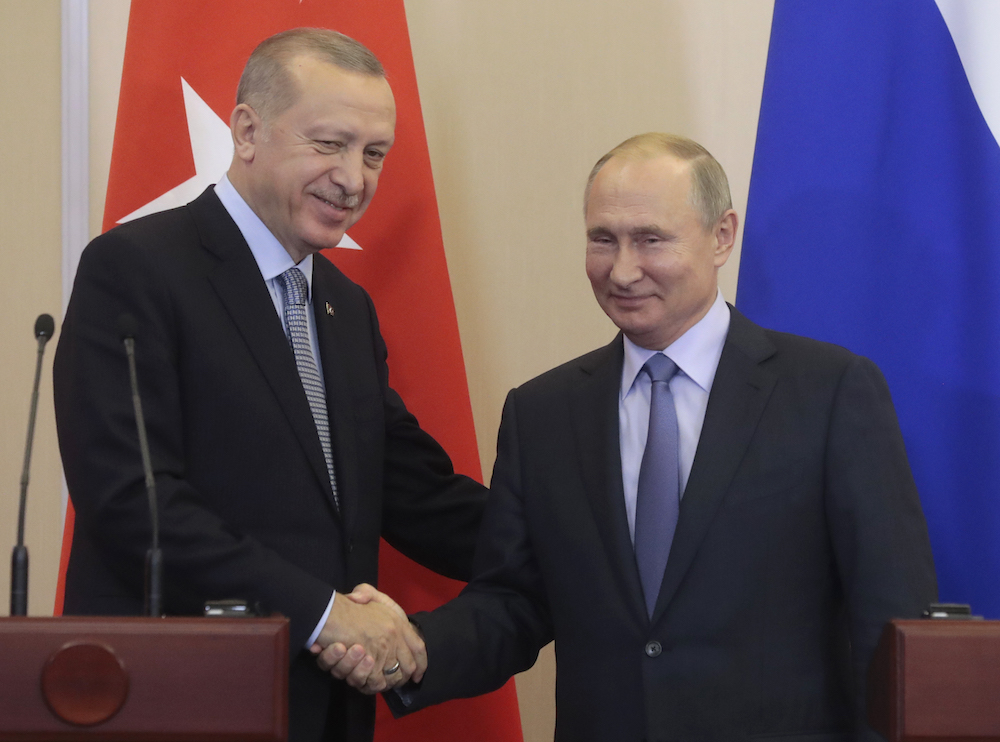
In recent years, Turkey has helped solidify Russian influence over large expanses of the war-torn Middle East at the expense of its traditional NATO allies, from whom it has steadily drifted away.

Assuming that Trump’s America (if not Europe) does not care so much about democracy or human rights norms, other recent Turkish policies make the collision with Washington and the Europeans abundantly clear.
Turkey helped Iran evade US sanctions for many years, leading to indictments against some of its officials and top bank executives.

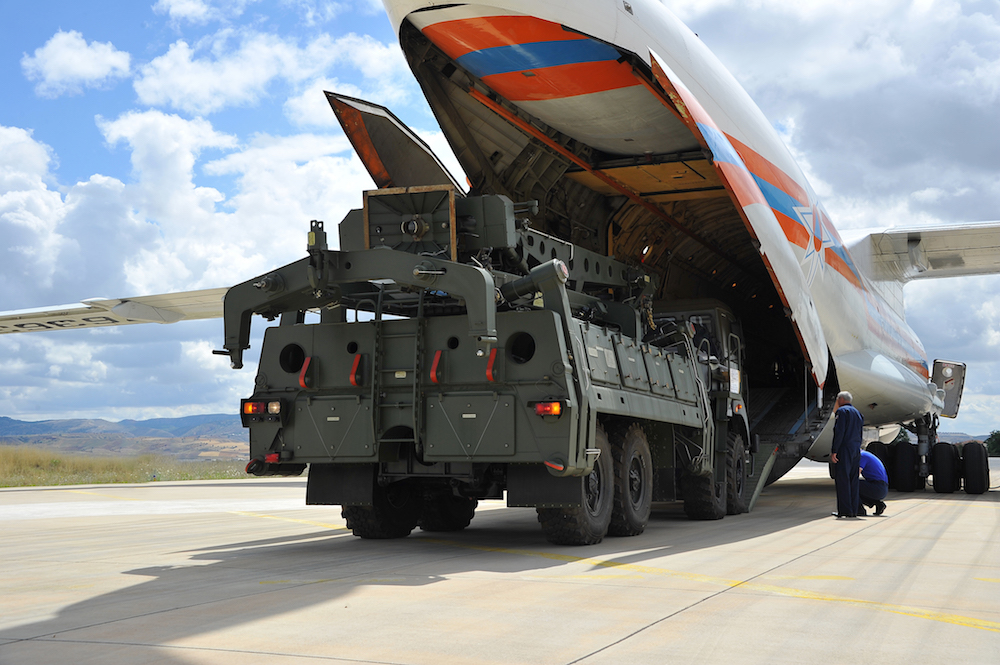
Last summer, Turkey purchased the S-400 air defense system from Russia, which is not inter-operable with NATO systems and could allow Russian technicians to gain valuable intelligence about American-made fighter aircraft.

Throughout most of the civil war in Syria, Turkey backed various extremist groups fighting Bashar Al-Assad’s regime. It allowed tens of thousands of militants to transit through its territory en route to Syria, without lifting a finger as they established their “caliphate” right over the border.

After also denying the Americans the use of the NATO airbase at Incirlik for anti-Daesh operations, Washington found its Syrian Kurdish allies to help them against Daesh. As soon as the Kurds had liberated the last of Daesh-held territories in Syria, Turkey insisted that it had to move against main Kurdish fighting force.

With its “Operation Peace Spring,” Turkey and its Syrian proxies successfully pushed the Americans out of most of Syria and forced the Kurds to turn to Russia and the Assad regime for protection.

As European leaders criticized the offensive, which many describe as a program of ethnic cleansing, Turkey threatened to unleash millions of Syrian refugees into Europe.

The ongoing fighting, chaos and displacement in northern Syria is also allowing Daesh captives held by the Kurds to escape, reinvigorating a movement that was on its deathbed just a few weeks ago.

Small wonder then, talk of expelling Turkey from NATO is now a mainstay in American and European media. Despite fierce Turkish opposition and lobbying, Congress on Oct. 29 finally passed a resolution recognizing the Armenian genocide.
American attitudes towards Turkey were not always like this.

In the halls of US government and particularly in the State Department, there was a time when one could not overemphasize Turkey’s importance or praise Ankara enough.

In the early days of the previous Democratic administration, President Obama often spoke of Turkey as “a model” for the rest of the Muslim world.

What happened?

President Erdogan and his Sunni nationalist Justice and Development Party (AKP) happened.

At the beginning of the AKP’s takeover of Turkey, the changes seemed too slow or subtle to draw much attention. Following the AKP’s first electoral victory in 2002, Turkey’s military and secular old guard (known as “Kemalists”) continued to wield a great deal of political power behind the scenes.

This Western-leaning old guard placed a great deal of value on Turkey’s NATO membership, its relations with Washington and a general policy of not becoming too entangled in the myriad problems of the Middle East.

The first sign of change came just before America’s 2003 invasion of Iraq. While few expected Turkey to participate in that war, top Turkish leaders and the military had promised the Americans they could pass through their territory to attack Saddam Hussein’s Iraq from the north as well as the south.

AKP parliamentarians surprised the old guard by voting not to allow American troops to transit through Turkey, effectively denying America its northern front against Saddam’s regime.

The move proved extremely popular with the Turkish public, which despite a long relationship with NATO and the US, was never known for much pro-American sentiment.

In the following years, Erdogan managed to completely purge the Kemalist old guard and military from politics. He did so through his own charisma and a series of mostly fabricated conspiracy charges against his political opponents, aided by a growing economy and an increasingly strident anti-American, Islamist-sounding rhetoric.
The change in Turkey became most apparent by 2011, when the Turkish chief of army staff, the head of the air force, the head of the navy and the head of the land forces all resigned on the same day.

Once the Kemalist old guard was purged and the military forced back into its barracks, Erdogan and his inner circle could freely pursue their own foreign policy instincts.

These instincts seemed to call for Turkey to become more involved in the Middle East, to aspire towards regaining some of the stature and importance of its Ottoman forebears, to distance itself from American and European policies, and even to lean more towards the East and Russia.

These new foreign-policy goals put Turkey on a collision course with America’s interests and those of other American allies.

When the Arab Spring began in 2011, Erdogan’s new Turkey supported Islamists in every Arab country rocked by protests. Erdogan himself reveled in the prospect of a new Muslim Brotherhood-dominated Middle East, envisioning himself as the neo-Ottoman leader of the new trend.

He bought currency for his ambition to lead the Arab and Sunni Islamist world by projecting himself as the Palestinians’ indispensable defender, wrecking Turkey’s delicate relationship with Israel in the process.

The mainstays of Islamist discourse include not only exploiting the Palestinian issue but anti-Western (especially anti-American) and anti-Semitic rhetoric, a promise to return to a “golden age” of Muslim ascendance, and a penchant for authoritarianism at home.

Erdogan and his inner circle proved no exception to this rule. Erdogan and his party members continually accused the American ambassador in Ankara of innumerable plots against Turkey. They used dog whistle anti-Semitic language wherein the “interest-rate lobby” and a “higher mind” sought to undermine Erdogan and his quest for a strong Turkey.

They spoke of “liberating Jerusalem” and insisted that any “friend of Zionism” is an enemy of Turkey (which might include Washington, many wondered).

The Turkish minister of defense in October even posted a map online which showed northern Syria, northern Iraq, Greek islands in the Aegean Sea, parts of the Balkans and Greece, and all of Cyprus as part of Turkey – with the message: “We have no eyes on anyone’s soil. We will only take what’s ours.”

The discourse fit very well with Erdogan’s constant glorification of the Ottoman Empire.

Erdogan even built himself a $615 million, 1,100-room Ottoman-style palace in 2014, dubbed the “White Palace” (AK Saray). The palace includes a costumed honor guard of 16 warriors dressed in period garb from various Turkic empires of the last 2,000 years.

At the same time, Turkey under Erdogan became increasingly authoritarian after 2011, to the point than many wonder if the country can remain in a NATO alliance whose preamble states that members “… are determined to safeguard the freedom, common heritage and civilization of their peoples, founded on the principles of democracy, individual liberty and the rule of law.”

All of which makes many wonder what Erdogan and Trump will discuss at the White House on Wednesday.

Will the conversation include any talk of how Turkey damaged American interests in the Middle East; assisted Russia, Iran and Assad’s designs on northeastern Syria; and provided Daesh and other militant groups there a new lease on life?

Do Turkey and America even share any strategic interests?

Main category: 

Turkey’s Erdogan called out for endangering ‘US national security’Turkey plays the Daesh card over potential EU sanctions