Former finance minister Mohammad Safadi put forward to be next Lebanese PM
Fri, 2019-11-15 00:44
Lebanese media are reporting an agreement has been reached to naming ex-Finance Minister Mohammad Safadi as the next prime minister.

Main category:
Lebanese media are reporting an agreement has been reached to naming ex-Finance Minister Mohammad Safadi as the next prime minister.
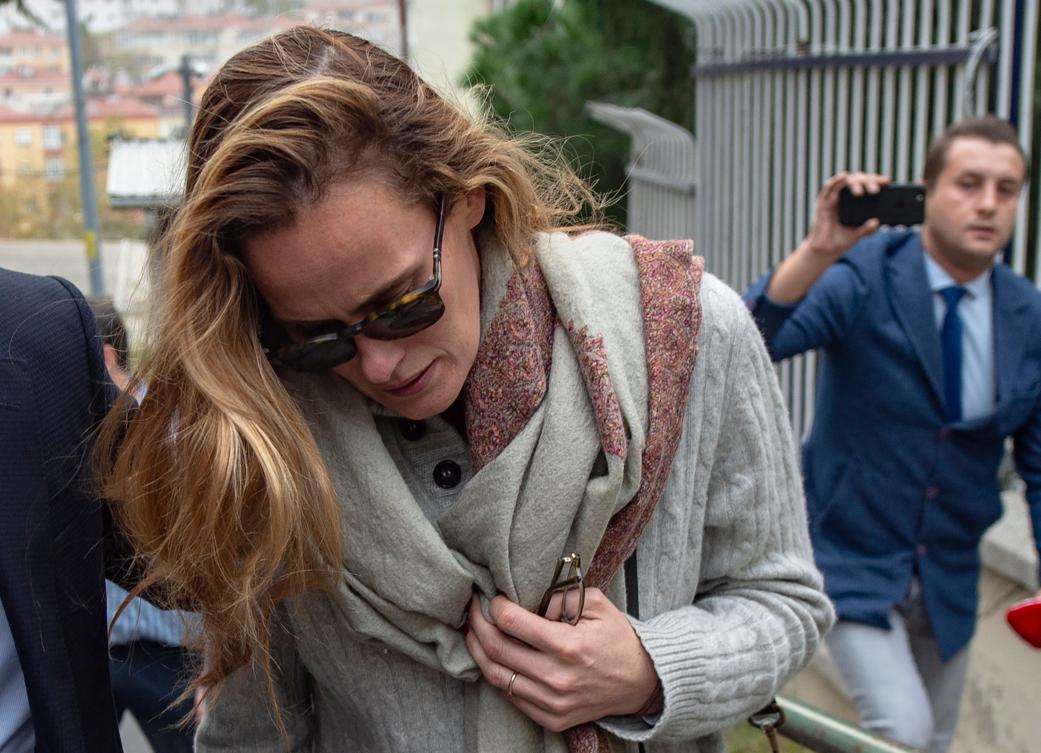
ISTANBUL: Turkey has imposed a travel ban on Emma Winberg, the wife of James Le Mesurier, founder of the Mayday Rescue Foundation, who was found dead in Istanbul on Monday.
Speculation abounds over the circumstances of Le Mesurier’s death, with questions over whether the former British intelligence officer was murdered or committed suicide.
Though Turkish police sources believe Le Mesurier jumped to his death from his flat, his wife, 39, has not been allowed to return home because of Turkish law.
Le Mesurier had reportedly told his wife of suicidal thoughts two weeks before the incident. His wife notified the police that he was in a deteriorating psychological state and taking anti-depressants and medication for stress. His hospital records are also being examined.
Umur Yildirim, an attorney specialized in criminal justice, said that according to Turkish law, it was possible for Turkish authorities to impose a travel ban on people not of Turkish nationality of importance to an open investigation.
Winberg will not be allowed to leave the country, as long as the investigation into her husband’s death continues.
Based on reports, Le Mesurier’s residence was only accessible via fingerprint, and in testimony released by Turkish authorities, Winberg claimed the pair had taken sleeping pills at around 4 a.m.the night before. She was woken by police after they were notified of a body lying outside the building.
The preliminary autopsy reports suggest suicide was the most likely cause of death, with the final report set to be completed next week. The investigation continues.
Le Mesurier was awarded an Order of the British Empire (OBE) by the UK government in 2016.

Body of White Helmets’ founder James Le Mesurier to be flown to LondonTurkey tries to shed light on White Helmets founder’s death
DUBAI: The United Arab Emirates and Egypt plan to jointly invest $20 billion in economic and social projects, under a bilateral project announced by the Crown Prince of Abu Dhabi Sheikh Mohammed bin Zayed Al-Nahyan on Thursday.
Sheikh Mohammed made the announcement on Twitter during a two-day visit to the UAE by Egypt’s President Abdel Fattah El-Sisi.
Abu Dhabi Development Holding Company and Egypt’s sovereign wealth fund will use the funds to establish joint strategic investment projects, specialized funds and investment tools, in a number of sectors, Egyptian presidential spokesman Bassam Rady said.

Egypt working to calm Israel-Gaza fightingEgypt’s sovereign wealth fund to raise authorized capital five-fold up to $62.15 billion
DUBAI: With over 200 nationalities currently residing in the GCC, countries across the region are continuing to promote the values of tolerance and coexistence through various initiatives.
The UAE first introduced the post of minister of tolerance with the appointment of Sheikha Lubna Al-Qasimi in 2016, reinforcing its commitment to eradicate ideological, cultural and religious bigotry in society.
The second edition of the World Tolerance Summit, held in Dubai on November 13 and 14, saw a bigger number of countries participating, including Saudi Arabia.
Dr Sheikh Abdullah bin Mohammed Al Fawzan, vice-chairman and secretary general of the King Abdulaziz Center for National Dialogue, reviewed the Kingdom’s tolerance initiatives, and described the summit as “an opportunity to bring about positive change.”
The summit’s second day included a session titled “Tolerance in Multiculturalism: Achieving the Social, Economic and Humane Benefits of a Tolerant World,” in which speakers from Saudi Arabia, Ethiopia, Tatarstan, and Columbia discussed ways in which their respective countries are attempting to instill social and economic tolerance.
Princess Lamia bint Majed Saud Al-Saud, secretary general and board member of Alwaleed Philanthropies in Saudi Arabia, touched on the importance of tolerance in humanitarian work.
“It is extremely important to be a tolerant and accepting person in order to be able to help others. Our organization works in 180 countries — and we do not have any discrimination when it comes to language, religion or color,” said Al-Saud.
She said the region’s diversity of nationalities is at the essence of the Arab society: “I think that tolerance is in our DNA. It is something we can trace back through our history and previous civilizations.”
Alwaleed Philanthropies promotes cultural understanding through various centers across the world. Some of the most active are those located in Harvard University and Edinburgh.
“Prince (Al-)Waleed realized there was a serious problem in the way people viewed Islam and Arab culture after 9/11 and decided to take a proactive approach to fix this through the centers, which work on restoring the image of Muslims,” said Al-Saud.
She added: “Tolerance starts with one’s self. You have two ears, so listen to others before you talk and keep an open mind.”
Also speaking at the summit, President Rustam Nurgaliyevich Minnikhanov of Tatarstan discussed the progress of tolerance in the republic’s various cities, which have a population of 4 million people from 173 nationalities.
The two main religions in Tatarstan are Islam and Orthodox Christianity, and the sovereign state went through a long period of conflict before religious groups found common ground.
“We have gone from 20 mosques in (Tatarstan) to more than 1,500, with some just 200 meters away from a church,” said Minnikhanov. “Today, we have stability in our cities, and we have created a council to adopt a system through which we can strengthen the values of tolerance and maintain the peaceful coexistence of religious parties.”
More than 20 million Muslims currently reside in Tatarstan, where new policies in healthcare, education and tourism are catering to the “halal lifestyle,” he added.
Similarly, Muferihat Kamil, Minister of Peace in the Federal Democratic Republic of Ethiopia said her country aims to move forward from a past based on prejudiced conflict.
“The reason behind building a ministry of peace in Ethiopia is the aspirations we have for our people in the existing situation in the country,” she said. “We aim to empower our people and build peace that will resonate with the rest of the region.”
Lucy Jeannette Bermudez Bermudez, president of the State Council of Colombia, discussed her country’s current transition between its government, residents and armed groups. “In order to promote tolerance and respect in the country, our concentration has been on the group known as FARC — the Revolutionary Armed Forces of Columbia, which has now evolved into a political party,” said Bermudez.
The conflict between government and paramilitary groups, crime syndicates and FARC in Colombia began in the mid-1960s, and she stressed the need for the coexistence of different views, religions and race.
“We have different characteristics that we have to live with and even celebrate,” she added. “The advances we see in the UAE are something we look forward to establishing in my country. This model of government is one we should all follow.”

UAE launches global tolerance initiative for youthKing Abdul Aziz Center for National Dialogue takes part in tolerance summit in Dubai
BEIRUT: Lebanese troops reopened major roads around Lebanon Thursday after a two-day closure triggered by a TV interview with President Michel Aoun in which he called on protesters to go home.
The roads linking Beirut with the country’s south and north were opened shortly before noon Thursday, as well as others around the country.
Protesters have been holding demonstrations since Oct. 17 demanding an end to widespread corruption and mismanagement by the political class that has ruled the country for three decades.
Aoun said Thursday that the demands of protesters are being followed adding that “they will be among the top priorities of the government that we are working on forming in the near future.”
Aoun expressed hopes in comments released by his office that a new Cabinet “will be formed in the coming days” after removing obstacles that have been delaying the formation.
Prime Minister Saad Hariri resigned his government on Oct. 29, meeting a key demand of the protesters. Since then there have been disagreements over the new Cabinet as Hariri insists it should be made up of technocrats who will concentrate on solving Lebanon’s worst economic and financial crisis in decades while other politicians, including Aoun, want it to be a mixture of technocrats and politicians.
“Dealing with the developments should be based on national interests that need cooperation from all sides to achieve pursued goals,” Aoun said.
Caretaker Foreign Minister Gebran Bassil tweeted that the priority is to form a “salvation government” and prevent anyone from taking the country into a confrontation. Bassil is Aoun’s son-in-law and close aide.
The opening of the roads came a day after protesters started building a wall inside a tunnel on the highway linking Beirut with north Lebanon leading to an outcry by the public who saw it as a reminder of the 1975-90 civil war.
In the town of Jal Al-Dib, just north of Beirut, troops pushed away protesters from the highway and removed barriers that had been blocking the road since Tuesday night.
In the town of Choueifat south of Beirut, thousands of people attended the funeral of a 38-year-old father who was shot dead by a soldier at a protest Tuesday night. Alaa Abou Fakher’s death marked the first such fatality since the economically driven demonstrations against the government engulfed the country last month.
That protest was ignited by comments made by Aoun in a televised interview, in which he said there could be further delays before a new government is formed.
Abou Fakher’s coffin was carried through the streets of Choueifat as women dressed in black threw rice on it from balconies in a traditional Lebanese gesture.
Bank employees announced they will continue with their strike on Friday for the fourth day amid concerns for their safety as some of them have been subjected to insults by bank clients who were not allowed to withdraw as much as they wanted from their accounts. The country’s lenders are imposing varying capital controls that differ from bank to bank, fueling the turmoil.


