Sudan is a partner, sanctions will end after process: US official

Fri, 2019-11-15 23:28

WASHINGTON: The United States no longer has an adversarial relationship with the Sudanese government and sees it as a partner, but removing it from a list of state sponsors of terrorism is a process, Tibor Nagy, assistant secretary for African affairs at the State Department said on Friday.
“It’s not an event, it’s not flipping a light switch. It’s a process and we are heavily, continuously engaged with our Sudanese interlocutors on how we can go about doing that,” he told reporters in a briefing. “It will happen when it happens, as quickly as possible,” he added. 

Main category: 
Tags: 

Amid unrest, Sudan’s bourse maps out expansion plansSudan PM talks of peace on maiden trip to Darfur


Tunisia’s Ennahda names Habib Jemli as choice for PM

Author: 
Reuters
ID: 
1573832400908852500
Fri, 2019-11-15 15:04

TUNIS: Tunisia’s moderate Islamist Ennahda, which came first in last month’s parliamentary elections, has named Habib Jemli, a former junior agriculture minister, as its choice to become prime minister, party spokesman Imed Khemiri said on Friday.
President Kais Saied is expected to officially ask him to form a new government later on Friday.
Jemli has two months to build a governing coalition from a fractured parliament in which Ennahda, the largest party, holds only a quarter of the seats.
On Wednesday, its election foe Heart of Tunisia supported Ennahda’s veteran leader Rached Ghannouchi as parliament speaker, a sign the two might put aside their earlier hostility and join together in coalition.
Any new government that Jemli is able to muster would need the support of at least one other party to command even the slender parliamentary majority of 109 seats needed to pass legislation.
Jemli, 60, an agricultural engineer, served as a junior minister in the first post-revolutionary government formed in late 2011, which was also led by Ennahda.
Analysts say the new government will need clear political will and strong backing in parliament to push through economic reforms started by the outgoing prime minister, Youssef Chahed, who is acting as caretaker during coalition talks.
His cabinet has focused on spending cuts backed by the International Monetary Fund to bring Tunisia’s hefty deficit and public debt under control while raising spending on security to woo back tourists.
Economic woes – unemployment of 15% nationally and 30% in some cities, inflation of nearly 7% and a weak dinar – have plagued Tunisia since its 2011 revolution ended autocratic rule, introduced democracy and sparked the “Arab Spring”.
Those problems, alongside deteriorating public services and a public perception of widespread government corruption, drove voters to reject the political establishment in this autumn’s elections.
That public anger may make it harder for a new prime minister to continue to cut spending, and he will be buffeted by the same competing demands to control the deficit while improving services.
President Saied, an independent retired law professor, has already pushed anti-corruption proposals since his inauguration, a programme that diplomats have said could win enough public support to buy time for new economic reforms.
Heart of Tunisia, which came second in the parliamentary election, is headed by media mogul Nabil Karoui who was detained for much of the election period on corruption charges, which he denies.
Ennahda, whose own candidate lost to Saied and Karoui in the first round of a separate presidential election, had sworn not to enter into coalition with his Heart of Tunisia party, painting it as part of a corrupt elite.

Main category: 

Tunisia’s parliament picks Ennahda leader as speakerTunisia’s Islamist Ennahda throws weight behind vote frontrunner


Harvard students walk out of Israeli ambassador talk

Fri, 2019-11-15 16:05

DUBAI: Dozens of Harvard students walked out of a talk by Israeli ambassador, Dani Dayan, on the Legal Strategy of Israeli Settlements earlier this week.

They were holding signs which read “Settlements are a war crime” as they silently left the room.

Dayan called the protesters “a bunch of losers” in a tweet after the lecture.

“I’m disappointed that the Harvard Law School would let this kind of propaganda for a colonial project for accumulation by dispossession be framed as “legal,”” a student organizer was quoted by the Harvard College Palestine Solidarity Committee (HCPSC).

“This is not only complicit but simply dishonest,” the student added.

Dayan, who is the Consul General of Israel in New York, advocates for the establishment and maintenance of Israeli settlements in the West Bank.

“Let us be clear, there is a consensus among the international community that Israeli settlements are illegal under international law and a violation of the Fourth Geneva Convention,” the student quoted by HCPSC said.

Main category: 

Palestine ‘dear to the hearts of Arabs’, Saudi envoy tells UN


Al-Sistani calls for new election law as three more protesters killed in Baghdad

Author: 
By QASSIM ABDUL-ZAHRA | AP
ID: 
1573819211187596700
Fri, 2019-11-15 11:15

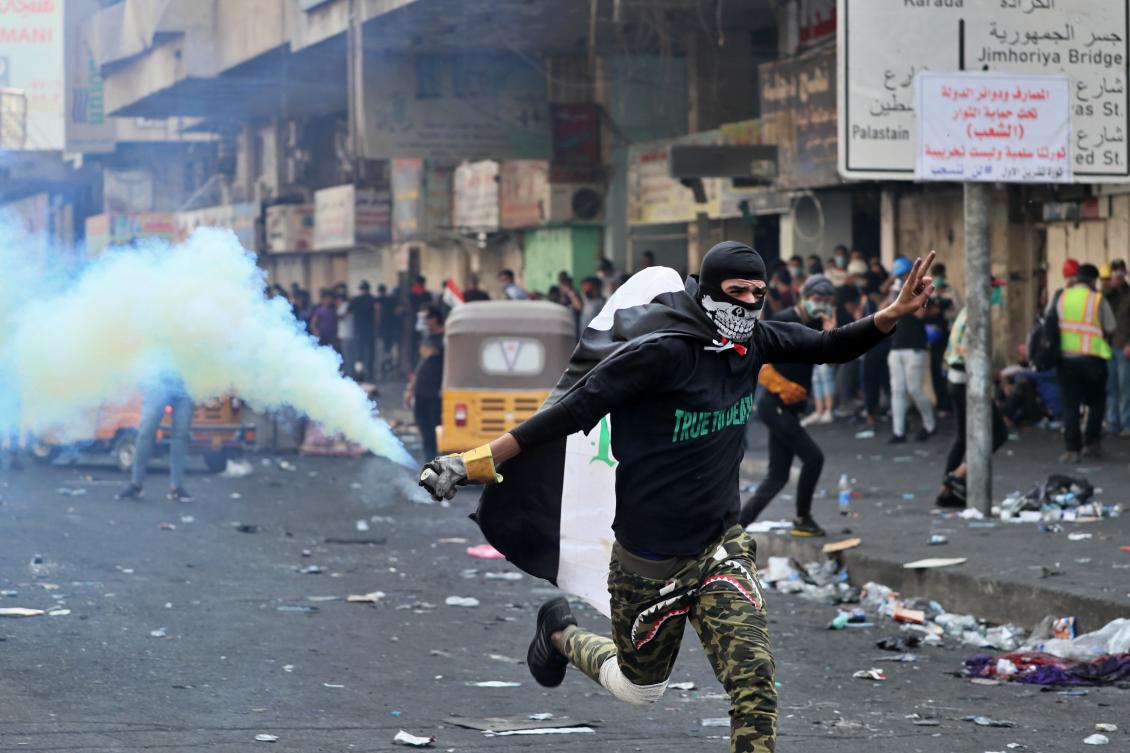
BAGHDAD: Iraqi security forces fired live ammunition and rounds of heavy tear gas in renewed and bloody clashes with anti-government protesters in central Baghdad on Friday, killing three people, while Iraq’s top Shiite religious leader warned its government to heed calls for sweeping political reforms.
Protesters repeatedly regrouped from under clouds of tear gas as they fought to tear down a concrete wall blocking access to Khilani Square. Security forces erected the barrier to keep the demonstrations from crossing a bridge that leads to the fortified Green Zone, the seat of government and many foreign embassies.
Tuk-tuk drivers ferried the injured back to makeshift medical tents stocked with saline used to douse demonstrators exposed to the tear gas. Many retched on the floor when they got there, saying the gas was the strongest they had ever experienced.
“We aren’t afraid of them, the authorities,” said Akeel, 21, who asked to be identified only by his first name. “They have already done their worst and their harsh response makes us stronger.”
Meanwhile, an improvised explosive device went off in Baghdad’s Tayaran Square, killing two people and injuring 12, Iraqi security sources said late on Friday.
It was not immediately clear if the incident was related to anti-government protests going on in the capital’s nearby Tahrir Square. 
At least 320 people have been killed and thousands have been wounded since the unrest began on Oct. 1, when protesters took to the streets in the tens of thousands outraged by what they said was widespread corruption, lack of job opportunities and poor basic services despite the country’s oil wealth.
Hours before the clashes erupted, Grand Ayatollah Ali Al-Sistani emphasized his support for the demonstrators in his weekly Friday sermon, saying none of their demands have been met so far and that electoral reform should be a priority. The senior cleric called for a new election law that would restore public confidence in the system and give voters the opportunity to bring “new faces” to power.
But Iraqi authorities appeared determined to disperse the protesters and keep them confined to a shrinking space in the capital’s center.
The confrontations in Khilani Square began on Friday afternoon after hundreds of protesters who breached the concrete barriers streamed into the square, where they were met by soldiers and riot police.
Around 5:30 p.m., live rounds were heard by The Associated Press several hundred meters from the square, and shortly after wafts of stinging tear gas caused a mass of protesters to run toward the medical tents.
Iraqi security and medical officials, who requested anonymity in line with regulations, said three protesters were killed and at least 25 others wounded.
Several protesters said breaking through the barrier leading to Khilani was key to counter attempts by the security forces to suppress the anti-government movement and limit protesters to the nearby Tahrir Square.
“They are trying to limit us to one place,” said Nashat Akram, 24, recovering in a medical tent in Tahrir square.
The atmosphere at Tahrir was a striking contrast with the violence nearby. Baghdad’s main square has been transformed into a carnival-like hub where protesters gather around music, comic art installations, pop-up food and street shops.
The demonstrations have kept up for weeks in central Baghdad and the mostly Shiite southern provinces, despite the clamp down by Iraqi security forces.
Al-Sistani, who’s opinion holds major sway over Iraqis, said a fair electoral law should give voters the ability to replace current political leaders with “new faces.”
“Passing a law that does not give such an opportunity to voters would be unacceptable and useless,” he said in his weekly sermon Friday.
“If those in power think they can evade dealing with real reform by procrastination, they are mistaken,” Al-Sistani said. “What comes after the protests is not the same as before, so be careful.”
He said corruption among the ruling elite has reached “unbearable limits” while large segments of the population are finding it increasingly impossible to have their basic needs met.
“People did not go out to demonstrations calling for reform in this unprecedented way, and do not continue to do so despite the heavy price and grave sacrifices it requires, except because they found no other way to revolt against the corruption which is getting worse day after day, and the rampant deterioration on all fronts,” he said.
On Monday, Al-Sistani said he backed a roadmap by the UN mission in Iraq aimed at meeting the demands of the protesters, but expressed concern that political parties were not serious about carrying out the proposed reforms.

Main category: 

Iraqis aim to rekindle protests with Iran football matchIraqi PM says needs more time to tackle corruption


Khamenei says Iran wants removal of Israel state not people

Author: 
AFP
ID: 
1573820059627680500
Fri, 2019-11-15 12:10

TEHRAN: Iran’s supreme leader said Friday that calls for the abolition of Israel which have sparked outrage in the West target the “imposed state” not the Jewish people.
Ayatollah Ali Khamenei said the future of the land should be decided by Palestinians of all faiths, Jewish as well as Christian and Muslim.
“The ‘abolition of the Israeli regime’ … does not mean the abolition of Jewish people; we have no problem with them,” Khamenei told a meeting of Islamic countries in Tehran, according to his official website.
It means “abolition of the imposed regime and state, that the Palestinian people, whether Muslim, Christian or Jewish… choose their own government and oust thugs like (Benjamin) Netanyahu,” he added, referring to Israel’s prime minister.
The Iranian government does not recognize Israel, referring to it as the “Zionist regime,” and support for the Palestinian cause has been a constant feature of its foreign policy since the Islamic revolution of 1979.
Iran openly supports Israeli foes like Hamas and Islamic Jihad in the occupied Palestinian territories and Hezbollah in Lebanon.
“We are not anti-semitic. Jews are living in utmost safety in our country. We only support the people of Palestine and their independence,” he said.
Khamenei said that the “enemies of Islam,” including Israel and the United States, seek to sow discord between Islamic countries and called for unity in the face of the “common enemy.”
Tensions between Tehran and Washington have soared since President Donald Trump unilaterally withdrew from a landmark 2015 nuclear deal last year and reimposed crippling sanctions as part of a policy of “maximum pressure.”
Since then the arch-foes have come to the brink of military confrontation after drones were downed and tankers and Saudi oil installations mysteriously attacked.

Main category: 

Iraqis aim to rekindle protests with Iran football matchSweden detains Iranian on suspicion of murder in Iran in 1988