Artists take a stand in Lebanon’s peaceful uprising

Sat, 2019-11-16 22:59

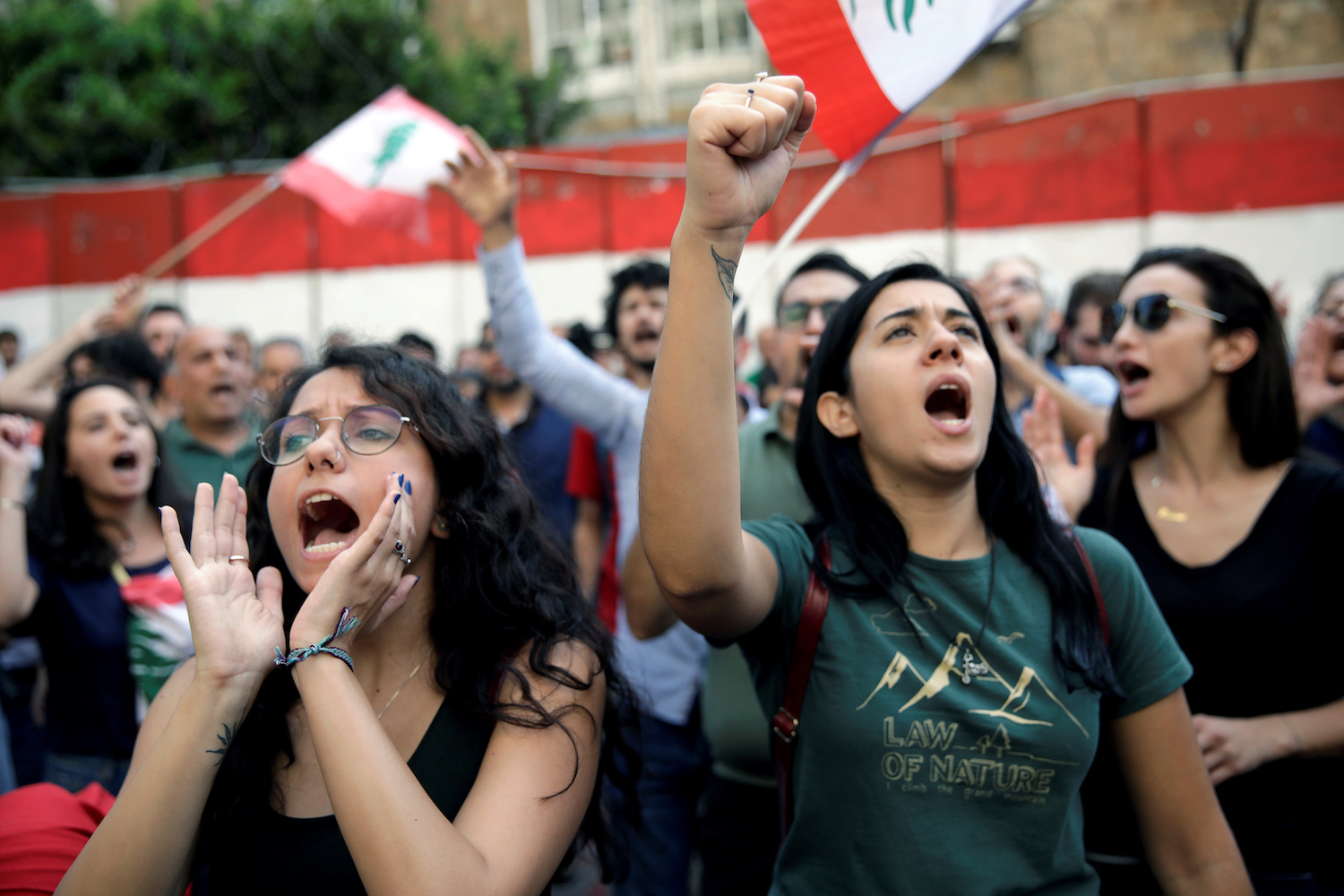
BEIRUT: Cries were heard in the town of Khaldeh, south of Beirut, on the night of Nov. 12. They were different from the sounds that have become the background noise of the Lebanese Revolution.

A soldier had killed Alaa Abou Fakher, a local official from the Progressive Socialist Party headed by Walid Jumblatt, a political leader of Lebanon’s Druze community, marking the third death in 27 consecutive days of protests.

The killing has escalated tensions that were already running high amid a nationwide protest movement that started off as a reaction to proposed new taxes before morphing into a veritable “people power” movement.

Protesters are demanding changes to Lebanon’s sectarian system of government, calls that have prompted the resignation of Prime Minister Saad Hariri and will likely lead to more departures.

Meanwhile, what blankets the revolution’s walls of Martyrs’ Square; the ring (the tunnel linking west Beirut to east Beirut); the ESCWA (the UN Economic and Social Commission for West Asia) boundary wall; the area next to Parliament; throughout Tripoli; and in countless other places is another form of protest: Art.

“The art we were trying to express has documented almost all the incidents of the revolution so far, day by day,” said Said Fouad Mahmoud, a graffiti artist who has been practicing for 11 years. “Some people are good with speech, others with song, and we raise our voices with drawings. I drew pictures of the moments that affected me the most: The role of the female in the revolution; the guy cleaning with one leg; and the first day of the revolution, with the flag and the fire.”


Graffiti by Said Fouad Mahmoud. (Supplied)

Many of the progressive-graffiti-laden walls fall under the umbrella of Iman Nasreddine Assaf’s Art of Change initiative, which she founded in May in partnership with local Beirut-based NGO Ahla Fawda and UK-based Where There’s Walls.

“Our purpose is to promote urban art to more than just the graffiti scene in order to spread important messages throughout the community,” said Assaf. “Our revolution walls are in support of, and part of, the demonstration and revolution. They are expressing people’s pain and demands and the impact has been strong. Art is the international language that touches all.”

Art has emerged as a favored medium of the revolutionaries to convey their political message. To this end, Art of Thawra (Art of Revolution), an Instagram page, is collecting and showcasing relevant artworks produced during the 2019 protests.

“There’s been a drastic increase in street art during this revolution,” said Mahmoud. “People are trying to send messages through their paintings. The art indicates how civilized people have been during the protests and how peaceful the revolution has been until now. I hope it will remain peaceful until the end. If it does, then it means art played a major role in this revolution because art is peace in itself.”

Lebanon’s contemporary art community has issued numerous statements regarding the closures of spaces, programs and exhibitions as artists, curators, and gallerists participate in protests for non-sectarian unity. Beirut’s art community had just assembled for the Home Works event when the protests began on Oct. 17.

The message from the organizers, Ashkal Alwan, postponing the event stated: “Artistic and cultural institutions and initiatives are in no way isolated from broader civic, political, economic, and ideological context but rather shaped as a result of and in response to historical events and their repercussions.”

On Oct. 25 the Beirut Art Center sent out a similar statement: “In solidarity with and participation in the popular uprisings taking place across Lebanon against the current systems of power, we the undersigned cultural organizations and structures collectively commit to Open Strike, and call for our colleagues in the cultural sector to join us.”

Another artistic expression of solidarity is visible at leading Lebanese art dealer Saleh Barakat’s space in the Clemenceau area of Beirut. On Nov. 8 he opened a show featuring an installation by Palestinian Beirut-based artist Abdul Rahman Katanani.


Graffiti by Said Fouad Mahmoud. (Supplied)

A series of temporary abodes made using painted scrap metal and wood, and surrounded by barbed wire — much like the surroundings of the Sabra refugee camp where the artist lives — were stationed throughout the gallery.

Katanani’s immersive and precarious installation, on view until Jan. 4, asks the question: What future awaits Lebanon?

“Many are now trying to figure out a good balance between getting their work done and participating in the public upheaval,” said Basel Dalloul, founder and director of the Dalloul Foundation. “Cultural production in all its forms can and will be one of the economic drivers of a future Lebanon.”

Ayman Baalbaki, one of Lebanon’s most recognized painters, “is not involved in creating art right now,” said Barakat. “He is going to all of the protests and is completely involved in the need for political change.”

The design duo David Raffoul and Nicolas Moussallem, whose studio goes by the name David/Nicolas, said in a statement: “What’s happening today is very important for all of us Lebanese who would like a brighter and honest future where corruption is not surrounding us.

“We are trying to work but it is not easy. Right now we are focused on how we can help our country.

“On the other hand, creativity is stronger because the revolution gives you such a push.

“Most places are closed and open spontaneously. Thank goodness for social media, so that we can show what we are doing to the world.” 

Marwan Sahmarani, a Lebanese painter known for his bold abstract canvases replete with their gestural brushstrokes and vibrant coloring, noted the difficulty of working during a time of turmoil.

“It’s a disturbing moment for everyone,” he said. “There are many feelings, good and bad. I divide my time when needed between my studio and the street. But what do I paint that can be relevant now and not fall into a journalistic rendering of current events?”

Individuals in the creative scene have joined hands in camaraderie to produce several initiatives in solidarity with the protesters. One is Nour Al-Thawra, staged by Sara Beydoun, founder of Lebanese fashion house and social enterprise Sara’s Bag, and her friend Mariana Wehbe.

On the evening of Nov. 6, a group of Lebanese women gathered in Martyrs’ Square, each carrying a lighted candle. “Let’s light a candle for the strength we have shown and the resilience that will never die,” wrote Beydoun on her Instagram account. “Bring a candle and your peaceful prayer and let’s combine all of our strengths to light up Martyrs’ Square.”

Beydon told Arab News: “We all want one thing — the Lebanon we dream of.”

Wehbe agreed. “Sarah and I have been on the ground since day one,” she said. “Like every Lebanese woman from this revolution, each one of us is trying to find her way to help, support and move this forward.”

The candle-bearing crowd of women, which the pair turned into a moving video that went viral, was driven by the need to create a “peaceful symbolic prayer.”

“It was a prayer for our country, for our future, for unity, no matter where you come from and what your religious beliefs are,” said Wehbe. “It is a symbol of unity and protection for love, compassion and for our home, Lebanon.”


Main category: 

Medics protest economic crisis in LebanonWikipedia the latest battleground in Lebanon’s protests



Egypt to reduce subsidised staple food prices

Author: 
Reuters
ID: 
1573916154106997700
Sat, 2019-11-16 14:53

CAIRO: Egypt is to reduce the prices of subsidised food staples from next month, the supply ministry spokesman said Saturday, as the country’s economy shows signs of recovery.
“Prices of cooking oil, sugar, rice and flour will be reduced starting the first of December,” said spokesman Ahmed Kamal.
He said the measures aimed to make goods available “in suitable quantities and prices”.
Last month, the government reinstated 1.8 million Egyptians to a food subsidy programme as instructed by President Abdel Fatah El-Sisi.
Also in October, fuel prices were cut by 25 piastres (0.015 US cents) a litre following several rounds of price hikes under a tough austerity programme that triggered popular discontent.
The measures came after rare and small-scale protests in September calling for El-Sisi’s removal after an exiled Egyptian businessman accused the president and top military brass of corruption.
Harsh austerity measures introduced by El-Sisi’s government since he took office in 2014 have hit poor and middle-class Egyptians.
Nearly one in three Egyptians lives below the poverty line, according to official figures released in July.
The tough reforms including subsidy cuts and a devaluation of the local currency were tied to a three-year $12-billion bailout loan from the International Monetary Fund secured in 2016.
The IMF loan was disbursed in full earlier this year, in a boost for the economy.
Egypt’s economy was sent into a downward spiral by the 2011 uprising that toppled longtime autocrat Hosni Mubarak and has also been hit by extremist attacks that damaged its vital tourism sector.
But the official statistics agency said inflation fell to its lowest level in nearly a decade last month, easing to 2.4 percent compared with 17.5 percent a year earlier.

Main category: 
Tags: 

Egyptian woman fights unequal inheritance lawsUAE, Egypt plan $20 bln spending on social, economic projects


Lebanese police to boost security near banks amid unrest

Author: 
Reuters
ID: 
1573905873636072900
Sat, 2019-11-16 11:43

BEIRUT: Lebanese security forces will boost measures near the country’s banks that have been closed for more than a week over fears by employees for their safety amid nationwide unrest, police said Saturday.
Police said in a statement that there will be more patrols near banks and two policemen will be stationed outside every branch.
Lebanon’s financial troubles have worsened since mass protests began on Oct. 17 over a plunging economy, and snowballed into calls for the entire political elite to step down.
An Interior Ministry statement said police commander Maj. Gen. Imad Othman met with banking officials and they agreed to take the measure “in order to guarantee the work of this vital sector.”
Banks reopened Nov. 1 after a two-week closure because of the mass anti-government protests. But depositors have rushed to withdraw their money while lenders imposed varying capital controls, adding to the turmoil.
In some banks, customers insulted employees after they were told they cannot withdraw as much money as they want. The banks closed again on Nov. 9, and employees have been on strike since then.
Lebanon is passing through its worst economic and financial crisis in decades. The small Arab country is one of the most heavily indebted countries in the world and was already dealing with a severe fiscal crisis before the protests began, one rooted in years of heavy borrowing and expensive patronage networks run by entrenched political parties.
The Lebanese pound is trading at up to 1,900 to the dollar on the black market, a devaluation of nearly 30% from the official rate that has been fixed since 1997.
Confidence in the Lebanese economy received another blow late Friday night when Standard & Poor’s downgraded the country’s credit ratings to ‘CCC/C’ from ‘B-/B’.
The agency said the outlook for Lebanon is negative in what “reflects the risk to the sovereign’s creditworthiness from rising financial and monetary pressures tied to widespread protests and the resignation of the government.”
Prime Minister Saad Hariri resigned his government on Oct. 29, meeting a key demand of the protesters. Since then President Michel Aoun has failed to call for consultations with heads of parliamentary blocs to name a new premier, raising concerns that the formation of a new Cabinet could be delayed.
“Recent temporary but prolonged bank closures and unofficial foreign currency transfer restrictions raise questions about the sustainability of the exchange rate regime, further eroding confidence,” S&P warned.

Main category: 

S&P downgrades protest-hit LebanonMedics protest economic crisis in Lebanon


Protest graffiti fills Beirut’s posh downtown

Author: 
AFP
ID: 
1573902400565856400
Sat, 2019-11-16 11:04

BEIRUT: A majestic phoenix spreads its wings as Hayat Nazer adds a splash of color to a Beirut wall. As Lebanon’s uprising enters its second month, graffiti has enveloped the capital’s posh downtown.
Since October 17, the chanting of tens of thousands of Lebanese denouncing the political elite have shaken the normally staid district around two Beirut squares — Martyrs’ and Riad Al-Solh.
Nazer, a 32-year-old artist, is one of the protesters who would not normally frequent the area, famed for luxury boutiques and elegant buildings. But the unprecedented protests also offered her a first experience with street art.
“I decided to go out in the street to be inspired by the people,” she said during a cigarette break, standing next to pots of red, green and yellow paint.
Then she turned to place the final brushstroke on the mythical bird emerging from a burning forest — a reference to the fires that ravaged Lebanon’s mountains shortly before the protests began.
“The phoenix reminds us that the Lebanese shouldn’t lose hope. When we fall, we need to rise up and fly to freedom, to claim our rights,” she said.
The long concrete barrier Nazer was painting protects a United Nations building, but has been named the “wall of the revolution” for the graffiti adorning it.
A ballerina pirouettes under shells, accompanied by the slogan “Rise up.” Further down, a big purple hand flashes a V for victory.
On nearby buildings, various causes are championed with spray-painted and stenciled slogans: “Our revolution is feminist”; “LGBT rights, love is not a crime“; and “We will burn your palaces.”
Political leaders are lampooned in caricature, including outgoing Prime Minister Saad Hariri, longstanding parliament speaker Nabih Berri, and central bank governor Riad Salameh.
The contrast is striking compared with the nearby opulence of a district that was controversially rebuilt after being ravaged during the 1975-1990 civil war.
Today a Rolex clock tower stands in front of a parliament cordoned off by security forces. Working-class souks have been replaced by a modern commercial center, home to banks and French luxury brands.
The reconstruction of the district, famed for its stone buildings in neo-Venetian and neo-Moorish style, was led by Solidere, the real estate company of billionaire former prime minister Rafiq Hariri.
Its detractors say the project killed the soul of a formerly vibrant neighborhood in order to attract Gulf investment and wealthy tourists.
“This city has become an icon of capitalism,” said artist and rights activist Selim Mawad.
He jumped onto a plastic barricade to retouch a mural of stylized bulls alongside the slogan: “What is the future of our revolution?”
Lebanon’s uprising — like protests elsewhere in the Middle East and Latin America — is both political and social.
“It’s also about personal liberation, which is the foundation of a revolution,” Mawad said.
He sees symbolism in graffiti.
“People say, ‘I can’t touch this building, I can’t live there, so I’ll leave my mark on it’,” the paint-spattered artist said.
One day, assailants attacked the protesters in the area where Mawad was painting his mural. He was beaten and his bicycle stolen.
“Give back the stolen money — and don’t forget the bike,” he later painted next to a picture of a bull brandishing a red bicycle.
He hopes the paintings will be preserved. “It’s the memory of an uprising. If they erase them, we will forget.”
Nearby, Rida Mawla left a meeting and decided to take a walk in the city center, something he said he never previously did.
“I’m starting to feel like downtown is a bit more like me,” the business consultant said.
“In theory it’s the place where everyone should meet, but the ruling class has taken possession of it,” he said.
He pointed out his favorite graffiti, a big black tag scrawled on a wall: “Beirut has spoken.”

Main category: 
Tags: 

Lebanese students join Beirut protestsProtesters block roads in Beirut, other parts of Lebanon


Car bomb kills at least 18 in Syrian town held by Turkey

Author: 
Reuters
ID: 
1573901430055804500
Sat, 2019-11-16 10:46

ANKARA: A car bomb exploded Saturday in a northern Syrian town controlled by Turkey-backed opposition fighters, killing at least 18 people and wounding several others, Syrian opposition activists and Turkey’s Defense Ministry said.
Northern Syria has been hit by several explosions that have killed and wounded scores of people over the past month. That’s since Turkey began a military operation against Kurdish fighters in the wake of President Donald Trump’s decision to pull the bulk of American troops out of northern Syria.
The Britain-based Syrian Observatory for Human Rights reported that 19 people, including 13 civilians, were killed Saturday in the town of Al-Bab in Aleppo province. The Aleppo Media Center, an activist collective, said 15 people were killed in the blast in a busy part of town near a bus station.
Turkey’s Defense Ministry said the blast killed 18 people and blamed the main Kurdish militia, known as the People’s Protection Units.
It is not uncommon for reports to give differing casualty figures in the immediate aftermath of this kind of attack.
No one claimed responsibility for the attack.
A video posted online by Albab City, an activist collective, showed several vehicles on fire with black smoke billowing from a wide street with shops on both sides. Inside the bus station, several white minibuses appear damaged.
“It looks like doomsday. May God help us,” a man could be heard saying as five young men carried a wounded person away. At least two bloodied and wounded men could be seen rushed away on motorcycles.
Turkey-backed opposition fighters took control of parts of Aleppo province, including the towns of Al-Bab and Afrin, in previous military offensives in 2016 and 2018, respectively.
The past month’s attacks have come amid an expanding Turkish invasion of into northeast Syria against Kurdish-held towns and villages along a stretch of the border.
Three car bombs went off Monday in the northeastern Syrian town of Qamishli near the border with Turkey, killing at least six people, according to activists and Syria’s state news agency SANA.
On Nov. 2, a car bomb killed 13 people in the northern Syrian town of Tal Abyad, which is also held by Turkey-backed opposition fighters.
The Turkish offensive has aimed at pushing Kurdish fighters away from the border. Those Kurdish fighters had been key US allies in the fight against the Islamic State group. Turkey considers the Syrian Kurdish fighters terrorists linked to a Kurdish insurgency within Turkey.
Turkish forces have consolidated control over a stretch of the border running 120 kilometers (70 miles) wide and 30 kilometers (20 miles) deep into Syria. They have also kept up pressure outside that area, fighting with Kurdish forces on the edges.
Syrian government forces and their Russian allies have moved into other parts of the border under a Russian-Turkish deal.

Main category: 
Tags: 

Syria’s Assad says ‘resistance’ will force US troops outDozens attend funeral of Daesh-slain priest in northeast Syria