Turkey targets Somalia for oil drilling

Author: 
Thu, 2020-01-23 01:12

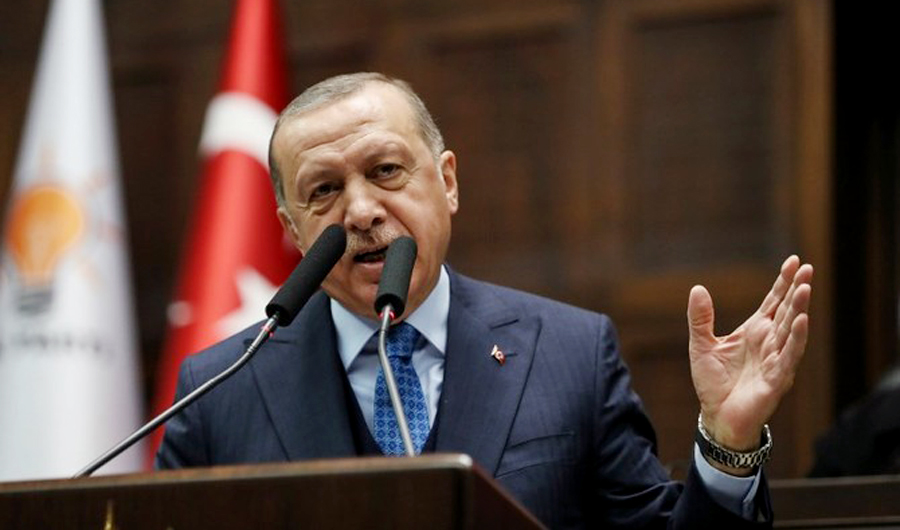
ANKARA: Turkey is to drill for oil off the shores of Somalia after an invitation from the Horn of Africa nation to explore its seas, President Recep Tayyip Erdogan said. 

Somalia adopted a new petroleum law last week to attract further foreign investment in the energy field, and opened up 15 blocks for oil companies that are willing to explore the country’s hydrocarbon potential.

Turkey has been increasing its footprint in Somalia, especially since 2011 when it began providing the country with humanitarian aid to tackle a famine problem, and is also signing energy and resource deals with African countries.

It will start exploring for gas in the eastern Mediterranean this year after signing a maritime agreement with Libya, and has a deal with Niger to carry out mineral research and exploration activities.

“There is a proposal from Somalia,” Erdogan said on Monday. “They are saying: ‘There is oil in our seas. You are carrying out these operations with Libya, but you can also do them here.’ This is very significant for us.” Turkish engineers are carrying out infrastructure work in Somalia, but contractors are increasingly being targeted in terror attacks.

Local forces have been trained by Turkish officers at a military base that was built by Turkey in the Somali capital Mogadishu.

Ibrahim Nassir, an Africa analyst from Ankara-based think tank Ankasam, said the Somali drilling offer might be payback for some of the reconstruction work and humanitarian aid. But he also suggested that Somalia might be using Turkey as a counterbalance against its regional rivals.

FASTFACT

Turkey has been increasing its footprint in Somalia, especially since 2011 when it began providing the country with humanitarian aid to tackle a famine problem, and is also signing energy and resource deals with African countries.

“The dispute over maritime territory in the Indian Ocean between Kenya and Somalia might result in security risks during drilling activities, and some armed groups may be used to prevent Ankara from proceeding with hydrocarbon exploitation,” he told Arab News.

Jędrzej Czerep, a senior analyst at the Polish Institute of International Affairs, said that Turkish oil extraction from Somalia could be presented as stealing national wealth.

“That would expose the Turks to greater risks both on the mainland and at sea where Al-Shabab is using motor ships. It could also divide the growing Somali diaspora in Istanbul or even radicalize some of its members,” he told Arab News.

An unstable political situation in Somalia could expose Turkey further, according to Atlantic Council senior associate Charles Ellinas. The third Turkey-Africa Partnership Summit is set to be held in April in Turkey.

“It is not just the short term one should be worried about,” he told Arab News. “It is also the longer term. It takes something like 20 years to recover the investment from an oilfield. And during that period oil sales must be maintained. As things stand, with a very unstable political environment, upheavals in Somalia over such a period are quite likely.”
Main category: 

Erdogan says Somalia has invited Turkey to explore for oil in its seasCyprus: Turkey may have stolen data for latest gas drilling


US says Hezballah works for the Iranian regime, not the Lebanese people

Wed, 2020-01-22 23:33

LONDON: Hezbollah works for the Iranian regime and not the Lebanese people, a senior US diplomat said as he urged European countries to impose an outright ban on the group.
Richard Grenell, the ambassador to Germany, made the plea as Lebanon formed a new government made up of ministers nominated by the militant, Iran-backed organization and its allies
The European Union lists Hezbollah’s military wing as a banned terrorist group, but not its political wing, which has been part of Lebanese governments in recent years.
“The EU thus maintains an artificial distinction between Hezbollah’s ‘political wing’ and ‘military wing,’ a division the terror group itself does not recognize,” Grenell said in an opinion article published by Politico.
“The EU’s stated intent for creating this false distinction is to preserve an open channel with Hezbollah and its representatives in the Lebanese government,” he added.
“An EU-wide designation of Hezbollah is necessary to deny it the vast European recruiting and fundraising networks it needs to survive.”

Grenell said the German parliament last month called on the government to ban the activities of Hezbollah and for the group to be put on the EU’s terrorist list.
The entire Hezbollah organization is designated as a terrorist group by the US, the UK, Canada, the Netherlands, Saudi Arabia and Gulf states among others.
US Secretary of State Mike Pompeo last week called on “all nations” to classify Hezbollah as 
terrorist after the UK said it had added the entire movement to its terrorism blacklist and frozen all its assets.
“Designating Hezbollah as a terrorist organization does no harm to US-Lebanese relations, but it does empower the US to disrupt the international criminal networks that help fund Hezbollah’s support for the (Syrian President Bashar) Assad regime and Iran’s Islamic Revolutionary Guard Corps,” he said.
Hezbollah’s large role in the formation of Lebanon’s new government under Prime Minister Hassan Diab is expected to raise concerns over the scale of the group’s hold over the country. The cabinet formed under Prime Minister Hassan Diab is facing mass protests and a dire economic crisis.
Grenell said EU states struggle to reach a consensus on “Hezbollah’s legitimacy due to its political role in Lebanon.”
Washington is “resolute in its efforts to stop the spread of Hezbollah’s terror, but we cannot contain the threat on our own,” he said.

Main category: 

New government shows Hezbollah ‘takeover of Lebanon is complete’Honduras declares Hezbollah a terrorist organization


Arab leaders call for greater understanding across region

Author: 
Jumana Khamis
ID: 
1579721758044123000
Wed, 2020-01-22 22:36

DUBAI: Countries need to respect the sovereignty and boundaries of their neighbors, while empowering Arab youth, if the region’s political and economic situation is to be improved, Omar Al-Razzaz, Prime Minister of Jordan and Minister of Defense said at the second day of the World Economic Forum (WEF) in Davos, Switzerland.

Speaking Wednesday on a panel ‘examining the geopolitical outlook of the Middle East and North Africa,’ Razzaz said Arab states needed to reflect on the region’s history in the last decade, and “draw lessons” to ensure the upcoming decade is one of prosperity.

“We must re-examine the model where we are constantly undermining countries’ sovereignties and boundaries and we must be very careful with the sorts of interventions we take part in regionally and globally,” he said.

Describing the Middle East as a “youth-orientated region,” with an average age of 35, he called on Arab states to shift their focus to investing in today’s young.

“We need to engage youth and hear their voices both politically and economically,” he said, adding that the region needed to deal with the refugee situation.

Razzaz emphasized the importance of extending support to host countries of those displaced, describing the migrant crisis as a “global” — not just Jordanian – issue, adding that they accounted for 20 percent of Jordan’s population.

“When we don’t support countries that host refugees… what is the message in principle that we are sending to others that are opening their arms to refugees?” he asked.

With well over a million displaced people residing in Jordan, the government’s annual spending on refugees has reached $2.4 billion, said Razzaz, adding that aid covered only 42 percent of the cost.

According to the United Nations Higher commissioner for Refugees (UNHCR) Jordan ranks among the highest impacted by the Syria crisis, hosting the second biggest share of refugees per capita in the world.

“This part of the world has decided they don’t want to deal with refugees from the region, and that is their right… but we must get over the donor fatigue issues,” said Razzaz.

He said no hate crimes had been committed against the 85 percent of Syrian refugees living in Jordan’s cities.

“We [Jordan] are proud of that because we are all trying to bear the burden together despite of challenges,” he added.

On his country’s progress, Razzaz said Jordan had presented a model that “shows political and economic resilience,” noting that exports had grown by 9 percent and tourism by 10 percent in 2019.

But he said Jordan continued to face “tremendous challenges.”

“We have high unemployment rates and we have youth who want jobs and want to be productive,” he said, adding that they made their calls through peaceful protest.  

“It is their right to go to the streets and ask for more jobs, and it’s our responsibility to make it happen,” he said.

Sharing his view on the region’s geopolitics, Yousuf Bin Alawi Bin Abdullah, Oman’s Minister of Foreign Affairs, who has held the same position for 48 years, said Arab governments should focus on building a positive future for the Middle East, one that involves the new generation.

He referred to conflicts in the region — including the Israeli- Palestinian situation — as “man-made” problems based on “tactics” that work to protect individual interests.

Main category: 

Jordan WEF event to focus on ‘new platforms of cooperation’AS IT HAPPENED: Davos 2020 Day Two – Middle East geopolitics and more


Manila to join inquiry into Filipino maid’s death in Kuwait

Author: 
Wed, 2020-01-22 22:00

MANILA: Kuwait will allow the Philippines to join an investigation into the death of a Filipino maid allegedly killed by her employer last December.
Details of the decision were announced by Kuwait’s Deputy Foreign Minister, Khaled Al-Jarallah, in a meeting with Philippines presidential adviser Abdullah Mama-o and envoy Noordin Lomondot last week.
The officials also discussed the Philippines’ decision to stop its citizens working in Kuwait until an inquiry into the death of Jeanelyn Villavende has been completed and Kuwait honors a labor agreement signed by the two countries in 2018.
Mama-o praised the Kuwaiti government for its handling of the Villavende case, including the arrest of her employers.
Kuwaiti authorities have not released the names of her employers who have been jailed since the incident. Kuwait’s Foreign Ministry is expected to release details of a police investigation and autopsy reports soon.
The Philippines and Kuwait also agreed to hold a joint meeting on a 2018 agreement on the employment of domestic workers.
Assistant Secretary Eduardo Meсez, a Department of Foreign Affairs official, told Arab News that Kuwait had “voiced its dismay over the Philippine government’s decision to impose a ban on the deployment of workers (to their country).”
Kuwaiti Assistant Foreign Minister for Consular Affairs Samie Al-Hamad said that the “appalling crime” is uncommon and “against our Islamic values.
“The legal action taken against the culprits reflects Kuwait’s keenness to apply the law, and guarantee the safety and protection of all those living on its soil,” Al-Hamad said.
Kuwait is a “favorable destination” for people of different nationalities, including 250,000 Filipino workers, he added.

Main category: 

Philippine, Kuwaiti officials meet amid labor banManila calls for ‘swift justice’ over death of Filipino worker


Iraq activist shot dead as anti-government protesters block roads

Author: 
Wed, 2020-01-22 21:29

BASRA: An anti-government activist was killed in Iraq’s south by unidentified gunmen, amid a resurgence of rallies and road closures by protesters pressing authorities to implement long-awaited reforms.
The youth-dominated movement is desperately trying to maintain momentum in the face of spiralling US-Iran tensions and a rival anti-American rally planned for Friday.
But as they escalate their demonstrations, they have also faced a new wave of violence.
Late Tuesday night, a female activist was killed by unidentified assailants as she was returning home from protests in the oil-rich port city of Basra.
“Civil society activist Janat Madhi, 49, was shot on Tuesday night around 11:00pm (2000 GMT) by armed men in an SUV,” a police source said, adding that five people including at least one other activist were wounded.
A source at the city’s forensics lab confirmed to AFP that Madhi suffered gunshot wounds.
Activists have for months complained of an intensifying campaign of kidnappings and killings that they say is meant to scare them into halting protests.
They are also worried about tensions with a competing rally this Friday organized by populist cleric Moqtada Sadr that will call for the 5,200 US troops deployed in Iraq to leave.
To simultaneously head off that protest and ramp up pressure on authorities, demonstrators this week launched sit-ins in new areas and shut roads with burning tires.
Their main demands include early elections under a new voting law, an independent premier and accountability for corruption and killings of protesters.
More than 460 protesters have been killed since the rallies first erupted in October, fueled by anger over graft and a lack of jobs that ballooned into demands for systemic reform.
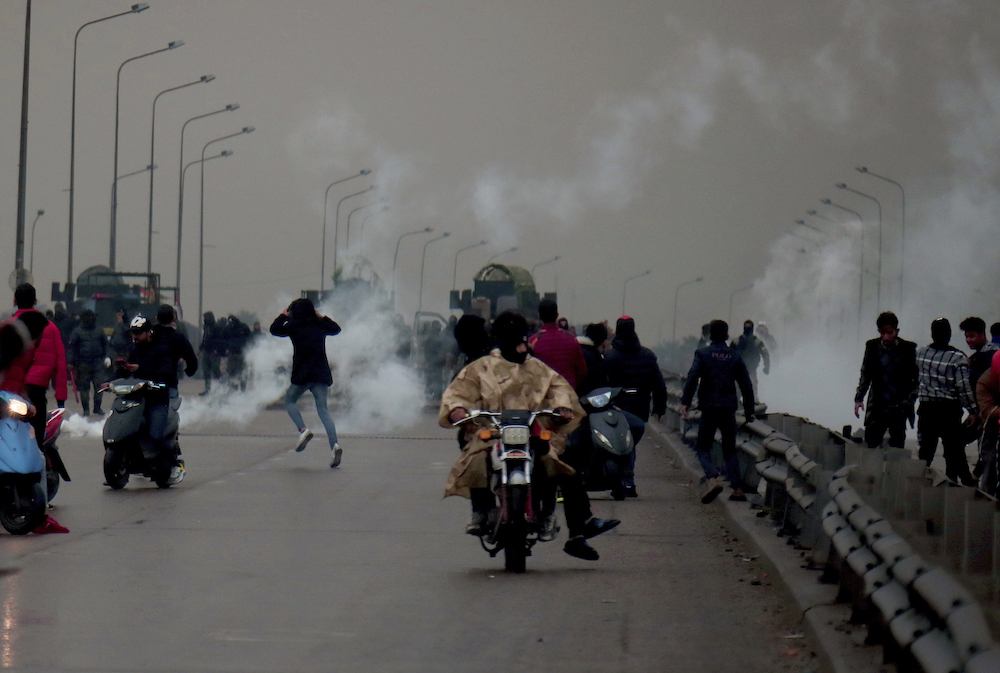
On Monday, three protesters were killed in clashes with security forces in Baghdad and another demonstrator died on Tuesday after a tear gas canister punctured his skull.
Rights groups accuse security forces of improperly using military-grade gas canisters — up to 10 times heavier than those designed for use against civilians — by firing them directly at crowds rather than into the air.
Demonstrators are outraged that only a handful of security force personnel have been charged with excessive violence and no perpetrators of hit-and-run attacks have been pursued, whereas protesters have been swiftly arrested for shutting down streets.
Blocking roads has been a key tactic this week, with protesters cutting streets and national highways around the capital on Wednesday.
Under a winter drizzle, they erected metal barricades to block the Mohammad Al-Qasim thoroughfare which cuts through eastern Baghdad.
Protesters wore plastic ponchos to protect against the rain, balaclavas so they could not be identified by security forces and brightly-colored party hats to lighten the mood.
Roads were cut and government offices closed across the Shiite-majority south too, including the holy city of Najaf and the cities of Al-Hillah and Diwaniyah.
In the protest flashpoint of Nasiriyah, burning tires and a sit-in blocked highways leading into the city for the third straight day.
“We’ll keep shutting roads and getting protesters into the street to keep these important demonstrations going,” said Aqil Al-Zamili, a 50-year-old activist there.
The key demand, Zamili said, was “the end of this ruling class — which in our view has wreaked havoc on Iraq by formalising sectarian power-sharing.”
The road closures have left hundreds of tankers carrying oil products north toward central Baghdad stranded outside the capital.
They also forced a shutdown at the main oil field northwest of Nasiriyah, the capital of Dhi Qar province, a source at the state-owned provincial oil company told AFP.
“Production… was halted for the third consecutive day because transport routes leading to the field are cut,” the Dhi Qar Oil Company source said.
The source said the field produces up to 100,000 barrels per day.
Oil-rich Iraq is OPEC’s second-biggest crude producer, logging around 3.4 million bpd of exports.
But public services are failing, unemployment is high and one in five people live in poverty, according to the World Bank.
The current government, in power since late 2018, had pledged to address those issues but it barely served a year before the sweeping protests prompted its head, Prime Minister Adel Abdel Mahdi, to step down.
He submitted his resignation letter to parliament in December but has continued to run the government in a caretaker role.
Political factions have failed to agree a successor and protesters have demanded a new premier untainted by prior involvement in the country’s politics.

Main category: 

Trump agrees US-Iraq ‘security partnership’Three Iraqi protesters killed and dozens wounded as anti-government unrest resumes