Syrian government forces enter Saraqeb, east of Idlib city

Author: 
Reuters
ID: 
1580928555343562300
Wed, 2020-02-05 18:31

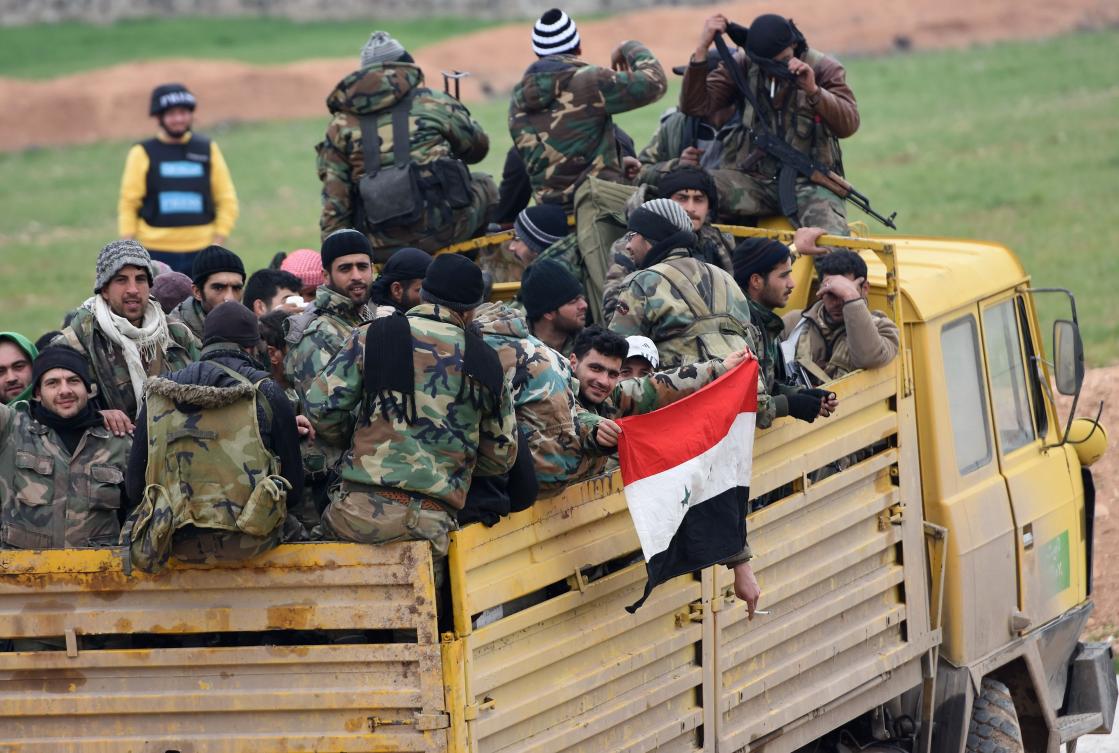
BEIRUT: Syrian government forces entered Saraqeb in northwestern Idlib province, a war monitor and eye witnesses said on Wednesday, in a renewed push by President Bashar Assad to recapture the last rebel stronghold.
Saraqeb, a town 15 km (9 miles) to the east of Idlib city, lies at the junction of two main roads that Damascus seeks to fully control. Syrian state TV said on Wednesday that the roads were now within firing range of government forces.

The United States is “very very worried” about the escalation in Syria’s northwestern province of Idlib, led by an assault by Syrian government forces and supported by Russians, and was also seeing active support of Iranian militia and Hezbollah on the ground, the top US envoy for Syria said on Wednesday.
“This is a dangerous conflict. It needs to be brought to an end. Russia needs to change its policies,” James Jeffrey, US Special Representative for Syria Engagement and fight against Daesh told reporters in a briefing.
The Idlib violence has accelerated in recent months despite several cease-fire efforts, including as recently as January.
“We’re seeing not just the Russians but Iranians and Hezbollah actively involved in supporting the Syrian offensive. We don’t know whether the offensive is just to get to the M4-M5 road, or it may continue further,” Jeffrey said, in reference to the strategic highways connecting Syria’s Aleppo to Hama and Latakia on the Mediterranean coast.
Jeffrey also said there have been more incidents of Russia violating the terms of the mutual de-confliction agreement in northeastern Syria, in what appeared to be an attempt to challenge the US presence in the region.

Main category: 

UN chief calls for end to hostilities between Turkey and Syria in IdlibTurkey won’t allow Syrian forces to gain ground in Idlib, says Erdogan


Clashes in Iraq’s Najaf kill 7 after cleric’s followers storm protest camp

Author: 
Reuters
ID: 
1580927291493471300
Wed, 2020-02-05 18:25

BAGHDAD: At least seven people were killed in clashes in Iraq’s southern city of Najaf on Wednesday after supporters of populist cleric Moqtada al-Sadr stormed an anti-government protest camp, medical and security sources said.
The medical sources said at least 20 more were wounded in the violence but did not provide further details.
The security sources said that supporters of Sadr, known as blue hats for the blue caps they often wear, had tried to clear the area of anti-government protesters, who in turn tried to stop them.
Fights broke out between both groups, the blue hats threw petrol bombs at protester tents and live gunfire rang out shortly afterwards, wounding and killing six people, they said.
Sadr has at different times both supported and abandoned Iraqi protesters who demand a removal of the entire ruling elite.
He urged followers last week to help authorities bring “day to day life” back to Iraq’s streets by clearing roads blocked by sit-ins and ensuring businesses and schools can reopen after months of protests in which nearly 500 people have been killed in clashes between protesters and security forces.
Sadr has also urged the blue hats to allow protests to continue. 

Main category: 

Iraqi protesters face off against cleric Moqtada Sadr’s followersIraq condemns attack on Iran’s consulate in southern Najaf – Foreign Ministry


Iraqi officials say Baghdad wants to minimize reliance on US

Author: 
By QASSIM ABDUL-ZAHRA and SAMYA KULLAB | AP
ID: 
1580921687933071400
Wed, 2020-02-05 15:34

BAGHDAD: The Iraqi government has told its military not to seek assistance from the US-led coalition in operations against the Daesh group, two senior Iraqi military officials said, in the latest tensions between Washington and Baghdad after an American strike killed a top Iranian general and Iraqi militia commander.
Officially, the Iraqi military announced Jan. 30 that it and the coalition resumed joint military operations after a three-week halt. The pause was called amid soaring tensions following the Jan. 3 US airstrike ordered by President Donald Trump that killed Iranian Gen. Qassem Soleimani and senior Iraqi militia leader Abu Mahdi Al-Muhandis.
But in practice, Iraqis are seeking to minimize coalition assistance against Daesh, based on government orders, two Iraqi military officials and one militia official said this week.
“After the killing of Soleimani, the Iraqi government decided to inform us formally not to cooperate and not to seek assistance from the US-led international coalition in any operation,” a senior military intelligence official told The Associated Press.
The US-led coalition paused its mission to fight Daesh in Iraq on Jan. 5 in the wake of the strike. That same day Shiite lawmakers, irate by what they called a flagrant violation of sovereignty, pushed a non-binding resolution requesting that the government cancel legal agreements that provide the basis for US troop presence in the country.
Outgoing Prime Minister Adel Abdul-Mahdi has stated publicly that US troops must go, but has stepped back from unilaterally canceling existing agreements, saying the matter was up to the next prime minister to decide. Prime Minister-designate Mohammed Allawi has not made his policy toward the troop presence known.
Some 5,200 US soldiers are stationed in Iraqi bases to support local troops fighting Daesh. They are part of a larger international coalition invited by the Iraqi government in 2014.
A commander in Iraq’s elite US- trained Counter-Terrorism Services in western Anbar province said some training continues, but “as for military operations and carrying out operations, there is no support.”
According to coalition spokesperson Col. Myles Caggins, no airstrikes have been conducted since the killing of Soleimani.
“The Iraqis have not requested assistance with airstrikes in recent weeks, while our operations are paused. All Coalition airstrikes have been coordinated with the Iraqi Security Forces for years,” he said.
US Marine Gen. Frank McKenzie, the top American commander for the Middle East, met Tuesday with Iraqi leaders and acknowledged that joint military operations and training have been scaled back, though he said US special operations forces are doing some missions with Iraqi commandos.
“We’re still in a period of turbulence. We’ve got a ways to go,” he said.

Main category: 
Tags: 

Daesh tries to stage comeback amid rising US-Iran tensionsIraqi protesters face off against cleric Moqtada Sadr’s followers


Palestinian killed in clashes as tensions rise over US plan

Wed, 2020-02-05 18:54

JERUSALEM: Israeli forces shot and killed a 17-year-old Palestinian during clashes with demonstrators in the West Bank on Wednesday, the first death since tensions rose following the release of President Donald Trump’s Mideast plan, according to Palestinian officials.
The shooting came hours after Israel struck Hamas targets in Gaza in response to rocket fire toward Israeli communities overnight.
The teenager was killed in Hebron, where a few hundred hard-line Jewish settlers live in a heavily guarded enclave in the heart of a Palestinian city. Violent protests have broken out across the occupied West Bank since the Trump plan was unveiled last week.
The Palestinian health ministry said Mohammed Al-Haddad was shot in the chest and succumbed to his wounds after being taken to a hospital. There was no immediate comment from the Israeli military.
The Palestinians have roundly rejected Trump’s Mideast proposal, which offers them limited self-rule in scattered chunks of territory with a capital on the outskirts of Jerusalem while allowing Israel to annex large parts of the West Bank.
Protesters have burned US and Israeli flags as well as posters of Trump and Israeli Prime Minister Benjamin Netanyahu. Stones and firebombs have been hurled at Israeli troops, with one exploding and lightly wounding a soldier. The Israeli military has instructed troops to “contain” the protests and not respond forcefully, concerned that Palestinian casualties would set off further violence.
In Gaza, the military said it targeted a Hamas weapons manufacturing site. There were no reports of casualties. The exchange comes amid an uptick in cross-border rocket and “explosive balloon” launches from the Hamas-controlled territory.
The Gaza Strip has been relatively calm in recent months as part of an informal truce between its Hamas rulers and Israel, but tension has increased since President Donald Trump unveiled his plan, which heavily favors Israel, last week.
Under the plan, Israel would be allowed to annex all Jewish settlements in the West Bank, as well as the strategic Jordan Valley. The Palestinians were offered limited self-rule in Gaza, parts of the West Bank and some sparsely populated areas of Israel in return for meeting a long list of conditions. The Palestinians, as well as much of the international community, view the settlements in the West Bank and annexed east Jerusalem — territories seized by Israel in the 1967 war — as illegal and a major obstacle to peace.
Hamas had recently curbed rocket fire from Gaza and rolled back weekly protests along the frontier that had often turned violent. In return, Israel eased the blockade it imposed with Egypt on Gaza after they seized power from forces loyal to the Palestinian Authority in 2007.
Hamas rejected the Trump plan and vowed that “all options are open” in responding to the proposal, but the group is not believed to be seeking another war with Israel.
Following the latest rocket fire, the military said it viewed the incident with “great severity and is prepared for various scenarios.” It said the zone available for fishing off the coast of the Palestinian territory would be tightened from 15 nautical miles to 10 in response to the rocket fire and explosive balloons.
Meanwhile, the Western-backed Palestinian Authority based in the West Bank announced it has stopped importing Israeli vegetables, fruits, beverages and mineral water. That’s the latest step in a brewing trade war with Israel that began in September, when the Palestinians decided to stop importing beef from Israel.
The P.A. claimed most of the 120,000 head of cattle the Palestinians import monthly from Israel was itself imported and that they therefore prefer to import directly from abroad. The move appeared aimed at reducing the Palestinians’ economic dependence on Israel.
Shortly after the September announcement, Israeli cattle ranchers saw a drop in their market and pressured Israeli authorities to take action. Defense Minister Naftali Bennett retaliated with a ban on Palestinian beef and other products, triggering the Palestinians to expand their boycott.
The Palestinian minister of economy, Khaled Al-Osaily, said the latest decision was meant to pressure Israel into revoking its ban on importing vegetables. He said the P.A. annually imports from Israel some $300 million worth of fruits and vegetables while exporting only $55 million.
“We told them this decision has come as a response to the Israeli decision and will be revoked the moment they back off,” Al-Osaily said. “We have chosen these products since we have an alternative or we can live without them.”
Main category: 

Palestinians protest Trump plan, Gaza militants fire rocketsKhamenei: Iran will support Palestinian armed groups as much as it can


Arab League chief calls for avoidance of escalation in northwest Syria

Author: 
Zaynab Khojji
ID: 
1580916424962573900
Wed, 2020-02-05 18:26

LONDON: The secretary-general of the Arab League expressed his deep concern about the military escalation in northwest Syria on Wednesday and called on all parties to “avoid slipping into armed confrontations that increase the suffering of civilians.”
Ahmed Aboul Gheit added that although terrorist threats in some areas of Idlib should be dealt with, care should be taken to avoid targeting civilians and hospitals.
Aboul Gheit also said that the Arab League continues to warn against Turkish intervention in Syria which has contributed to the deteriorating humanitarian situation and the increase in the number of displaced people.
Russian-backed Syrian regime forces on Wednesday pressed on with their offensive in Idlib, where they have seized more than 20 towns and villages from rebels and extremists over the past 24 hours, according to the Britain-based Syrian Observatory for Human Rights and state news agency SANA.
Intensive aerial bombardment and ground fighting in the Idlib region since December have killed almost 300 civilians and triggered one of the largest waves of displacement in the nine-year war.
The United Nations and aid groups have condemned the escalation and called for an end to hostilities in a region that is home to three million people, half of them already displaced from other parts of Syria.

Main category: 

Cold, disease threaten more than half a million Syrians fleeing Idlib fightingPutin, Erdogan agree to improve coordination of actions in Syria — Kremlin