War-torn Yemen braces for China virus

Author: 
Thu, 2020-02-06 23:43

AL-MUKALLA: Yemen’s government has set up an emergency committee to counter the threat of coronavirus, and ordered air and seaports to remain on heightened alert. 

Salem Al-Khanbashi, Yemen’s deputy prime minister and head of the committee, told Arab News that fever detectors will be installed at all Yemeni entry points.

The emergency committee includes members of government bodies, World Health Organization officials and aid groups. 

Al-Khanbashi said the government will build a quarantine facility at Al-Sadaka hospital in Aden in case the virus reaches the country. 

“We have ordered seaports and airports to intensify their checkups. A health committee will inspect preparations at entry points,” Al-Khanbashi said.

There have been no confirmed coronavirus cases in Yemen, and the country’s airports and seaports have no direct links with China.

However, health officials believe the virus might enter the country through Aden and Seiyun airports, said Al-Khanbashi.

“We have no problem with land border crossings. We predict that the coronavirus might come through airports,” he said.

Yemen’s deputy leader said there were no plans to evacuate 173 Yemenis, mostly students, in the Chinese city of Wuhan, which is at the center of the outbreak. 

“They are in good health. The government has sent student stipends plus foodstuffs,” he said. 

Health facilities in Yemen have crumbled during the current conflict, which began when Iran-backed Houthi rebels stormed Sanaa and extended their grip in other regions of the country.

Outbreaks of cholera and dengue fever have killed scores of people, and the country faces the world’s worst humanitarian crisis, according the UN.

Thousands of Yemeni patients travel to Egypt and Jordan for medical treatment each month.

Health experts have warned that bringing Yemenis home from virus-affected Chinese cities could pose a threat to the country.

Meanwhile, in Al-Mukalla, capital of the southeastern province of Hadramout, a meeting of army, port and health officials decided to monitor all arrivals at the seaport, one of the busiest in Yemen.

From Sunday, cargo workers at the port will be asked to wear face masks and rubber gloves, and wash their hands regularly. 

Omer Bakrshoum, head of the port’s health department, told Arab News that four health workers will be deployed at Al-Mukalla seaport to check arrivals and educate port workers about the illness. 

If suspected cases are found on board a ship, the vessel will not be allowed to enter the port and the case will be isolated on the same ship, Al-Mukalla said. 

Officials also discussed turned back ships with suspected cases due to lack of health facilities. Fishermen who sail to the Horn of African will not be examined till the virus hits Somalia. 

“At the moment, it is difficult to check all the fishermen,” Salem Ali Basamer, manager of Al-Mukalla seaport, said.

His main concern is that the virus could reach India, which has a direct shipping link with Al-Mukalla.

“If the plague reaches India, we will be forced to restrict sailing to the country,” he said.

Main category: 

King Salman expresses confidence in China’s ability to deal with coronavirusSaudi Arabia bars travel to China amid coronavirus


Sudan says Al-Burhan made no promises to Israel PM

Author: 
Abdelmoneim ABU IDRIS ALI | AFP
ID: 
1581019091362689600
Thu, 2020-02-06 11:27

KHARTOUM: Sudan’s cabinet said Thursday that the country’s leader General Abdel Fattah Al-Burhan had made no promise to Israel’s prime minister of “normalizing ties” between the two countries.
Al-Burhan, who heads Sudan’s ruling sovereign council, met Israeli Prime Minister Benjamin Netanyahu for previously unannounced talks in Entebbe on Monday that appeared to signal an end to Sudan’s long-standing boycott of the Jewish state.
Soon after their meeting, Netanyahu announced that the two leaders had agreed to cooperate toward normalizing ties.
Sudan’s transitional cabinet said Thursday that meeting Netanyahu was Al-Burhan’s “personal initiative” and he had made no promises to the Israeli premier.
“The chief of the sovereign council told us … he did not give any commitment and did not talk of normalizing relations,” government spokesman Faisal Mohamed Salih told reporters early Thursday.
“He did not give a promise of normalizing or having diplomatic relations.”
Salih said the issue of relations with Israel was something the current transitional government was not mandated to decide.
“This government has a very limited mandate. The issue of relations with Israel is beyond its mandate,” he said.
The transitional government headed by Prime Minister Abdalla Hamdok was formed months after the ouster of longtime despot Omar Al-Bashir amid nationwide protests in April last year.
Al-Burhan heads the ruling sovereign council, a joint civilian and military body tasked with overseeing the country’s transition to civilian rule.
Sudanese top brass have backed Al-Burhan’s initative in holding the meeting, saying it will help boost national security. The cabinet says it was not informed of the meeting in advance.
Sudan has long been part of a decades-old Arab boycott of Israel over its treatment of the Palestinians and its occupation of Arab lands.
After their meeting, Netanyahu’s office said the Israeli premier believed that post-Bashir Sudan was headed “in a positive direction.”
It said he and Al-Burhan had “agreed to start cooperation leading to normalization of the relationship between the two countries.”
The Palestine Liberation Organization called Al-Burhan and Netanyahu’s meeting “a stab in the back of the Palestinian people.”
On Thursday, veteran Sudanese politician Sadeq Al-Mahdi, who was prime minister when Al-Bashir seized power in a coup in 1989, spoke out against normalizing ties with Israel.
“We reject this meeting as it will impact our national interest negatively. We are against it strongly,” Al-Mahdi told reporters.
“We close the door completely for normalizing of relations with Israel.”

Main category: 

Sudan army agrees Burhan-Netanyahu meeting will boost security


Bagpiper graffiti celebrates Jordan’s ‘Scottish connection’

Thu, 2020-02-06 23:01

AMMAN: For almost a century now, Jordanians have had a special affinity with the bagpipe, a musical wind instrument with roots in the Scottish Highlands.

That historic bond is now being commemorated with stunning graffiti in an Amman neighborhood.

The colorful artwork, for which the capital’s western Khalda district has been in the limelight of late, shows a Jordanian soldier in a checked red keffiyeh (headdress) blowing air into his bagpipe.

Local residents know the bagpiper with the chubby face as Habes, whose portrait has become one of the most visited and photographed sites in the entire capital.

How young Jordanians have come to identify with a musical instrument with checked red bags that resembles the Scottish kilt is a fascinating story steeped in history.

FASTFACTS

  • A sculpture of bagpipers has reportedly been found on a Hittite slab from 1,000 B.C.
  • Images are known to have been found of ancient Greeks playing piped instruments.
  • Many foreign militaries patterned after the British Army as well as police and fire services have adopted the tradition.

The bagpipe is a windblown device that can produce a wide range of musical tunes. For centuries, pipe bands have been a reassuring presence at parades, weddings, festivals and funerals throughout the world.

During the expansion of British colonial rule, spearheaded by military forces that included Scottish Highland regiments, the bagpipe became a familiar sight across the empire.

The instrument’s popularity received a further boost in the 20th century when large numbers of bagpipers were trained for military service during the two world wars.

In Britain as also in Commonwealth countries such as Canada, New Zealand and Australia, the Great Highland bagpipe became a favored musical instrument of military bands, often played during formal ceremonies.

In the Middle East, the British began fielding bagpipe bands during the days of the Transjordan Mandate in the early 1920s, when they were helping set up and train the protectorate’s army.

Despite the passage of decades and the termination of the Mandate, the instrument became a fixture of military bands and popular culture in Jordan and Oman.

In 1996, Ahmad Khatabeh, a member of the Jordanian armed forces, decided to join the army’s musical band. This meant he had to learn how to play the bagpipe.

It took Khatabeh two years to master the instrument. “The first year was totally theoretical,” he told Arab News, referring to the physics of the bagpipe, which uses enclosed reeds that are fed from a constant reservoir of air in the form of a bag.

“We learned how to read and understand notes. I began practicing on the instrument only in the second year.”

Khatabeh said a player must have powerful teeth that can clutch the wooden portion of the bagpipe as well as strong and wide fingers that can cover its eight holes.

“The eight holes reflect a musical scale much like the piano, beginning and ending with (the fifth note) sol.”

In addition to the over-500 individuals that Khatabeh has trained in Jordan’s armed forces, he has mentored young aspiring bagpipe players in six public schools with the support of the American aid agency USAID.

Khatabeh’s remarkable career mirrors the history of the bagpipe itself in Jordan. In addition to its popularity with upcoming musical groups, the instrument has gained wide currency in the country’s Christian community.

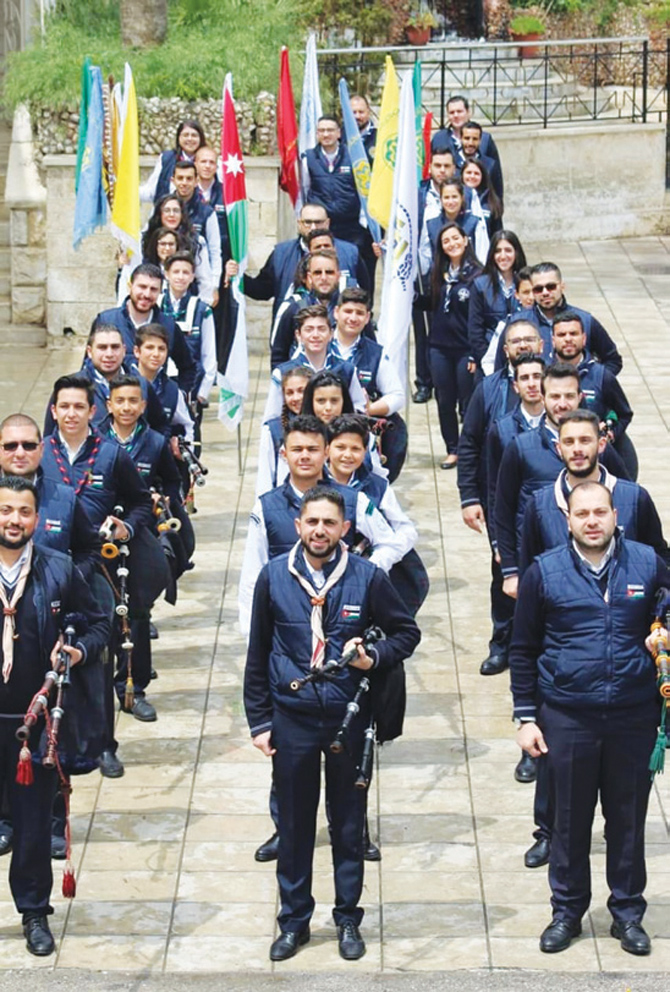
Bashar Muasher, director of the Latin Patriarchate scouts in the Amman neighborhood of Masdar, said the bagpipe was extremely popular with church-based scouts, both male and female.

“The melancholy funeral song ‘Amazing Grace,’ the song praising the army ‘Jeshan Jesh Al-Watan’ and the wedding song ‘Mubarak Mubarak’ are always on demand and appreciated,” he added.


The bagpiper has gained a following among young Jordanians. (Supplied)


Hanna Ismair, another church scout leader, said the bagpipe enabled young people to play both local and foreign tunes.

“The kids love the fact that they can play popular national songs, well-known international tunes as well as spiritual religious hymns,” he told Arab News.

Noting that the audiences sometimes dictated the songs played at weddings, he said: “Whenever it is a Palestinian audience, people are excited when we play popular songs like ‘Wen a Ramallah’ (Going to Ramallah), while rural audiences love the folkloric Dahia tunes.”

One thing common to Jordan’s bagpipers, whether from the army or church scout groups, is that they entertain people for no apparent pecuniary purpose. But the instrument does not come cheap.

Rakah Fakhoury, who hails from the industrial Jordanian city of Zarqa and heads the Latin Church scout band, said a hybrid version put together in Jordan can be bought for about $500, though “Chinese bagpipes can be cheaper.”

By contrast, Khatabeh said, the cost of a genuine, high-quality instrument can exceed $1,000.

“A Chinese bagpipe can come as cheap as $500 but if you go for an original instrument from Scotland, you have to pay anything up to $1,500,” he added.

Khatabeh should know. Since becoming a skilled bagpipe player, he has traveled four times to Scotland.

After a distinguished career in the Jordanian army band, he became a trainer, a career that has taken him to Lebanon, Syria, Bahrain, Kuwait and Egypt.

Beyond the military, Khatabeh has been asked to train scout groups in 20 churches in different parts of Jordan. He has participated in festivals, including ones with religious or political themes, both in Jordan and abroad, including once in Moscow.

For Jordanians, uniformed bagpipers like Khatabeh are no longer a faceless band of musicians who entertain for free. They are a national treasure, fit to be celebrated with the finest street art.

Main category: 

Pakistan — the other great home of the bagpipesPakistani bagpipe business a throwback to colonial times


UN envoy says push continues toward cease-fire deal in Libya

Author: 
Associated Press
ID: 
1581007749391898100
Thu, 2020-02-06 16:46

CAIRO: The UN’s special representative for Libya said Thursday the country’s warring sides are working to turn a provisional cease-fire into a formal agreement as they emerged from four days of talks.
Ghassan Salame, head of the United Nations support mission in Libya, said rival military leaders are negotiating the remaining sticking points in a cease-fire deal. Those include the return of internally displaced people, the disarmament of armed groups and ways to monitor the truce.
“The cease-fire agreement is made of a number of issues, and there have been points of convergence on many points. And there are points of divergence,” Salame told reporters in Geneva.
The latest round of fighting in oil-rich Libya erupted last April when eastern-based forces under the command of Khalifa Haftar laid siege to Tripoli in a bid to wrest power from the Government of National Accord (GNA) led by Prime Minister Fayez Al-Sarraj.
Al-Sarraj and Haftar both sent delegations of military officials to represent them at the Geneva talks.
The cease-fire talks come amid intensified diplomacy among world powers seeking to end the conflict that has ravaged Libya for nine years.
World powers have deplored the reality on the ground and pledged to uphold a widely flouted UN arms embargo at a peace summit last month in Berlin. But continued violations of the ban have dimmed hopes that international players in Libya can resolve the crisis.

Main category: 

US wants foreign intervention in Libya to stopUN: Libya rivals agree to turn truce into lasting cease-fire


Algeria president pardons thousands but not protesters

Author: 
AFP
ID: 
1581007746191897600
Thu, 2020-02-06 16:16

ALGIERS: Algeria’s president pardoned almost 6,300 prisoners on Thursday, but scores detained as part of an anti-government protest movement will not benefit from the move, a support group said.
The pardon came two days after the president issued a similar pardon for almost 3,500 other prisoners.
Abdelmadjid Tebboune signed a decree Thursday pardoning “a second group of prisoners (6,294 detainees) … whose remaining sentence is 18 months or less,” a statement from the presidency carried by official press agency APS said.
The measure does not apply to those imprisoned for crimes including terrorism, treason, espionage and corruption, it added.
On Tuesday, Tebboune pardoned 3,471 people who had six months or less remaining of their sentence.
The Hirak movement was launched in February 2019 to demand that longtime President Abdelaziz Bouteflika resign instead of running for a fifth term.
The CNLD prisoners’ rights group, which identifies and supports detainees, said the pardons did not affect 142 Hirak members who are still in preventive detention.
Tebboune was elected president on December 12 in a poll marred by an official turnout of less than 40 percent.
Nearly a year after the movement began, Hirak protesters continue to demand systemic reform and the resignation of government officials.

Main category: