Iranian-backed Hezbollah stepping in to guide Iraqi militias after death of Qassem Soleimani

Author: 
Reuters
ID: 
1581453107191951400
Tue, 2020-02-11 15:48

BAGHDAD: Shortly after Iranian Major General Qassem Soleimani was killed in a US drone strike in Iraq, the Tehran-backed Lebanese organization Hezbollah urgently met with Iraqi militia leaders, seeking to unite them in the face of a huge void left by their powerful mentor’s death, two sources with knowledge of the meetings told Reuters.

The meetings were meant to coordinate the political efforts of Iraq’s often-fractious militias, which lost not only Soleimani but also Abu Mahdi Al-Muhandis, a unifying Iraqi paramilitary commander, in the Jan. 3 attack at Baghdad airport, the sources said.

While offering few details, two additional sources in a pro-Iran regional alliance confirmed that Hezbollah, which is sanctioned as a terrorist group by the US, has stepped in to help fill the void left by Soleimani in guiding the militias. All sources in this article spoke on condition of anonymity to address sensitive political activities rarely addressed in public. Officials with the governments of Iraq and

Iran did not respond to requests for comment, nor did a spokesperson for the militia groups.
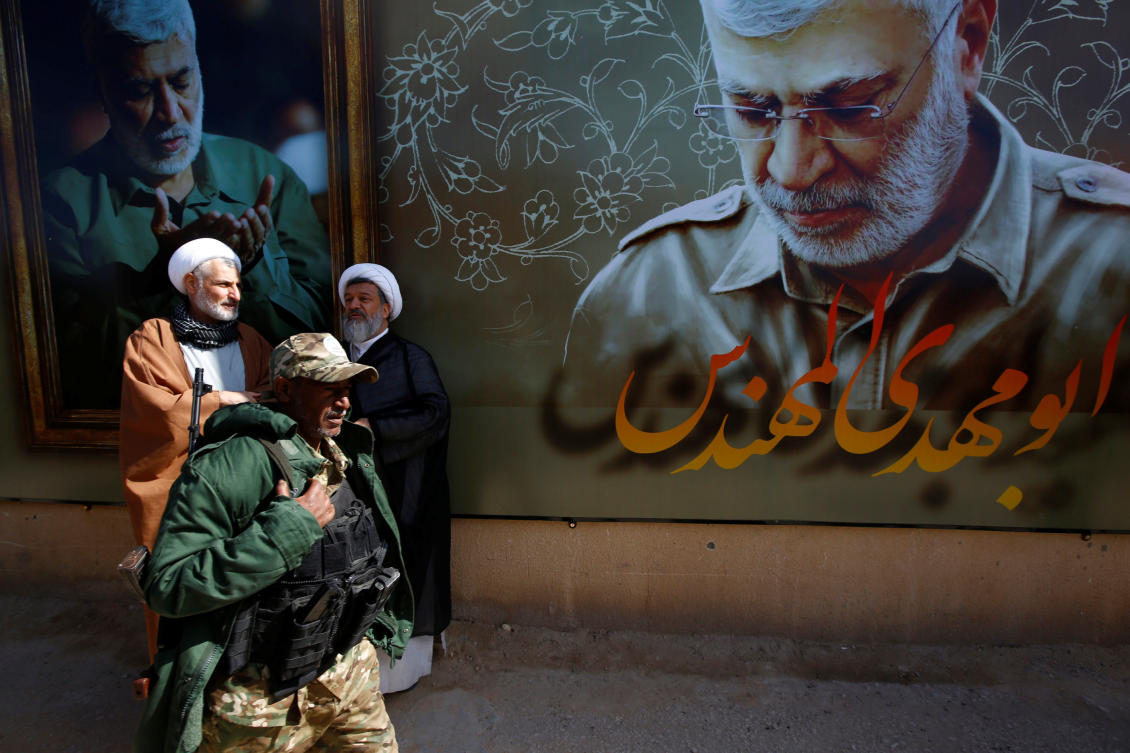

Iranian clerics are seen during the forty days memorial, after the killing of Iran’s Quds Force top commander Qassem Soleimani and the Iraqi militia commander Abu Mahdi al-Muhandis in a US air strike at Baghdad airport. (Reuters)

The discussions shed light on how Iran and its allied groups are trying to cement control in the unstable Middle East, especially in the wake of the devastating US attack on a revered Iranian military leader.

The Tehran-backed militias are critical to Iran’s efforts to maintain control over Iraq, where the US still maintains some 5,000 troops. The country has experienced years of civil war since US forces toppled Saddam Hussein and more recently, the government — and the militias — have faced growing protests against Iran’s influence in the country. Iran helped found some Iraqi militia groups.

In the months ahead of his death, Soleimani had waded ever deeper into the Iraq crisis, holding meetings with the Iraqi militias in Baghdad as Tehran sought to defend its allies and interests in its power struggle with the United States, one of the two Iraqi sources said.

Hezbollah’s involvement marks an expansion of its role in the region. The Shiite group, founded by Iran’s Revolutionary Guards in 1982, has been at the heart of Iran’s regional strategy for years, helping Soleimani to train paramilitary groups in both Iraq and Syria.

One pro-Iran regional official said Hezbollah’s guidance of the militias would continue until the new leadership in the Quds Force – a unit of the Revolutionary Guards led by Soleimani since 1998 – gets a handle on the political crisis in Iraq.

Opinion

This section contains relevant reference points, placed in (Opinion field)

The meetings between Hezbollah and Iraqi militia leaders began in January, just days after Soleimani’s assassination, the two Iraqi sources said. Reuters couldn’t confirm the number of meetings or where they took place. One source said they were in Beirut and the other said they were either in Lebanon or Iran.

Sheikh Mohammad Al-Kawtharani, the Hezbollah representative in Iraq who worked closely with Soleimani for years to guide the Iraqi militias, hosted the meetings, the Iraqi sources said.

Kawtharani picked up where Soleimani left off, the Iraqi sources said. The sources said Kawtharani berated the groups, as Soleimani had done in one of his final meetings with them, for failing to come up with a unified plan to contain popular protests against the Baghdad government and the paramilitaries that dominate it. The government and militia groups have killed hundreds of protesters but not managed to contain the rebellion.

Kawatharani also urged a united front in picking a new Iraqi prime minister, the Iraqi sources said. Since then, former Iraqi communications minister Mohammed Tawfiq Allawi has been named — a development welcomed by Iran and accepted by the militia-linked parties it backs but opposed by protesters.

FASTFACT

Death of Qassem Soleimani

A US air strike killed Iran’s top general Qassem Soleimani, 62, and six others after they had landed at Baghdad’s international airport in January.

For now, Kawtharani is seen as the most suitable figure to direct Iraqi militias until a permanent Iranian successor can be chosen, although he possesses nowhere near Soleimani’s clout and charisma, according to the two Iraqi sources and a senior Iraqi Shi’ite Muslim leader.

“Kawtharani has connections with the militia groups,” the Shi’ite leader said, noting that he was born in Najaf, lived in Iraq for decades and speaks Iraqi dialect. “He was trusted by Soleimani, who used to depend and call on him to help him in crises and in meetings in Baghdad.”

One of the Iraqi sources close to the militias said that Kawtharani also met with the Iraqi populist cleric Moqtada Al-Sadr, a powerful but unpredictable figure, to convince him to support the new Iraqi prime minister. As Reuters has reported, Sadr has given Allawi his support.

Kawtharani will face serious — perhaps insurmountable- challenges in filling the shoes of the leaders killed in the drone attack, the Iraqi sources close to the militias told Reuters.

“A lot of faction leaders see themselves as too big and important to take orders from ” one Iraqi source said. “For now, because of pressure from Iran, they’re cooperating with him, but I doubt that will continue and the Iranians know that.”

One of the pro-Iran sources, a military commander, said Hezbollah’s involvement would consist of political guidance but stop short of providing manpower and materiel to retaliate for the Solemani killing. The militias “do not need Hezbollah’s intervention because they have the strength in numbers, combat experience and firepower,” the commander said.
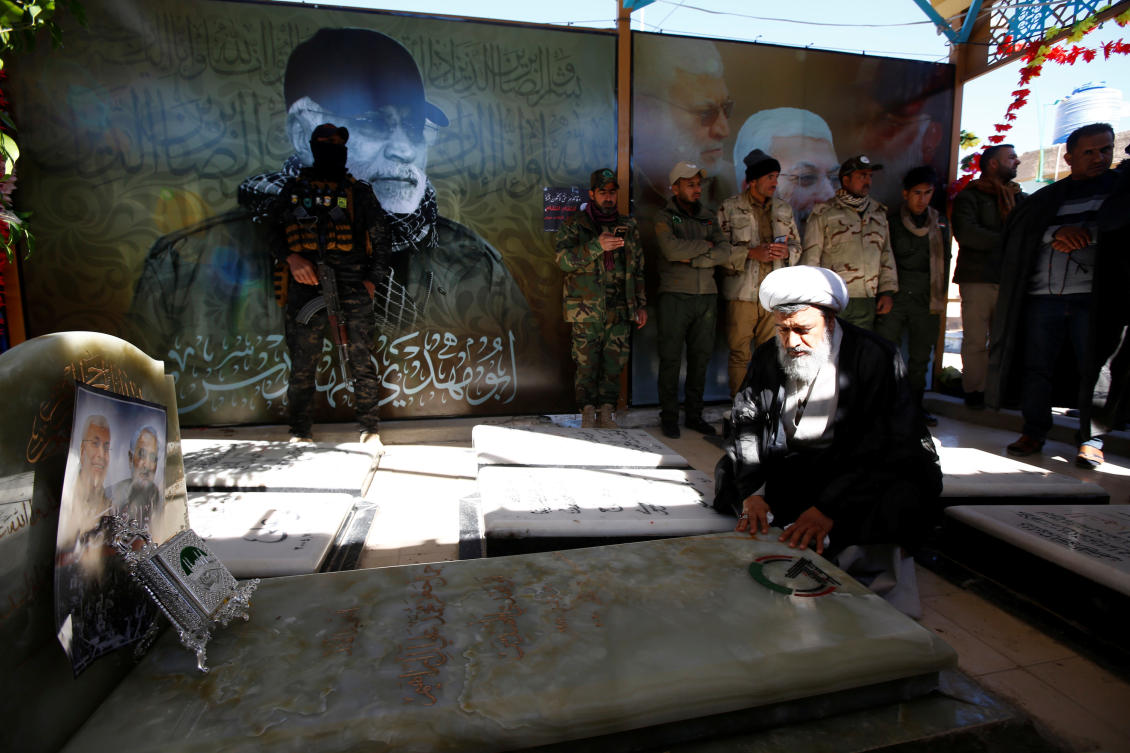

An Iranian cleric is seen during the forty days memorial, after the killing of Iran’s Quds Force top commander Qassem Soleimani and the Iraqi militia commander Abu Mahdi al-Muhandis in a US air strike at Baghdad airport. (Reuters)

Those groups are difficult to control while Hezbollah is seen as more disciplined. But like the rest of Iran’s network, Hezbollah risks stretching itself thin, a senior US official in the region and an Iraqi political leader said.

In recent years, Hezbollah’s role has grown considerably. It has fought in support of President Bashar Assad in Syria and extended political support to the Iran-allied Houthis of Yemen in their war with a Saudi-led military alliance.

Iran is likely to rely partly on the clout Nasrallah, a figure who commands deep respect among Iran’s allies across the region, the US official said. Nasrallah is seen as overseeing Kawtharani’s efforts, according to a senior Shi’ite Iraqi leader.

——–

READ MORE: Arab News’ spotlight – Death Of Qassem Soleimani

——–

“I think ideologically, religiously, he’s seen as a charismatic figure to many of the Iraqi Shia militias,” the US official said, requesting anonymity because he was not authorized to speak on the record.

In two lengthy televised addresses, Nasrallah has paid homage to Soleimani and vowed to avenge his death.

He has also declared it a goal of Hezbollah and its allies to eject US forces from the region once and for all . US forces have been in Iraq since 2014 as part of a coalition fighting against Islamic State.

If the Iraqi militias have their way, sources close to them say, these troops will be the first to depart.

Main category: 

Kuwait summons Iran envoy over Soleimani killing claimSoleimani’s successor faces same fate if he kills Americans Iran warned


Rare snowfall carpets Baghdad and other Iraqi cities

Author: 
AFP
ID: 
1581445821601567000
Tue, 2020-02-11 17:45

BAGHDAD: Residents of Baghdad rushed to have snowball fights or take photographs Tuesday as the Iraqi capital woke carpeted in white by only its second snowfall in a century.
The last recorded snowfall in the city was in 2008, but it was a quick and mostly slushy affair — and prior to that, it had been a century since Baghdad saw any flakes.


Iraqis young and old said it was the first time they had ever seen snow falling in Baghdad.
The city’s iconic palm trees were daintily outlined in white, and the tarpaulins of the long-running anti-government protest camp in Tahrir Square in the city center were sprinkled with snow.
People on their way to work stopped their cars to snap pictures or break out into impromptu snowball fights.


“Snowfall may continue until Wednesday given the very cold weather,” said Amer Al-Jaberi, media head of the Iraqi Meteorological Center.
“This cold wave came from Europe,” he told AFP.
The people of Baghdad are more used to heat than cold.

The highest temperature recorded in the capital was a searing 51 degrees Celsius (124 degrees Fahrenheit), a record it has neared several times in recent years.
South of the capital, snow also carpeted the Shiite holy city of Karbala, which draws pilgrims from round the world to its famed shrines, the golden-domed mausoleums of Abbas and Imam Hussein.
Snowfall is more common in northern Iraq, where snow covered the war-battered city of Mosul, but in the center and south there is rarely enough precipitation.
Iraq has been hit by a succession of extreme weather events in recent years.
In 2018, chronic water shortages sparked a health crisis in the center and south but the following year, heavy rains caused deadly flooding and heavy damage to homes and crops.
Blistering temperatures then hit the north triggering wild fires and scorching crops.
Experts say Iraq lacks the funding or infrastructure to cope with climate change and the desertification of once productive land.

Main category: 
Tags: 

Saudis warned to prepare for big freeze with temperatures set to plummetParts of Saudi Arabia blanketed in snow


Sudan to hand Bashir to ICC for Darfur crimes

Author: 
Jay Deshmukh and Abdelmoneim Abu Idris Ali | AFP
ID: 
1581436469810841900
Tue, 2020-02-11 15:50

KHARTOUM: Sudan has agreed to hand ousted autocrat Omar Al-Bashir and others to the International Criminal Court for alleged war crimes in Darfur, a member of Khartoum’s ruling body said Tuesday.
The Hague-based ICC has charged Bashir and three of his former aides with genocide, crimes against humanity and war crimes in Sudan’s western region during a brutal conflict from 2003.
“Those who have been indicted by the ICC, they have to go there,” Mohamed Hassan Al-Taishay, a member of the ruling sovereign council said, without mentioning their names.
His remarks, quoted in a statement issued by the sovereign council in Khartoum, came as a government delegation met rebel groups in the South Sudanese capital of Juba.
Taishay said the talks focused on justice and reconciliation in Darfur, where the United Nations says about 300,000 people have been killed and millions displaced since the conflict erupted.
Taishay said they had agreed several mechanisms for achieving peace in the region.
“First, all those who have been indicted by the ICC should appear before the ICC,” he said.
“Second, a special court be set up to investigate crimes committed in Darfur.”
The conflict in Darfur, the size of France, erupted when ethnic minority African rebels took up arms against Bashir’s then Arab-dominated government, accusing it of marginalizing the region economically and politically.
The ICC has charged Bashir with genocide, war crimes and crimes against humanity for his role in the conflict.
It has also indicted three of his former aides, Ahmed Haroon, Abdulrahim Mohamed Hussain and Ali Kushied.
“We cannot achieve justice unless we treat the suffering of the victims because this is a truth that we can’t escape from,” Taishay said.
“In Darfur, crimes against humanity and war crimes have been committed.”
Bashir has denied the charges.
Bashir was ousted by the army in a palace coup last April after months of protests against his iron-fisted rule of three decades.
He was detained following his ouster and has since been jailed on corruption charges.
Anti-Bashir protesters, residents of Darfur and rebel groups from the region have consistently demanded that the ousted ruler be handed over to the ICC.
For years before his ouster and despite the ICC indictments, Bashir had regularly visited regional countries as well as Russia and China.
Days before the protests erupted in December 2018, he visited Syria’s President Bashar Assad in Damascus, becoming the first Arab leader to do so since the Syrian conflict began in 2011.
In 2018, Bashir helped broker a tentative peace deal in South Sudan after five years of intense conflict in the world’s newest country, which won independence from Khartoum in 2011.

Main category: 
Tags: 

Sudan says Al-Burhan made no promises to Israel PMSudan opens Darfur crimes probe against Bashir regime figures


Trump deal makes ‘Swiss cheese’ Palestinian state, Abbas tells UN Security Council

Tue, 2020-02-11 18:34

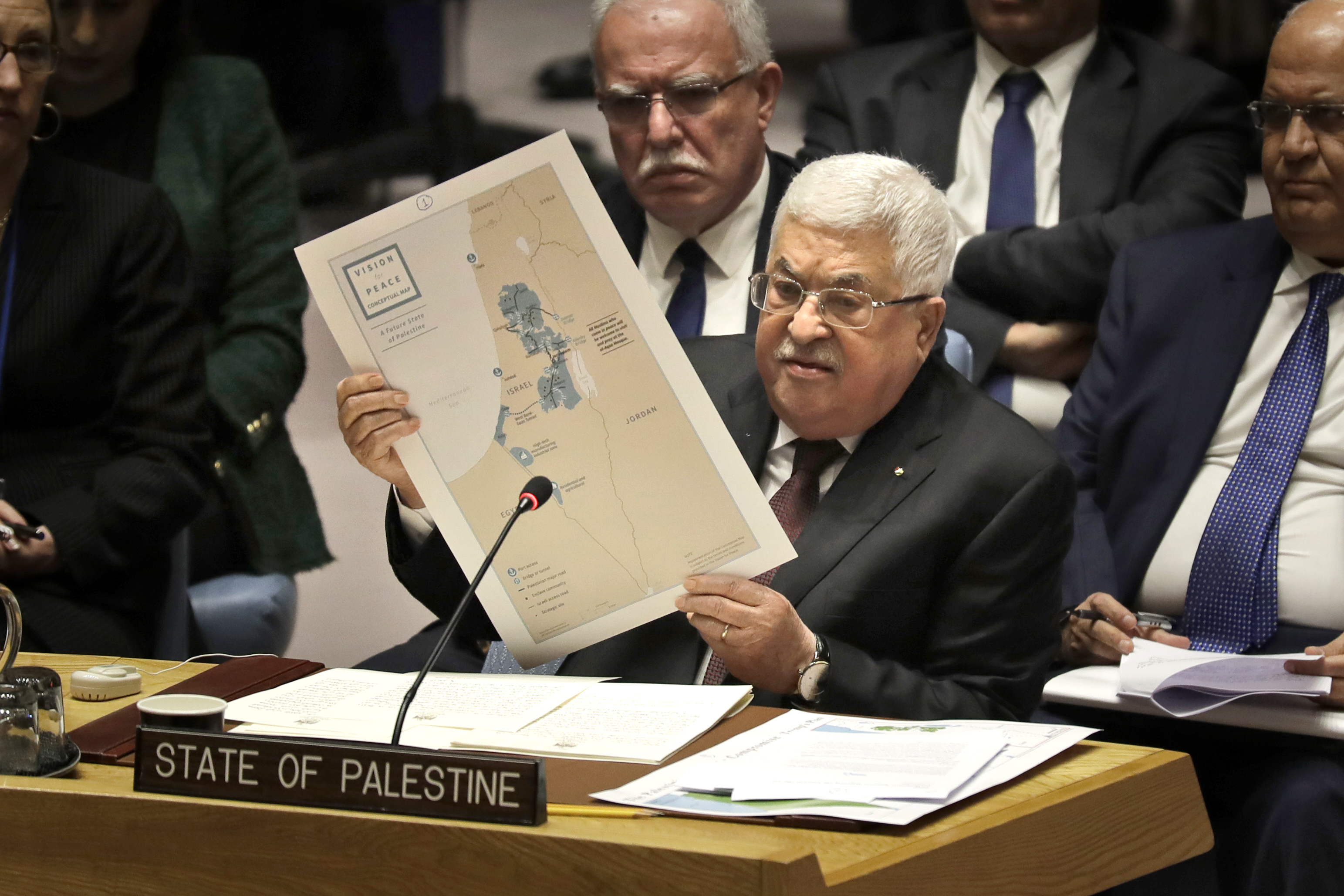
Palestinian President Mahmoud Abbas rejected US President Donald Trump’s peace plan on Tuesday during a meeting of the UN Security Council, but withheld a resolution urging the UN’s rejection of it.

UN Secretary-General Antonio Guterres opened the Security Council meeting saying increased instability in Yemen, Syria and Libya “underscores a need for a political solution to the Israeli-Palestinian conflict, which has lasted far too long and which remains crucial for sustainable peace in the Middle East.”

Saying he endorses a “two-state solution,” Guterres urged Palestinians and Israelis to reach an agreement “which the international community can support.”

Nickolay Mladenov, the UN’s special coordinator for the Middle East peace process, gave an update on reaction to the Trump plan, noting opposition from Abbas, the Arab League and the Organization of Islamic Cooperation.

Although he said the plan received support from Israel’s government, Mladenov added that the EU high representative said Trump’s plan “departs from international agreed parameters,” while African Union member states “also rejected the proposal at their recent summit.”

Abbas later addressed the Security Council, saying Trump’s plan “violates UN resolutions” and annuls the Palestinians’ right to self-determination while legitimizing illegal Israeli settlements and the illegal annexation of occupied Palestinian land.

The Palestinian leader held up a map of the US proposal for a fragmented Palestinian state and said: “It’s like a Swiss cheese really.”

Abbas urged the international community to reject “an Israeli-American pre-emptive plan in order to put an end to the question of Palestine.” 

He called for the convening of an international conference “to bring real peace between the Palestinians and Israel.”

A resolution was expected to have been introduced denouncing the plan, but that did not happen, leading observers to speculate that the Palestinians did not believe they could get past an almost certain US veto.

The failure to introduce a resolution prompted a positive reaction from the White House. A senior US official, who asked not to be identified, called the anticipated resolution “polarizing” and said “the old ways of doing things is over” at the UN.

“For the first time on the Israeli-Palestinian issue, the (Security) Council was willing to think outside the conventional box and not reflexively fall back on the calcified Palestinian position, which has only allowed the failed status quo to continue,” the White House official said.

“We’re optimistic that countries are keeping an open mind with regard to our Vision for Peace, and are willing to have an honest and open discussion on it as a possible basis to restart negotiations for a realistic two-state solution,” the official added. 

“As we’ve said all along, our plan is the start of a process, not the end. We hope the Palestinians will take advantage of the opportunity to move the ball forward.”

Main category: 

Thousands join Gaza protests against peace planPalestinians rally against Trump plan amid struggle at UN


Iraq cleric Al-Sadr dissolves ‘blue caps’ units accused of deadly attacks on protests

Author: 
AFP
ID: 
1581435291250736800
Tue, 2020-02-11 15:33

BAGHDAD: Iraqi cleric Moqtada Al-Sadr announced on Tuesday he was dissolving the “blue caps”, an organised unit of his supporters accused of deadly attacks on anti-government protests in recent days.

Al-Sadr, who has a cult-like following of several million Iraqis, had first backed the popular rallies demanding a government overhaul when they erupted in October, but has switched course multiple times in recent weeks.

He finally broke with the broader movement when he endorsed the premier-designate Mohammad Allawi, seen by protesters as too close to the elite they have railed against for months.

Since then, diehard Al-Sadr supporters wearing blue caps have raided protest camps in Baghdad and the Shiite-majority south, with eight protesters killed in the ensuing violence.

The cleric has faced growing criticism over the violence and on Tuesday, he suddenly took to Twitter.

“I announce the dissolution of the ‘blue caps,’ and I do not accept the (Sadrist) movement’s presence in and of itself at the protests, unless it is absorbed into them,” he tweeted.

In the early days of the movement, Al-Sadr supporters were seen as the most organised and well-stocked of the demonstrators but his recent tweets have infuriated activists.

After backing Allawi, he ordered the “blue caps” to help security forces reopen schools, roads and public offices shut down for months by anti-government sit-ins.

But Al-Sadr has insisted that his movement ultimately wants “reforms”.

Allawi has until March 2 to form his cabinet, and is expected to govern only until early parliamentary elections.

“We hear that there are pressures from political parties and from sects over the forming of the temporary government,” Al-Sadr tweeted on Tuesday.

“This could lead us to completely wash our hands of all of it.”

Al-Sadr already controls the largest parliamentary bloc and top ministerial positions in the current government.

But one of his senior aides said Saturday that the new prime minister must not include members of the political elite in his new cabinet.

“If Sayyed (Lord) Moqtada hears that Allawi has granted a ministry to any side, specifically the Shiite armed factions, Iraq will turn into hell for him and will topple him in just three days,” Kadhem Issawi said.

Main category: 

Cleric Al-Sadr urges rivals to help oust Iraq’s prime ministerIraqi officials say protester shot, killed in southern Iraq