Houthi militias bury dozens of fighters

Author: 
Wed, 2020-02-19 03:49

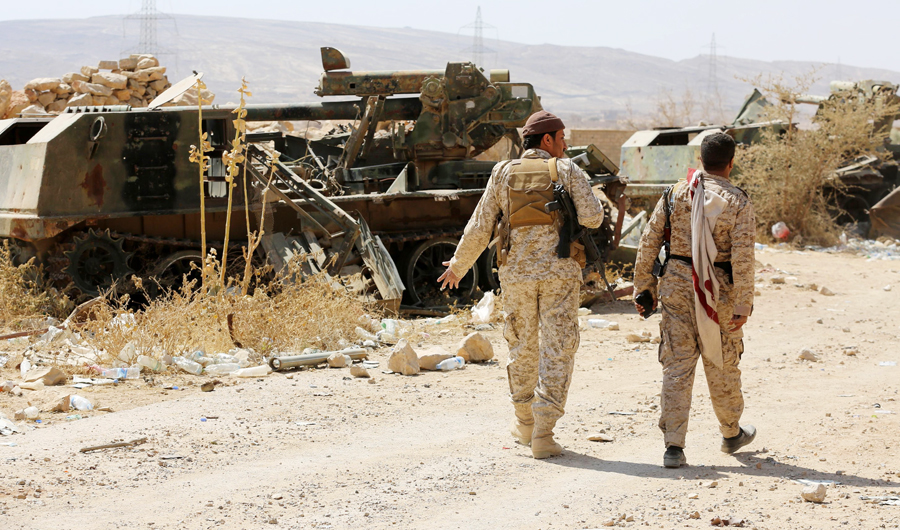
AL-MUKALLA, YEMEN: Houthi media reported that the Iran-backed militia buried dozens of fighters, including a senior commander, who had been killed in combat against Yemeni government forces or by Saudi-led coalition airstrikes.
Brig. Yahiya Abdul Jabbar Juhedan, commander of the Brigade 417 Border Guards, was buried in Houthi-held Sanaa. Houthi media described him as having had “unrivaled” military know how.
Yemeni Army commanders say at least 1,000 Houthi fighters have been killed or injured since early last month, when fighting flared in the country’s north in the wake of a Houthi missile and drone attack that killed more than 110 soldiers and civilians in the city of Marib.
Fighting has intensified over the last couple of days, mainly in the provinces of Jouf, Marib and Serwah.
The heaviest fighting was reported on Monday and Tuesday in the northern province of Jouf, where government forces ambushed Houthi fighters and pushed backed their assaults in the districts of Masloub and Ghayl. Many Houthi fighters were killed, state TV reported.

IED kills family
An improvised explosive device (IED) planted by the Houthis struck a vehicle, killing a family of four and injuring a person in the western province of Hodeida, state media reported.
The family members were killed on Sunday when their car drove over the IED in the region of Moushaj.

FASTFACT

Fighting has intensified over the last couple of days, mainly in the provinces of Jouf, Marib and Serwah.

The Houthis have planted thousands of landmines in Hodeida to obstruct a major push by government forces to liberate the province.
Local rights groups that document war casualties say Houthi landmines and IEDs have killed dozens of civilians so far this year.
The spiraling number of civilian deaths has prompted Yemeni officials to urge the UN to pressure the Houthis to stop planting landmines and to hand over maps showing where they are planted in liberated areas.
Brig. Gen. Tareq Mohammed Saleh told a UN official that the Houthis have planted thousands of landmines that kill civilians every day. Saleh urged the UN to help local demining efforts.
Masam, the Saudi project for landmine clearance, on Tuesday announced the detonation of more than 1,000 landmines, rockets and IEDs in the Mocha district of Taiz province.
Main category: 
Tags: 

Saudi Arabia reaffirms full support for Yemeni peopleUS threatens to suspend Yemen aid operations over Houthi interference 


UN demands humanitarian corridors for Syria refugees

Author: 
Wed, 2020-02-19 01:04

BEIRUT, ANKARA: Syrian regime troops on Tuesday pressed an offensive on the country’s last major opposition enclave where the mass displacement of civilians is sparking fears of a humanitarian catastrophe.

Around 900,000 people have been forced from their homes and shelters in less than three months, leaving huge numbers to sleep rough in the thick of winter.

The UN said that half a million among them were children, some of whom have died of exposure in snow-covered camps. 

“Over the past four days alone, some 43,000 newly displaced people have fled western Aleppo where fighting has been particularly fierce,” UN spokesman David Swanson said.

Since the start of February, the displacement figure was a staggering 300,000, he said.

The UN High Commissioner for Human Rights called for the creation of humanitarian corridors, expressing horror at the  regime offensive. 

“No shelter is now safe. And as the government offensive continues and people are forced into smaller and smaller pockets, I fear even more people will be killed,” Michelle Bachelet said.

Bachelet was “horrified” by the unfolding humanitarian crisis, a statement said. “How can anyone justify carrying out such indiscriminate and inhumane attacks?” Bachelet said.

Tuesday’s violence left at least two civilians dead. A member of regime-backer Iran’s Revolutionary Guards was killed in Aleppo province in a rocket strike.

According to Save The Children, seven children — including a baby only seven months old — have died from freezing temperatures and bad living conditions in the camps.

“We’re worried that the death toll will increase given the absolutely inhumane living conditions that women and children are finding themselves in,” the charity’s Syria director Sonia Khush said.

Meanwhile, Turkey will deploy more troops to Idlib and retaliate against attacks by regime forces there, even as Ankara continues to discuss the situation with Moscow, Turkish presidential spokesman Ibrahim Kalin said.

Main category: 
Tags: 

Turkey tells Russia: Syria regime attacks on Idlib must stopCar bomb kills two in Turkish-controlled Syrian town


All fuel vessels evacuated urgently from Tripoli port after LNA strike

Tue, 2020-02-18 22:38

TRIPOLI: Eastern Libyan forces said they attacked the sea port of Libya’s capital on Tuesday to target a weapons depot, signalling a new escalation in the battle for control of Tripoli.

The Libya National Army (LNA) faction, which is based in the east of the country and commanded by Khalifa Haftar, did not elaborate about the arms depot it cited in a statement.

The LNA had earlier said that it had targeted a Turkish ship which had been delivering arms to the government based in the capital, located in Libya’s northwest.

Tripoli port is a major gateway for food, fuel, wheat and other imports for the capital area, engulfed in war since the LNA began a campaign in April 2019 to take the city, where the UN-backed government is backed by Turkey.

All ships including fuel tankers were moved out of the port after Tuesday’s attack, two port officials said. Tripoli-based forces said the LNA had fired four missiles.

Since January, Turkey has sent several ships carrying arms and heavy trucks to Tripoli and Misrata, another western port, diplomats say.

The LNA is allied to a parallel government in eastern Libya supported by the United Arab Emirates, Egypt, Jordan and Russian mercenaries. Eastern ports and airports are out of range of the Tripoli forces.

Oil-rich Libya has been riven by factional warfare and disorder since rebels toppled Muammar Qaddafi in 2011.

Tuesday’s attack on the port unfolded as officers from the Tripoli forces and the LNA held a second round of indirect talks in Geneva to establish a permanent ceasefire. Both sides refused again to sit in the same room, UN Libya envoy Ghassan Salame said, though he said he was hopeful of making progress.

“So while the situation on the ground remains a situation where the truce is very fragile…, nobody has so far reneged on the principle of accepting the truce and the political process is trying to find a way to move forward,” he told reporters.

Salame also said a ceasefire was not a precondition for advancing on other matters such as how to better distribute state revenues generated by oil.

“It (talks) are going pretty well on the economic side, but it is harder on the military side,” he said.

He added that he had received conditions from tribesmen allied to eastern forces to lift a blockade of eastern oil export ports, but said these were quite general and would have to be fleshed out in more UN-led talks in Geneva next week. 

Main category: 

EU begins air, sea patrols off Libyan coastLibya’s internationally recognized government suspends ceasefire talks after port attack


Mayor’s ‘joy’ as Turkish court acquits businessman, 8 others over Gezi Park protests

Author: 
Tue, 2020-02-18 22:10

ISTANBUL: Jailed Turkish businessman Osman Kavala and eight other defendants were on Tuesday acquitted over their alleged roles in organizing the 2013 Gezi Park protests in Istanbul.

In a surprise move, the Istanbul 30th Heavy Penal Court ordered the prison release of philanthropist and human rights activist Kavala after 840 days behind bars.

Kavala and a number of co-defendants had been facing life sentences on charges of plotting to overthrow the government through violence and force, with the other defendants accused of helping them.

An estimated 3.6 million people took part in the Gezi Park protest events between May 28 and Sept. 25. More than 5,500 individuals were arrested and 189 held in custody, while four civilians and two police officers died in the unrest.

Tweeting after the verdict, Mayor of Istanbul Ekrem Imamoglu, said: “The acquittal of all the defendants in the Gezi Park trial is a true source of joy, and restores trust in the Turkish judicial system. I salute all those who stand to defend our city’s history, culture and nature.”

The verdict comes at a time of growing tensions between Turkey and Russia in Syria and follows calls from the EU and the Council of Europe for Ankara to release Kavala and all other politically prosecuted activists. As a result, Turkey has suddenly found itself pushing for Western assistance through “symbolic steps.”

In December last year, the European Court of Human Rights (ECHR) demanded the immediate release of Kavala and ruled that Turkey had violated his rights.

However, Selahattin Demirtas, the former co-chair of the pro-Kurdish Peoples’ Democratic Party (HDP), and countless other political prisoners still remain in pre-trial detention.

The case of a further seven defendants, who are abroad and were being tried in absentia, was separated but arrest warrants for them were suspended.

Envoys, diplomatic representatives and consul generals of several European countries attended Tuesday’s court hearing.

The day before the trial, Ahmet Davutoglu, the former Turkish prime minister under the ruling Justice and Development Party (AKP) who recently formed the rival Future Party, was also withdrawn as a plaintiff from all criminal cases involving offenses against him, including the Gezi Park case.

Louis Fishman, a Turkey expert from Brooklyn College, said: “This is fantastic news and highlights from the start that it was nothing more than a politically motivated trial.

“Turkey has a long record of sham trials over the decades and fortunately this one ended without a conviction. However, lives have been ruined and an innocent man, Osman Kavala, was forced to sit in prison for 840 days awaiting his freedom, despite the fact he proved no danger to society,” he told Arab News.

Fishman noted that the case had left a stain on Turkey and its judicial system and did nothing to detract from its continued unjust imprisonment of others.

On Feb. 19, more than two years after they were first detained, a court will give its verdict on 11 human rights activists, including former senior members of Amnesty Turkey. They were accused of “aiding armed terrorist organizations” and “being members of an armed terrorist organization” after attending a meeting on “digital security and protection of human rights defenders” in the Princes’ Islands of Istanbul.

Andrew Gardner, Turkey strategy and research expert at Amnesty International, said they had been awaiting a verdict at the final hearing for some time. “But we are under no illusion. Many of our colleagues, human rights defenders, political prisoners are facing unfair trials or are going through unfair trials and facing unfair verdicts,” he told Arab News.

“The release would be however a change in the political dynamic because it was a politically motivated trial and at the same time an attack against civil society and a crackdown on civil freedoms. The solidarity shown within Turkey from a wide range of society was incredibly important in this process,” he added.

Main category: 

Turkey escalates crackdown on dissent six years after Gezi protestsTurkish court accepts indictment against 16 over Gezi protests -lawyer


Israel plans new east Jerusalem settlement

Author: 
AFP
ID: 
1582046335714059400
Tue, 2020-02-18 17:15

JERUSALEM: Israel has developed plans to build 9,000 settler homes in annexed east Jerusalem, the first such project in the city in more than 20 years, watchdog Peace Now said Tuesday.
Details of the plan emerged a day after Israel’s transport ministry approved a controversial proposal to extend a train line from Tel Aviv into Jerusalem’s flashpoint Old City.
Peace Now said the housing ministry had a week ago submitted plans to Jerusalem’s Municipality to build the settlement units on the site of the former Atarot airport, between two Palestinian neighborhoods.
It said final approval of the project could take years.
But if built, it would drive “a wedge in the heart of the Palestinian urban continuity between Ramallah and East Jerusalem, thus preventing the establishment of a viable Palestinian state with its capital in East Jerusalem.”
It would be the first new settlement in east Jerusalem since a previous government of Prime Minister Benjamin Netanyahu built the Har Homa settlement near Bethlehem in 1997, Peace Now said.
More than 600,000 Jewish settlers live in the occupied West Bank and annexed east Jerusalem, in communities considered illegal under international law.
Peace now said the Atarot plan “also includes the demolition of dozens of Palestinian residential units that were built in the area without permits throughout the years.”
Palestinians regularly build without the required permissions because they are unable to obtain them from Israeli authorities.
Jordan, the custodian of Muslim holy sites in Jerusalem, blasted the proposed rail extension as “a flagrant violation of international law.”
A Middle East peace plan unveiled last month by US President Donald Trump gave a green light for Israel to declare sovereignty over all of Jerusalem as well as settlements and other territory in the West Bank.
The Trump proposal has been rejected by the Palestinians, who demand east Jerusalem as the capital of their state.

Main category: 
Tags: 

Israel approves more than 1,900 new settler homes: NGOIsrael approves more than 2,300 settler homes: NGO