UN tries to salvage Libya talks after Tripoli govt withdraws

Author: 
Thu, 2020-02-20 03:15

GENEVA/CAIRO: The UN tried to salvage talks over a cease-fire for Libya on Wednesday after the government based in Tripoli said it was pulling out after a single day to protest against the shelling of the capital’s port.

Talks began on Tuesday in Geneva between the internationally recognized Tripoli government and its main rivals, the eastern-based Libya National Army (LNA), which has been trying to take the capital.

Late on Tuesday, the government said it would suspend its participation after the LNA shelled Tripoli port in the latest of several strategic plays by troops loyal to eastern commander Khalifa Haftar that have coincided with attempts to ease tensions.

Delegations in Geneva

UN Libya envoy Ghassan Salame was trying to convince the Tripoli delegation to stay in Geneva and resume indirect talks, a source close to the talks said and the UN confirmed.

“Delegations are still here (in Geneva) and Dr. Salame has a meeting today with the head of the GNA delegation,” said Jean El-Alam, spokesman for the UN Libya mission, referring to the Tripoli-based Government of National Accord. 

“The mission leadership is in contact with the GNA in Tripoli and member states to keep the momentum going.”

In a separate statement, the UN mission said it was “expressing its strong and renewed condemnation of the bombing of Tripoli’s seaport yesterday by the Libyan National Army.” 

There was no immediate comment from either side. 

Russian Defense Minister Sergei Shoigu met with Haftar and they discussed to resolve the conflict in the north African state, the ministry said in a statement.

They agreed a political settlement is the only option for Libya, according to RIA news agency.

Shoigu and Haftar also discussed “the important role of talks” held in Moscow in January as well as “the need to fulfil” terms agreed at an international summit in Berlin later last month, Moscow said.

Russian Foreign Minister Sergei Lavrov said on Wednesday that outside players should push both sides in Libya to sit down for peace talks.

“All those who in one way or another influence political or other forces in Libya should stimulate them to sit down for talks. The first steps in this direction were taken but now additional difficulties are coming up again,” Lavrov said while meeting his Jordanian counterpart Ayman Safadi in Moscow, RIA Novosti news agency reported.

Nearly nine years after rebel fighters backed by NATO airstrikes overthrew Muammar Qaddafi, Libya still has no central authority. The streets are controlled by armed groups, with rival governments based in Tripoli and the east.

HIGHLIGHTS

• Russian Defense Minister Sergei Shoigu met with Haftar and they agreed a political settlement is the only option for Libya, according to RIA news agency.

• Since the LNA marched on Tripoli nearly a year ago, fighting has displaced 150,000 people.

Since the LNA marched on Tripoli nearly a year ago, fighting has displaced 150,000 people. Both sides have support from an array of foreign governments, with Turkey supporting the Tripoli government.

The Geneva meetings have so far been held in different rooms, with Salame shuttling between the parties. Another round of talks is scheduled next week in Geneva.

The latest attack is part of an emerging pattern amounting to an apparent power play by the commander.

Haftar’s forces last month shut down Libya’s main oil ports as European and Arab powers and the US were meeting with his supporters in Berlin aimed at halting the campaign to capture the capital. 

In 2019, eastern military forces moved to western Libya just as UN Secretary-General Antonio Guterres arrived.

The LNA initially said its strikes on Tuesday had targeted a Turkish vessel bringing weapons. It later said it had hit an arms depot.

The port is the main entry gate for wheat, fuel and other imports for Tripoli and has also been used by Turkey to send military trucks and other equipment to its government allies.

Main category: 
Tags: 

EU begins air, sea patrols off Libyan coast


Government forces foil two Houthi attacks in Hodeida

Author: 
Thu, 2020-02-20 00:58

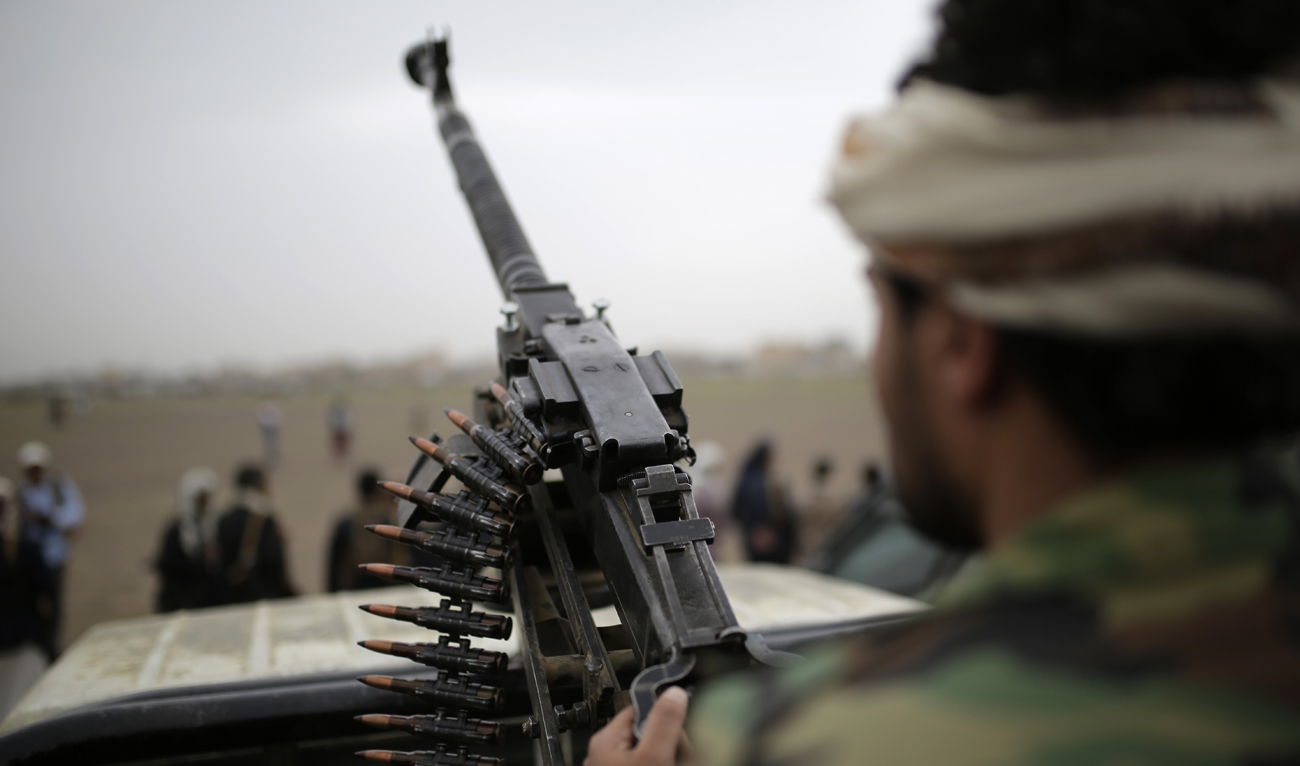
Yemeni government forces have pushed back two consecutive military attacks by Iran-backed Houthi militias in the western province of Hodeida, as the government warned of the potential collapse of the Stockholm Agreement, local media said on Wednesday.

Troops from the Joint Force, a gathering of three major military units in Hodeida including the Giants Brigades, National Resistance and Tehama Resistance, engaged in heavy fighting with the Houthis in Hodeida’s Ad-Durayhimi district.

The first Houthi attack began on Tuesday morning when rebels targeted government forces from outside Ad-Durayhimi with mortar and cannon rounds before advancing on the ground, triggering heavy clashes with loyalist forces. The clashes subsided in the afternoon when the Houthis retreated after failing to make any gains. On Tuesday night, the Houthis attacked government forces in Ad-Durayhimi again, local government media said.

Government forces responded with heavy shelling. Three loyalists were killed and several others were injured in the fighting.

The government also announced on Tuesday the downing of a Houthi explosive drone in Ad-Durayhimi. Joint Forces military commanders convened in Mocha on the Red Sea on Tuesday to discuss how to respond to Houthi assaults.

Elsewhere, government forces pushed back Houthi attacks on army locations at Al-Mahzamat in the northern province of Jawf. Loyalists also engaged in fighting with Houthis in the southern city of Taiz and Marib’s Serwah.

Stockholm Agreement

The attacks in Hodeida came as the internationally recognized government of Yemen warned that it might pull out of the Stockholm Agreement.

In New York, Yemen’s permanent representative to the UN, Abdullah Ali Al-Saadi, told the UN Security Council on Tuesday that the Stockholm Agreement had not achieved a cessation in fighting in the western province.

“It is regrettable that after more than one year, the agreement did not bring about anything. But it marked the beginning of a new level of escalation and further suffering,” he said.

The Yemeni government echoed those concerns about the threat of Houthi military activities in Hodeida and other contested areas.

At a meeting on Tuesday, the Yemeni Cabinet affirmed its support for peace efforts by the UN envoy to Yemen, and urged the international community to mount pressure on the rebels to quickly implement the agreement. 

Local rights groups say that the rebels have been responsible for the deaths of hundreds of civilians in Hodeida since late 2018, when the Stockholm Agreement was ratified.

Main category: 

UN: Houthi militia impeding aid flow in YemenSaudi Aramco attack drone components linked to Iran and Houthis in Yemen


What shapes the Middle East’s migration patterns

Thu, 2020-02-20 00:21

ABU DHABI: Less than two months since an unhappy year for the Arab region’s migrants and refugees came to an end, the omens of things to come are far from good.

According to the latest “Situation Report on Migration in the Arab Region,” prepared by the International Organization for Migration (IOM) in collaboration with various UN agencies, displacement and migration are two prominent trends at the beginning of 2020. Particularly — and unsurprisingly — in countries withongoing wars.

An overwhelming majority of Arab countries endorsed the Global Compact for Migration (GCM) at the UN General Assembly in December 2018, voting to adopt its principles in national legislatures.

Subsequently, the number of migrants and refugees crossing the Mediterranean Sea was found to have plunged in 2018 to almost a tenth of what it was in 2015.

However, the reality of the region’s migrant and refugee situa- tion belies the hopes raised by the adoption of the GCM.

In Libya, for example, there was a steep deterioration last year in the living conditions of migrants and refugees stranded in the unstable North African country.

FASTFACTS

29m – An estimated 29 million people have migrated from Arab countries since 1990.

1/2 – Almost half of the people who migrated stayed within the Arab region.

9.1m – Refugees who have sought protection in the Arab region include 3.7 million under the mandate of the UN Refugee Agency and 5.4 million registered with UNRWA.

14.5% – The number of migrant workers in 18 Arab countries stood at 23.8 million in 2017, representing 14.5 percent of all migrant workers globally.

?The country’s protracted civil conflict has not only caused massive displacement within its borders, but also means it has become a dangerous place for economic migrants from sub-Saharan Africa wishing to travel to Europe. World leaders have just pledged in Berlin not to interfere in Libya’s civil conflict and to uphold a UN arms embargo, but only time will tell if that promise will be honored.

In Syria, meanwhile, the human- itarian situation in Idlib — the last stronghold of opposition forces and a safe haven for millions of internally displaced persons (IDP) — remains shaky as Russian- backed regime forces press on, despite mounting civilian casualties.

In Yemen, a peace opportunity was missed in early 2019, and there has been no let-up since in the fighting between government forces and the Houthi militia, who control the capital Sanaa and the northern highlands. The country currently hosts between 2 million and 3.5 million IDPs and another 1.28 million returnees, in addition to 279,000 migrants and refugees — almost exclusively from Somalia and Ethiopia — for whom the country is a short-term way station, not a final destination.

Lebanon is in the grip of a wide- ranging crisis, too. People at the bottom of the economic ladder, including 1.5 million Syrian refugees and almost 500,000

Palestinian refugees, supple- ment their meager incomes with handouts from aid agencies. Even before the protests erupted in Lebanon in October last year, a UN vulnerability assessment report for refugees in the country, carried out in early 2019, made grim reading.

It said about 73 percent of Syrian refugees in Lebanon were living below the poverty line — up from 69 percent the year before, and considerably higher than the estimated 28 percent of Lebanese in the same situation.

Of course, migration and displacement have long shaped the Arab region, with countries simultaneously acting as points of origin, transit and destination.

However, in recent years, the distinction between voluntary and forced migration has become blurred as political crises and civil conflicts — viewed as the chief causes of human displace- ment — have proliferated. “The challenge today is to put in place policies that will ensure successful and true integration while benefiting both the countries of residence and origin,” Laura Petrache, a senior adviser at Migrant Integration Lab, told Arab News.

According to UN reports, the number of migrants and refugees originating from the Arab region reached 29 million in 2017. Almost half of them remained in the region. Overall, the number of migrants and refugees as a propor- tion of the total population of the Arab region has risen steadily over the past three decades.

In 2018, around 80 percent of the region’s refugees originated in the Levant, mostly on account of the Syrian conflict.


Caption


Jordan, Lebanon, Libya, Syria and Sudan are among the top 10 Arab destinations for migrants and IDPs owing to conflicts in the neighborhood. Apart from Lebanon, all of those countries have witnessed an increase in the number of refugees and migrants within their borders since 2015.

After Turkey, Jordan was the second-most-popular destination country for refugees and migrants from the region, with Lebanon, 

Saudi Arabia and the UAE also reporting significant numbers. Iraq was the only country that saw its national refugee and migrant population decrease.

What the latest reports confirm is that migration in the Arab world not only has multiple drivers — socio-economic pressures, political instability and environmental degradation — but also complex patterns and trends.

Take the Gulf and the Levant regions. They attract different kinds of migrants because their levels of stability, security and development are not comparable. While Libya, Syria, Lebanon and Yemen are plagued by conflict, violence, corruption and divisions in both society and polity, GCC member countries are leading the way in groundbreaking ideas and investments, building cities of the future and attracting talent from across the world.

The migrant population in the GCC countries swelled from 8.2 million in 1990 to 28.1 million in 2017 — a substantial rise compared with figures for other parts of the Arab region.

Around 27 percent of global remittance outflows in 2017 reportedly came from the Arab region, estimated at $120.6 billion, and almost all of that (98.9 percent or $119.3 billion) came from GCC countries. According to the IOM’s report, the top remittance-sending countries were the UAE (at $44.3 billion) and Saudi Arabia (at $36.1 billion).

Under the circumstances, it is difficult to see meaningful, positive change for migrants happening any time soon in the Arab region, with the possible exception of the GCC.

“Migration policy making should move away from assimila- tionist frameworks,” Petrache, of the Migrant Integration Lab, told Arab News. “Instead, the policy emphasis should be on working with countries of origin to achieve sustainable integration — and re-integration in the case of return immigration.

“The policies should take into consideration the potential for win-win solutions using and developing the capability of the migrants to make a positive contri- bution to local host communities,” Petrache said.


Main category: 

Middle East migration patterns defy generalization


Syrian father and daughter laugh off the shelling

Author: 
Thu, 2020-02-20 00:46

SARMADA, Syria: In Syria’s Idlib, there’s no escaping the war, so Abdullah Al-Mohammed says the only way he found to reassure his daughter Salwa was to turn the shelling into a game.

A video in which she laughs every time an explosion goes off was widely shared on social media in recent days as a heartening but grim reminder of Idlib residents’ daily lives.

“Is it a plane or is it a mortar?” he asks, as a whizzing sound grows in the background.

“A mortar,” the three-year-old answers. “When it comes, we will laugh.”

In another video, Salwa is standing on her father’s lap in their living room and her hearty laugh is set off by the sinister thunder of a bomb dropped by a warplane.

“Tell me Salwa, what did the plane do,” the father asks his daughter.

“The plane came and I laughed a lot. The plane just makes us laugh, it tells us: Laugh at me, laugh at me,” she says.

An AFP reporter met the 32-year-old father in Sarmada, a town in Syria’s last rebel pocket, which Russian-backed regime forces are trying to crush.

He and his family fled from Saraqeb, another town in Idlib which has already been retaken by regime forces and has been partly levelled by air raids.

Now as the regime presses its northwards offensive and continues to push civilians ever closer to the Turkish border, the air strikes are back.

Mohammed explains that when Salwa was still 12 months old, she started crying when she heard fireworks in the neighborhood.

He had to explain that it was only the sound of children playing for the Muslim holiday of Eid Al-Fitr.

“After that, whatever was coming to us from the air, I would take out my phone and tell her: ‘Come, let’s laugh together, these are children playing for Eid,” he says.

“I try not to show her that what is happening as a bad thing but rather show it as something funny,” he explains.

“One day, she will know that this is a sound of death but by then, she will have understood who we are and what our story is,” Mohammed says.

The north of the province of Idlib is a dead end for hundreds of thousands of civilians displaced from other former rebel bastions across Syria.

It has been described by aid groups as the world’s largest de facto open-air displacement camp.

Hundreds of people, many of them children, have been killed in recent weeks as pro-regime bombardment spares nothing, from homes to hospitals.

According to the United Nations, 900,000 people have been forced to flee their homes and shelters since December alone.

Tens of thousands of them are left to sleep rough in the thick of winter, with temperatures dipping to minus 7 degrees Celsius (around 19 degrees Fahrenheit) in some areas last week.

More than half of the displaced are children and at least seven of them have died from the cold and the bad living conditions.

For those who have a shelter, the trauma of the intensive shelling is an issue that overwhelmed health services and relief organizations can scarcely address.

After nearly nine years of a conflict that has killed more than 380,000 people, Salwa’s father says he no longer has dreams or hope.

“We are tired of sending messages, we have no aspirations. We just want these children to have a decent life,” he says.


Main category: 
Tags: 

Syria’s Aleppo airport resumes flights for 1st time in yearsTurkish, Iranian media outlets exchange blows on Syria


Man dies live on air while complaining about Iraq’s health service

Wed, 2020-02-19 23:20

RIYADH: An elderly Iraqi man died live on television as he complained about the country’s health services.

The health ministry said Wednesday the man was on his way to Al-Yarmok Hospital after the authorities had removed him from his shop in Al-Dawrah region, causing him to fall ill.


On his way to the hospital, he saw the cameraman and went to complain about the poor treatment of the facility, but he suffered a heart attack and died immediately.

The incident took place last week.

Main category: 

Bangladeshi Hajj pilgrim treated for heart attack at King Abdullah Medical CityIker Casillas suffers heart attack, taken to hospital