‘Social explosion’ in Lebanese camps imminent, warn officials

Author: 
Fri, 2020-02-21 01:33

BEIRUT: Authorities are battling to prevent “a social explosion” among Palestinian refugees crammed into camps in Lebanon, a top official has revealed.

Fathi Abu Al-Ardat, secretary of Palestine Liberation Organization (PLO) factions in Lebanon, told Arab News that urgent measures were being put in place to try and stop the “crisis” situation getting out of control.

“Conditions in Palestinian refugee camps in Lebanon are very difficult due to the economic crisis facing the country, and we are trying to delay a social explosion in the camps and working on stopgap solutions,” he said.

And Dr. Hassan Mneimneh, the head of the Lebanese-Palestinian Dialogue Committee (LPDC), said: “More Palestinian refugees from the camps in Lebanon are immigrating. Embassies are receiving immigration requests, and Canada is inundated with a wave of immigration because its embassy has opened doors to applications.”

According to a population census conducted in 2017 by the Central Administration of Statistics in Lebanon, in coordination with the Palestinian Central Bureau of Statistics (PCBS), there are 174,422 Palestinian refugees in Lebanon spread across 12 camps and nearby compounds.

Mneimneh insisted the figure was accurate despite the UN Relief and Works Agency (UNRWA) estimating there to be 459,292 refugees in the country. He said: “The census we had conducted refers to the current reality in Lebanon.”

He added that he feared “increased pressure on European donor countries over UNRWA in the coming days after the unilateral implementation of the ‘Deal of the Century’ (the US peace plan for the Middle East) by Israel.

“Israel’s goal is to undermine UNRWA’s mission as a prelude to ending the Palestinian cause and, thus, preventing the return of Palestinians.”

Mneimneh held a meeting on Wednesday with two Lebanese and Palestinian action groups in Lebanon to discuss Palestinian asylum issues in light of the American peace plan. There were no representatives of Hezbollah or Hamas present at the talks.

He said: “This deal kick-starts an unusual stage that carries the most serious risks not only to the Palestinian people and cause, but also to the other countries and entities in the Arab region.

“The first of these is Lebanon, which senses the danger of this announcement in view of the clauses it contains to eliminate the Palestinian cause, including the refugee issue and the possibility of their settlement in the host countries.”

Al-Ardat said: “Palestinian refugees have no choice but to withstand the pressures on them to implement the so-called ‘Deal of the Century.’ What is proposed is that we sell our country for promises, delusions, and $50 billion distributed to three countries. Palestine is not for sale.”

He pointed out that “the camps in Lebanon resorted to family solidarity in coordination with the shops in the camps. Whoever does not have money can go to the shop after two (2 p.m.) in the afternoon and get vegetables for free.

“We have been securing 7,000 packs of bread to distribute in the camps and buying the same amount to sell the pack at 500 liras. But this does not solve the problem.”

He added: “The PLO leadership continues to perform its duty toward the refugees and, until now, we have not been affected by the restrictions imposed by banks in Lebanon, and refugees are still receiving medical treatment.

“However, our concern now is that Palestinian refugees do not starve, taking into account all the indications that the situation in Lebanon will not improve soon.

“Twenty percent of the Palestinians in Lebanon receive wages either from UNRWA — as they work there — or from the PLO because they are affiliated with the factions, but 80 percent are unemployed and have no income.”

The meeting hosted by Mneimneh agreed “the categorical rejection of the ‘Deal of the Century’ because it means further erasing the identity existence of the Palestinian people as well as their national rights, especially their right to return and establish their independent state.

“It also means assassinating the Palestinian peoples’ legitimate rights and supporting Israel’s usurpation of international justice and 72 years of Arab struggle.

“The deal includes ambiguous, illegal and immoral approaches that contradict all relevant UN and Security Council resolutions, especially with regard to the establishment of the Palestinian state on the Palestinian territories occupied in 1967 and the inalienable right of Palestinian refugees to return to their homeland and establish their state with Jerusalem as its capital,” a statement on the meeting added.

“UNRWA must remain the living international witness to the ongoing suffering and tragedy of the Palestinian people, and UNRWA must continue to receive support.”

Attendees at the talks also recommended “improving the conditions of the Palestinian refugees in Lebanon to strengthen the elements of their steadfastness until they return.” This was “based on the Unified Lebanese Vision for the Palestinian Refugees Affairs in Lebanon document, which includes the right to work.”
Main category: 
Tags: 

Surge in Lebanese crossing into Syria for supplies, new year celebrationsHundreds of Syrian refugees in Lebanon return home


In northwest Syria, children tossed about by war and exile

Author: 
Fri, 2020-02-21 01:26

 DARET EZZA, Syria: Mustafa and Ines were helping their parents load the van once again to flee advancing Syrian troops, when bombardment hit the area and sowed panic on the street.

The 12-year-old boy flinched and leapt onto the truck stacked with rugs and mattresses, followed by his 10-year-old sister, her face contorted by fear.

The scene has become routine for residents of northwestern Syria, where Russian-backed government troops have been conducting a devastating offensive to flush rebels out of their last bastion.

The government has made major gains since December, prompting 900,000 people to flee their homes and shelters in the thick of winter in the biggest displacement of civilians of the nearly nine-year conflict.

“Our life boils down to this now — bombs and fear,” said the children’s father Abu Mohammed.

The town of Daret Ezza lies west of Syria’s second city Aleppo and close to the border with Turkey that remains firmly closed.

It was only a month ago that, forced on the road by a previous phase of the offensive, he washed up in this hilly region still controlled by jihadists and their rebel allies.

NUMBER

900,000 — people flee their homes and shelters in the thick of winter in the biggest displacement of civilians of the nearly nine-year conflict.

The man in his fifties is originally from the south of Idlib province, which the government forces retook weeks ago, at the beginning of their push north.

“We’re scared for our children, this is what leads us to leave every time,” Abu Mohammed said.

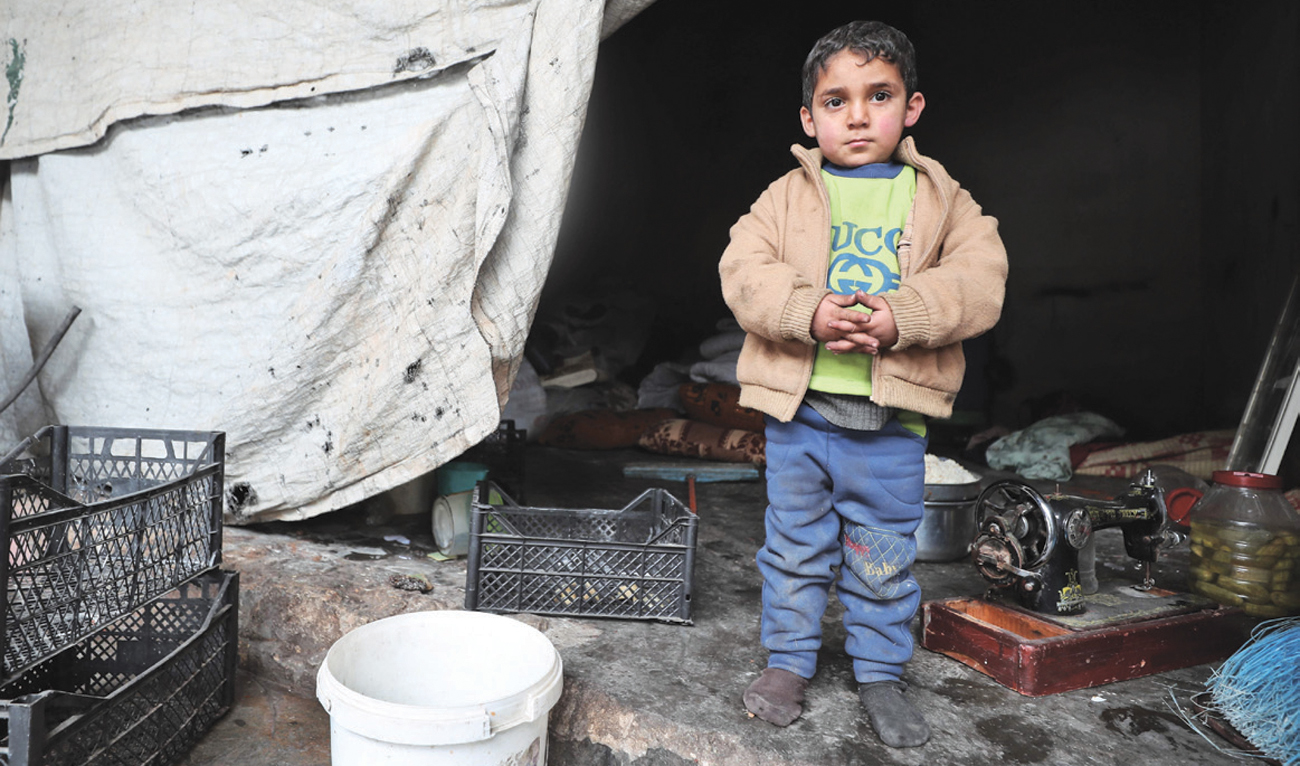
To live in Daret Ezza, his family had to rent a single-room workshop with blackened walls, separated from the concrete yard by nothing but a torn plastic sheet.

“This is what we could afford,” Abu Mohammed said. The family spent the winter coughing and sneezing, he said. In some mountain areas of Idlib and neighboring Aleppo province, the temperature dipped to minus 7 Celsius and several children have died of exposure.

As an estimated 3 million people, half of them children, get cornered in an ever shrinking enclave, aid groups warn of an unprecedented humanitarian emergency.

“The situation is getting worse, fear is growing, we can’t calm the children down when they hear a jet or a bomb,” the father said.

Hiding under a black winter coat and a green woolly hat, Ines ia the most traumatized of Abu Mohammed’s four children.

“She freezes completely when the bombardment starts,” her father said.

“I block her ears and tell her ‘Don’t be scared, it’s far away, there won’t be strikes’. But still she screams and cries,” he said.

At night she sleeps with her head under the pillow, so as not to hear the warplanes passing overhead.

Even as the truck got ready to move, Abu Mohammed wasn’t sure where his family would sleep next.

“We might spend the night with a cousin who took a tent as he left,” he said.

Abu Mohammed said they would head toward Azaz, a town considered safer because it lies on the Turkish border.

The truck is so packed that some will have to endure the ride balancing on top of the pile of mattresses in the back.

A stove, a sewing machine and some cooking pots had to be left behind.

A moving video of a father teaching his three-year-old daughter to treat air strikes and shelling as a game was widely shared on social media this week, drawing more attention to the plight of children in the conflict.

According to Save The Children, at least seven children have died since December from the cold or bad living conditions in the camps for the displaced.

Most of the nearly 1 million people displaced by the offensive on Idlib are women and children, who often have to burn furniture or whatever they can find to keep warm.

The United Nations has called for a cease-fire to help tackle what it has warned could become the worst humanitarian disaster of the war.

But on Wednesday Russia blocked a cease-fire resolution at the UN Security Council.

Main category: 
Tags: 

Turkey launches operation against Syrian regime troopsIdlib operation ‘imminent’: Erdogan


It’s time to implement radical changes, says Algeria’s new president

Fri, 2020-02-21 01:01

Algerian President Abdelmadjid Tebboune, who succeeded longtime leader Abdelaziz Bouteflika in December, asked in the face of his country’s insistent protest movement for time to implement “radical changes,” in an interview published on Thursday.

The interview with French daily Le Figaro was Tebboune’s first since his election in Dec. 12 polls that were rejected by the year-old “Hirak” protest movement that forced out Bouteflika and marked by a record 60-percent abstention rate.

“We cannot reform, repair and restore that which was destroyed over a decade in two months,” Tebboune told Le Figaro.

Tebboune has been slammed by protesters as representing the ruling elite they want removed, having served several times as minister and once briefly as prime minister during Bouteflika’s two-decade rule.

Tebboune, who after his election “extended a hand” to the Hirak movement to build a “new Algeria,” said he has prioritized “political reforms.”

“I am determined to go far in making radical changes to break with bad practices, clean up the political sphere and change the approach to governing.”

Revising the constitution is the “priority of priorities,” he said.

SPEEDREAD

The interview with French daily Le Figaro was Abdelmadjid Tebboune’s first since his election in Dec. 12 polls that were rejected by the year-old ‘Hirak’ protest movement that forced out Abdelaziz Bouteflika.

“The limits,” he added, are those elements “relating in particular to national identity and national unity. “Everything else is negotiable.”

“The second area of work will be that of the electoral law,” to give legitimacy to parliament, “which will have to play a larger role,” he said, underscoring the need to “separate money from politics.”

He said “things are starting to calm” in the streets and that “the Hirak got almost everything it wanted,” including the departure of Bouteflika last April and figures from the “old regime” as well as the arrests of officials and businessmen suspected of corruption.

Even as the unprecedented popular movement has thinned in numbers since December, protesters still turn out in droves every Friday, keeping up demands for a complete overhaul of the system in place since Algeria’s independence from France in 1962.

In his interview, Tebboune dismissed any notion that he — like his predecessors — was a president chosen by the army, a pillar of the regime.

“I feel indebted only to the people who elected me freely and openly. The army supported and accompanied the electoral process, but it never determined who would be president.”

Tebboune is, however, considered to have been close to the late General Ahmed Gaid Salah, powerful army chief for 15 years until his death on Dec. 23.

Gaid Salah wielded de facto power in Algeria between Bouteflika’s resignation in the face of mass street protests last April 2 and Tebboune’s succession.

“The army … is not concerned with politics, investment or the economy,” Tebboune said, contradicting most observers who say the army’s top brass have influence in all those spheres.

The president said he also wants to reform the economy, which has been battered by the low price of oil — on which Algeria’s economy is dependent — and “unbridled imports, which generate overcharging, one of the sources of corruption.”

Main category: 
Tags: 

A year on, challenges remain for Algerian protest movementAlgeria court upholds 15-year sentence for Bouteflika’s brother


Iranian scarf campaigner calls for vote boycott

Fri, 2020-02-21 00:57

GENEVA: Anti-headscarf campaigner Shaparak Shajarizadeh once believed in the potential for change in Iran but is now so despondent she is calling for a boycott of Friday’s parliamentary elections in the Islamic republic.

Shajarizadeh became a dissident in 2018 when she was arrested for repeatedly removing her headscarf in public and waving it on the end of a stick, as part of a women’s rights protest that caused a social media storm.

“The Iranian people lost their hopes … I was among those who had some hopes. But now it is like choosing between bad and worse,” the 44-year-old women’s rights campaigner told AFP in Geneva, where she was attending an annual conference for human rights activists.

Shajarizadeh said the supposed political choice in Iran between reformist and conservative politicians was like picking between “two faces of the same coin.”

Thousands of reformist and moderate candidates are in any case being barred from contesting the elections — something that critics say could turn the vote into a choice between conservatives and ultra-conservatives.

Iranians “lost their hopes,” particularly after a bloody crackdown last year on fuel price protests, she said.

Shajarizadeh calls President Hassan Rohani, who was first elected in 2013 and again in 2017 and was once seen as a possible force for change, a “so-called reformer.”

The protest movement against Iran’s Islamic dress code began when in December 2017 when a woman, Vida Mohavedi, stood on a pillar box on Enghelab Avenue in Tehran without the mandatory long coat and raised her veil on a stick.

Enghelab means revolution in Farsi and the square and avenue are among the busiest areas in the capital.

Movahedi’s move sparked similar protests by other women like Shajarizadeh and they soon won recognition as “Dokhtaran-e-Enghelab,” or the Girls of Revolution Street.

“Young women are back in the streets,” she said — a reference to other demonstrations in recent years which have seen women taking a leading role.

During her visit to Geneva, Shajarizadeh received a prize for her defense of women’s rights in Iran but she talks about herself as an ordinary person whose life changed completely when she decided to join the protest.

She was arrested three times and beaten for her defiance.

She decided to run away, crossing the mountains into Turkey on foot with her head covered to avoid detection.

She now lives in Toronto in Canada with her husband and their 11-year-old son, from where she is still campaigning against the obligation of wearing the hijab.

The BBC has listed her as one of the world’s most influential women and she has written a book about her story with Canadian journalist Rima Elkouri.

Her lawyer, Nasrin Sotoudeh, is a leading women’s rights campaigner in her own right and is currently in prison.

Shajarizadeh said “targeted sanctions” on the government could help change the situation in Iran but these should be designed “not to put more difficulties on the people.”

Ultimately she thinks the best agents of change are civil society movements like her own and the “real heroes” are the women who decide to show their hair in public.

Main category: 
Tags: 

Hijab-wearing model Ikram Abdi Omar stars in new campaignSix hijab-wearing trailblazers to know on World Hijab Day


Egypt’s street music ‘more dangerous than new coronavirus’

Author: 
Fri, 2020-02-21 00:53

CAIRO: An Egyptian ban on performances of a popular form of street music, branded “more dangerous than coronavirus,” has sparked uproar in the country.

Singers of mahraganat (Arabic for festivals) have been accused of overstepping moral boundaries with their controversial “low-taste” lyrics.

The row erupted after the Egyptian Musicians Syndicate on Sunday ordered a ban on mahraganat artists performing their rapid-fire electronic music at clubs, cafes, hotels, concert venues, and even on Nile cruise boats.

One MP has called on the Egyptian Parliament to hold a debate on the matter and the country’s Supreme Council for Media Regulation is considering a bar on TV appearances by mahraganat singers.

But the performers themselves have hit back, with one lawyer filing a lawsuit calling the decision a violation of the Egyptian constitution as well as the nation’s rules on freedom of expression in arts.

The latest condemnations came after a huge Valentine’s Day concert held in Cairo International Stadium at which numerous mahraganat singers performed. Among them was Hassan Shakoosh who sang his hit song “Bint Al-Giran” (The girl next door) that includes the lyrics, “drinking alcohol and smoking hash.”

Following the concert, Musicians Syndicate President Hany Shaker issued a statement banning the songs and said: “All sections of society reject the wave that threatens Egyptian art and culture.” The style of music contained negative meanings and promoted immoral behavior, he added.

Shaker, a famed singer himself who began his career in the 1970s, pointed out that under the syndicate’s terms and conditions, members had a duty to adhere to social and moral values and use lyrics that “did not incite immorality or bad habits.”

He said Shakoosk had used inappropriate words that went against the traditions and values of Egyptian society, adding that where necessary he would be reviewing singing licenses and syndicate memberships.

President of the Supreme Council for Media Regulation, Makram Mohamed Ahmed, said: “We are investigating the issue through the council complaints committee and we will take certain decisions and measures.”

Banned mahraganat artist, Kozbara, whose singing partner Hangara is an Uber driver, said he was “sick and looking for a job at a gas station.”

However, Egyptian Parliament spokesman, Salah Hasaballah, described the mahraganat singers as “more dangerous than the new coronavirus.”

Other MPs said the music should be banned “to protect public taste” while some politicians called for a less heavy-handed approach by urging singers to select their lyrics more carefully in accordance with morals and good taste.

MP Abdel-Hamid Kamal filed a report to Parliament Speaker Ali Abdel-Aal calling on the Egyptian Minister of Culture Inas Abdel-Dayem to hold a session to discuss what he described as “low-taste art” and how it affects society. In his report, Kamal said that the spread of mahraganat music could have a negative impact on future generations.

Member of the media and culture committee in Parliament, novelist Youssef El-Kaeed, backed Kamal saying the music “mutilated” public taste and spread undesired types of arts. He appealed for officials to act over the situation and warned that the ban could fuel popularity for the music and make its singers even more famous.

El-Kaeed blamed the media for being partly responsible for promoting the phenomenon by giving publicity to singers.

Osama Sharshar, a member of Egypt’s parliamentary culture and media committee, said he was not against mahraganat songs or folk music “provided that they take into account preserving public taste.”

He added that the Art Production Monitoring Authority, which issued licenses to produce art works in Egypt, had a role to play in determining whether such songs were commensurate with public taste.

“We cannot artistically execute mahraganat singers. We need to redirect their singing compass in the right direction by choosing proper lyrics that match our culture and traditions,” Sharshar said.
 

Main category: 
Tags: 

Meet the Egyptian sisters revitalizing classical musicEgypt pulls plug on popular street music