Tehran accused of virus cover-up

Author: 
Sun, 2020-02-23 04:04

JEDDAH: Iran was accused on Saturday of covering up the impact of the coronavirus amid fears that the infection could spread through the region because of the country’s poor health care standards.

Ten new cases were confirmed in Iran on Saturday, bringing the total to 29, and the death toll rose to six — the highest outside China.

Most of the cases have been in Qom, where schools and universities will be closed from Sunday.

The US State Department said the Iranian regime was playing down the danger and giving people “incorrect information.”
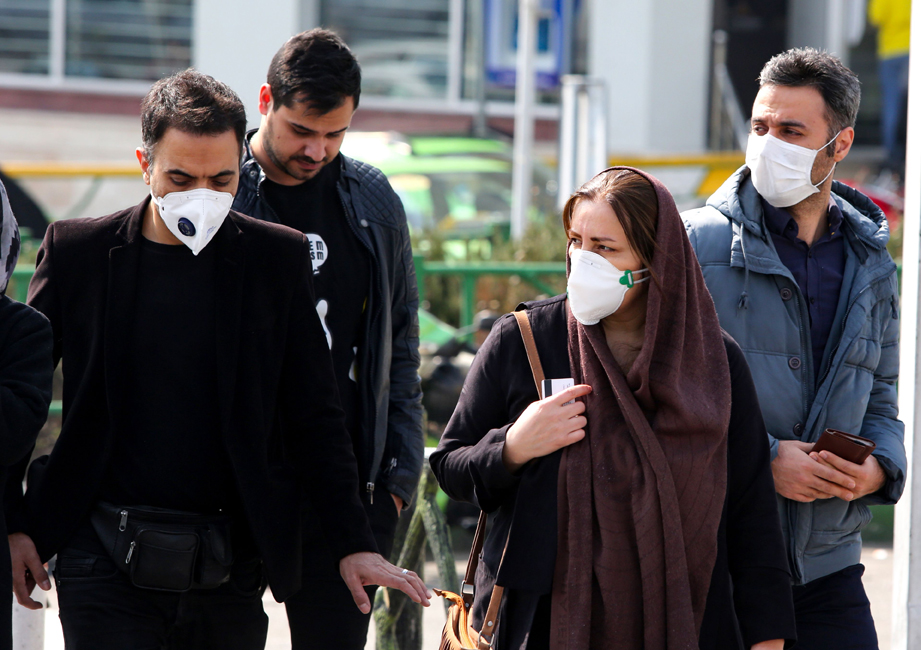

Iranians, some wearing protective masks, wait to cross a street in the capital Tehran on Feb. 22, 2020. Iran has reported two more deaths among 10 new cases of coronavirus, bringing the total number of deaths in the Islamic republic to six and infections to 28. (AFP / ATTA KENARE)

Online posts compared Iran’s coronavirus announcements with the attempted cover-up after the Islamic Revolutionary Guard Corps shot down a Ukrainian passenger plane last month, killing 176 people.

The World Health Organization said it was worried about the spread of the virus from Iran.

The two latest cases in the UAE on Saturday were an Iranian tourist and his wife, and Lebanon’s first confirmed case on Friday was a 45-year-old woman returning from Qom.

“The concern is … a very rapid increase in a matter of a few days,” said Sylvie Briand, director of the WHO’s global infectious hazard preparedness department.

“We are just wondering about the potential of more exported cases in the coming days.”

The coronavirus was first detected in December in Wuhan, in Hubei province in China. There have been nearly 78,000 confirmed cases and 2,362 deaths, almost all in China.

Main category: 

Lebanon cuts back on Iran flights amid coronavirus casesIranian mayor tests positive for coronavirus with new cases reported


Israeli taxi app sued for discrimination against Arab drivers

Author: 
Sun, 2020-02-23 01:20

LONDON: Local rights groups in Jerusalem have sued Israeli on-demand taxi app Gett for offering what they allege is an option designed to discriminate against Arab drivers.

Gett, which also has operations in the US and the UK, offers its users in Jerusalem a unique service called Mehadrin, which refers to the most rigorous level of Jewish standards.
The service offers users the option to choose a taxi that is not driven on the Sabbath. Palestinian Arab drivers in the city are largely Muslim or Christian, and often work on the Sabbath.
While Gett claims that it does not discriminate on the basis of religion and that drivers of any faith can register, lawyer Asaf Pink calls the Mehadrin option a “proxy for a racist service that provides taxis with Jewish drivers.”

FASTFACT

Gett, which also has operations in the US and the UK, offers its users in Jerusalem a unique service called Mehadrin, which refers to the most rigorous level of Jewish standards.

Pink, along with the Israel Religious Action Center, sought a private investigation into the service before submitting the case, sending in undercover people posing as potential drivers.
Herzl Moshe, Gett’s Jerusalem representative, allegedly said he would never allow an Arab driver to register with the Mehadrin service.
“It’s for people who don’t want an Arab driver,” he said in comments recorded during the private investigation.
Anat Hoffman, executive director of the Israel Religious Action Center, claimed that religion is only being used by Gett as a cover for racial discrimination.
“Using Judaism to justify racism isn’t Jewish,” Hoffman said. “Racism by any other name smells just as foul.”  
Gett insists that its policies are not discriminatory. “Any driver, regardless of religious belief, can drive in this fleet,” said a spokesperson for Gett.

Main category: 
Tags: 

Iraq’s Sadr warns MPs against rejecting new govtSudan to probe violence against Khartoum protesters


Iraq’s Sadr warns MPs against rejecting new govt

Author: 
Sat, 2020-02-22 23:39

NAJAF: Populist cleric Moqtada Al-Sadr returned to Iraq on Saturday with a threat to organize protests outside Parliament unless lawmakers back the government of Prime Minister-designate Mohammad Allawi in a confidence vote.
The cleric with a cult-like following in Iraq has thrown his weight behind the appointment of Allawi, despite the premier’s rejection by a protest movement Sadr once backed.
The onetime anti-US militia leader whose supporters form the largest bloc in the Parliament had spent most of the past few months in neighboring Iran but came back to whip up support for Allawi’s government lineup.
Sadr demanded that parliament approve the line-up in the coming days.
“If the session does not take place this week, or if lawmakers don’t (back) a transparent Iraqi Cabinet in a vote … then this will require a demonstration of a million people,” he tweeted.
“Sit-ins around the Green Zone (where Parliament is located) will have to be used to exert pressure,” he said.
Allawi has called for a vote of confidence to be held on Monday and has been backed by his predecessor Adel Abdul Mahdi, who bowed out as prime minister in December in the face of pressure from the street.
But the constitutional position is unclear.
Deputy Parliament Speaker Hassan Karim Al-Kaabi, who is close to Sadr, told Iraqi media that Abdul Mahdi’s request for an extraordinary session to hold the confidence vote was binding.
But Parliament Speaker Mohammed Halbusi said he has not yet agreed to convene the session and several lawmakers from Iraq’s Sunni Arab minority said they would boycott any vote.

Main category: 
Tags: 

Meet the Iraqi hair blogger making ‘waves’ on social mediaAs Iraqis rally against corruption, ministries up ‘for sale’


Sudan to probe violence against Khartoum protesters

Author: 
Sat, 2020-02-22 23:36

CAIRO: Sudanese Prime Minister Abdalla Hamdok on Saturday ordered an investigation into a violent crackdown by security forces on protesters in Khartoum.
 Hamdok said in a televised speech: “I decided to form an investigative committee in the events that occurred on Feb. 20-21.”
 He said Attorney General Taj-Elsir Ali would head the committee and a final report would be issued within seven days.
 On Thursday, Sudanese security forces used teargas and batons to disperse thousands of protesters.
They were demanding the reinstatement of army officers dismissed for refusing to crack down on demonstrations against former President Omar Bashir, witnesses said.
 A doctors’ committee linked to the opposition said in a statement that at least 17 people were wounded, and many of the wounded were hit by teargas canisters.

HIGHLIGHT

Mohamed Seddik, an iconic figure of the uprising, is among those dismissed last week and one of several young army officers who had refused to participate in the crackdown on demonstrations in front of the Defense Ministry calling for the removal of Bashir.

The military removed Bashir from office and arrested him last April after months of demonstrations, bringing an end to his 30 years of autocratic rule.
But dozens of protesters were killed during crackdowns on the demonstrations, and dozens more died last June when security forces cleared a sit-in at which protesters pushed for further reforms.
Mohamed Seddik, an iconic figure of the uprising, is among those dismissed last week and one of several young army officers who had refused to participate in the crackdown on demonstrations in front of the Defense Ministry calling for the removal of Bashir.

Main category: 
Tags: 

Huge locust outbreak in East Africa reaches South SudanICC trial in The Hague one option for Sudan’s Bashir -minister


Thousands hit streets of Algiers on protest movement anniversary

Author: 
Sat, 2020-02-22 23:34

ALGIERS: Several thousand people gathered in the Algerian capital on Saturday on the first anniversary of a protest movement that seeks an overhaul of the political system and forced the former president to resign.
Protesters shouted “the people want the fall of the regime” and “we have come to get rid of you,” referring to the country’s rulers.
“No to military power, civil not military state” was written on one banner, referring to the authority exercised by the high military command since the country’s independence from France in 1962.
Mass protests first erupted on Feb. 22 last year, in response to then-President Abdelaziz Bouteflika announcing he intended a run for a fifth term — despite being debilitated by a 2013 stroke.
Less than six weeks later, he stepped down after losing the support of the then-army chief in the face of enormous weekly demonstrations.
Despite hordes — diplomats said “millions” — turning out after Bouteflika’s fall to demand an overhaul of the entire system, the military maintained a political stranglehold in the months that followed.
Police were deployed around the Grande Poste in central Algiers in numbers unusual for a Saturday, as people responded to calls on social media to celebrate the first anniversary of the “Hirak” protest movement.
Friday had seen the 53rd straight weekly demonstration, with Algerians flooding the streets of Algiers and numerous other cities across the country.
Even as the unprecedented movement has thinned in numbers since December, protesters still turn out in droves on a weekly basis.
President Abdelmadjid Tebboune, a former prime minister under Bouteflika who was elected in December, had recently claimed that “things are starting to calm” in the streets and that “the Hirak got almost everything it wanted.”

Main category: 
Tags: 

Neighbours to meet in Algiers on Libya crisisMore than 80 detained in Algiers protest, says rights group