Palestinians resigned to status quo in Gaza after latest Israeli election
Author:
Thu, 2020-03-05 03:08
GAZA CITY: Palestinians were on Wednesday resigned to more of the same in the Gaza Strip following the results of Israel’s third parliamentary election within the space of a year.
With further deadlock leaving Prime Minister Benjamin Netanyahu struggling to form a government and the prospect of a possible fourth ballot in the pipeline, Palestinian factions in Gaza expected to see little if any change to the status quo.
Hamas spokesman Fawzi Barhoum said: “We are not counting on any variables within Israeli society, as they are all the product of an occupation Zionist project aimed at stabilizing the pillars of the Zionist entity at the expense of the Palestinian right.”
Islamic Jihad official Daoud Shehab said: “The election results will not change anything from reality, as there is ongoing occupation and aggression, and it is natural and self-evident that we face this occupation and its aggression.”
Spokesman for the Fatah movement, Hussein Hamayel, said: “These results are clear evidence that whoever rules Israel and directs public opinion is the behavior of settlers based on repression, killing and attacks on the Palestinian people.”
For two years the Gaza Strip witnessed protests demanding Israel lift its 14-year blockade. Hamas, with Egyptian mediation, agreed to de-escalate tensions along the borders a year ago, in exchange for the provision of facilities at crossings, an increased fishing zone, and an allowance for some materials that Israel considered of dual use.
The deal was divided into two phases, the first before the Israeli elections and the second after the formation of a government. Both sides could not proceed to the second phase as the government has yet to be formed in Israel.
Ibrahim Zaid, 29, did not see much difference between Israeli candidates and thinks that the right-wing domination of the Israeli government will have a negative impact on Gaza.
“All the successive Israeli governments are trying to keep the Gaza Strip away from the scene, trying to facilitate the entry of aid, but not trying to make a real change. I do not think that there will be a complete lifting of the blockade,” he told Arab News.
Columnist, Fathi Sabbah, told Arab News: “The Israeli government, whether Netanyahu or an exchange between Netanyahu and (opposition leader Benny) Gantz, will not offer anything to the Gaza Strip except for some simple facilities that will not affect the Gaza Strip significantly or make any fundamental change.
“The reality in the Gaza Strip will remain as it is, neither complete calm nor extensive war, as long as Netanyahu or Gantz are unable to form a government, and the Palestinian factions don’t have many options but will accept additional Israeli facilities.”
Nawal Siksik, 24, said: “I live in the Gaza Strip and have not participated in any elections. The Israelis voted in three elections within one year.
“We need elections (in Palestine) in order for someone to represent us democratically, and to restore unity between the West Bank and Gaza Strip. In this way we can confront any Israeli government, whether from the right or otherwise.”
The last Palestinian elections were held in 2006, in which Hamas won a majority of seats. Since then, no elections have taken place despite promises made by Palestinian President Mahmoud Abbas more than once as a result of the political division.
Calm returns after two-day flare-up in and around GazaCease-fire by militants in Gaza after 7 die
Yemeni army vows imminent offensive on Houthis
Author:
Thu, 2020-03-05 01:39
AL-MUKALLA: The internationally recognized government of Yemen has vowed to launch a military offensive to recapture strategic areas in northern Yemen taken by the Houthis over the past couple of weeks.
Prime Minister Maeen Abdul Malik said the war with the Iran-backed forces is in a critical phase since the Houthis made rapid military advances in the northern province of Jawf and the mountainous Nehim district, near Sanaa, stressing that the army is preparing a major offensive aimed at expelling the Houthis from those areas.
According to the official Saba news agency, Prime Minister Malik told military commanders on Tuesday that the Yemeni leadership would not tolerate military setbacks, ordering the commanders to intensify military efforts to expel the Houthis from all Yemeni areas under their control.
Malik’s remarks come as a government delegation led by the minister of local administration, Abdul Raqeeb Fateh, visited military bases in the city of Marib, where they met senior army commanders and soldiers.
Fateh told Al-Arabyia TV that President Abed Rabbo Mansour Hadi ordered them to travel to Marib to see what the army needed for its offensive against the Houthis and to assess humanitarian situation in city. “Victory is looming. We have seen great (military) preparations,” Fateh said from a military base in Marib.
The latest circle of fighting in Yemen erupted in January when a Houthi missile and drone attack killed more than 110 soldiers at a training camp mosque in Marib.
The Houthis have attacked government forces in Sanaa and Jawf provinces over the past couple of months. After intense fighting, they wrested control of territory in Sanaa’s Nehim district and stormed two districts in Jawf, including the city of Hazem, the province’s capital.
Displacement
Fighting in Jawf province has forced thousands of residents to flee, fearing Houthi reprisal attacks, Yemeni government officials said on Wednesday.
Yemen’s minister of information, Muammar Al-Aryani, said Houthi assaults drove more than 25,000 people out of their homes in Jawf, adding that the Houthis launched reprisal attacks on opponents who did not flee Hazem.
“Reports confirm the displacement of more than 25,000 people, including women and children, in the largest wave of displacement from the city since 2014,” Al-Aryani said on Twitter.
Residents in Marib say that dozens of vehicles carrying displaced people are arriving in Marib, and many more people slept rough in Marib desert due to lack of shelters.
The Executive Unit for the Internally Displaced People in Marib said in a statement that local aid organizations managed to meet the needs of only 5 percent of the growing number of the displaced people, urging international humanitarian organizations to step in.
The first large wave of displacement this year was in January when more than 3,000 families fled their homes and camps in Marib province and Sanaa’s Nehim district, in the wake of heavy fighting between loyalist forces and Houthis.
The fleeing families headed toward the city of Marib amid severe shortages of shelters, food and medication.
Houthi court sentences 35 Yemeni lawmakers to deathSaudi Arabia’s development program delivers change in Yemen
Erdogan denies blackmail over Syria migrants
Author:
Thu, 2020-03-05 01:02
ANKARA: Turkish President Recep Tayyip Erdogan laid his cards on the table on Wednesday and demanded EU help for his military action in Syria in return for ending the migrant crisis on Turkey’s border with Greece.
Thousands of refugees have massed at the border and around the Greek islands since Erdogan last week tore up a 2016 deal with the EU to keep the migrants in Turkey in return for cash aid to help with the influx from northwest Syria. Clashes have broken out between police and refugees.
Erdogan said Europe had to support Turkey’s “political and humanitarian solutions in Syria” if it wanted to resolve the situation, but government spokesman Ibrahim Kalin denied this was blackmail.
“Our objective by opening the doors was not to create an artificial crisis, to place political pressure or to serve our interests,” he said, but Turkey’s capacity “has a limit.”
Turkey already hosts more than 3.6 million refugees, most of them Syrians, and has been fighting the Assad regime in a bid to prevent more crossing from Idlib province.
EU foreign policy chief Josep Borrell and European Council president Charles Michel met Erdogan in Ankara on Wednesday, and pledged an additional 170 million euros in aid for vulnerable groups in Syria.
But Turkish spokesman Kalin urged the EU to produce a “road map” for the management of the funds.
Borrell said the EU recognized the “difficult situation Turkey is facing” but Turkey’s green light to migrants could “only make the situation worse.”
Turkey’s migrant policy turns into a hot potato for EuropeGreek navy ship on Lesbos houses latest island migrants
‘I fear for the whole country,’ says senior Lebanon politician Walid Jumblatt
Thu, 2020-03-05 00:50
PARIS: Druze leader Walid Jumblatt has told Arab News that if Lebanon wants to deal with Hezbollah’s weapons issue, the Iran-backed political party cum Shiite militia will try to change the Taif Agreement and write a new constitution that works in its favor.
In an exclusive interview, the veteran politician added that it was necessary for Lebanon to work on a program with the International Monetary Fund (IMF) on acceptable conditions.
He denied that the new Lebanese government was a Hezbollah-sponsored one, and said he believed that a government in place was better than a political vacuum.
During a brief visit to Paris, Jumblatt, who is president of the Progressive Socialist Party (PSP), expressed fears about a US-Iran rift over Lebanon.
He said he would still call for dialogue with the Free Patriotic Movement party — led by President Michel Aoun’s son-in-law Gebran Bassil — for the sake of Christian-Druze coexistence.
According to Jumblatt, Lebanon’s political governing system as envisaged in the 1989 Taif agreement — which ended the 1975-1990 Lebanese civil war — can only be changed by a new electoral law.
French radio reports of the current situation in Lebanon suggest that 800 Lebanese businesses, such as hotels, bars and restaurants, have closed, and that 100,000 employees have been laid off during the political crisis, with people unable to withdraw money from banks.
BIO
Name: Walid Jumblatt
Born :August 7, 1949
Party: Progressive Socialist Party
Family: Son of Kamal Jumblatt, leader of Lebanon’s Druze community until his assassination in 1977
Political base: Moukhtara, in Lebanon’s Chouf Mountains
Government experience: Served as cabinet minister in the 1980s
Jumblatt spoke about the circumstances that had brought about the crisis, and who, in his view, was responsible for it.
“It is partly the responsibility of the political class and partly the mismanagement of public affairs in Lebanon,” he said.
“We were living in a dream when each time we had a crisis, there was an appeal to the international community and millions of dollars poured in.
“We have passed through many international aid conferences — Paris 1, Paris 2, Paris 3, and also Arab assistance. This is no longer working. We have to reschedule the Lebanese debt and work with an IMF program on acceptable conditions.
“Maybe we have to ask the IMF to manage our affairs, such as electricity and other public utilities, because it seems that the political class and the actual administration are unable to do what is needed.”
Jumblatt was asked about the Lebanese popular uprising, its rejection of the political class and whether he felt he was part of it, and responsible for the long-running problems.
“I was part of it, but the people are blaming everybody, even though they cannot accuse everybody. I am a minority because of our system. There is also the fact that Lebanon is in a unique position: We have a Lebanese state and another parallel entity which is Hezbollah.”
Jumblatt added: “We have to reach an understanding with Hezbollah on a minimum (number) of issues.
Lebanese anti- government protesters flash the victory sign next to a burning roadblock during a de onstration in the capital Beirut in January. (AFP)
“That means controlling the borders, fighting corruption together and, for the time being, leaving aside the issue of Hezbollah’s weapons — because we cannot discuss this question now and see the future of Lebanon.”
Jumblatt said it was clear that there were “conflicting views” between Hezbollah and the PSP.
“The main issue has been weapons but nobody nowadays — neither us nor the revolutionaries — is bringing up the subject of Hezbollah’s weapons,” he said.
“The main conflict of views is over the control of our borders, both the official and non-official ones. Hezbollah has financial autonomy but most Lebanese citizens lack this autonomy.”
Given the likelihood of Hezbollah rejecting the planned IMF program, Jumblatt said: “Most Lebanese rely on the banking system and we have to find a solution, a compromise. The IMF is not a danger
to Hezbollah.
Jumblatt added: “Unless Hezbollah have another solution, can they afford to sustain the whole Lebanese people and provide them with welfare and medical care?”
On the anti-corruption and anti-nepotism demonstrations in the streets of Lebanon, Jumblatt said: “We want a new political class, but that will not happen except through elections.
“I have failed because we have been in a war for decades. Now it is up to them. This confessional system is very strong (but) it has to be changed.”
But can the existing political system really be changed? “I don’t know; it is up to the people,” Jumblatt said.
“Changing the system cannot come except through a new electoral law, but up to now, the revolution has not formulated what it wants. It wants the downfall of the political class but no means of achieving that has materialized.”
Asked if he fears for the safety of Lebanon’s Druze due to his complicated relationship with two powerful Iran-backed entities, the Syrian regime and Hezbollah, Jumblatt replied: “I fear for the whole country and not only for the Druze. Of course, I have opponents backed by the Syrians and the Iranians but that is a minor problem.
Walid Jumblatt has warned that dealing with Hezbollah’s weapons “issue” would lead to the Shiite group trying to change the Taif Agreement and rewrite the constitution. (AFP)
“I fear for the whole country when its elite go to foreign embassies to flee from Lebanon because they have no future in their own country.
“I fear a conflict between the US and Iran on Lebanese soil. The whole country is on the verge of total collapse.”
Against this backdrop, Jumblatt is worried that the victory of hardliners in Iran’s recent elections will result in a tightening of Tehran’s grip on Beirut.
Lebanon’s new government is described by its opponents as “one color” because it is backed by President Michel Aoun and his allies — including Hezbollah — and does not include Western-supported parties.
Jumblatt rejects this characterization. “I don’t share the point of view that it is a government sponsored by Hezbollah,” he said.
“We have excellent ministers. I was supporting the government indirectly because I was against having a void. From the start of the revolution on Oct. 17 until Saad Hariri’s resignation, we had a total void. A government is better than a void.
“Also, the people in the government are doing their best in this terribly difficult situation.”
In his opinion, “somebody has to take us out of this economic mess and find a formula for formally dealing with the IMF on acceptable conditions. In addition, we have to pay part of the due eurobonds or reschedule them.”
Quizzed about Lebanon’s government failure to condemn the suspected Iranian attacks on Saudi Arabia’s Aramco oil facilities in September, Jumblatt replied: “I condemned it. I was not foreign minister. Lebanon is unfortunately divided.”
Asked whether he had plans to visit GCC countries, Jumblatt said: “I have received no invitation. I have good relations with both the Saudis and Kuwaitis.”
As for his forthcoming visit to Russia, he has no doubt about its timeliness. “I have always had good relations with the Russians. Relations were excellent when they were the Soviet Union,” he said.
“It is absolutely necessary to go there now because the Russians are a very important power in the Middle East.”
Jumblatt ended the interview on a wistful note, saying: “On Sept. 20 this year, the Lebanese will celebrate the hundredth anniversary of ‘Greater Lebanon.’
“I wonder what it means to celebrate that when Lebanon is totally isolated, is no longer protected by a compromise involving the West, the East and the Arab world, and a so-called economic miracle has totally collapsed.
Calls for creation of new UN anti-corruption body for LebanonHezbollah says it opposes IMF management of Lebanon crisis
Turkey’s migrant policy turns into a hot potato for Europe
Author:
AFP
ID:
1583355417980715700
Wed, 2020-03-04 20:38
ANKARA: Amid an unprecedented migration crisis along the Turkish-Greek border, the international community is searching for ways to quickly de-escalate the situation.
Turkish President Recep Tayyip Erdogan’s decision to open the floodgates to the flow of migrants from the Middle East into mainland Europe, violating the 2016 Turkey-EU deal, has pushed more than 136,000 refugees to leave for Europe, according to Turkish statistics.
The EU decided to provide Greece with up to €700 million ($780 million) to manage migration flow to its borders — the external borders of Europe — which has now turned into a frontline with heightened clashes between asylum-seekers and Greek police.
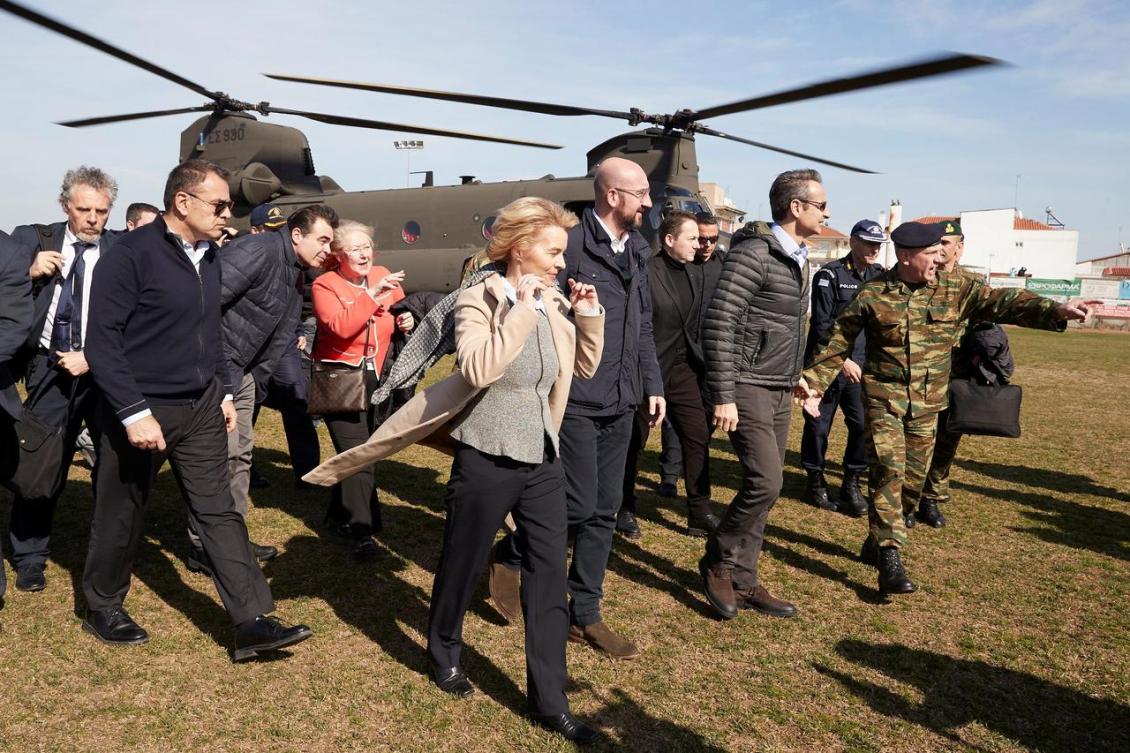
Along with boosted sea and land border controls, Athens suspended asylum rules for a month by invoking article 78.1 of the EU treaty. The presidents of the European Council, European Commission and European Parliament also traveled on Tuesday to the Greek-Turkish land border as a sign of support for Athens.
On Sunday, a child migrant drowned during a dangerous sea crossing to the Greek island of Lesbos.
Turkey currently hosts 4.1 million refugees, including 3.7 million Syrians. There are also about 1 million civilians at the Syrian border with Turkey who left Idlib after the advance of the Russian-backed Syrian forces.
A northern town of Turkey has offered free bus services for desperate migrants trying to make a journey to the Greek border, covering hundreds of kilometers.
“The gates are open” narrative and the free busses to Edirne have produced consternation and disbelief across the EU, and are seen as the first government-organized humanitarian crisis. “It makes further dialogue more difficult,” Marc Pierini, a former EU ambassador to Turkey who is now at the Carnegie Europe think tank, told Arab News.
Ankara has criticized Brussels for not keeping its promises under the refugee deal — to provide financial aid fairly quickly, lift visa requirements for Turkish citizens by the end of 2016, upgrade the Customs Union, and accelerate Turkey’s stalled accession process to the EU in exchange for dealing with migrant management within Turkish borders.
Only 25,000 refugees have been resettled in European countries in the past three years, although Brussels committed to a large-scale resettlement. Of the €6 billion that was promised to Turkey, only 53 percent (€3.2 billion) has been disbursed.
EuroMed Rights President Wadih Al-Asmar said: “Refugees are not a bargaining chip to be played with at the whims of political leaders. Europeans cannot look away from what might become one of the worst humanitarian disasters the war in Syria has brought on its people. Respecting international humanitarian law as well as the human right to protection and refuge remain the sole possible answer in the face of such indiscriminate violence.”
After Turkish forces suffered heavy military losses in Syria’s rebel-held stronghold Idlib, Ankara opted for an increasingly aggressive regional policy. Meanwhile, polls in Turkey reveal that almost 60 percent of the population holds anti-Syrian sentiments.
The mutual suspicion between Ankara and Brussels has encouraged Erdogan to weaponize the Syrian migrant situation.
Research fellow Luigi Scazzieri, from the Center of European Reform (CER), thinks Ankara’s “opening of the gates” has been seen in Europe as a move to blackmail the EU, with leaders saying that they will fully support Greece in controlling its border.
“European leaders have a very negative image of Turkey at the moment and do not fully appreciate its role in hosting refugees over the past few years. But leaders also know they need to cooperate with Turkey if they want to avoid mass pushbacks at the border,” he told Arab News.
How Germany’s Angela Merkel’s efforts to ease the humanitarian crisis will play out not only on Ankara’s side but also on Europe’s far-right populist parties is still unclear.
Germany recently announced that it is ready to deal with the issue with Ankara, which is aggressively asking for more help from Europe after its regional partnership with Russia in Syria backfired.
“After we opened the doors, there were several calls saying ‘Close the doors’,” Erdogan said on Monday.
“I told them it’s done. It’s over. The doors are now wide open. Since we have opened the gates, the number of refugees heading toward Europe has reached hundreds of thousands. This number will soon reach millions.”
Ahead of the EU’s extraordinary Foreign Affairs Council in Zagreb on March 5-6, EU’s High Representative/Vice President Josep Borrell and Commissioner for Crisis Management Janez Lenarcic visited Ankara on Tuesday and Wednesday to hold consultations on migration management.
This time, Ankara can also ask Europe for more money for the possible reconstruction of a Turkish-controlled buffer zone in Northern Syria.
“A cross-border humanitarian operation for Syrian internally displaced people (IDPs) in Idlib province is entirely dependent on a cease-fire agreement between Turkey and Russia, and security guarantees agreed by Russia and Damascus and their enforcement,” Pierini said.
“Once this is agreed, the EU should contribute to an UN-led humanitarian operation,” he said.
However, for expert Scazzieri, it will be difficult for the EU to assist with reconstruction or humanitarian assistance in Idlib until there is some sort of diplomatic agreement between Russia and Turkey to wind down the fighting in Syria.
“But the EU can provide Turkey with more assistance in supporting the refugees it is currently hosting. I think it is quite likely that leaders will begin talks with Turkey over how to extend and potentially increase EU funding. But they will be careful to avoid the impression that they are simply giving in to Ankara’s demands,” he said.