Iran reports 85 new virus deaths

Sat, 2020-03-14 02:02

TEHRAN: Iranian forces will clear the streets nationwide within 24 hours and all citizens will be checked for the new coronavirus in a bid to halt its spread, the military said Friday.

A newly formed commission has been charged with overseeing the “emptying of shops, streets and roads” within that time frame, armed forces chief of staff Maj. Gen. Mohammad Bagheri said.
“During the next 10 days, the entire Iranian nation will be monitored once through cyberspace, by phone and, if necessary, in person, and those suspected of being ill will be fully identified.”
The measures were brought into force after Iran’s supreme leader Ayatollah Ali Khamenei ordered the armed forces to lead the battle against the new coronavirus.
They are the most stringent to be imposed in Iran to combat what is the one of the world’s deadliest outbreaks of COVID-19 outside China.
The country on Friday reported that the novel coronavirus claimed another 85 lives, its highest single-day toll since the first deaths were announced on Feb. 19.
In all, the Health Ministry says 514 people have been killed by the illness out of 11,364 confirmed cases of infection.
Several politicians and officials in the nation of 80 million people have been infected, with some dying from the illness.
The latest suspected case of infection was Ali Akbar Velayati, who advises Iran’s supreme leader on foreign policy.
Velayati fell ill with “mild symptoms” on Wednesday and has been placed in quarantine, according to Tasnim news agency.
Separately, Sudan on Friday reported its first confirmed coronavirus case, a man who died on Thursday and had visited the UAE in the first week of March.
The man, in his 50s, died in the Sudanese capital Khartoum, the Health Ministry said in a statement.
Sudan on Thursday stopped visa issuance and flight services to eight countries including Italy and neighboring Egypt over fears of the coronavirus outbreak. Bus trips to Egypt have also been suspended.
Kenya and Ethiopia also announced their first confirmed cases of coronavirus, as East Africa, which has so far been unscathed by the global pandemic, scaled up emergency measures to contain its spread.

HIGHLIGHTS

• Several politicians and officials in the nation of 80 million people have been infected, with some dying from the illness.

• The latest suspected case of infection was Ali Akbar Velayati, who advises Iran’s supreme leader on foreign policy.

In Kenya, a 27-year-old Kenyan woman tested positive for the virus on Thursday in Nairobi, a week after returning from the US via London. She was in a stable condition and recovering, Health Minister Mutahi Kagwe told reporters.
“We wish to assure all Kenyans that the government will use all the resources available to fight coronavirus,” he said, as the government rolled out a raft of new containment measures.
The government had traced all the contacts of the patient since she arrived back in Kenya on March 5, he said.
“At the moment, there is absolutely no need for panic and worry,” he said.
Kenya, with a population of 50 million people, saw a spree of panic buying among the middle-class in Nairobi supermarkets, in the wake of the announcement.
Meanwhile Ethiopia, Africa’s second most populous nation with over 100 million people, said a 48-year-old Japanese man who had arrived in the country on March 4 from Burkina Faso was confirmed to have contracted the virus.
“He is undergoing medical follow-up and is in a stable condition. Those who have been in contact with this person are being traced and quarantined,” the Health Ministry said in a statement.
Burkina Faso only confirmed its first case on Tuesday — a couple returning from France — and the Japanese patient had been in that country since Feb. 24.
Ethiopian Health Minister Lia Tadesse said three other patients were in isolation.
Other countries in the region have been rolling out their own measures.

Main category: 

Coronavirus sparks fear as cases continue to rise across the Middle EastAmid coronavirus chaos, Corona is not the best brand name. Or is it?


Egyptians fight stormy weather with humor 

Author: 
Sat, 2020-03-14 00:47

CAIRO: Weather forecasts warned of a wave of aggressive wind and rain from Thursday to Saturday (March 12-14). Consequently, the government gave people the day off on Thursday and advised them to not leave their houses unless absolutely necessary.
Stuck in their residences for the duration of the storm, some even without electricity or water, Egyptians combated the situation the only way they know how — with humor.
Citizens took to Facebook to share the humorous sights they witnessed on the streets during the heavy rains.
In the flooded streets cars created waves as they moved around. This was caught in a video that quickly went viral as people searched for entertainment. Even with water up to its windshield, the driver was still determined to get to his destination.
Another video was of shop owners and salesmen at a small supermarket “fishing” in the ocean created by the gathered rainwater. The man fishing can be seen extracting a fish using his fishing rod and his colleagues are cheering him on. The video was captioned “Weather forecast: 0, Egyptians: 1,”  — as Egyptians refuse to surrender to the bad weather.
Among the most memorable videos was one initially shared on TikTok and then on Facebook. It was of a woman using the heavy rains to wash her coffee mug amid the water cuts. A series of memes were also shared, such as one of a sea of rainwater leading up to one of the pyramids of Giza. The image was accompanied by the caption: “The Nile is back near the pyramids, like the days of the pharaohs.”
Another image was of a man in a diving suit, preparing to dive, and it was captioned “Do you want anything other than the yogurt mom?”
The videos and memes are solid proof of Egyptian’s ability to find humor in all the bad situations.

Main category: 
Tags: 

Death toll at 21 as Egypt storms, flooding enter second day13 injured in Egypt train accident amid heavy rain


Turkey risks sanctions if it activates S-400 missile system, experts warn

Author: 
Sat, 2020-03-14 00:41

ANKARA: Turkey has reportedly decided to activate its Russian-made S-400 surface-to-air missile system in April despite warnings from the US that if it does so, it will be unable to acquire America’s Patriot missile-defense batteries.

Ankara’s purchase of the S-400s from Russia has been a major source of disagreement between Ankara and Washington, which insists that the Russian system is incompatible with the NATO systems. Turkey says it has no intention of integrating the S-400s into NATO systems.
Following recent tension with Russia over Syria’s rebel-held Idlib province — where dozens of Turkish soldiers have been killed by Russia-backed Syrian regime attacks, Turkish President Recep Tayyip Erdogan recently stated that he was interested in purchasing the US Patriot system to reinforce Turkey’s defenses.
But the US administration has clearly stated that it will not sell the Patriot system to Turkey unless it scraps its plans to use the S-400s.
Karol Wasilewski, a Turkey analyst at the Polish Institute of International Affairs, thinks that Erdogan and Turkish decision-makers are serious when they say that they would like to have both S-400s and Patriots.
“It corresponds to their vision of (Turkey having) a multi-vector foreign policy,” he told Arab News. “But Turkey won’t get the Patriots as long as it has active S-400s on its soil. If the Turks activate the S-400, the US will most likely impose sanctions under the 2017 Countering America’s Adversaries Through Sanctions Act (CAATSA),” he said.
CAATSA sanctions cover 12 options, including the denial of visas to officials, prevention of access to the US-based Export-Import Bank, refusal or prohibition of export licenses and the prevention of any transactions with the US financial system.
Erdogan has been asked repeatedly by his US counterpart Donald Trump to abandon the $2.5 billion Russian system, which began arriving in Turkey in July accompanied by much fanfare.

BACKGROUND

President Tayyip Erdogan recently stated that he was interested in purchasing the US Patriot system to reinforce Turkey’s defenses.

In response to Ankara failing to take the warning seriously, Washington removed its NATO ally from the multinational manufacturing program for F-35 joint-strike fighter jets and prohibited the sale of those aircraft to Turkey.
“Not only is it impossible for Turkey to operationalize S-400 and also purchase Patriot batteries at the same time, operationalizing the S-400 will likely lead to sanctions by the United States,” said Ozgur Unluhisarcikli, Ankara office director of the German Marshall Fund of the United States.
These sanctions, he warned, could not only be selected from the CAATSA options, but also from the harsher Turkey Sanctions bill, S. 2641, which has already passed the Senate Foreign Affairs Committee.
Bill S.2641 places restrictions on US arms sales to Turkey for use in any military offensive in northern Syria, and will mean that America opposes any loans being granted to Turkey from international financial institutions. It also restricts visas and freezes Turkish assets in the US. At the same time, the bill calls for the enforcement of CAATSA sanctions against Turkey. While the White House claims that such a move risks pushing Turkey into a closer relationship with Russia, the US Congress reportedly favors imposing sanctions on Ankara.
Still, Unluhisarcikli suggests there is a way to “overcome this stalemate.”
“The US could deploy Patriot batteries in Turkey for a year in return for Turkey committing to not activating the S-400 in that same period,” he said.
This way, Unluhisarcikli argues, sanctions would at least be postponed and there would be a window of opportunity to resolve the S-400 problem in a more positive way that would not so heavily damage an already weakened Turkish economy.
It is still unclear to what extent Ankara might be willing to compromise in order to avoid sanctions, considering that last year Turkish Foreign Minister Mevlut Cavusoglu stressed that Turkey needs the Russian system, and said, “A product is not bought to be kept in the box.”
In other words, the Turkish government has already made up its mind about the S-400 system.
If Turkey, NATO’s second-largest member in terms of military force, activates the rival Russian system as declared, it will likely set the country on a collision course with its NATO allies over concerns that the Russian system could undermine NATO technology and open a potential backdoor through which to spy on NATO assets.
For Washington, the only solution to this impending crisis is that the system remains inactive.


Main category: 

NATO leaders ramp up pressure on Turkey over S-400 missile systemErdogan: Turkey’s efforts to solve S-400 missile row with US to continue until April


Amid coronavirus chaos, Corona is not the best brand name. Or is it?

Fri, 2020-03-13 23:31

CAIRO: Up until recently, Egyptians associated the word “Corona” with a venerable chocolate-manufacturing company.

However, after the emergence of the new coronavirus, the name has taken on a whole new meaning.

Many Arabs familiar with Corona confectionary have been pondering as to whether the global outbreak has impacted on sales and damaged the brand’s image.

As counterintuitive as it may seem, Ahmed Shaaban, Corona’s sales manager, said the health crisis has had the opposite effect.

He pointed out that sales had increased as the coronavirus infection spread from Wuhan in China, where it originated, around the globe. It has now been officially declared a pandemic by the World Health Organization (WHO).

“Egyptians have been buying more Corona chocolate bars. Many visit our stores to joke with the staff about the relationship between the virus and chocolate. The conversation usually ends up with the purchase of our chocolate,” Shaaban added.

Mohamed, a salesman at a Corona outlet, said: “The association of our product name with the name of the virus has encouraged many people to buy our products.” Jokingly, he added: “The virus has been the best advertising we’ve ever had.”

On a serious note, the outbreak is posing a growing threat to the Egyptian economy, with pressure on tourism, trade and gas exports, according to a Reuters report.

The country has recorded at least 80 infection cases, many of whom were on a Nile cruise ship in Luxor, where its Pharaonic temples are a major tourist attraction.

Tourism, which had rebounded after the 2011 uprising in Egypt, has been showing the first signs of a slowdown.

But Egyptians are not holding back on buying their favorite chocolate.

“I was raised on Corona chocolate, and I passed my love for it down to my children,” Amani Wajid, a cinema employee in Cairo, told Arab News.

“The coincidental link between coronavirus and Corona chocolate has given rise to jokes at home, but at the end of the day we love Corona chocolate.”

Corona, originally called the Royal Chocolate Co., was founded in the Egyptian city of Ismailia in 1919.

The factory’s headquarters later moved to the coastal city of Alexandria, and the company’s name was changed to Corona. At the time, the owner was a Greek businessman named Tommy Christo, whose reputation for magnanimity has outlived him among his employees.

“Christo used to treat the staff with great generosity, and gave them excellent salaries and bonuses,” Shaaban said. “He used to give out movie tickets to employees, workers and their families, and also distributed boxes containing a large selection of Corona products at the beginning of each year.”

Opinion

This section contains relevant reference points, placed in (Opinion field)

Several years after the revolution of 1952, led by the Free Officers Movement, the Corona Co. was nationalized through a decree by then President Gamal Abdel Nasser.

The merger of Nadler Confectionery Co. with Corona and Al-Hawamdiya Factory gave birth in 1963 to a nationalized industrial asset, Alexandria Chocolate and Confectionery Co. Mohamed Rashad Zaki, an engineer, was appointed chairman of the board.

In 2000, when a downturn in the global economy hit Egypt hard, Corona witnessed a drop in its market share. The company was sold to the Sami Saad Group in 2000 as part of a larger government program of privatization and economic reform.

Shaaban said that due to its dependence on imported manufacturing materials, Corona was adversely affected by the rise in the value of the dollar against the Egyptian pound in 2016.

Since then, the business has been substituting imported raw materials with local commodities in an attempt to reduce its exposure to foreign-exchange fluctuations.

Although privatization failed to halt the decline in Corona chocolate sales, the firm has been on a recovery path in recent years as a leading FMCG company locally in the sandwich-biscuit and cocoa categories.

The practice of selling Corona products exclusively through its outlets has been discontinued in favor of arrangements with supermarkets, including Hyper One, Zahran and Seoudi.

Corona exports about 15 percent of its production and aims to expand in the US, Libya, Tunisia and Kenya.

“We aim to increase our exports to 20 million Egyptian pounds ($1.3 million) during 2020, as opposed to 10 million pounds in previous years,” Shaaban added. “We have drawn up a plan to increase the number of distributors for our products in Egypt in order to raise the growth rate by 40 percent by the end of the year.”

Main category: 

Companies in Saudi Arabia adapting to coronavirus measuresTwitter moves to protect conversations on COVID-19 in MENA region


Death toll at 21 as Egypt storms, flooding enter second day

Fri, 2020-03-13 18:14

CAIRO: Thunderstorms and flooding around Egypt entered a second day Friday, interrupting daily life in much of the country, including the capital Cairo, as the death toll rose to 21, authorities said.
Most of the fatalities took place in the country’s rural areas and run-down slums. At least six children died, either from electrocution or rubble after heavy rains knocked down their houses.
Since the rains hit late Wednesday and early Thursday, social media has been inundated with images and video showing flooded roads and villages as well as water-filled apartments in some of Cairo’s richest neighborhoods.


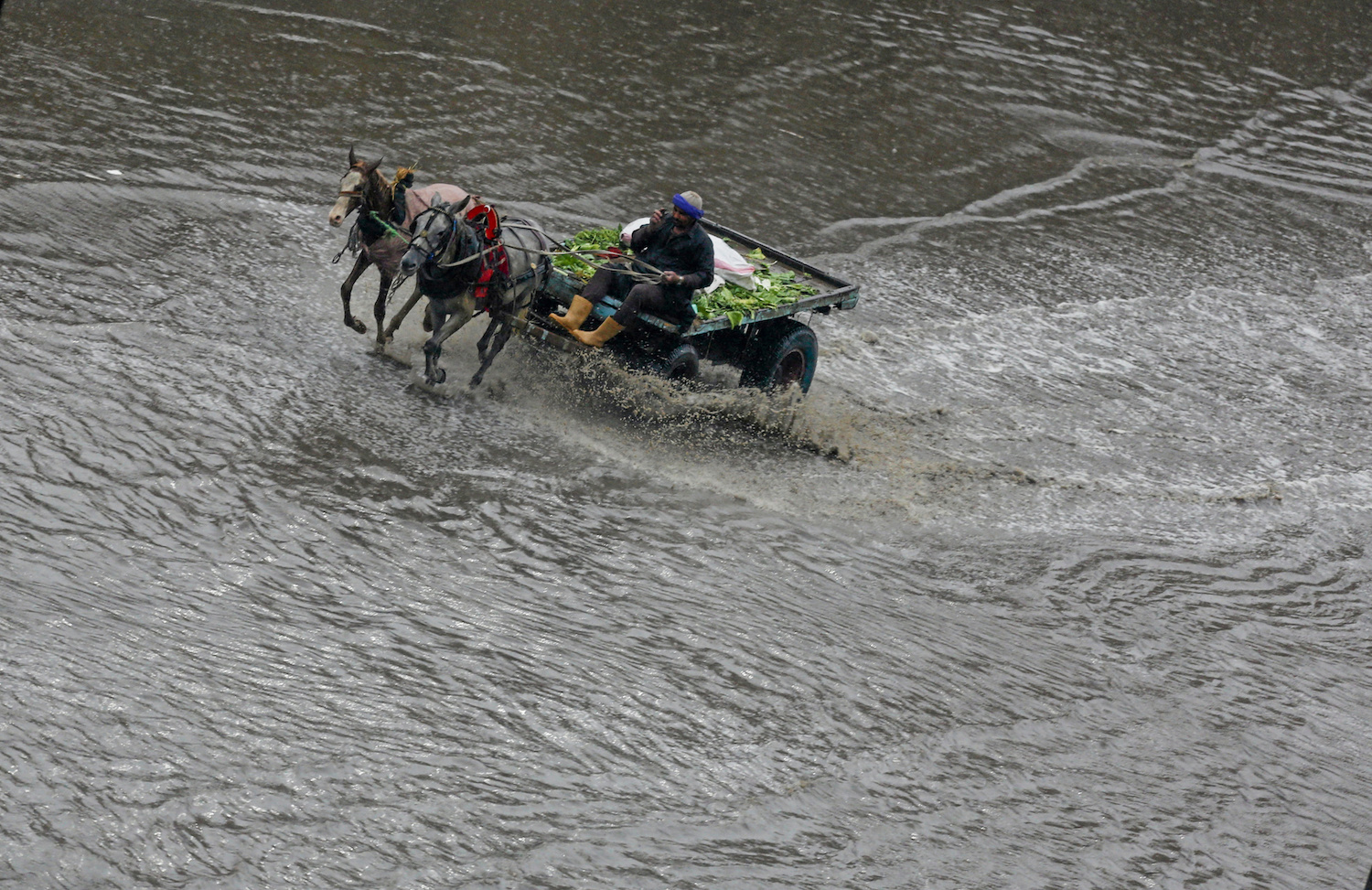
A man rides a cart during a thunderstorm and heavy rains in Cairo, as the government announced a day off while the rain exceeds the infrastructure’s capacity in most cities, Egypt Mar. 12, 2020. (Reuters)


Chaos always accompanies bad weather in Egypt, raising questions about the country’s poor infrastructure and dilapidated sewage and drainage systems. To minimize the impact of bad weather, the government closed down schools and suspended work in businesses and government offices after forecasters warned of heavy rains and flooding across much of the country through Saturday.


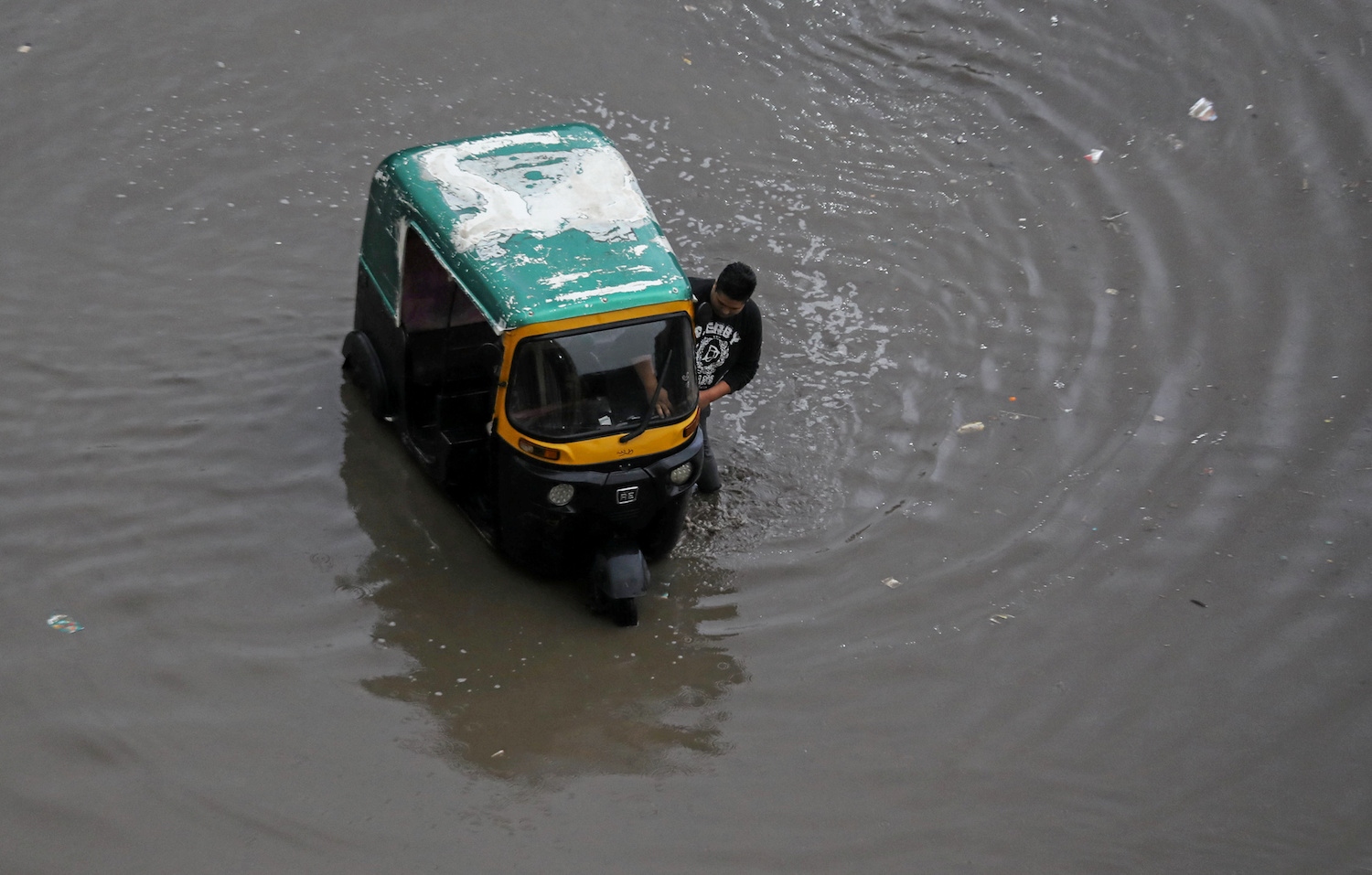
A man tries to fix an auto rickshaw during a thunderstorm and heavy rains in downtown of Cairo, as the government announced a day off while the rain exceeds the infrastructure’s capacity in most cities, in Egypt Mar. 12, 2020. (Reuters)


Late on Thursday, Cairo’s Water Authority announced it had suspended water service to the entire megacity because heavy rain had overwhelmed the vast sewage system. Water would return when the weather improved, it said, without offering an exact time. By Friday morning water had returned to some parts of the city.
The floods forced the country’s railway authorities to suspend train service nationwide. Power outages were also reported in several parts of the country, including parts of Cairo.

Main category: 
Tags: 

13 injured in Egypt train accident amid heavy rainThunderstorms bring widespread flooding to Egypt, killing 5