Yemenis stranded abroad demand rescue flights

Author: 
Sat, 2020-04-18 23:14

AL-MUKALLA: Hamoud Hassan was supposed to have left India in mid-March with his sick brother after doctors told him that the surgeries his sibling needed would cost $54,000.

“We decided to leave India to collect the money, spend Ramadan with our families and return,” he told Arab News. “Also, my brother’s health improved after taking drugs.” 

But their plan to leave never got off the ground after Yemen last month halted flights in and out of the country to stop the spread of coronavirus. The decision left thousands of Yemenis stuck in India, Egypt, Jordan, and other countries. Hassan lives in Saudi Arabia, while his brother lives in Yemen. Both want to leave India.

The abandoned nationals have appealed to their government to arrange repatriation flights as they are running out of money and food. “Our only demand is returning home,” said Hassan. “Do they want us to die here? We do not mind staying in quarantine in the desert at home. I also want to go back to my family in Saudi Arabia.” 

A crumbling health system in war-torn Yemen led thousands of its citizens to seek treatment overseas. But some have been forced into borrowing money from friends and relatives while abroad after spending what they had on food and healthcare. 

“We moved to a new, cheaper flat and borrowed $20 from one person and another $50 from another,” Mutaher Hassan, a Yemeni patient who traveled with three others to Egypt last year for a liver transplant, told Arab News. “All hospitals here have been closed due to the disease. My mother and brother want to return home very soon. We spend our time praying, eating and sleeping.”

He urged the government to evacuate them quickly as his friends in Egypt and relatives in Yemen and Saudi Arabia had stopped funding him. “Everyone is suffering from financial problems, even my relatives in Saudi Arabia,” he added.

Yemen also closed land crossings with Saudi Arabia and Oman, leaving hundreds of Umrah pilgrims in the Kingdom. Yemen recorded its first case of coronavirus on April 10, and health officials warned that large repatriations would lead to the spread of the disease amid chronic shortages of medical supplies and quarantine centers.

Omer Hassan, who traveled with his mother to the UAE in February for treatment, was planning to fly back to Yemen to prepare for his wedding. “I see myself much luckier than many stranded patients in Egypt and other places since at least I live here with relatives,” he told Arab News from Abu Dhabi. “But I want to go home to furnish my house.” 

Another Yemeni man, called Omer, was in Egypt and said that he stayed indoors most of the time. “I booked a flight after recovering from surgery,” he told Arab News. “Now, I have to limit my errands in order not to spend money.”

Several Yemenis stuck in Egypt and India who spoke to Arab News said they preferred being quarantined in Yemen rather than living with no money or help abroad.

Yemen’s internationally-recognized government is considering several options to address the problem, such as sending urgent financial assistance or asking them to bring medical reports showing they were not infected with coronavirus.

“We are under huge pressure to address this issue,” a senior government official told Arab News on condition of anonymity because he was not authorized to brief reporters. “One of the options is wiring $2 million to the stranded people.” He added that the number of stranded Yemenis was around 10,000. “We do not want the disease to spread in Yemen. At the moment we prefer sending the money before moving to the other options.”

The Yemeni government might also ask host countries to test Yemenis and supply them with a medical report. Those who test negative would be allowed to return. Buses would ferry them from airports to their homes, the Yemeni government official said. 

But some Yemeni provinces that host functioning airports, such as Hadramout and Aden, reject the idea of repatriating Yemenis before putting them in quarantine, fearing the rapid spread of coronavirus. “It is true that there is a strong opposition to the idea of bringing back the stranded people soon,” the official said.

“We do not even want to live in a hotel in India,” Hamoud Hassan said. “The government should be using the money for buying fuel for the planes that would carry us. $200 would not solve our problems.”

Main category: 
Tags: 

UN thanks Saudi Arabia for Yemen humanitarian aid amid coronavirusFunding shortage means UN programs in Yemen will start closing down: Aid chief



Israel accuses Hezbollah of “provocative” activity

Author: 
Associated Press
ID: 
1587233252781163800
Sat, 2020-04-18 17:38

JERUSALEM: Israel on Saturday accused the Lebanese militant group Hezbollah of “provocative” activity along the Lebanese-Israeli frontier and said it would complain to the UN Security Council.
In a statement, Foreign Minister Israel Katz accused Hezbollah of multiple attempts to breach the border Friday night.
He said Israel “thoroughly condemns” the incident and expects the Lebanese government to prevent such threats.
On Friday night, the Israeli military fired flares along the volatile frontier after signs of a possible border breach. It said it later found damage to the separation fence in three locations.
Israel and Hezbollah fought a month-long war in 2006 that ended in a stalemate. Under a UN-brokered truce, Hezbollah is barred from conducting military activity along the frontier.
There was no immediate comment from the Iranian-backed militant group.

Main category: 

Israeli drone strike targets top Hezbollah security officialMystery surrounds murder of Hezbollah fighter


Why coronavirus is a ticking bomb in war-ravaged northern Syria

Sat, 2020-04-18 20:08

ERBIL, Iraqi Kurdistan: As the coronavirus pandemic cuts a wide and deadly swathe through the Middle East and Asia, people in war-torn areas are pretty much sitting ducks, waiting to contract the infection.

Nowhere are crisis-ravaged communities more exposed to the deadly virus than in large expanses of Syria, especially in the country’s northwest and northeast.

Northern Syria is particularly vulnerable owing to dire humanitarian conditions and the risk of further conflict, analysts told Arab News.

The northwestern governorate of Idlib and the mostly Kurdish-controlled northeast, the two remaining areas outside the Syrian regime’s control, now face an invisible enemy.

Syria confirmed its first case on March 23, after insisting for weeks that the virus had not reached the country.

The regime had been waging an aggressive military campaign to retake territory in Idlib. For the past several weeks fighting has abated, especially after Turkey, which backs several rebel groups, reached a cease-fire deal with Russia, Syrian President Bashar Assad’s main military backer.

The hundreds of thousands displaced by the fighting have sought shelter in already overcrowded displacement camps, where conditions make it impossible for residents to practice social distancing or self-isolation.

Out of Idlib’s 2 million-plus population, at least 900,000 were displaced by the latest round of fighting between the regime and rebels.


A child looks on as volunteers gather in a sewing workshop to make protective face-masks in the northeastern city of Idlib, to be used as a means of protection against COVID-19. (AFP)

“About a million people are displaced, living in tents along the Turkish border,” said Mustafa Gurbuz, a non-resident fellow at the Arab Center in Washington DC. “Social distancing is a luxury. There’s nothing called home, water shortage is pervasive, hygiene is impossible, and people are already suffering from poor health.” 

Under the circumstances, if a COVID-19 contagion infects only a few people, it could spread very quickly.

“Only a few cases could result in an explosive outbreak. If the fragile cease-fire derails, a renewed conflict may cause more displacement, which could lead to further spread of COVID-19,” Gurbuz said, referring to the March truce that brought the fighting in Idlib to a halt.

The UN has called for a cease-fire across all of Syria so that efforts can be focused on preventing a major outbreak, which could affect the lives of millions of people living in deplorable and unsanitary conditions across the country.

Opinion

This section contains relevant reference points, placed in (Opinion field)

Aron Lund, a fellow with The Century Foundation, said Idlib is too disorganized and poorly equipped to handle an epidemic.

“There’s no coherent government, just a gaggle of militias half-heartedly strung together by a system of councils,” he said, adding that Idlib sorely lacks staff, medical facilities and medicine to cope with the likely effects of any significant outbreak.

Hundreds of thousands of people live cheek by jowl with each other in tent camps and decrepit buildings.

“Old people, who are most at risk of dying or falling very ill from the virus, are mixed up with children and have no way of isolating themselves for protection,” Lund said.


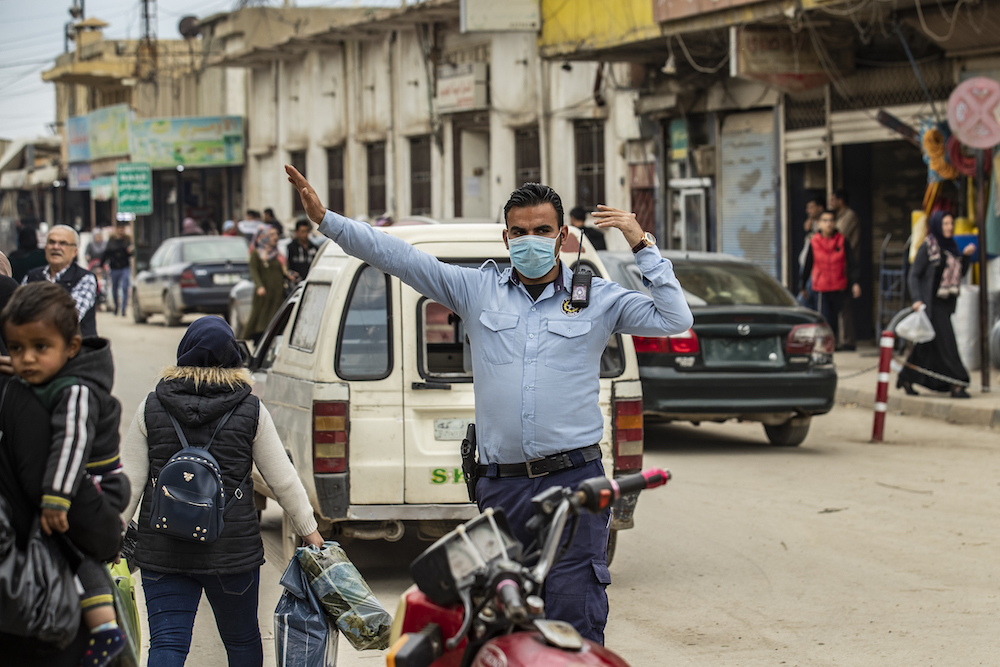
A policeman wearing a mask as a means of protection against the cononavirus Covid-19, directs the traffic at an intersection in the northeastern Syrian Kurdish-majority city of Qamishli. (AFP)

Furthermore, many people in Idlib have no access to clean or hot water, or necessities such as soap that can help prevent the spread of the virus.

To compound the crisis, the regime’s Russian-backed air campaign in Idlib saw repeated bombing of hospitals and health facilities, which has crippled the local health infrastructure and rendered it incapable of handling any outbreak.

When it comes to a COVID-19 outbreak, Idlib’s fears and vulnerabilities are mirrored by those of northeast Syria, most of which is controlled by the Kurdish-led Syrian Democratic Forces (SDF).

The news of the first death here — in a hospital in the city of Qamishli, which is under the regime’s authority — drew a strong reaction from the Kurdish Red Crescent and the SDF-backed Autonomous Administration of North and East Syria (NES) on Friday.

The Red Crescent lamented the “high risk of a large spread of the virus” due to announcement by the World Health Organization (WHO) of “the positive result after 15 days of the case.”


Syrian Red Crescent vehicles spraying disinfectant along a street in the capital Damascus. (AFP)

Joshua Landis, director of Middle East studies at the University of Oklahoma, describes the area as “a ticking time bomb for the coronavirus.”

For instance, on March 29 Turkey and its armed proxies, which occupy part of northeast Syria since launching an invasion last October, cut off water supplies to the area by shutting down the Allouk water station, on which 460,000 people depend.

If these supplies are indefinitely withheld, hundreds of thousands of local inhabitants could fall prey to coronavirus for much the same reason that makes many civilians in northwest Syria vulnerable.

“Tensions are extremely high as six armies are in a standoff: The Turkish Army, the Syrian Army, the SDF, the US Army, along with Russian and Iranian forces stationed in the region, not to mention the many proxy militias, which have their own agendas,” Landis said. “This makes getting aid to the region or coordinating policy impossible.”

The medical infrastructure in northeast Syria, which was at best primitive even before the uprising began in 2011, has been devastated by years of conflict.

The SDF began to enforce a lockdown on March 23 in an attempt to contain any spread of the virus.

However, it sorely lacks testing kits for detecting COVID-19 cases and determining which individuals or areas might have the virus and need to be strictly quarantined.

The US-led anti-Daesh coalition has partially addressed the issue through the supply of $1.2 million worth of medical supplies to help the NES, but that is unlikely to be even nearly enough.


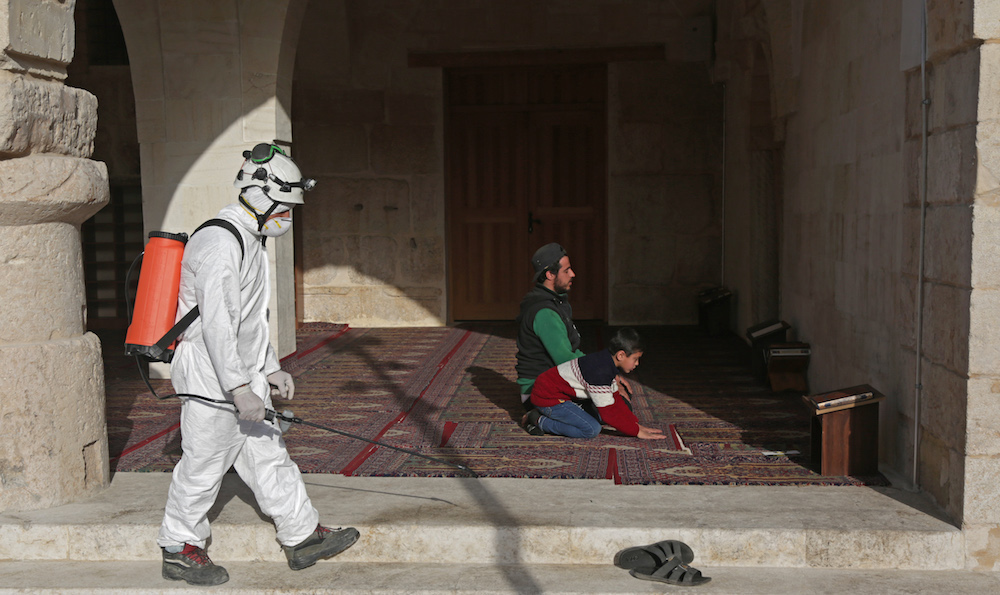
Members of the Syrian Civil Defence (White Helmets) disinfect a mosque in the city of al-Bab in the north of Aleppo province on March 24, 2020, as part of protective measures against COVID-19 coronavirus disease. (AFP)

In December, Russia and China used their veto power to prevent the UN Security Council from renewing permission for the delivery of aid to northern Syria from neighboring countries, in a move denounced as “callous” by Amnesty International, the human-rights advocacy group.

As a result, up to 400,000 medical items that would otherwise have been delivered to northeast Syria were left stuck in trucks in neighboring Iraq.

The Syrian regime, likely as part of a bid to pressure the SDF, has also prevented the flow of aid through Damascus.

The WHO says it has provided Syria with at least 1,200 testing kits, but the NES says Damascus has failed to provide protective equipment and artificial respirators.

This leaves the NES in a bind and more vulnerable to any outbreak given its heavy reliance on aid from the UN and NGOs, especially for the region’s displaced-persons camps and overcrowded prisons.

In the absence of a resumption of the flow of UN aid or unhindered passage of medical supplies through Damascus to NGOs, the meager resources of the NES are bound to become overwhelmed quickly in the event of an outbreak.

A coronavirus contagion in northeast Syria could also pose a very severe security threat to the region and possibly beyond.

“Some 10,000 Daesh fighters, along with close to 70,000 Daesh family members, are held in tight quarters, where social distancing is impossible,” said Landis.

At the very least, the situation in northern Syria is a big cause for concern as the pandemic causes havoc throughout the Middle East.

What is certain is that the pain and suffering of the war-weary people of Idlib and northeast Syria are unlikely to end anytime soon.

Main category: 


Turkey’s coronavirus cases overtake Iran, highest in Middle East

Author: 
Reuters
ID: 
1587229629161012200
Sat, 2020-04-18 17:05

ISTANBUL: Turkey’s confirmed coronavirus cases have risen to 82,329, Health Minister Fahrettin Koca said on Saturday, overtaking neighboring Iran for the first time to register the highest total in the Middle East.
An increase of 3,783 cases in the last 24 hours also pushed Turkey’s confirmed tally within a few hundred of China, where the novel coronavirus first emerged.
Koca said 121 more people have died, taking the death toll to 1,890. A total of 1,822 people have recovered from coronavirus so far, and the number of tests carried out over the past 24 hours came to 40,520, the minister said.
The Interior Ministry also said it was extending restrictions on travel between 31 cities for a further 15 days starting at midnight on Saturday.

Main category: 

Watchdog slaps ban and fine on FOX Turkey Turkey bars firms from laying off workers amid pandemic


Rockets strike near Chinese oil site in Iraq, no casualties

Author: 
AP
ID: 
1587222192900701900
Sat, 2020-04-18 13:11

BAGHDAD: Two rockets struck near a Chinese oil facility south of Baghdad without causing any casualties, Iraqi officials said Saturday, the second such attack to target energy interests in the country this month.
An Iraqi army statement said the rockets struck near a “Chinese company” in the Nahrawan area, southeast of Baghdad, without elaborating. Iraqi security officials said the rockets caused minor damage.
China’s ZhenHua, a subsidiary of the arms manufacturer Norinco, has been working in the nearby East Baghdad oil fields since May 2018 under a 25-year development contract with the Oil Ministry. The officials did not say whether this was the company that was targeted.
One security official said the rockets were launched by militia groups as a threat following a failed business proposition. The officials spoke on condition of anonymity because they were not authorized to speak to media.
Iraq depends on revenues from oil exports to fund 90% of its budget.
On April 6, at least three rockets targeted the site of an American oil field service company in the southern oil-rich province of Basra. The rockets were targeting Halliburton in the Burjesia area and caused no damage, according to Iraq’s military.

Main category: 
Tags: 

Iraq oil minister says crude price ‘fair,’ aims to hike output capacityRockets hit near site of foreign oil firms, state-run companies in Iraq’s Basra