TUNIS: A Tunisian NGO has set up a food bank that dispenses aid by text message to some 300 needy families rendered more vulnerable because of the coronavirus pandemic.
The initiative, which had been long in the making, was finally launched at the end of April to coincide with the start of the holy Muslim fasting month of Ramadan.
It targets families who have lost jobs because of the lockdown imposed by Tunisia to contain the spread of the virus, like that of Messaouda Raouafi, a cleaning woman forced to stay indoors.
“Because of Ramadan and the lockdown I can no longer go out to work,” said the 49-year-old.
“I cannot clean homes and earn money to feed my seven children.”
Her family was among the 300 chosen by the women’s affairs ministry and signalled to the NGO known as the “Banque Alimentaire Durable” or Sustainable Food Bank.
Under the initiative, Raouafi receives a code by text message allowing her to spend 40 to 60 Tunisian dinars (around $21-32) weekly at specially designated grocery stores.
With that money, Raouafi has been able to buy basic goods such as oil, milk, coffee and flour.
Farah, who runs a grocery store in the working-class district of Kram, is among those who signed up to take part in the project.
“The money is sent to us ahead of time — that way the clients can buy what they want with the funds allocated to them,” she said.
Farah said this works much better than allowing customers to buy on credit, a system that takes its toll on her own finances.
“In our area there are many poor families and unemployed people,” she said, explaining why she decided to embrace the initiative.
A member of the NGO, Aisha Zakraoui, said she hopes the initiative will grow so as to reach more needy families across Tunisia.
The NGO also aims to help families become more self-sufficient through training in skills such as growing their own vegetables or baking bread to sell.
“Our objective is to provide food aid to needy people and in exchange they agree to take part in initiatives aimed at integrating them socially and professionally,” Zakraoui said.
Even before the virus outbreak, Tunisia has been struggling with economic and social hardship that has worsened since the country went into lockdown in March to battle the pandemic.
The government estimated that two million of Tunisia’s 11.5 million population were in need of financial assistance during that time.
In March and April, the government made emergency handouts of 200 dinars to vulnerable families.
Tunisia, which has officially declared 1,000 cases of the novel coronavirus including 45 deaths, began easing its lockdown on May 4.
In the early days of the containment measures, several hundred Tunisians had demonstrated in working class districts of the capital demanding government support and protesting the lockdown.
Tunisian actress Hend Sabri to star, create new Netflix drama-comedy Tunisia to partially reopen economy from next week
Coronavirus crisis changing public attitudes in the Middle East, polls suggest
Sat, 2020-05-09 19:24
DUBAI: Public opinion surveys conducted in Saudi Arabia and the UAE are revealing a mix of sharp changes in attitudes and an uptick in optimism that the coronavirus crisis will be resolved in the next three months.
Nearly two months ago, as coronavirus was declared a global pandemic by the World Health Organization (WHO), the online research firm YouGov began tracking attitudes and behaviors surrounding the coronavirus disease (COVID-19), using their global research panel of more than 8 million respondents.
When YouGov published its first findings on March 18, 64 percent of Saudi residents said they were scared of catching the virus; the corresponding figure for the UAE was 61 percent.
On May 6, YouGov released the eighth wave of their tracker data, which suggests that the threat perception has only increased: 75 percent of Saudi respondents reported being fearful of contracting the infection while 73 percent of UAE residents felt the same way.
Just 7 percent described themselves as “Not at all scared that I will contract COVID-19,” while 12 out of the 2,002 people surveyed reported having already contracted the virus.
Globally, over 4 million people have been infected by COVID-19 and more than 276,000 of them have died.
In Saudi Arabia, the number of confirmed cases now exceeds 35,000 while the UAE has reported 16,793 confirmed cases.
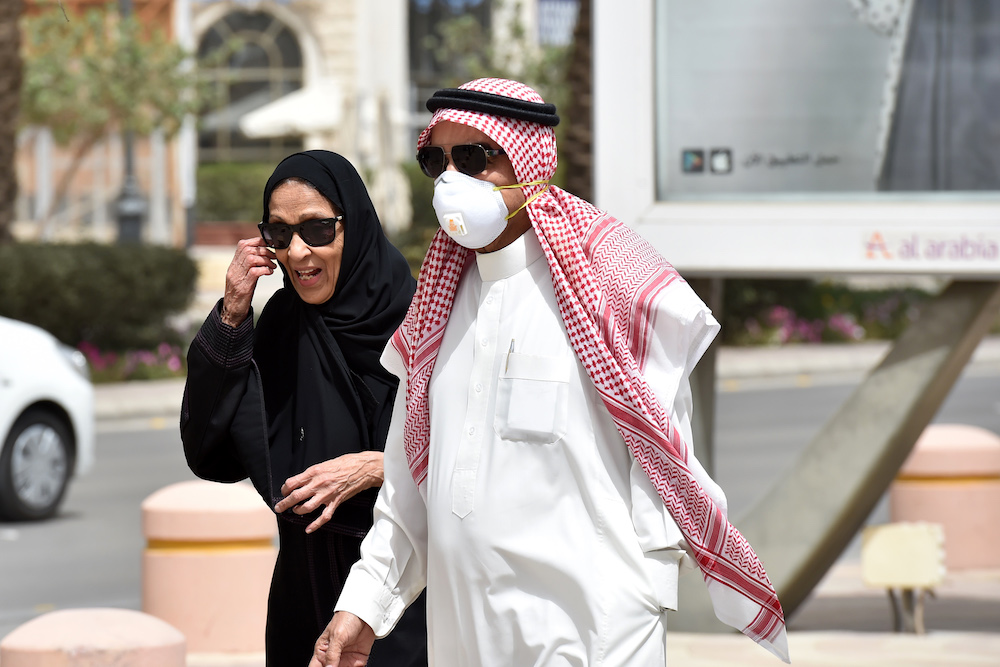
A Saudi man, wearing a protective mask as a precaution against COVID-19 coronavirus disease, walks with his wife along Tahlia street in the centre of the capital Riyadh. (AFP/File Photo)
With widespread and persistent fear of the illness continuing to dominate daily life, it is unsurprising that 46 percent of Saudi and UAE residents strongly feel that the pandemic will permanently change the way we live and interact with each other.
Just 8 percent of respondents do not agree with the statement “The coronavirus pandemic will permanently change the way we live and interact with each other.”
Both the UAE and Saudi Arabia have managed to keep COVID-19 fatality cases to less than 1 percent of the total number of infections — among the lowest ratios in the world, going by available data.
FASTFACTS
NUMBERS
62% of KSA and UAE residents have increased socializing online.
66% of residents are spending more time social media browsing.
According to self-reported figures, just 0.66 percent of those contracting the virus in Saudi Arabia die from the disease where as In the UAE, the figure is 0.93 percent.
These figures are lower than the WHO’s latest estimated mortality rate of 3.4 percent (by comparison, seasonal flu globally kills far fewer than 1 percent of those infected).
The low mortality rates of Saudi Arabia and the UAE can perhaps be explained by their high testing rates, young populations and effective social distancing measures.
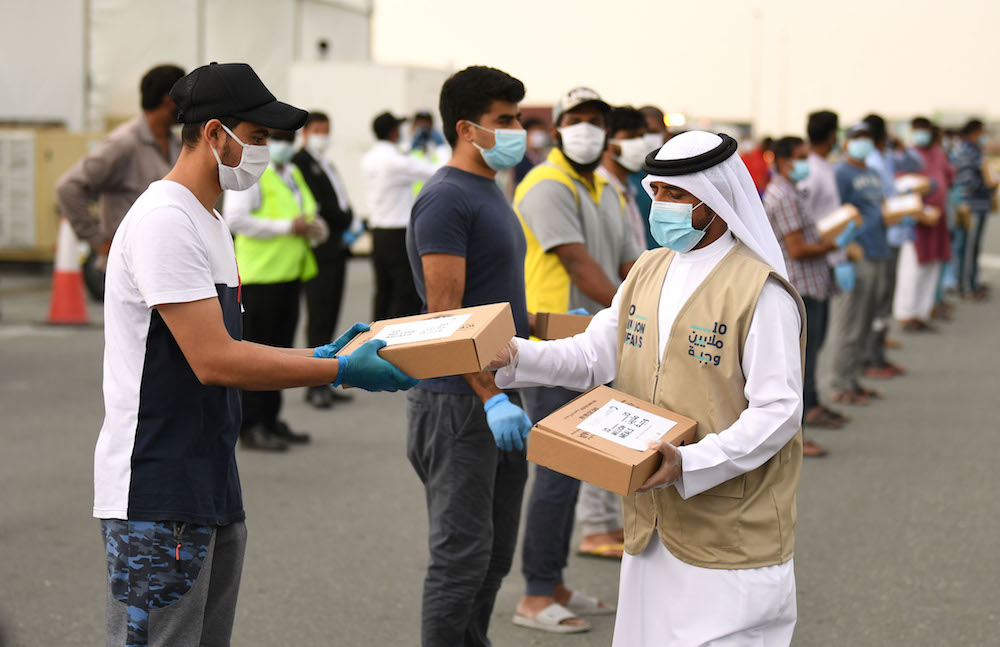
Volunteers distribute Iftar meals to migrant workers keeping distance from each other during the Muslim holy month of Ramadan within the initiative of Sheikh Mohammed bin Rashid al-Maktoum, the ruler of Dubai, to distribute 10 million meals. (AFP/File Photo)
YouGov data suggests that the practice of social distancing has been widely adopted in both countries.
Indeed, 98 percent of Saudi and UAE respondents said they have changed their daily behaviors and are now taking precautionary measures.
These include avoiding crowded places (78 percent), wearing a face mask (71 percent), improved personal hygiene (74 percent) and working from home (47 percent).
In the UAE, where wearing a face mask is now mandatory in public, 80 percent of respondents said they are complying with this measure.
The corresponding figure for Saudi Arabia is lower, at 63 percent.
By contrast, the percentage of people who said they are working from home in Saudi Arabia is higher (54 percent) than in the UAE (44 percent).
And as the Gulf countries enter the second week of the holy month of Ramadan, the YouGov data indicates that the coronavirus is not only changing residents’ daily habits, but also having an impact on some of their oldest traditions.
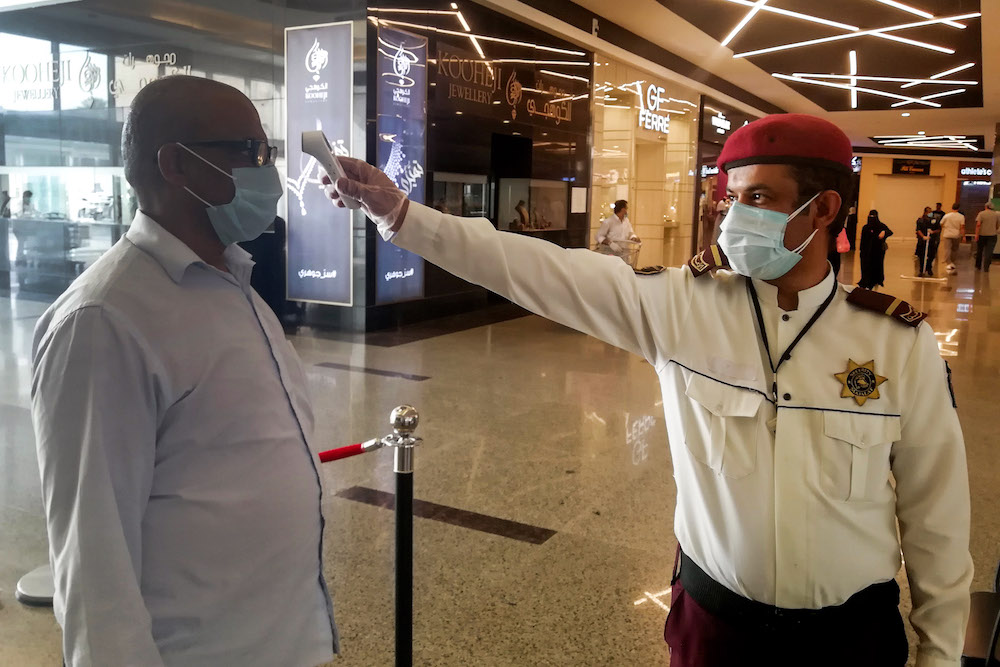
A security guard checks temperature of man arriving at a shopping mall, as a screening precaution against the COVID-19 coronavirus pandemic, in the Saudi capital Riyadh on May 4, 2020, as malls reopen after authorities began a partial lifting of the coronavirus lockdown. (AFP)
With more residents observing Ramadan at home, 50 percent of UAE and Saudi respondents reported spending more money on essential items such as groceries, 45 percent of residents said they are watching more TV than in previous years, and 49 percent said they are watching more online content.
With 68 percent reporting fewer in-person gatherings, many residents are looking online to maintain connections with friends and families.
The YouGov data suggests 62 percent of Saudi and UAE residents have increased the amount of time they are spending socializing online through messaging or video calling and 66 percent are spending more time social media browsing.
Data released by YouGov in early April suggests that an increasing number of people (51 percent) in Saudi Arabia and the UAE are concerned about losing their jobs.
Notably, UAE residents are much more worried about this outcome compared with those of Saudi Arabia (64 percent vs 38 percent).
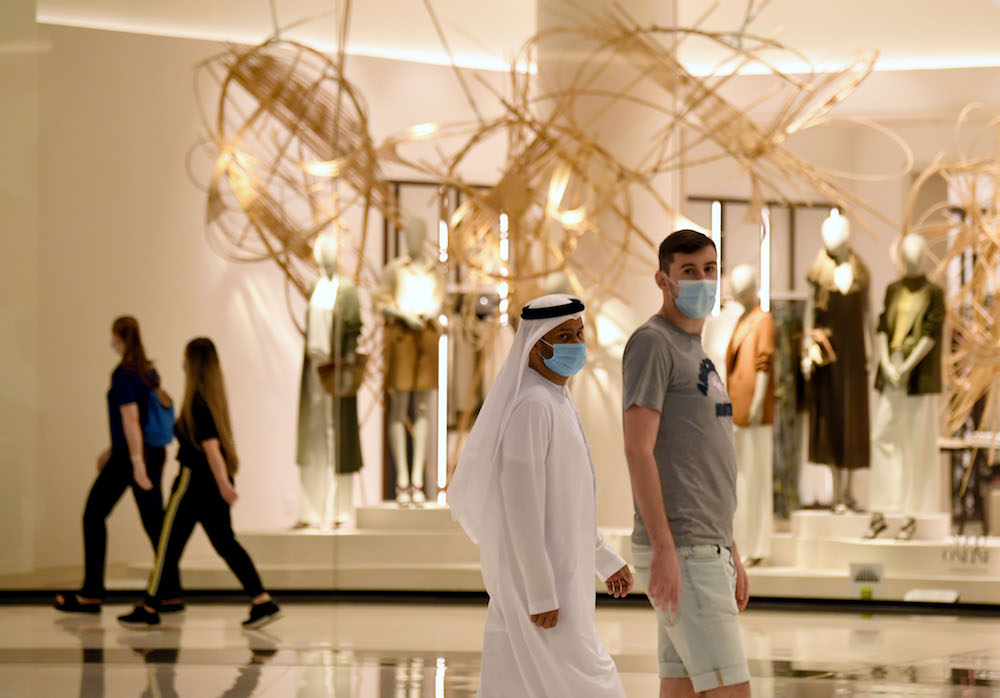
People wearing masks for protection against the coronavirus, walk in the Mall of Dubai on April 28, 2020, after the shopping centre was reopened as part of moves in the Gulf emirate to ease lockdown restrictions. (AFP/File Photo)
Mindful of a challenging time ahead, 58 percent of Saudi respondents said they have decreased their spending on non-essential items since last year.
The proportion of UAE residents who expressed the same sentiment was higher, 61 percent.
At the same time, the streak of generosity remains strong as ever, with 39 percent of respondents saying that they have increased their charitable donations since last year.
In the two countries, 35 percent said their charitable giving is the same as last year, with just 20 percent saying this amount has decreased since last year.
The virus impact is being felt positively in other areas as well.
Going by the YouGov tracker data, a majority of residents in Saudi Arabia and the UAE feel that the coronavirus crisis will have a positive impact on life as they know it.
Only 10 per cent (most likely 18-24-year-olds) said they feel that nothing positive will emerge from the experience.
A Saudi man, wearing a protective mask as a precaution against COVID-19 coronavirus disease, walks along Tahlia street in the centre of the capital Riyadh on March 15, 2020. (AFP/File Photo)
The vast majority of respondents (61 percent) agree that coronavirus pandemic will have a positive impact on the environment; 55 percent feel that it will lead to greater appreciation of family and social ties; and 34 percent believe it has the potential to drive transformation in technology.
The data suggests, however, that the two countries’ residents are divided on when and how the coronavirus crises is likely to be resolved.
In terms of numbers, 37 percent were optimistic that a global resolution would happen by the end of June; 53 percent said by the end of August; and 66 percent by the end of the year.
Whilst the majority are optimistic, 13 percent expect the crisis to continue into 2021 and a further 21 percent do not know or cannot say when the crises might end.
Many in the Kingdom and the UAE think waiting for a vaccine to materialize before resumption of normal activities might not be possible.
Just 9 percent said that they would need a vaccine to be ready before they feel comfortable visiting shopping malls.
One in five people feel that an effective coronavirus treatment is the key to getting life back to normal.
Overall, a mere 20 percent of Saudi and UAE respondents said they would feel comfortable visiting restaurants, cinemas, shopping malls and hotels even if a medicine to treat coronavirus was made widely available.
Syria reduces fuel subsidies as economic crisis deepens
Author:
Associated Press
ID:
1589041536402231800
Sat, 2020-05-09 15:44
BEIRUT: Syria’s oil and mineral resources ministry announced Saturday a reduction in automobile fuel subsidies, the latest government measure to tackle a deepening economic crisis.
The ministry said it was revising down its fuel subsidies, excluding from its ration system users of cars with engines of 2,000 cubic centimeters or more, as well as owners of more than one car.
Subsidized fuel is distributed through a smart card system, whereby smaller cars receive up to 100 liters (26 gallons) of fuel a month at 250 Syrian pounds a liter (36 cents per 0.25 gallons.)
Non-subsidized fuel goes for nearly double the price at 450 Syrian pounds a liter (64 centers per 0.25 gallons.) The smart card distribution and limit on subsidized fuel were introduced last year amid an increasing fuel shortage.
The economy of the war-ravaged country, also suffering from years of sanctions, saw the local currency plummet before the dollar late last year. That sent prices of basic goods soaring and was soon followed by restrictions imposed to prevent the spread of the coronavirus that limited movement and trade.
The price of vegetables and eggs went up by as much as 75% in March and the government included subsidized bread under the smart card system. It also banned the export of some commodities, including eggs and dairy, to contain the price rise.
The Syria Report, which follows the local economy, reported last month a drop in the consumption of oil by about 50% because of coronavirus movement restrictions — a decline that is likely to have hurt government revenues. The government produces some of its fuel for domestic needs but buys the rest from Iran, which extends a credit line to Damascus, that in turns sells it for a profit on the market.
Restrictions on movement are being gradually lifted. Public transportation resumes operating within provinces starting Sunday.
Amid ruins of a Syrian town, Ramadan meal reunites a communityFor 2nd time, Syrian elections delayed over coronavirus
HRW: Iran imprisons protesters over Ukraine airplane disaster
Author:
Zaynab Khojji
ID:
1589034808352023100
Sat, 2020-05-09 17:49
LONDON: Iran has imprisoned at least 13 people since April for protesting against the shooting down of a passenger jet by the Islamic Revolutionary Guard Corps (IRGC), according to the group Human Rights Watch (HRW).
In a report published on its website, HRW accused the Iranian authorities of “dodging accountability” and “refusing to provide details” about the disaster, while “wasting no time” in bringing prosecutions against people protesting against Iran’s handling of the episode.
The IRGC shot down Ukraine International Airlines Flight 752 on Jan. 5, 2020, minutes after it had taken off from Tehran’s Imam Khomeini International Airport, killing all 176 people on board.
Iran initially denied involvement, before stating on Jan. 11 that the plane was caught in the crossfire of the Iranian military response to the assassination of IRGC commander Gen. Qassem Soleimani by a US drone at Baghdad International Airport on Jan. 3 and was shot down in error.
The widespread protests in the country in response to the admission were met with a crackdown described as “brutal” by observers, including HRW.
On Jan. 14, the spokesman for Iran’s judiciary, Gholamhossein Esmaili, said that at least 30 people had been arrested for their part in the protests.
HRW revealed the details of several people who were subsequently convicted. They included Mostafa Hashemizadeh, a student at the University of Tehran who was sentenced to five years in prison, three months of community service and 74 lashes for “assembly and collusion to disrupt national security.”
Another University of Tehran student, Amir Mohammad Sharifi, was sentenced to six months for “propaganda against the state,” which he said stemmed from him photographing police officers. HRW added that 11 people were sentenced to 8 months in prison for “propaganda against the state, chanting slogans against the Islamic Republic of Iran, and taking photos and videos” at a vigil for the victims of the plane in the city of Amol, in Mazandran province.
Michael Page, HRW’s deputy Middle East director, said: “Iranian authorities are following their usual playbook of dodging accountability. While refusing to provide details about any investigation of culpability for the deadly mistake, judicial officials are wasting no time in sentencing people who protested the loss of 176 lives.
“Instead of prosecuting those who exercised their right to free expression and peaceful assembly, the Iranian authorities should conduct a transparent investigation and cooperate with international bodies to find out exactly what happened in this tragedy.”
Despite admitting culpability, Iran has so far failed to cooperate with the international community over investigating the shooting down of Flight 752 and has not allowed other countries access to evidence or to the site of the crash.
On March 11, according to HRW, Iran’s delegation to the International Civil Aviation Organization “agreed to send black boxes from (the) downed Ukrainian jetliner to Kiev for analysis,” but said that they had failed to materialize.
So far, no one has been charged for their role in the incident, and Iranian politicians have speculated that prosecutions remain unlikely.
Of the “unspecified” number of IRGC members and others initially arrested, only one remains in custody, according to Shokrallah Bahrami, head of Iran’s Judicial Organization of the Armed Forces.
Ukraine to press for plane crash black boxes as Iran minister visitsLondon meeting for Ukraine plane victims urges Iran to hold responsible to account
Iraqi PM Al-Kadhimi calls on govt to meet peoples’ demands
Sat, 2020-05-09 17:38
LONDON: Iraq’s new prime minister Musafa Al-Kadhimi on Satutrday chaired his first cabinet meeting since being sworn in on Thursday.
“Iraqi government must secure safe conditions for upcoming elections,” he said, while also calling on the government to work to achieve the demands of the Iraqi people.
Kadhimi also received the US ambassador to Iraq Douglas Silliman, telling him that it was “essential to maintain security and stability in the region.”
He added: “Iraq will not be a proxy arena for settling affairs or a launch pad for attacking any neighboring or friendly country.”
Ambassador Silliman assured the new Iraqi prime minister that Washington is ready to support the country and its fight against coronavirus.