The activation of Turkey’s Ilisu Dam is likely to complicate relations with Baghdad

Sat, 2020-05-23 00:11

ANKARA: Turkey’s controversial, decades-long Ilisu Dam project reached a milestone on Tuesday when its first turbine began generating power.

When fully operational the dam, on the river Tigris in the southeastern Mardin province, is expected to generate 4.1 billion kilowatt hours of electricity a year.

However, in addition to ongoing criticism of the displacement of 80,000 people whose homes were flooded, there are concerns about the possibility that the $2 billion dollar project will reduce water flow to neighboring, water-scarce Iraq.

“The Ilisu dam adds another twist to the already complicated relationship between Iraq and Turkey,” said Dr. Muhanad Seloom, an assistant professor of security studies at the Doha Institute for Graduate Studies.

“The shares of Tigris water have been present in almost all high-level diplomatic, commercial and security meetings between the two sides. Iraqi officials accuse Turkey of using water shares to further its economic interests, and to force the Iraqi government to attack and eventually expel the outlawed Kurdistan Workers’ Party (PKK) from its territories.”

Seloom said the partially-formed government of Iraqi Prime Minister Mustafa Al-Kadhimi has neither has the capacity nor the mandate to negotiate with Turkey about mitigating the effects of the dam on Iraq’s water supply and agriculture.

“Iraq will most likely issue another rhetorical statement voicing concern and calling on Turkey to respect its obligations under international water-shares treaties,” he said.

Geopolitical analyst Bashdar Ismaeel said that water is such an important issue for drought-susceptible Iraq, and its agricultural sector in particular, it is imperative that agreements are reached with Turkey that guarantee requirements are met.

“Agriculture provides a means of livelihood for more than a third of Iraq’s population, and 80 per cent of the country’s water goes to agriculture, so you can see its reliance on water,” he said. “If Iraq gets sufficient rainfall, then concerns over water supply from Turkey can be papered over, but any semblance of drought and Iraq will suffer greatly.”

The problem, he added, is that Ilisu is just the latest in a number of dams that have given Turkey control over Iraq’s water supply. As a result, Iraq is at the mercy of Turkey.

“In case of any water shortages, does Turkey put its own interests first or those of Iraq?” Ismaeel wondered.

Ilisu Dam is 140 kilometers from Iraq, and experts warn that that it could can easily be used as a “regional weapon” in any dispute between the neighbors.

“Iraq’s vast oil resources give it strategic and political advantage in the region, so in a similar vein, Turkey can (argue it has the right to control) strategic water resources that emanate from its lands,” said Ismaeel.

“If relations are cordial, it is unlikely that Iraq and Turkey would fall out over water. But with the sensitive sociopolitical and economic landscape in the region, it would not take much for tension or disagreements to arise.

“Future tit-for-tit measures might mean Iraq could also try to undermine Turkey’s interests, through proxies or direct means, if Turkey threatened to cut off water supplies.”

Baghdad has expressed many concerns about the building of dams in Turkey. Even if the Iraqi government reaches a compromise with Turkey, Ismaeel said, it would face a massive backlash from the public if there are any water shortages.

“The Iraqi government cannot afford more mass protests and social and political chaos,” he added. “If it appears the Iraqi PM is appeasing Ankara at the expense of the welfare of ordinary Iraqis, then can you imagine the reaction from the public?”

Ankara has not made any statement about legal guarantees that might be given to Baghdad about the operation of the Ilisu Dam.

“With the dam set to produce a huge amount of electricity, there could yet be a trade off, economically, for Iraq,” said Ismaeel. “Even if water flow is reduced, Iraq could benefit in other ways.

“If Iraq gets sufficient rainfall, water-flow rates might not be problematic and Iraq’s resistance to the dams might be more muted — but this is a dangerous tactical approach.”


Main category: 
Tags: 

Easing of restrictions intensifies COVID-19 cases in LebanonMorocco prisoners make masks for fellow inmates


Murder of student in UK shocks Lebanese

Author: 
Fri, 2020-05-22 20:28

LONDON: The murder of Lebanese student Aya Hachem in a drive-by shooting in the UK on Sunday has shocked her compatriots worldwide.

“Honestly, it hit really close to home,” Gabreille Antar, a student at London’s School of Oriental and African Studies, told Arab News. “A Lebanese student my age died walking to the supermarket. It’s worrisome.”

Hachem, 19, succumbed to her wounds after she was shot from a car in Blackburn, Lancashire, outside a supermarket in broad daylight.

Authorities believe that the law student was not the intended target, and have appealed to the public for help with the investigation.

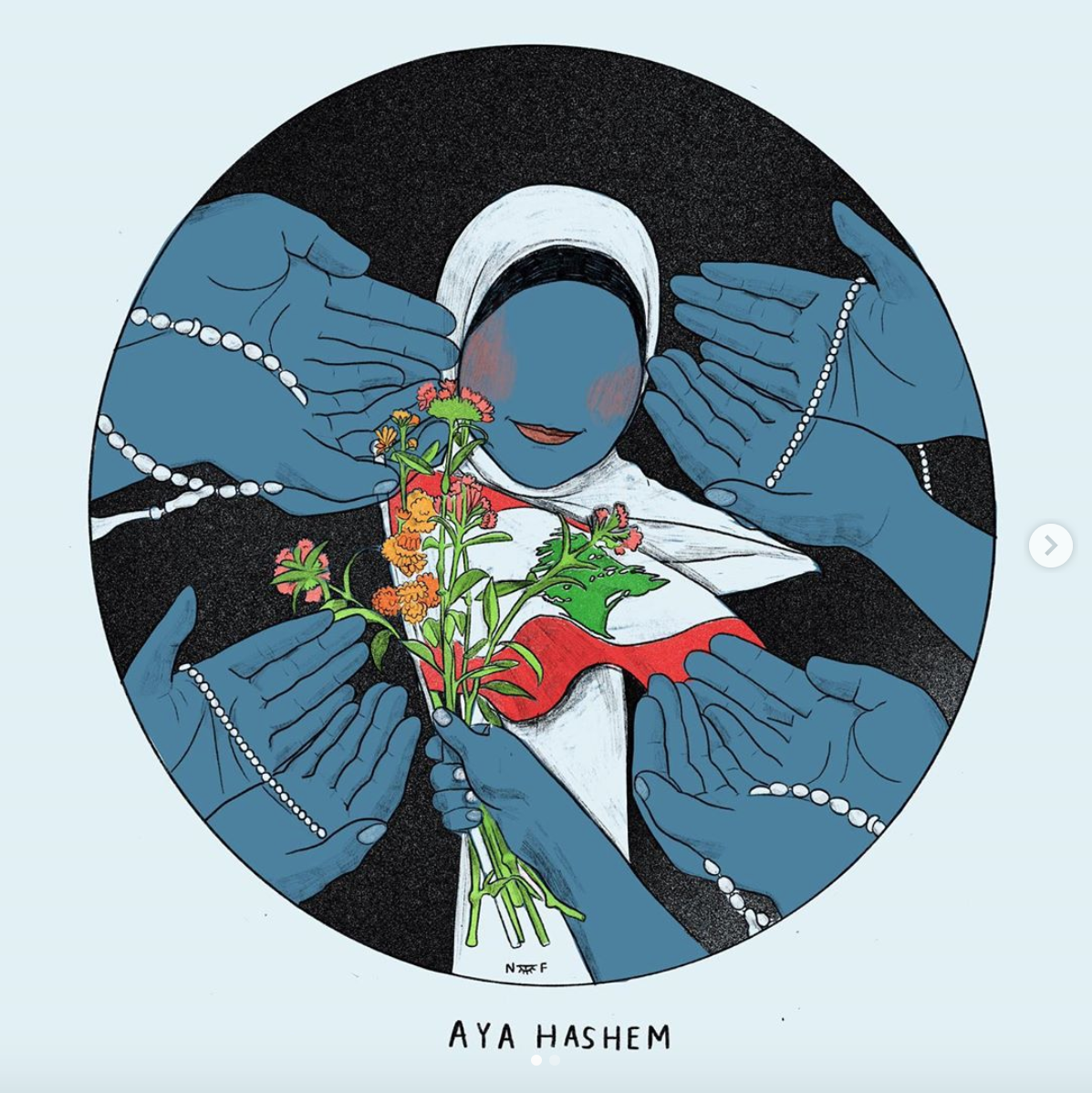
Kuwait-based Lebanese illustrator Nour Flayhan created a memorial illustration in Hachem’s name.

The artwork, which was uploaded onto Flayhan’s Instagram page, has garnered over 8,000 likes.


A post shared by nourie (@nouriflayhan) on

“I wanted to honour her death as a Lebanese young woman who had a bright future ahead of her,” Flayhan told Arab News.

According to Hachem’s family, her body will be flown to Lebanon on Saturday, with the burial taking place the same day.

“Regardless of whether Aya was the intended target or not, justice needs to be served for her and her family,” pharmaceutical saleswoman Nour Safieddine told Arab News.

“Such a brutal, inhumane act is unacceptable and unbearable. Extremely sad news. My heart goes out to all her loved ones. May God be with them.”

Police have arrested 11 people as part of the investigation into the killing, eight of whom are suspected of Hachem’s murder.

Lancashire Police said in a statement: “Detectives are aware of a number of videos circulating across social media and are asking people to report them to the police. We would also ask people not to share these videos out of respect for Aya and her family.”

Detective Chief Constable Terry Woods said his officers would “not be going away until we’ve got justice for Aya and her family,” adding that “it’s now time for the criminal fraternity to come forward.”

Main category: 

Three more arrested over killing of UK student Aya HachemThree arrested in connection with murder of Lebanese student Aya Hachem


Doff your caps to this Lebanese artist’s record-breaking Ramadan artwork

Fri, 2020-05-22 16:45

CAIRO: A Lebanese artist is about to set a new world record with a massive mosaic image of the Ramadan crescent moon she made with a million bottle caps.

Caroline Chaptini, who is a Christian, said she decided to create the 240-square-meter artwork featuring the symbol of the Muslim holy month to celebrate the Eid Al-Fitr holiday, which marks the end of Ramadan, and highlight the unity of Lebanese people of all religions and sects.

She opted to think big when planning the project and set out to break the existing world record for bottle-top mosaics, which was set in 2019 when employees of Japanese manufacturing company Sintokogio used 105,840 caps to create a 108-square-meter image.

This is not Chaptini’s first world record success. Last year in Chekka, a coastal town in northern Lebanon, she built a 28.1 meter-tall Christmas tree made from 120,000 plastic bottles, which set a new Guinness World Record for the tallest plastic bottle sculpture.

The million blue and white caps used in her latest project were collected by people in Lebanon, Qatar, Saudi Arabia and the UAE. They were used to create a blue crescent moon and two stars against a white background.

“I made a video telling people that I was planning to collect one million plastic bottle caps,” Chaptini said. “They got my back,” she said of her social-media followers, who quickly spread the word.

“Believe it or not, most of the people who helped me were not my friends or people I knew before this project,” she said.

Chaptini’s plans were unexpectedly threatened when the coronavirus pandemic emerged, but she remained determined to see the project through.

“When we dream, we can make the impossible possible,” she said. So she pushed ahead, with a smaller support team and a few minor changes to the project.

“Initially we were planning to get support from the municipality but they apologized given the coronavirus situation,” she said. “I didn’t want to give up my idea, especially since I had promised people that I would go for it, even though I was still looking for a sponsor.”

Just as she did with the bottles she used in her previous record-breaking project, when this one is complete Chaptini will give the two tons of plastic caps she used to recycling companies who, in return, will donate money to Kids First, an organization in Jbeil that provides support for young cancer patients.

“I’m grateful for the opportunity to help these young patients in any way that can help them feel better,” said Chaptini, who has an 11-year-old daughter of her own.

She added that she is proof that you do not have to fit a certain stereotype to build a following on social media or become an influencer.

“I was surprised to see how much influence I had and how much people appreciated art with an environmental and a humanitarian aim,” she said.

“I did not need to be anything but myself to get support and attention for my initiative. I didn’t need to be a model or a makeup artist or to dress up a certain way seeking attention.”

Main category: 

KSA gears up for record-breaking retail shopping in RamadanBulgarian singer hits high with record-breaking vocals


Iran appeals to people not to travel for Eid holiday to avoid COVID-19 spike

Author: 
Reuters
ID: 
1590053863299560400
Thu, 2020-05-21 09:17

DUBAI: Iran’s top health official appealed to Iranians to avoid traveling during the Eid Al-Fitr religious holiday later this month to avoid the risk of a new surge of coronavirus infections, state TV reported on Thursday.
Iranians often travel to different cities around the country to mark the end of the Muslim holy fasting month of Ramadan, something Health Minister Saeed Namaki said could lead to a disregard of social distancing and a fresh outbreak of COVID-19.
“I am urging you not to travel during the Eid. Definitely, such trips mean new cases of infection…People should not travel to and from those high-risk red areas,” Namaki was quoted by state television as saying.
“Some 90% of the population in many areas has not yet contracted the disease. In the case of a new outbreak, it will be very difficult for me and my colleagues to control it.”
Confirmed cases in Iran of COVID-19, the respiratory disease caused by the virus, rose by 2,346 to 126,949 on Wednesday, the health ministry said. The death toll is 7,183, the highest in the Middle East region.
A report by parliament’s research center suggested that the actual tally of infections and deaths inn Iran might be almost twice that announced by the health ministry.
However, worried that measures to limit public activities could wreck an economy which has already been battered by US sanctions, the government has been easing most restrictions on normal life in late April.
Infected cases have been on a rising trajectory for the past two weeks. However President Hassan Rouhani said on Wednesday that Iran was close to curbing the outbreak.

Main category: 
Tags: 


Lebanon at risk of major food crisis, PM warns

Author: 
Reuters
ID: 
1590045301699210600
Thu, 2020-05-21 06:37

BEIRUT: Lebanon is at risk of a major food crisis and many Lebanese may soon find it hard to afford bread because of an acute financial crunch and the fall-out of COVID-19, the prime minister warned.
Writing in the Washington Post, Hassan Diab also warned of a global food security emergency triggered by the pandemic. He said attempts to restrict food exports must be resisted and called on the United States and the European Union to set up an emergency fund to help the Middle East avoid a severe crisis.
Otherwise, “starvation may spark a new migration flow to Europe and further destabilize the region,” he wrote.
Lebanon was in deep crisis even before COVID-19. The local currency has more than halved in value since October amid a hard currency liquidity shortage. Inflation and unemployment are soaring. Lebanon defaulted on its sovereign debt in March.
Imported food prices had more than doubled since the start of 2020, Diab wrote. More than half of Lebanon’s food is imported.
“Once the breadbasket of the Eastern Mediterranean, Lebanon is facing a dramatic challenge that seemed unimaginable a decade ago: the risk of a major food crisis,” Diab wrote.
“A few weeks ago, Lebanon witnessed its first ‘hunger protests.’ Many Lebanese have already stopped buying meat, fruits and vegetables, and may soon find it difficult to afford even bread.”
Diab, who took office this year with backing from the Iran-backed Shiite group Hezbollah and its allies, also blamed decades of political mismanagement and corruption for a lack of investment in agriculture.
COVID-19 and lockdowns had “dramatically worsened the economic crisis and profoundly disrupted the food supply chain.”
Eighty percent of Lebanon’s wheat had been coming from Ukraine and Russia, but last month, Russia suspended wheat exports, while Ukraine is considering a similar move, he said.

Main category: 

Lebanese army arrests soldiers who assaulted ER doctorCook and deliver: Dubai restaurants start to get creative