Egypt’s hotels win over domestic tourists with on-site clinics
Author:
Reuters
ID:
1591299013948976900
Thu, 2020-06-04 19:06
CAIRO: Hotels in Egypt have implemented government safety regulations which include having an on-site clinic with resident doctor, regular temperature checks of guests and a quarantine area, as they try to attract domestic tourists, hotel officials said.
Egypt suspended international flights in March and shut down restaurants, hotels and cafes in order to combat the pandemic, which has cost its tourist sector an estimated $1 billion per month.
Tourism accounts for about 12%-15% of gross domestic product.
Although airports remain closed to all but domestic and repatriation flights, 99 hotels have been allowed to reopen at a quarter of their usual capacity if they met strict health and safety protocols.
Guests must be registered online and workers have to undergo rapid coronavirus tests when entering resorts, while a hotel floor or small building must be assigned as a quarantine area for positive or suspected coronavirus cases.
As of June, hotels certified as meeting regulations have been allowed to run at maximum 50% capacity.
“They have sanitized my bag. I have also done the key-less check in, which is the first time this has happened and the first time I see this,” said Hossam Ragaie, a guest at the Conrad luxury hotel in Cairo.
Large events and buffets have been banned, said Karim Helmy, general manager of the Hilton King’s Ranch hotel in the Mediterranean city of Alexandria.
Nevine Hamdy, who used to be a regular guest at the hotel before the pandemic, returned with her family to spend a few nights.
“From the very start at the gate, the workers are wearing masks and gloves. There is no close interaction… They are taking the highest precautionary measures,” she said.
Egypt has reported 29,767 coronavirus cases as of Thursday including 1,126 deaths.
Women in Egypt’s restive Sinai makes Bedouin face masksNo children, no toilets: Egypt sets out mosque reopening rules
Lebanon warns protesters against blocking roads
Author:
Zaynab Khojji
ID:
1591298141588925400
Thu, 2020-06-04 22:32
BEIRUT: The Lebanese Council of Ministers has extended the period of general mobilization in the country to July 5 following a recommendation by the Lebanese Supreme Council of Defense.
The decision comes two days before the demonstration planned by the civil movement on Saturday, resuming anti-government protests that erupted in the country on Oct. 17.
“We do not fear the demonstrators, rather we fear for their health, and we are keen to protect the demonstration so that it would achieve its goals,” said Minister of Information Manal Abdel Samad after a Cabinet session on Thursday.
In a statement, the Lebanese Supreme Council of Defense said: “The military and security services should be firm in deterring violations of the general mobilization in order to prevent the proliferation of the coronavirus, and to cooperate with civil society and local authorities to achieve this objective.”
General mobilization conditions include wearing masks, maintaining social distancing and avoiding overcrowding.
During the meeting of the Supreme Council of Defense, Prime Minister Hassan Diab said: “The risk remains high, considering that cases of COVID-19 are still being recorded.
“The precautionary and preventive measures are still necessary to avoid a second wave of the pandemic, which could be harder than the first wave.
“The government understands the suffering of the people due to the social situation, but there is fear that some groups might take advantage of this for their political objectives in cutting roads and dismantling the country, shutting down enterprises, and obstructing people’s businesses, that could result in employees losing their jobs,” he added.
“We respect the right to demonstrate, but it would become total chaos if roads were blocked and public and private property was sabotaged,” he said, adding: “Lebanese people cannot accept these practices as democratic practices.
“People will soon see a decline in food prices and a gradual return to the normal economic cycle after a large number of enterprises were allowed to reopen in order to save businesses, and people’s jobs and enterprises,” the Lebanese leader said.
Meanwhile, lawyers from the civil movement filed a case against outspoken parliamentarian Jamil Al-Sayyed for calling for the killing of protesters.
Al-Sayyed’s comments drew widespread condemnation on social media, even among his own supporters. In a press conference on Wednesday, he said: “If demonstrators come to the doorstep of an official who does not have guards, then this official has the right to shoot them from his own window, especially if the protesters verbally abuse the official.”
In a follow-up statement, he added: “My words yesterday were addressed to every bully who would dare come under my window to insult me or insult my family, I am serious when I say this and it is not a slip of the tongue.”
The Lebanese General Security declared that Lebanon will open its borders with Syria for two days per week to allow Lebanese citizens to return, while the government approved a fourth stage of repatriation of Lebanese people from abroad between June 11 and 19.
“We will take a decision to open the airport and start air travel with specific countries,” said Minister of Health Hamad Hassan. Ethiopian workers
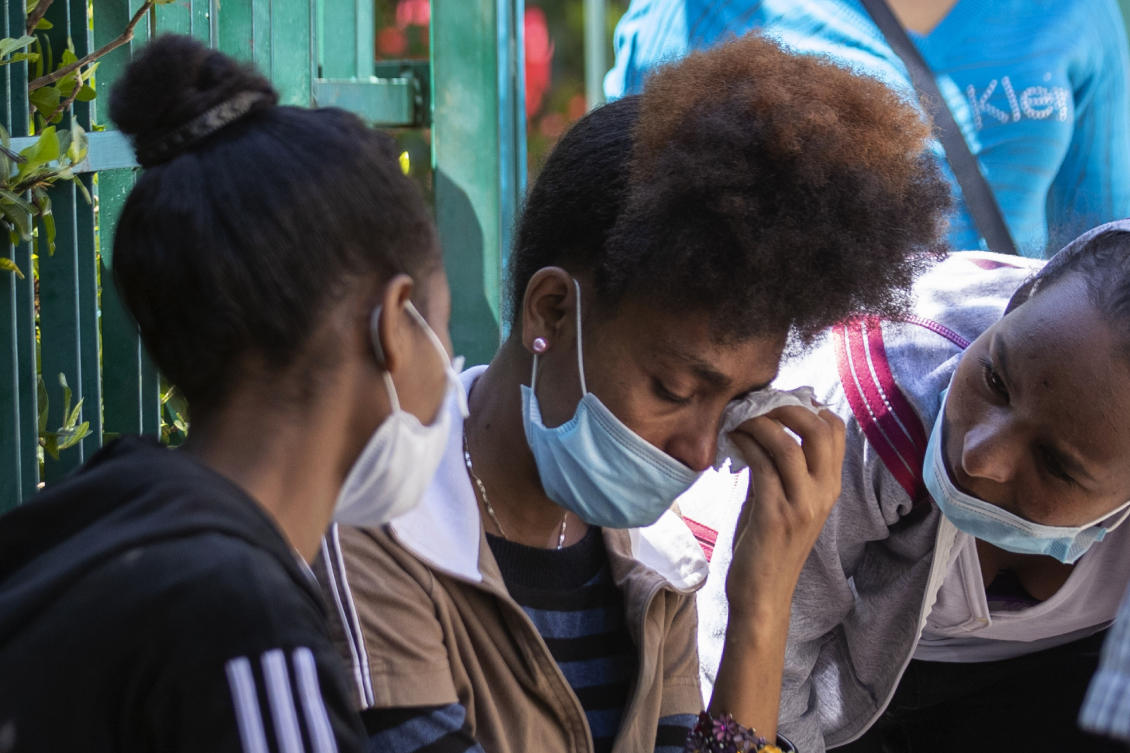
An Ethiopian domestic worker cries as she waits outside the Ethiopian consulate in Hazmieh, east of Beirut, Lebanon, on Thursday, June 4, 2020. (AP)
Dozens of Ethiopian workers gathered in front of the Ethiopian Embassy in Hazmieh in the eastern suburb of Beirut.
The Ministry of Labor said on Thursday that 35 Ethiopian workers had been transferred to a hotel in Beirut to provide them with shelter after they were dismissed by their employers.
The ministry said it provided health examinations for the workers, before transferring them from the hotel to the Caritas Foundation, adding that it is investigating claims of unfair dismissal.
The founding committee of the Domestic Workers Union and the National Federation of Employees’ and Workers’ Union in Lebanon said: “We condemn the racist behavior against migrant workers, especially domestic workers, in these economic conditions and during this health crisis.”
The Union of Owners of Recruitment Agencies of Domestic Workers hoped that the ministry would succeed in returning foreign workers to their countries.
Lebanon’s money dealers agree to exchange limitsLebanon earmarks June 21 to reopen airport if coronavirus decline remains stable
Egypt calls for anti-Daesh coalition to prioritise Africa
Thu, 2020-06-04 21:08
CAIRO: Egypt’s foreign minister said Thursday that the coalition to defeat Daesh must prioritise the extremist group’s growing threat in Africa.
In a video conference held by the coalition, Sameh Shoukry said the coalition efforts in curbing the group’s ambitions must continue.
Shoukry said the Global Coalition to Defeat Daesh should prevent the extremists from exploiting the coronavirus pandemic, according to Ahmad Hafez, Shoukry’s advisor.
Hafez said the foreign minister was concerned about the emerging threat posed from Daesh in West Africa and the Sahel, and that the coalition needed to make this a top priority.
But Shoukry said the coalition needs to complete efforts to defeat Daesh and prevent it from reshaping itself in Iraq and Syria. The coalition must ensure the group and its affiliates are unable to reconstitute any territorial enclave, he added.
The meeting included 31 representatives who met at the invitation of Italian Minister of Foreign Affairs Luigi Di Maio and US Secretary of State Michael R. Pompeo.
The coalition ministers reaffirmed their belief that this comprehensive effort is necessary to achieve a full and enduring defeat of Daesh worldwide.
Pompeo urged the 31 member states to step up funding to defeat the group despite a budget crunch caused by the pandemic.
A US raid last year killed the group’s leader, Abu Bakr Al-Baghdadi.
“That said, our fight against ISIS (Daesh) continues, and will for the foreseeable future. We cannot rest,” Pompeo told the conference.
“We must continue to root out ISIS cells and networks and provide stabilization assistance to liberated areas in Iraq and Syria,” he said.
He asked nations to pledge toward a goal of more than $700 million for 2020.
UN cease-fire talks resume in Libya but fighting continues
Author:
AFP
ID:
1591215951412125600
Wed, 2020-06-03 19:58
NEW YORK: Military talks on a cease-fire in Libya resumed Wednesday, the United Nations announced, welcoming it as a “positive” first step.
The interim UN envoy, Stephanie Williams, met with a five-member delegation representing military commander Khalifa Haftar’s forces, UN spokesman Stephane Dujarric said.
A meeting with the UN-recognized Government of National Accord will be held within the coming days, he added.
“Negotiations will continue on the cease-fire agreement and associated arrangements on the basis of the draft presented by the UN mission to both delegations on Feb. 23 this year,” Dujarric said.
“The UN mission encourages the parties to de-escalate, consider a truce to enable improved delivery of humanitarian assistance and to refrain from incitement and create an environment conducive for negotiations and building trust between the parties.”
The UN mission in Libya had announced on Tuesday that the rival factions had agreed to resume talks after a suspension of more than three months.
Fighting has continued, however, notably near the capital Tripoli, which since April 2019 has been the target of an offensive by Haftar’s eastern-based forces.
On Wednesday, the GNA said its forces had retaken Tripoli’s international airport after heavy fighting with troops loyal to Haftar.
The conflict has resulted in hundreds of deaths, including numerous civilians, and displaced more than 200,000 people.
Over the past year, foreign powers have become increasingly involved in the conflict.
The UAE, Egypt and Russia have supported Haftar’s camp, while Turkey has intervened militarily on behalf of the GNA, which has recently scored a series of military victories.
All previous attempts at a cease-fire, most recently in January on the occasion of a conference in Berlin, have failed.
In February, when talks were suspended, the rival camps had agreed to negotiate a “permanent cease-fire” under a joint GNA/pro-Haftar military commission.
UAE, Egypt welcome Libya cease-fire talksSenior Libyan official arrives in Moscow for talks
Palestinians snub tax handover by Israel over annexation plan
Author:
Reuters
ID:
1591216056002133800
Wed, 2020-06-03 20:15
RAMALLAH: The Palestinians said on Wednesday they were rejecting taxes collected on their behalf by Israel, an escalation of measures in protest of Israel’s plan to annex parts of the occupied West Bank.
The taxes, managed by Israel under 1990s accords, make up over half of the budget of the Palestinian Authority. The Palestinians snubbed the handovers for several months last year after Israel trimmed the cash in retaliation for their funding for the families of jailed or slain militants.
With Israeli Prime Minister Benjamin Netanyahu having last month secured a new government, and annexing the West Bank’s Jewish settlements and Jordan Valley on the agenda, Palestinian President Mahmoud Abbas has declared bilateral deals null.
Ibrahim Melhem, spokesman for the Palestinian government, said in a statement that it had rejected the May tax levies “in compliance with the leadership decision to stop all forms of coordination with Israel.”
Israel’s Finance Ministry declined comment.
It was not immediately clear how the PA, its economy already hit hard by the coronavirus crisis, could function should it continue doing without the around $190 million in monthly taxes.
Abbas previously said his security forces would stop helping Israel stem violence in the West Bank, among territories where the Palestinians, with international support, seek statehood.
Abbas’ peace talks with Israel stalled in 2014 and he is boycotting the Trump administration for perceived bias. Israel and the United States appear to prefer to see the PA stay afloat rather than West Bank Palestinians revert to full Israeli rule.