Will coronavirus pandemic intensify or defuse Middle East conflicts?

Tue, 2020-06-09 20:21

DUBAI: The coronavirus pandemic has left people living in the Middle East’s many conflict zones and hot spots more vulnerable than ever, according to a senior UN official. But there will be an opportunity to “build back better” once the storm blows over.

In a recent online talk titled, “Will COVID-19 exacerbate or defuse conflicts in the Middle East?,” organized by the Atlantic Council, Rosemary DiCarlo, UN under-secretary-general for political and peacebuilding affairs, called for a reshuffling of priorities to combat the pandemic, which has placed the region’s long-running conflicts in a different light.

She admitted that there is no good time for a pandemic, but said the outbreak has hit at a difficult moment, with the international community and rules-based order built after World War II under increasing attack.


Libyans wearing protective face masks queue in front of a bank in the centre of the capital Tripoli on April 1, 2020, amidst the novel coronavirus pandemic crisis. (AFP/File Photo)

“Great power rivalry is intensifying,” said DiCarlo.

“Violent conflicts have drawn in regional and global powers and actors, displaced millions and collapsed state and local institutions.”

Before the pandemic, Antonio Guterres, the UN secretary-general, had underscored the urgent need for effective crisis management systems and lines of communication in the Gulf region, she said.

“That need is greater now than ever before. Any miscalculation and the current atmosphere can lead to consequences that could overwhelm the mechanisms that are currently in place.”

DiCarlo drew attention to Guterres’ appeal for a global cease-fire so that all efforts could be aimed at fighting the coronavirus.

“His call has resonated around the world: 115 member states have endorsed his appeal, as have regional organizations, civil society, religious leaders and 24 armed groups,” she said.

According to DiCarlo, the challenges for conflict prevention and resolution efforts include the economic fallout of the pandemic, which could lead to civil unrest and violence.

“As countries slowly lurch back to life from weeks of lockdown, the demands for economic recovery may grow beyond the capacity of many states,” she said.

“The rate of unemployment is skyrocketing, and the decline in oil and gas prices is further straining national finances.”

DiCarlo cited the protests and violence in Lebanon and Iraq as reasons for concern given the risk of human-rights violations, adding that the “shrinking civic space” in the region poses an obstacle to fighting the pandemic.

“We’ve seen discrimination in accessing health services, increased cases of domestic violence, and an overall disproportionate impact on women and on households headed by women,” DiCarlo said.

“Refugees and internally displaced persons, as well as detainees and abductees — many living in crowded and squalid conditions — have been particularly vulnerable. Migrant workers in the Gulf have faced growing pressure to return home.”

DiCarlo said migrant workers were most vulnerable to high prices and food shortages, and faced limited access to health care and crowded living conditions.

To cap it all, there is the continuing threat of terrorism, she said.

In DiCarlo’s view, the pandemic is occupying the attention of governments, giving terrorist groups an opportunity to strike.
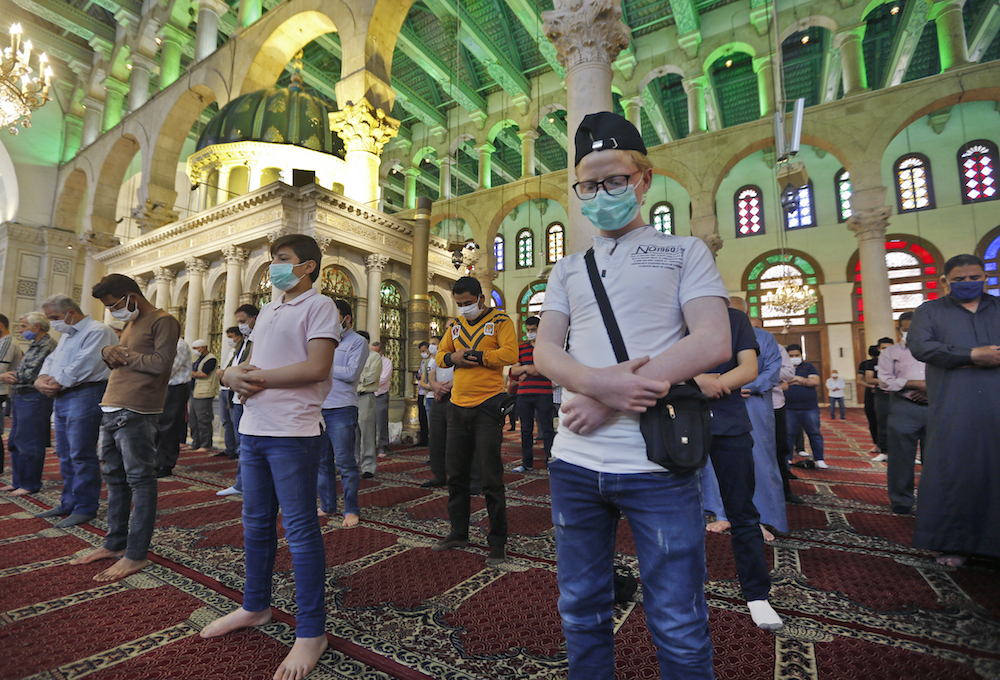

Syrian Muslims wearing face masks attend the Friday prayer at the Umayyad Mosque in Damascus on May 15, 2020, following the authorities’ decision to allow prayers on Fridays in disinfected mosques with strict social distancing and protection measures to limit the spread of the coronavirus COVID-19 pandemic. (AFP/File Photo)

“There are reports that Daesh has tried to exploit the pandemic in Iraq and elsewhere, launching new initiatives and intensifying propaganda,” she said.

“Actors in conflict settings could also exploit the confusion created by the virus to press their advantage, leading to a greater escalation of violence that will further complicate efforts for a peaceful resolution.”

In regard to Yemen, international organizations had been asking for funding to shore up their operations in the impoverished country after 75 percent of UN programs had to shut their doors or reduce operations because of a lack of funds.

Saudi Arabia answered the humanitarian call by organizing a pledging event on June 2, co-hosted by the UN, where participants included representatives from more than 125 member states.
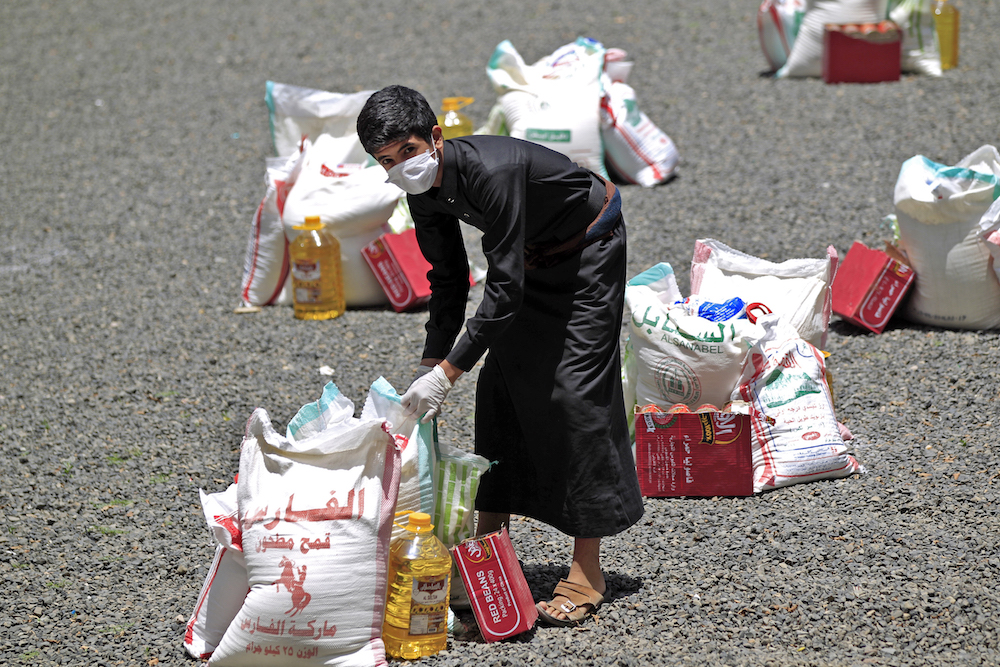

A Yemeni youth carries a portion of food aid, distributed by Yadon Tabney development foundation, in Yemen’s capital Sanaa on May 17, 2020. (AFP/File Photo)

At the event, $1.35 billion was pledged, falling short of the $2.5 billion that the organizations said they needed to keep their operations going.

In a subsequent interview with Arab News, Abdallah Al-Mouallimi, Saudi Arabia’s Permanent Representative to the UN, said: “The conference was a huge success for the United Nations and for the Kingdom of Saudi Arabia, for Saudi diplomacy.

“The fact that you can hold such a conference, with such wide participation, under the current circumstances, virtually, and with the economic clouds hanging in the air over the heads of the participants, and then come up with (actual) results — I think that is a major success.”

Al-Mouallimi described the situation in Yemen as “catastrophic, both in terms of the humanitarian situation and in every (other) respect.”

DiCarlo likewise said Yemen faces one of the “gravest humanitarian challenges in the world.”
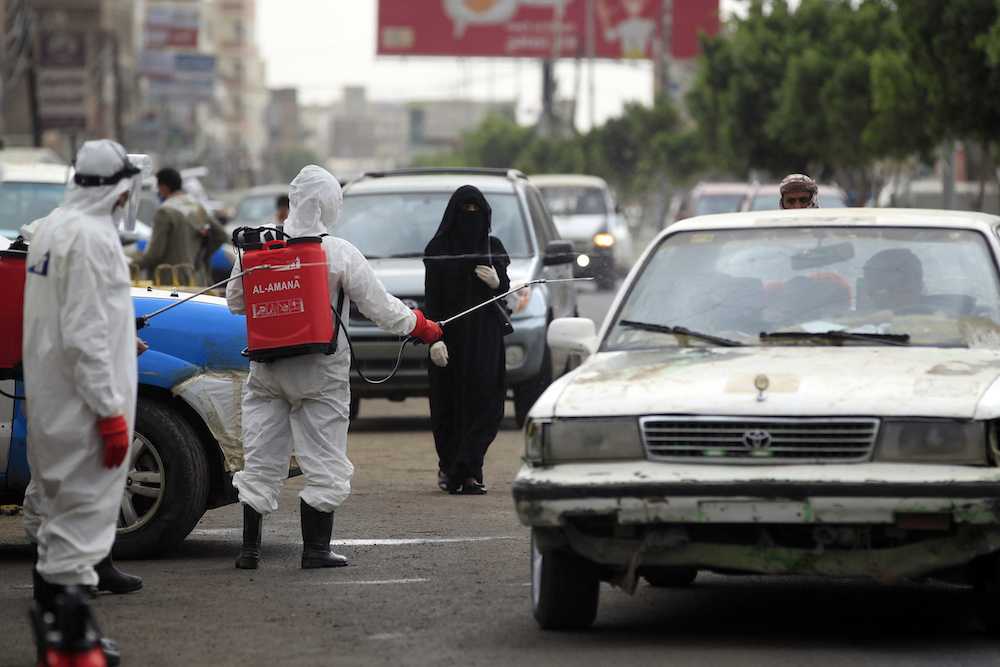

Yemeni workers wearing protective outfits spray disinfectant on a car in the capital Sanaa, during the ongoing novel coronavirus pandemic crisis, on May 21, 2020. (AFP/File Photo)

Noting that Arabia was “very committed” to seeing a peaceful resolution to the conflict, she said the Kingdom did declare a unilateral ceasefire and does “understand that there is not a military solution to the disagreements among the various parties, that it has to be negotiated.”

On Syria, DiCarlo said cease-fire agreements are fragile and humanitarian efforts on the front lines insufficient.

The need for continued and expanded cross-border assistance could not be overstated. “Progress on the UN-led political process remains elusive, despite our efforts,” she said.

Recent developments in war-torn Libya are also doing little to inspire optimism. “When parties have called for humanitarian truces at various times in the past, the conflict has intensified,” DiCarlo said.

THE NUMBERS

COVID-19 in the Middle East

– Over 16,000 Libyans displaced by recent military movements in Greater Tripoli and Tarhouna.

– 80,000 Syrian refugees in Jordan’s Zaatari camp closed off by authorities during a two-month lockdown.

– 15 million Yemenis, or half the country’s population, may become infected, resulting in more than 40,000 deaths, says WHO.

– 1 in 5 Syrian refugees in Turkey do not have access to clean water.

– 75% of Lebanese people in need of aid, with the pound losing 60% of its value as of May.

– 115 UN member states have endorsed global cease-fire to fight pandemic

The COVID-19 crisis has prompted many Arab countries to step up humanitarian efforts, with the UAE, Kuwait, Oman and Qatar providing much-needed medical equipment and assistance to Iran. However, the pandemic has not proven to be the olive branch for ending the region’s divisions.

Despite the seemingly intractable issues, great opportunity awaits, DiCarlo said, adding that the UN is hoping that the region will explore this in the near future.

She said the pandemic has been a catalyst for much-needed cooperation and dialogue.
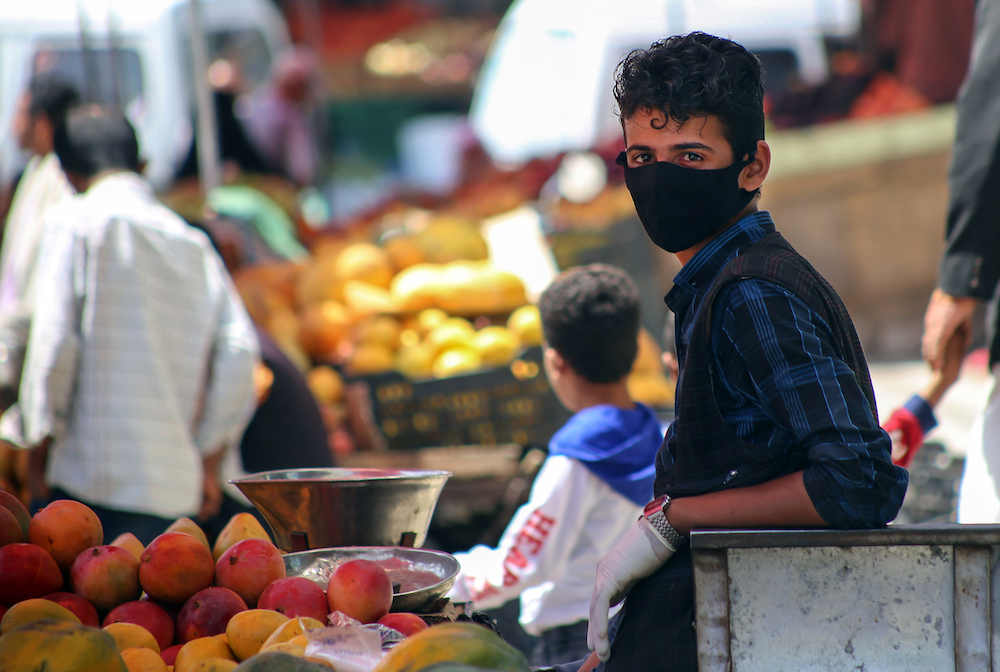

A Yemeni youth wearing a protective mask sells fruits at a street market in Yemen’s third city of Taez, on June 1, 2020 amid the novel coronavirus pandemic crisis. (AFP)

“There are encouraging examples of this in the Middle East,” she said, pointing to Israel and the Palestinian government, which are working in tandem with the UN to tackle the common threat posed by the pandemic.

“We continue to strongly urge Israeli and Palestinian leaders to build on recent cooperation,” DiCarlo said.

There are other positive developments, she said. In the Gulf, the dangerous escalation of tensions between Iran and Iraq, and the region as a whole, is thought to be tapering off.

“There is this understanding of a number of parties, who have been involved or supporting different sides in this conflict, that there is a time now for negotiation and for finding a resolution to this issue. I find that encouraging,” DiCarlo said.
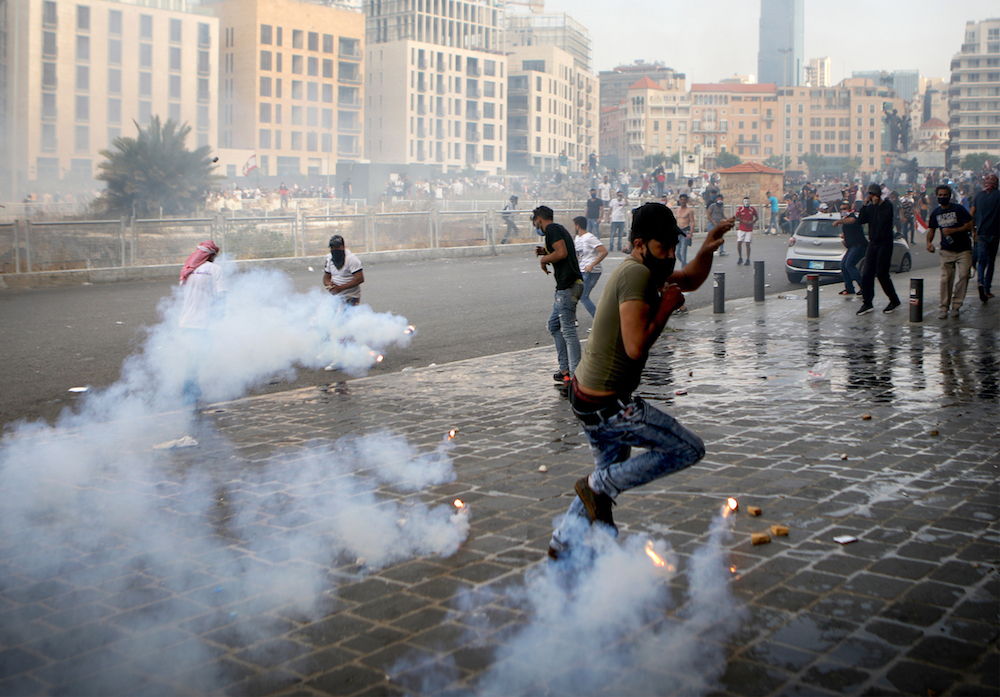

Lebanese protesters run from tear gas fired by riot police amid clashes following a demonstration in central Beirut, on June 6, 2020. (AFP)

She said despite restrictions on face-to-face meetings, the increased use of technology could create new opportunities and enhance the inclusivity of peace processes, including the participation of women and young people.

“The secretary-general and our UN envoys and special representatives continue to exercise good offices, and cajole and support conflict parties in pursuit of dialogue and cooperation,” she said.

“These efforts now rely mostly on the use of secure digital tools and platforms.”
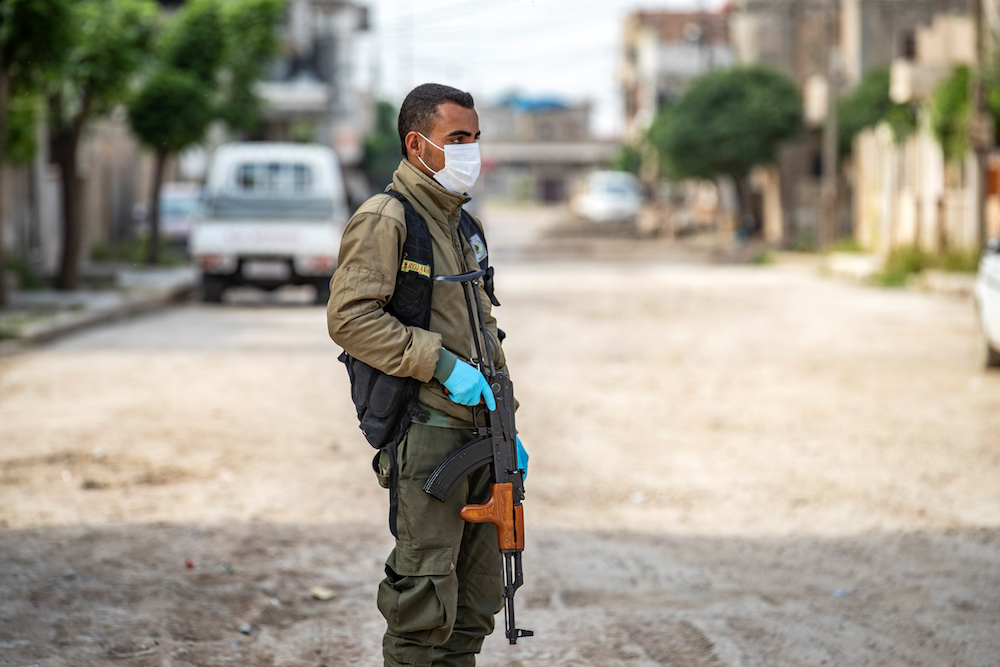

A member of the Kurdish Internal Security Forces of Asayesh stands guard on a deserted street in Syria’s northeastern city of Hasakeh on April 30, 2020, following measures taken by the Kurdish-led local authorities there, to limit the spread of the novel coronavirus. (AFP/File Photo)

DiCarlo concluded her briefing on a note of optimism, saying: “I think we will overcome COVID-19. I believe so, but obviously the international community will not be unscathed.

“It will take a lot of vigilance and hard work, at the UN, between individual states or groups of countries, in civil society and among many of you,” she said.

“We have a chance to go beyond recovery. We can safeguard the progress achieved over the past 75 years that helped societies prevent, resolve and rebuild from violent conflict. We can do more. We must build back better.”

————–

@CalineMalek

Main category: 


Airstrikes again hit Syria’s rebel area, displace thousands

Author: 
AP
ID: 
1591721341690366900
Tue, 2020-06-09 12:26

BEIRUT: Suspected Russian airstrikes pounded villages on the edge of the last rebel enclave in northwestern Syria, sending thousands of civilians fleeing, activists reported Tuesday — scenes unseen in the area since a cease-fire three months ago.
The violence at the edge of Idlib province is the most serious breach of the cease-fire in place since early March, when an agreement between Turkey and Russia halted the Syrian government’s three-month air and ground campaign into rebel-held Idlib.
The Syria Response Coordination Group, a team of aid workers, said the military escalation displaced more than 5,800 civilians in the last 24 hours from areas in southern Idlib and western Hama countryside. Many of the displaced had only recently returned to their villages after the cease-fire, the group said.
On Monday, insurgents launched a limited offensive against government-held positions, briefly seizing a couple of villages. Government troops, backed by Russian air support, responded, repelling the insurgents but also widening their area of operations, targeting 10 villages, according to Mohamed Rasheed, a Syrian media activist documenting the offensive.
Rasheed reported airstrikes, believed to be carried out by Russia’s air force, on a number of villages in southern Idlib. He said he documented 45 airstrikes since Monday.
The Britain-based Syrian Observatory for Human Rights recorded 15 airstrikes on Tuesday, also saying they were believed to be Russian. The Observatory and other local networks said at least one civilian was killed in Kansafra village.
Meanwhile, Syrian state media said government forces repelled an offensive by the insurgents, and that a soldier was killed.
Russia is a main backer of Syrian President Bashar Assad, while Turkey backs opposition fighters trying to remove him from power. Russia and Turkey have become the main power brokers in the war-torn country.
Rasheed said the insurgent offensive was led by the Al-Qaeda-linked Hayat Tahrir Al-Sham, now the dominant group in the rebel-held northwest.

Main category: 

North Syria clashes leaves dozens of fighters deadFirst Russian airstrikes in three months hit northwest Syria


Algeria urges cooperation against ‘terror’ after Qaeda chief killed

Author: 
Amal Belalloufi | AFP
ID: 
1591721117610345500
Tue, 2020-06-09 16:19

ALGIERS: Algeria’s president called Tuesday for international cooperation against “terrorism,” in the country’s first official response to French forces’ killing of the leader of Al-Qaeda in the Islamic Maghreb (AQIM).
French Defense Minister Florence Parly announced Friday that Algerian Abdelmalek Droukdel and several close associates had been killed by French forces in northwestern Mali, near the Algerian border.
Reacting Tuesday, Algerian President Abdelmadjid Tebboune said his country believes “terrorism has an international dimension and the fight against (it) is the responsibility of the international community.”
Droukdel’s killing “is in this context,” he said.
Despite keeping a low profile, Droukdel was one of the Maghreb region’s most powerful Islamist warlords, commanding several groups under the banner of AQIM.
He was active for decades in Algeria, particularly during the country’s 1992-2002 civil war between Islamists and the state, in which some 200,000 people died.
AQIM emerged from a group founded in the late 1990s by radical Algerian Islamists, who in 2007 pledged allegiance to Osama Bin Laden’s global extremist network, Al-Qaeda.
It calls for an Islamic revolution in the Maghreb and the Sahel, a vast band of territory along the south of the Sahara desert, where it has claimed numerous deadly attacks.
The semi-desert region has been plagued by jihadists since militants seized control of Mali’s north in 2012.
Despite a French-led intervention and a long-running UN peace mission there, the conflict has spread to Niger and Burkina Faso and killed thousands of soldiers and civilians.
AQIM is on a US list of “terrorist” organizations, and US Africa Command said it had provided intelligence that had helped track Droukdel down.
Analyst Akram Kharief, head of the regional defense and security website menadefense.net, said Droukdel’s death could accentuate rivalries among jihadist factions.
“His disappearance is important because it marks the end of Algerian domination” of extremist groups in the Sahel, Kharief said.
Droukdel is likely to be replaced by a northern Algerian with “few ties and therefore little control” over groups in the south, he said.
That could weaken AQMI’s influence over the Group to Support Islam and Muslims (GSIM), a Mali-based extremist alliance, and “rekindle tensions between militant factions, especially in Mali,” Kharief said.
The Daesh group also has a franchise in the region, set up by former AQIM member Adnan Abou Walid Sahraoui.

Main category: 
Tags: 

Algeria to ease coronavirus restrictions on SundayTwenty-six killed in central Mali attack


Hong Kong residents rush for offshore accounts

Author: 
Tue, 2020-06-09 01:01

HONG KONG: Banks including HSBC, Standard Chartered and Citigroup have seen a spike in enquiries from Hong Kong residents about opening offshore accounts amid concerns stemming from China’s decision to impose a national security law on the city, sources said.

HSBC and Standard Chartered have each seen a 25-30 percent jump in enquiries, they said. All five have direct knowledge about the rise in interest but did not want to be named as they were not authorized to speak to the media.

The queries add to concerns about capital flight from the Asian financial hub, which has been roiled by pro-democracy protests in the past year, and underline worries about the liquidity of assets as the new law inflames Sino-US tensions.

President Donald Trump has said he will strip Hong Kong of its special status under US law if China moves ahead with the law that aims to curb sedition, secession, terrorism and foreign interference.

“What I’m worried about the most is I might not be able to freely exchange Hong Kong dollar anymore if the US decided to sanction Hong Kong,” said 39-year-old May Chan, who recently asked HSBC about opening an offshore account.

The city’s de facto central bank has sought to allay concerns, saying it has all the means necessary to defend the Hong Kong dollar’s peg to the greenback.

None of the leading global retail banks with operations in the Chinese-ruled city have seen large outflow of deposits in the last two weeks, said two of the sources, noting it can take at least a month to open an offshore account.

But the rise in enquiries has been strong enough to slow banks’ response times, the sources said, adding places including Singapore, Britain, Sydney and Taiwan, are popular destinations.

Chan was told by HSBC she would have to wait a month just to get information about opening an offshore account.

She has already changed 70 percent of her savings into foreign currencies including the US dollar and British pound.

“If things get messy here I might not even be able to transfer my money out in the worst-case scenario, so it’s good to diversify risks.”

While authorities insist the legislation will target only a small number of “troublemakers,” critics say it could erode the high degree of autonomy of the former British colony.

Many Hong Kong residents are renewing their British National Overseas passport, after the proposed new law prompted Britain to offer a potential refuge to the almost 3 million eligible for it.

“Now is the second wave of opening offshore accounts; the first wave was after June last year during the protests,” said one of the sources, referring to the sometimes violent unrest against a now-withdrawn bill that would have allowed people to be extradited to the mainland.

HSBC declined to comment on offshore account enquiries, but a spokeswoman said the bank “had not seen any signs of significant outflows.”

A Standard Chartered spokeswoman said there had been enquiries about offshore accounts, but it had “not seen any noticeable capital outflows.”

A Citigroup spokesman said the bank had seen a pick up in local account openings as Hong Kong lifted coronavirus-related curbs, but it had not seen capital outflows or a rise in offshore account openings. 

Main category: 


Countdown begins on UAE Mars mission aiming to bring Hope to the Arab world

Tue, 2020-06-09 00:37

LONDON: In just 40 days, the UAE will become the first Arab country to send a mission to Mars, part of a wider regional effort to build knowledge and create opportunities, particularly for your people.
“This mission is not just about the UAE it’s about the region, it’s about the Arab issue,” Omran Sharaf, the mission’s project manager at the Mohammed Bin Rashid Space Center (MBRSC), said.
“The region is going through tough times and we do need good news and we need the youth in the region to really start looking inwards, building their own nations and putting differences aside to co-exist with people with different faiths and backgrounds and work together.”
The Hope Mars Mission will start its journey on July 14 and is expected to reach the planet by February, coinciding with the 50th anniversary of the establishment of the UAE. 
The project has been planned, managed and implemented by an Emirati team overseen and funded by the UAE Space Agency. 
The MBRSC has developed the probe in cooperation with international partners, including the Universities of Colorado, Berkeley and Arizona.


The UAE’s mission to Mars, the Hope Probe. (Courtesy of UAE Space Agency)

Speaking at a webinar on the mission on Monday, Sarah Al-Amiri, the UAE’s Minister of State for Advanced Sciences, outlined why the project was so important to the Emirates.
“Today the UAE is an economy based on services, logistics, and oil and gas, and within the region it is considered a diversified economy, but if we project that down the line, the importance of knowledge-intensive sectors becomes more and more prominent for the country, as well as creating new knowledge-intensive organizations,” she said.
Developing talent, creating opportunities for engineers, scientists, and researchers working in natural sciences are the next important endeavours for the country, the minister added.
“Mars provided us with the necessary challenge to rigorously develop talent in engineering, it gave us an appetite for risk and being able to circumvent the risk and push forward with the mission for development. It allows us to start integrating and creating new opportunities for scientists within the UAE and those that are studying the natural sciences,” Al-Amiri said.
Since the project was launched in 2014, the team has designed, developed and assembled the spacecraft, and repeatedly tested it through the harsh conditions it is expected to encounter.


The Hope probe will study the Martian atmosphere to understand how it developed into its current state. (Courtesy of UAE Space Agency)

As the UAE does not have a launch pad, the spacecraft was shipped to Japan in April. It was moved three weeks ahead of schedule, due to the increasing travel restrictions being imposed to combat the spread of COVID-19.
“Nothing about this mission has been easy, since day one the timeframe has been challenging, the budget itself has been a bit challenging, there were very strict requirements when we came to the budget and it was limited and then the COVID-19 situation came into place on top of all the other challenges,” Sharaf said.
He added that the details of the budget would be announced at a later stage.
“When it comes to these projects, the public understands the importance for the UAE,” Sharaf said. “It’s about addressing our national challenges and building capabilities. We live in a region with geographical challenges, when it comes to water, food and clean energy and and everybody is quite excited about this mission because they understand the value it brings.”
Al-Amiri said the data from the mission would be publicly available from two months after the spacecraft starts to orbit Mars between August and September next year.
Any scientist would be able to use the information and analyze the figures, she said.
“We are looking at and studying a planet that has indications that it was very similar to our own planet and that has undergone some form of change and has gone into a point where it can’t have one of the major building blocks of life, as we humans know it and as we have defined it. 
“Understanding the reasons for the loss of hydrogen and oxygen, the building blocks of water from the atmosphere of Mars and understanding what role does mars itself play.”


The Hope probe will start its journey on July 14, 2020, and is scheduled to arrive to Mars by Feb. 2021, in celebration of the 50th anniversary of the union of the UAE.

The team would also be studying the weather on Mars throughout an entire year.
“We are the very first weather satellites of Mars,” Al-Amiri said. “Prior to this we have been studying the weather on that planet and understanding better the climate of Mars by sporadically sampling various areas around the planet but not understanding the changes that happened throughout an entire day.”
However, Sharaf said “the UAE has always had plans for the future and we are definitely not going to stop with Mars. 
The UAE space program is more of a mean or a tool to build our knowledge economy, so reaching Mars is not the objective and whatever the next phase is will be focused more on transferring that knowledge to the different sectors that we have in the UAE.”
Over the last 60 years, only six countries have sent missions to the Red Planet.
“Space travel has by and large been in the group of a small select number of superpowers, so this is a great opportunity for the UAE to go beyond that and to go into something different,” Alistair Burt, Chairman of the Emirates Society, which hosted the webinar from London, said.
The Emirates has already launched two satellites and sent an astronaut to the International Space Station and it has vowed to build a human settlement on Mars by 2117.


The UAE Astronaut Programme sent the first Emirati and Arab astronaut to join astronauts at the International Space Station (ISS) in Spetember 2019. (Courtesy of MBRSC)

“Fifty percent of the missions that go to Mars have failed and this is one of the reasons the UAE chose Mars as a target because of the challenges around it and it’s a message that the challenges that we are facing in the region are not easier,” Sharaf said. “The best way to increase the likelihood of succeeding is by testing, testing and again testing, debugging and then fixing, and that’s why the philosophy of the mission is to continue testing till the day that we are going to launch and we won’t stop this.”
Sir Ian Blatchford, director of the UK’s Science Museum Group, described the UAE’s project as fascinating.
“What they are trying to achieve is remarkable for a country that is developing this infrastructure, but particularly I think they’re being very modest in describing the fact that they’re doing it in half the time,” he said.
Three other missions are heading for Mars over the next year, including NASA’s Mars Perseverance Rover, China’s Tianwen-1, which will launch next month, and ExoMars, a collaboration between the European Space Agency and the Russian space agency Roscosmos.

UAE to launch first Arab probe to MarsDubai Crown Prince reviews preparations for Emirates Mars MissionThere is life on Mars, Musk saysOman desert used for Mars mission spacesuit tests