COVID-19 crisis puts regional health-care occupations in the limelight

Sat, 2020-07-11 22:11

DUBAI: With the coronavirus pandemic showing no sign of ebbing in the absence of a proven vaccine, the importance of medicine and related sciences to humankind’s continued existence and well-being has been underscored in dramatic fashion.

As the crisis pummels economies and upends the lives of millions of people by taking away their jobs, restricting their lifestyles and compromising their safety, the world is waking up to the indispensability of doctors, nurses, medical assistants and other health professionals.

For a relatively long period of time, the appeal of these professions had suffered as careers in finance, technology and management exerted a powerful grip on the popular imagination, including in the Arab world. Not anymore.

The pandemic has made unprecedented demands on health-care systems around the world and proved that some sectors of the economic system, namely health care, are essential in every sense of the word.

The increased requirements are not just for surviving the current health crisis, say economists and career counsellors, but also to prepare for a more secure future for humanity.

A strong indication of this realization was found in the mass tributes paid to doctors and other health-care providers during the early stages of lockdowns. From Rome to Dubai, people cheered and clapped from their balconies to express their gratitude and admiration.

Many front-line medical personnel in the Arab region have lost their lives in the line of duty. And more will probably contract the infection if a COVID-19 cure continues to elude researchers around the world.


A health worker prepares to perform nose swab tests during a drive through coronavirus test campaign held in Diriyah hospital in the Saudi capital Riyadh on May 7, 2020 amid the COVID-19 pandemic. (AFP)

Referring to the global outpouring of appreciation for the medical fraternity, Hussein Shobokshi, Saudi businessman and commentator, said he was taken by surprise.

“For a while now, the field of medicine has not been in vogue. The glamor had moved to people on Wall Street, in accounting, finance, to bankers, lawyers and, to some degree, to engineers as well,” he told Arab News.

“Medicine was perceived as a tedious, expensive and taxing profession that stole your social life and made you pay a heavy price for it.”

Many people were not ready “to sacrifice all that for a tiny amount of returns. People didn’t look at it from a moral point of view,” he said. “They were looking at it from a financial perspective.”


In the future, Shobokshi believes, there will be a “revolution in terms of the demand for jobs in the medical field across the world” — the demand will be “massive.”


“The medical field is going to expand, and its definition, from a traditional, classical concept, is going to be reinvented, restructured and re-engineered,” he said.

Priya Babel, a career and education consultant, agrees, saying that the coronavirus crisis has brought about a new understanding both of the many job roles in medicine and health, and their importance in keeping society healthy.

THENUMBERS

Ratio of physicians to every 1,000 patients in the population

– 2.6 in Saudi Arabia (2018)

– 0.5 in Egypt (2018)

– 2.3 in Jordan (2017)

(* World Bank)

People were reluctant to take up certain medical professions because they believed that “they were secondary to (the role of) a doctor, and not equally important,” but the pandemic has forced them to question their assumptions, said Babel, director of Dubai-based Uni Crest, an education and admissions consultancy.

“I feel that the shift in (careers in) medicine will be from treating the disease to a lifestyle-based approach. I am not saying there won’t be a demand for doctors, but there is also a great demand for physiotherapists, occupational therapists, psychologists and dietitians,” she told Arab News.

“A chest physiotherapist, for example, can teach people breathing techniques while they are being treated for COVID-19. When I say occupational therapists, I am also saying microbiologists because there is a lot of focus on treating the person, not just the disease. There are all these parallel science majors which have become as important, and I think people respect those equally.”


Biochemists, biologists and viral specialists will also be in demand, Babel said.


However, even if these professions find a place in the sun in the post-pandemic era, they have little chance of lessening doctors’ indispensability.

In the pre-pandemic era, the ratio of doctors to the population in the Arab region varied remarkably. According to World Bank data, the ratio of physicians to every 1,000 patients in the population was 2.6 in Saudi Arabia (2018), 0.5 in Egypt (2018), 2.5 in the UAE (2018), 2.3 in Jordan (2017) and 0.7 in Iraq (2018).

The challenges faced by health-care systems in the Arab world during the pandemic are mostly to do with the medical infrastructure’s capacity, measures to contain the spread of the infection and the timing of those measures.

A sharp imbalance between need and capacity developed as a result of a sudden increase in patient numbers, shortage of medical doctors and the lack of “the right equipment to treat patients,” said Babel.


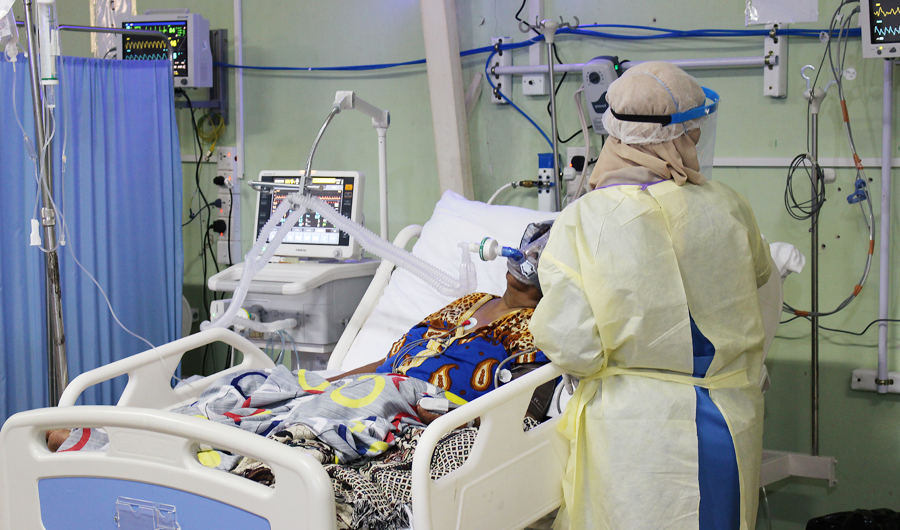
Nurses and doctors pose at the temporary COVID-19 hospital built in downtown Dubai in the United Arabic Emirates after it was deactivated, on July 7, 2020. (AFP)

On an individual level, the pandemic has reinforced the importance of self-development in individuals, say experts. The extended lockdown has prompted many people to review their career choices, looking at what they need to do to support themselves in a future that will be very different from what they thought.

According to the experts, the increasing appeal in recent months of online courses in life-coaching, nutrition, meditation and well-being, to name a few, points to a shift in people’s thinking triggered by the pandemic.

The need to stay relevant in a post-COVID-19 job market is as popular a theme these days as is self-preservation through better management of stress and higher immunity levels.

“We will see more marriages between technology and medicine to ensure access to knowledge through apps, websites and webinars, simplifying the messages for the masses,” said Shobokshi.


In his view, the fight with COVID-19 has taught every nation that medicine is the new defense industry.


“For a long time, the Middle East in general — and I don’t discount any country in this statement — has been pouring money into arms and defense-related industries as a priority to secure their borders and skies, which were essential requirements,” said Shobokshi.

“However, the concept of the medical field as a defense mechanism, as we have seen in the COVID-19 experience, will lead to further investments in this sector.”  

Apart from channeling more investment into hospitals and medical centers, governments in the Arab world can “encourage recruitment of national and international talent to help fill the gaps,” he said.

Only time will tell if any of these post-COVID-19 scenarios will come to pass. What is certain, however, is that life after the pandemic will be different from before.

Even if a vaccine becomes available to combat COVID-19 in the coming months, the future is likely to be characterized by adaptability, fresh thinking and a renewed respect for the role of health-care professionals in keeping societies safe.

——————-

@jumanaaltamimi

Main category: 

250 Saudi doctors volunteer for scheme offering free medical consultationsYemen receives COVID-19 aid as medical sector struggles with virus


Iran’s president warns lockdowns could lead to protests

Author: 
AP
ID: 
1594494431216114900
Sat, 2020-07-11 19:00

TEHRAN: Iran’s President Hassan Rouhani said Saturday that lockdowns meant to curb the spread of the pandemic could lead to street protests over economic problems, his website reported.
In a regular Cabinet meeting on the coronavirus, Rouhani said the easiest way to fight the virus is to close off all activities. But “then people come and stage protests because of chaos, famine and problems,” he said.
Confirmed virus cases and deaths reached a record low in May after mass lockdowns were imposed in Iran. But since then, the numbers have spiked again, with officials saying a combination of improved testing and re-openings has driven the surge.
Rouhani urged that ceremonies be held with a limited number of participants. Many experts blame an increase in virus-related deaths over the past week on wedding and funeral ceremonies with large crowds.
Ali Reza Zali, the head of Tehran’s virus task force, in a letter to officials banned any conferences, festivals or exhibitions and limited participants in wedding and funeral ceremonies to 10.
Earlier this week, Iran reported 221 fatalities in a 24-hour period, the highest single-day death toll.
Rouhani’s remarks came as many experts urged a halt to business activities to stop the increase in virus related deaths that have exceeded 12,600 out of 255,117 confirmed cases.
Iranian officials have been particularly eager to remove restrictions on its economy, already crippled by sanctions the US imposed after the Trump administration’s 2018 withdrawal from the 2015 nuclear agreement.
A sharp rise in subsidized gasoline prices led to four days of unrest in cities and towns across Iran in November, which rights group Amnesty International said led to more than 300 people being killed in clashes with police and security forces.
Tehran has yet to release any official statistics about the scale of the unrest, though in June the government acknowledged that the security forces shot and killed protesters and a lawmaker said that 230 people were killed in the anti-government protests.

Main category: 

Iran denounced for torture, abuse of prisoners, and unfair trialsRouhani: Iran cannot shut down economy despite worsening coronavirus outbreak


Egypt army drill ‘sends a message to Erdogan’

Author: 
Fri, 2020-07-10 22:06

CAIRO: A major Egyptian army exercise near the border with Libya is being viewed by military and strategic experts as a message of deterrence to Turkish President Recep Tayyip Erdogan over his backing for the Government of National Accord led by Prime Minister Fayez Al-Sarraj and supported by militia groups.

The combat exercise, codenamed “Hasm 2020” (Firmness 2020), was carried out by Egypt’s Western Region units together with armed forces formations and special troops, including paratroops and SEAL teams.

The drills included strategic incursions by land forces and land-sea operations by troops in coastal areas of the Western Region near the border with Libya. Other exercises focused on the threat from mercenary or terror groups.

Air defense and artillery maneuvers were also carried out during the exercises, which lasted several days. 

African affairs and national security expert Gen. Mohammed Abdel-Wahed said the Hasm 2020 exercise “carries many internal and external messages of assurance to our brothers in Libya and deterrence to some regional parties.”

The drill “was a message of deterrence to anyone who thinks he can threaten Egyptian national security” and “a simulation of war,” he added.

According to an army statement, the drill’s main phase was attended by Egyptian Minister of Defense Mohamed Zaki, and included live artillery and weapons fire.

Strategic expert Gen. Samir Farag said: “What happened was not an ordinary drill because the forces attacked mercenaries. Our army always fights a regular army. What is different about this drill is training to combat mercenaries. One of the training tasks is to carry out attacks to eliminate mercenaries in cooperation with the air force.”

Farag said the drill “is a message that we will operate on the coasts if they are under threat.”

He said the Egyptian air force succeeded in providing air supplies, “meaning that we have forces capable of going anywhere.”

Farag said that the Western Region had been carefully selected as a location for the exercises.

“We closely monitor any drill carried out by any of our enemies,” he said, adding that Hasm 2020 had been studied and followed up by some countries in the region. 

Egyptian MP and journalist Mustafa Bakry said that “every Egyptian should be proud of their armed forces and their extensive preparation to counter any attack on Egypt or threaten its national security.”

Bakry said that Hasm 2020 sent “a clear message to anyone who attempts to threaten Egypt or its people.”

The Libyan cities of Sirte and Al-Jufra are a red line, he said, adding that “Egypt will never leave Libya and its brotherly people as an easy prey to the Turkish invader.”

Main category: 

Egypt carries out military drill near Libya borderBattle looms for key Libyan city Sirte


Explosions in Iran: Isolated incidents or acts of sabotage?

Fri, 2020-07-10 22:37

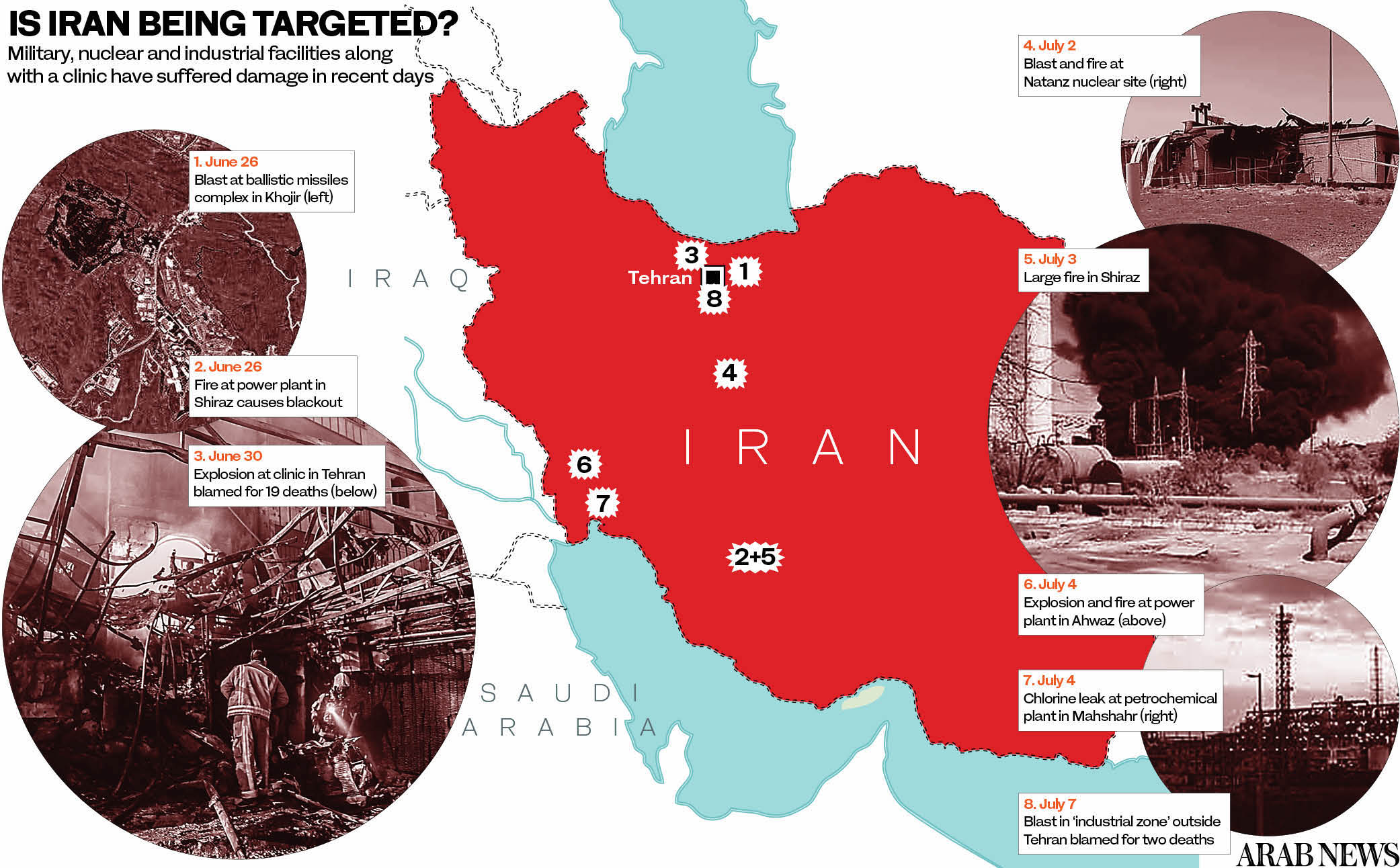
LONDON: Explosions in western Tehran resulting in power outage. A fire at a ballistic-missile production facility. A deadly blast at a medical clinic in the Iranian capital’s north. Huge floods at one of the country’s most important shipping hubs.

These apparently isolated recent incidents, mainly at military, nuclear, and industrial facilities, have been either subjected to cover-ups by Tehran or explained away as unfortunate accidents.

But when a blast on July 2 crippled the Natanz nuclear research facility in Isfahan, Iran was forced to come clean and admit that the showpiece of its nuclear-enrichment program was the target of an act of sabotage.

Experts have told Arab News that this admission has thrown into question the whole series of events. They said that what initially could have been a string of ill-timed separate incidents was starting to look like a coordinated campaign of cyber and psychological warfare. The real questions, to them, were: How impactful has the campaign been, who is behind it, and how will the regime respond?

Olli Heinonen, a senior adviser on science and nonproliferation at the Foundation for Defense of Democracies, said that whoever was responsible for the Natanz sabotage was sending Iran a message.

The attack, he added, would not have “been possible without detailed knowledge on the design and operations of the workshops.”


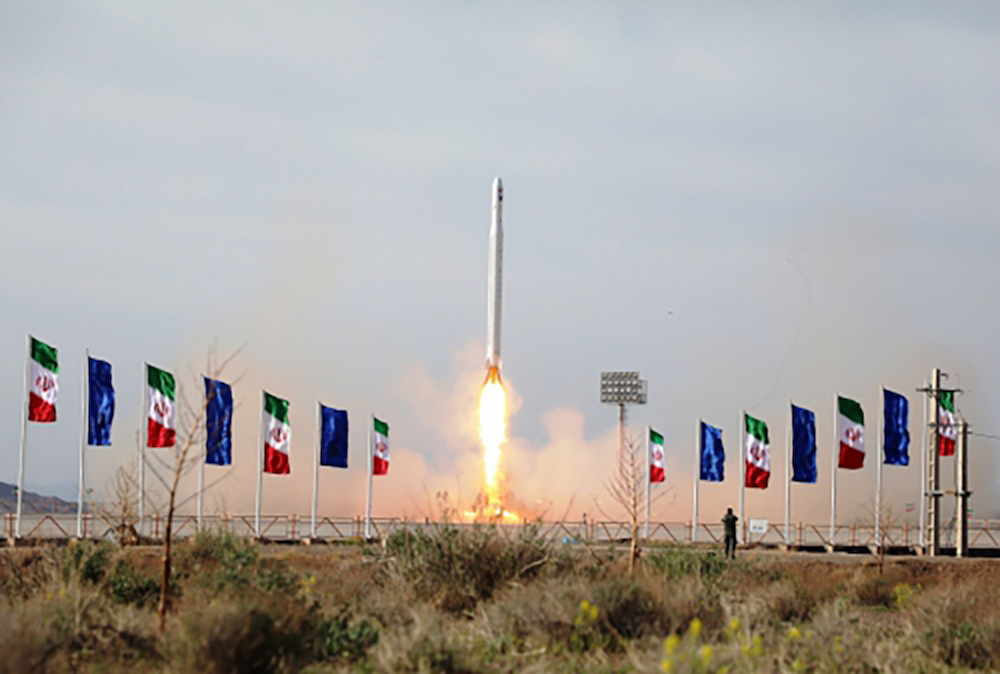
This handout photo provided by Iran’s Revolutionary Guard Corps (IRGC) official website via SEPAH News shows an Iranian military satellite — dubbed the Nour — which the Revolutionary Guards said on April 22, 2020 was launched. (AFP/Iran’s Revolutionary Guard via SEPAH NEWS/File Photo)

This “sends a stern message to the nuclear and missile programs: Their operations and goals are not secret.”

Whoever was responsible, Heinonen said, may not be finished yet. “The hitting of the assembly plant of the advanced centrifuges is likely a warning shot only.”

As if on cue, electricity reportedly got cut off after a large explosion hit a suburb west of Tehran on Friday in a missile facility of the Islamic Revolutionary Guard Corps (IRGC). Iranian officials denied the report. Another mysterious explosion had been reported just three days before, on July 7, at a factory south of Tehran.

While the full picture has yet to emerge of the damage caused by the blast at Natanz, it may have set back Iran’s nuclear ambitions by up to two years.

Opinion

This section contains relevant reference points, placed in (Opinion field)

The 2015 nuclear deal, JCPOA (joint comprehensive plan of action), reached between Iran and six world powers allowed only enrichment of uranium at Natanz with just over 5,000 first-generation IR-1 centrifuges, but Iran has installed new cascades of advanced centrifuges after US President Donald Trump’s administration withdrew from the accord in 2018 and reinstated economic sanctions.

Iran, which said it would not negotiate as long as the sanctions remained in place, has repeatedly threatened to continue building up what it calls a defensive missile capability run by the IRGC.

Ali Alfoneh, a senior fellow at the Arab Gulf States Institute in Washington, said: “It is difficult to interpret recent incidents at Iran’s nuclear facilities as anything but coherent and sustained acts of sabotage conducted by state actors.”

Referring to the Natanz blast and the other explosions and fires, he added: “There is a pattern.” This pattern stretched back years, and has used cyberattacks, sabotage, and targeting of scientists to curtail Iran’s nuclear ambitions.


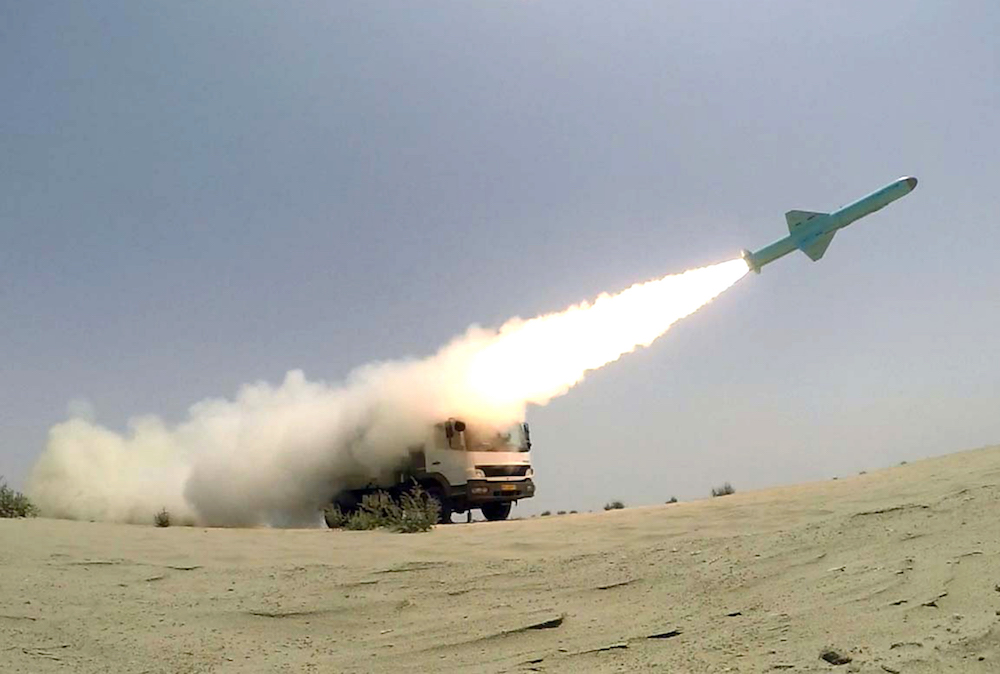
This picture made available by the Iranian armed forces office on June 18, 2020 shows a missile being fired out to sea from a mobile launch vehicle reportedly on the southern coast of Iran along the Gulf of Oman during a military exercise. (AFP/File Photo)

As for the culprit, Alfoneh believes it “makes very good sense” that Tehran’s arch-nemesis Israel could be behind the attacks on nuclear and missile facilities. Israeli statements, he said, “give further credence to these allegations.”

Israel is just one of a number of enemies of the regime who may now be targeting Iran, Theodore Karasik, senior adviser at Gulf State Analytics, told Arab News.

His understanding of the situation, largely in line with Alfoneh’s assessment, is that the blast at the Natanz nuclear facility was most likely “a cyberattack by Israel.”

However, he said: “Were all of the attacks by Israel? That is the question we’re not clear on, and that’s where it gets interesting.”

Karasik pointed out that Tehran also had domestic adversaries with their own grouses. “There’s messaging that a group attached to the (Iranian ethnic minority) Baluch people could be responsible. With Baluch sentiments inflamed, the ethnic minority have at times been used by outside forces as another way to undermine Iran,” he added.

A number of attacks targeting the IRGC personnel and military infrastructure have been claimed by Baluch groups in the past few years. They have not, however, come forward to claim responsibility for the latest series of incidents in Iran.

“Overall, we can say someone is using various tactics — external cyberattacks, internal sabotage — to hit Iran right now, and it’s part of a larger pattern,” Karasik said.

Much of the discussion surrounding the series of attacks has revolved around cyber warfare. Karasik believes this is a central part of the campaign by whoever is targeting the Islamic Republic.

Someone is telling Iran: We know where you live, we know your weak spots, and if we need to hurt you, we can.

Yossi Mekelberg, associate fellow at Chatham House

“To cause explosions, to make something stop operating — this is very sophisticated in terms of cyber warfare. It’s one thing to shut down a street or a factory; it’s another issue to actually detonate something,” he added.

The technological sophistication points to Israeli cyber sabotage. Israel has long employed cyberattacks as a means of targeting Iran’s nuclear and military capacity, famously unleashing the Stuxnet attack which set back Iran’s nuclear ambitions by up to five years.

The emerging consensus among Iran watchers such as Karasik is that Israel was likely responsible for some, if not all, of the recent major disruptions that have struck Iran. The question then, is how Tehran will respond?

Tehran was patient and opportunistic, Karasik said, but “there is a danger that the tail may wag the dog.” As Tehran faced more domestic pressure and its legitimacy in the eyes of the people eroded further, the only way to prove its strength could be to lash out.


This handout satellite image released by Maxar Technologies shows the Konarak support ship before the accident in the port of Konarak, Iran on April 30, 2020. (AFP/Satellite image ©2020 Maxar Technologies/File Photo)

However, one of the advantages of using cyber warfare and other such clandestine means of undermining Iran, was that the attacks had plausible deniability, Yossi Mekelberg, associate fellow at Chatham House, told Arab News.

“It’s hard to definitively prove who was behind the attacks, so it does not force Iran to respond to preserve its legitimacy and save face,” he added.

But he warned that it was a “highly volatile” situation. “There is a danger of miscalculation — you’re guessing other peoples’ thresholds for retaliation and it’s easy to miscalculate. It’s a risky game.”

The strategy being employed against Iran, Heinonen, Mekelberg, and Karasik all agreed, was a psychological one. An outside power — which many suspect to be Israel — was sending a message to Iran.


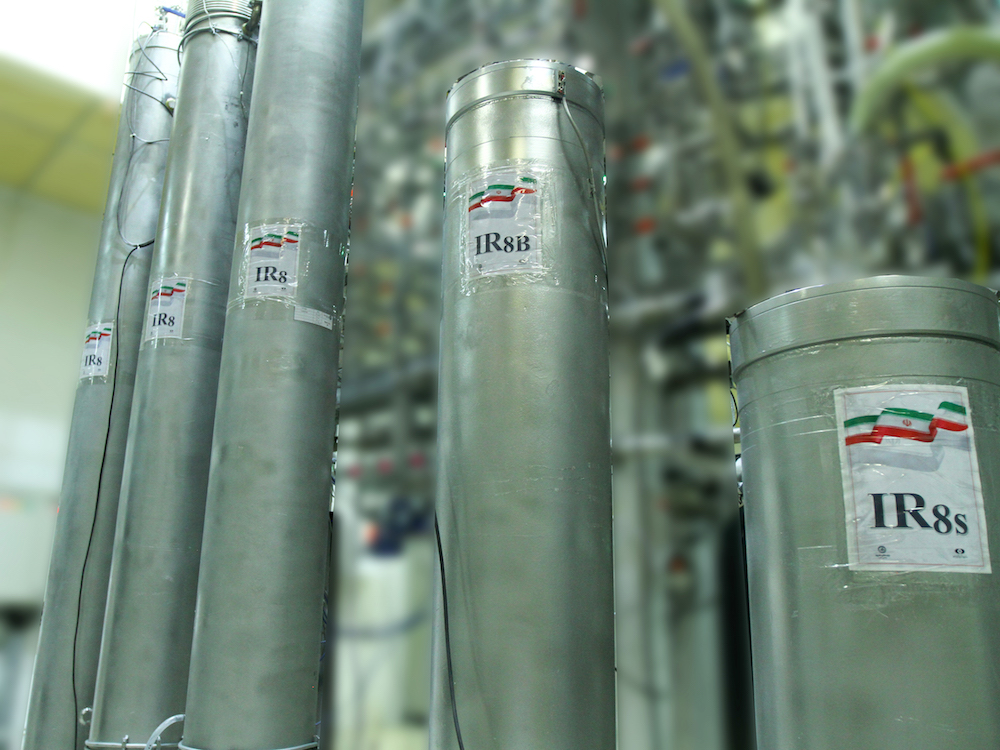
A handout picture released by Iran’s Atomic Energy Organization on November 4, 2019, shows shows the atomic enrichment facilities Natanz nuclear power plant, some 300 kilometres south of capital Tehran. (AFP/Atomic Energy Organization of Iran/File Photo)

Karasik said that someone had been “hammering away at specific targets related to Iran’s national security, creating an explosion here, a fire there. That has a psychological impact.”

Mekelberg added: “Someone is telling Iran: We know where you live, we know where your weak spots are, and if we need to hurt you, we can. It’s a show of force.”

Iran is upgrading its ballistic missile arsenal and investing heavily in obtaining nuclear weapons. It should come as no surprise then, that as its posture becomes ever more aggressive, its adversaries are sending a clear message that they will not stand for a nuclear-armed Iran.

The campaign of cyberattacks and sabotage is making that position abundantly clear.

——————

@CHamillStewart

Main category: 


Yemenis warned against ignoring COVID-19 prevention advice

Author: 
Fri, 2020-07-10 22:33

AL-MUKALLA: Local health officials in Yemen have appealed to people to follow social-distancing rules and other precautionary advice related to COVID-19 as reports suggest the country’s death rates are falling.

Dr. Ishraq Al-Subaee, a spokesman for the Aden-based National Coronavirus Committee, said the spread of the pandemic has not slowed in Yemen despite reports of fewer COVID-19-related deaths in some areas, noting that a shortage of testing kits means the reported number of cases in Yemen is likely inaccurate.  

“I have recently seen that many people have abandoned their masks and joined large gatherings. There has been great awareness since the beginning of the pandemic and I hope people will remain vigilant so as not to lose (what we have gained),” she said.

Almost all Yemeni provinces have relaxed curfews and other measures imposed following the detection of the first case of COVID-19 in the country on April 10. People are now allowed to pray in mosques, visit markets and move between cities amid reports that death rates from COVID-19 and other diseases that hit Yemeni cities in May have fallen by 50 percent.

But Al-Subaee said hospitals in government-controlled areas are still reporting fresh cases and deaths, and warned people against thinking the pandemic is over.

On Thursday, the National Coronavirus Committee announced 38 new confirmed cases of COVID-19 in Yemen, 10 new deaths, and 24 recoveries, bringing the total number of confirmed cases to 1,356, including 619 deaths and 361 recoveries.

Falling cases

In Aden, the international medical NGO Médecins Sans Frontières (MSF) said on Friday that it would be reducing its activities in the southern port city of Aden due to a decrease in the numbers of patients visiting its centers.

“In light of the continuing reduction in the number of admissions to the two MSF COVID-19 treatment centers in Aden, MSF has taken the decision to combine its activities in one facility, “ the organization said in a statement.

MSF intervened in Aden in May when the city was hit by outbreaks of COVID-19 and other diseases that claimed the lives of more than 1,800 people, according to official figures.

While the numbers in Aden are decreasing, local authorities in the southeastern province of Hadramout have reintroduced a curfew in the city of Qaten as medical centers there have reported a surge in the number of COVID-19 cases in recent days.

In Al-Mukalla, Hadramout’s capital, doctors at Ibn Sina Hospital’s isolation center have gone on strike to protest their excessive workload and missed payments. Many doctors in Hadramout have refused to work in COVID-19 treatment facilities in the province, placing extra strain on the doctors on duty there.
   

Main category: 
Tags: 

Yemeni government condemns Houthi sea lane violationsBritain calls on Houthis to allow UN access to Yemen’s time bomb oil tanker