UN approves aid to Syria’s rebel area through 1 crossing

Mon, 2020-07-13 02:12

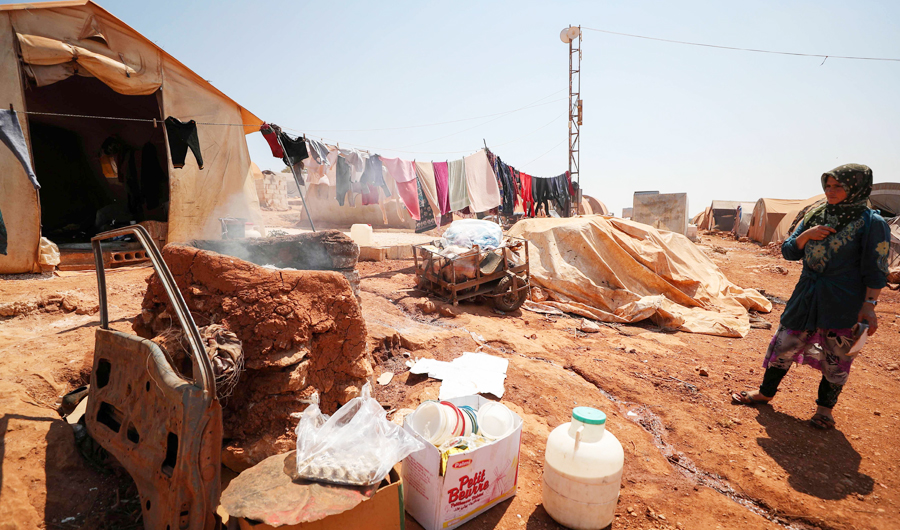
NEW YORK: Russia scored a victory for its ally Syria by forcing the Security Council to limit humanitarian aid deliveries to the country’s mainly rebel-held northwest to just one crossing point from Turkey, a move that Western nations say will cut a lifeline for 1.3 million people.
Russia on Saturday argued that aid should be delivered from within the country across conflict lines, and says only one crossing point is needed.
UN officials and humanitarian groups argued unsuccessfully — along with the vast majority of the UN Security Council — that the two crossing points in operation until their mandate expired Friday were essential for getting help to millions of needy people in Syria’s northwest, especially with the first case of COVID-19 recently reported in the region.
The Security Council vote approving a single crossing from Turkey was 12-0, with Russia, China and the Dominican Republic abstaining.
The vote capped a week of high-stakes rivalry pitting Russia and China against the 13 other council members. An overwhelming majority voted twice to maintain the two crossings from Turkey, but Russia and China vetoed both resolutions — the 15th and 16th veto by Russia of a Syria resolution since the conflict began in 2011 and the ninth and 10th by China.
Germany and Belgium, which had sponsored the widely supported resolutions for two crossing points, finally had to back down to the threat of another Russian veto. The resolution they put forward Saturday authorized only a single crossing point from Turkey for a year.
In January, Russia also scored a victory for Syria, using its veto threat to force the Security Council to adopt a resolution reducing the number of crossing points for aid deliveries from four to two, from Turkey to the northwest. It also cut in half the yearlong mandate that had been in place since cross-border deliveries began in 2014 to six months.
Before adopting the resolution on Saturday, the council rejected two amendments proposed by Russia, including one suggesting that US and EU sanctions on Syria were impeding humanitarian aid. That contention was vehemently rejected by the Trump administration and the EU, which noted their sanctions include exemptions for humanitarian deliveries. It also rejected an amendment from China.
Russia’s deputy UN ambassador, Dmitry Polyansky, said after the vote that from the beginning Moscow had proposed one crossing — from Bab Al-Hawa to Idlib — and that Saturday’s resolution could have been adopted weeks ago. He said Russia abstained in the vote because negotiations over the resolution were marred by “clumsiness, disrespect.”
Polyansky accused Western nations on the council of “unprecedented heights” of hypocrisy, saying they were ready to jeopardize cross-border aid over the references to unilateral sanctions.
He said cross-border aid to Syria’s northwest doesn’t comply with international law because the UN has no presence in the region, which he described as being controlled “by international terrorists and fighters” that make it impossible to control and monitor who gets aid.
German Ambassador Christoph Heusgen retorted that while Russia talks about delivery of aid across conflict lines, “in practice it doesn’t” happen.
He said his side fought to maintain multiple crossing points for aid, including the Al-Yaroubiya crossing point from Iraq in the northeast that was closed in January, because that is what is needed for efficient delivery of aid to millions in need — and he asked Polyansky “this is clumsy?”
“This is what we tried to do over these past weeks, to get the optimum to the population,” Heusgen said.
US Ambassador Kelly Craft told the council: “Today’s outcome leaves us sickened and outraged at the loss of the Bab Al-Salaam and Al Yarubiyah border crossings.”
“Behind those locked gates are millions of women, children, and men who believed that the world had heard their pleas. Their health and welfare are now at great risk,” she said.
Still, Craft called the authorization of access through Bab Al-Hawa for 12 months “a victory” in light of Russia and China’s “willingness to use their veto to compel a dramatic reduction in humanitarian assistance.”
“This solemn victory must not end our struggle to address the mounting human needs in Syria — that fight is far from over,” Craft said.
Belgium and Germany said in a joint statement that 1.3 million people, including 800,000 displaced Syrians, live in the Aleppo area, including 500,000 children who received humanitarian aid through the Bab Al-Salam crossing — and now have that aid cut off.
“Today is yet another sad day. It is a sad day for this council, but mostly, it is a sad day for the Syrian people of that region.,” they said. “Both Yarubiyah and Bab Al-Salam were vital crossings to deliver, in the most efficient way possible, the humanitarian help, those people deserve.”
In a later statement, they added: “One border crossing is not enough, but no border crossings would have left the fate of an entire region in question.”
Main category: 
Tags: 

COVID-19 infects Syrians in Lebanon, spreads in refugee campIn a victory for Assad, UNSC approves aid to Syria’s rebel area through only one crossing



Houthis back down over access to ‘ticking timebomb’ Red Sea tanker

Mon, 2020-07-13 01:54

JEDDAH: Houthi militias in Yemen finally backed down on Sunday over access to a stricken oil storage vessel to prevent it from leaking more than a million barrels of crude into the Red Sea.

Engineers from a UN inspection team are now expected to board the FSO Safer in the next few days to assess the vessel’s condition and carry out emergency repairs.

The 45-year-old Safer has been moored 7 km off the coast of Yemen since 1988. It is stationary, with no engine or means of propulsion. The vessel fell into the hands of the Iran-backed Houthis in March 2015, when they took control of the coast around the port city of Hodeidah.

The militants have refused for more than 5 years to allow international engineers to board the Safer to carry out essential repairs, and as the vessel’s condition deteriorates there are fears that the 1.4 million barrels of oil it contains will start to seep out. A breach would have disastrous results for Red Sea marine life and tens of thousands of people who depend on fishing for their livelihood.

Apart from corrosion, essential work on reducing explosive gases in the storage tanks has been neglected for years. The Yemen government has warned the Safer could explode and cause “the largest environmental disaster, regionally and globally.”

FASTFACTS

  • The 45-year-old Safer has been moored 7 km off the coast of Yemen since 1988.
  • It is stationary, with no engine or means of propulsion.
  • The Yemen government has warned the Safer could explode and cause a regional and global environmental disaster.

 The latest problem came in May with a leak in a cooling pipe. “The pipe burst, sending water into the engine room and creating a really dangerous situation,” said Ian Ralby, chief executive of the maritime consultancy IR Consilium.

If the vessel ruptures, “you’re going to have two catastrophes,” said Lise Grande, the UN’s humanitarian coordinator for Yemen.

 “There’s going to be an environmental catastrophe that’s bigger than almost any other similar kind … and it’s going to be a humanitarian catastrophe because that oil will make the port of Hodeidah unusable.”

Critics say the Houthis have been using the Safer to blackmail Yemen’s legitimate government into offering concessions in peace talks brokered by the UN and to enable them to sell the vessel’s oil. Yemeni Prime Minister Maeen Abdulmalik Saeed wants the proceeds from selling the oil to be spent on health care and humanitarian aid.

Crude stored in the Safer’s tanks is worth about $40 million, half what it was before prices crashed, and experts say it may be of poor quality and worthless.

Main category: 

US ambassador to Yemen says ready to solve Safer tanker crisis Britain calls on Houthis to allow UN access to Yemen’s time bomb oil tanker


US ‘disappointed’ by Turkey mosque move on Hagia Sophia

Author: 
Sun, 2020-07-12 00:48

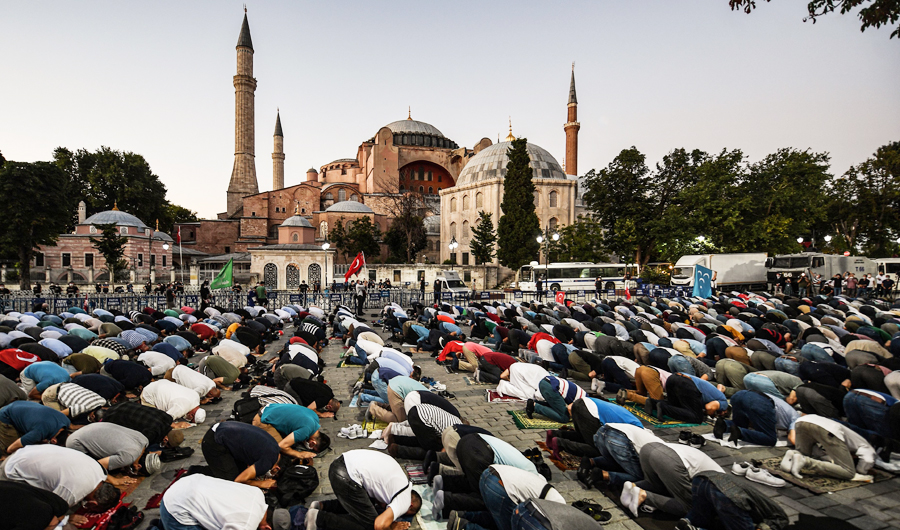
WASHINGTON: The US said it was “disappointed” by Turkey’s decision to turn the Byzantine-era monument Hagia Sophia back into a mosque and urged equal access for all visitors.
“We are disappointed by the decision by the government of Turkey to change the status of the Hagia Sophia,” State Department spokeswoman Morgan Ortagus said.
“We understand the Turkish government remains committed to maintaining access to the Hagia Sophia for all visitors, and look forward to hearing its plans for continued stewardship of the Hagia Sophia to ensure it remains accessible without impediment for all,” she said on Friday.
Turkish President Recep Tayyip Erdogan, who has chipped away at the Muslim-majority country’s secularism, announced Muslim prayers on July 24 at the UNESCO World Heritage site.
A magnet for tourists worldwide, the Hagia Sophia was first constructed as a cathedral in the Christian Byzantine Empire but was converted into a mosque after the Ottoman conquest of Constantinople in 1453.
Erdogan’s announcement came after the cancellation of a decision under modern Turkey’s secularizing founder Mustafa Kemal Ataturk to preserve the church-turned-mosque as a museum.

We understand the Turkish government remains committed to maintaining access to the Hagia Sophia for all visitors, and look forward to hearing its plans for continued stewardship of the Hagia Sophia to ensure it remains accessible without impediment for all.

Morgan Ortagus, State Department spokeswoman

Erdogan went ahead despite an open appeal to the NATO ally by US Secretary of State Mike Pompeo, an evangelical Christian who frequently speaks about religious freedom.
In a statement last week, Pompeo called the museum status an “exemplar” of Turkey’s “commitment to respect the faith traditions and diverse history” of the country and said a change risked “diminishing the legacy of this remarkable building.”
Democratic presidential candidate Joe Biden also said on Friday he deeply regretted Turkey’s decision.
Biden called on Erdogan to reverse it “and instead keep this treasured place in its current status as a museum, ensuring equal access for all.”

Main category: 

‘Sad day for rule of law’ as Turkey passes legal bill


UN fails to find consensus after Russia, China veto on Syrian aid

Author: 
Sun, 2020-07-12 00:25

NEW YORK: The UN Security Council failed to find a consensus on prolonging cross-border humanitarian aid to Syria on Friday after Russia and China vetoed an extension and members rejected a counter proposal by Moscow.
Without an agreement, authorization for the transport of aid to war-torn Syria, which has existed since 2014, expired Friday night.
Germany and Belgium were working on a final initiative to save the effort, with hopes of bringing it to a vote this weekend.
“We are ready to work round the clock, and call on others to think of the millions of people in Syria waiting for the Security Council to decide their fate,” said German Ambassador Christoph Heusgen, who holds the rotating presidency of the Security Council this month.
After Moscow and Beijing wielded vetoes for a second time this week, only three countries joined Russia in backing its proposal to cut the number of aid transit points from two to one.
China supported Russia, but seven countries including the United States, Britain, France, Germany and Belgium voted against, with four abstentions.
An attempt by Russia to pass a similar resolution also failed earlier this week.
The NGO Oxfam had warned that stopping cross-border aid would be “a devastating blow to the millions of Syrian families who rely on this aid for clean water, food, health care and shelter.”
Thirteen countries voted in favor of an earlier German-Belgian draft, but Moscow and Beijing opposed the extension because they favor a more limited proposal.
European countries and the US want to maintain two crossing points on the Turkish border — at Bab Al-Salam, which leads to the Aleppo region, and Bab Al-Hawa, which serves the Idlib region.
The UN authorization allows the body to distribute aid to displaced Syrians without needing permission from Damascus.
Russia and China argue that the UN authorization violates Syria’s sovereignty, and that aid can increasingly be channeled through Syrian authorities.
The latest proposal by Russia, which claims to want continued aid for the insurgent Idlib region, would have kept only the Bab Al-Hawa access point open, and for one year.
Moscow claims that more than 85 percent of current aid goes through Bab Al-Hawa and that the Bab Al-Salam entry point can therefore be closed.
Western countries oppose it, with the US having described two entry points as “a red line.”
In January, Moscow, Syria’s closest ally, succeeded in having the crossing points reduced from four to two and in limiting the authorization to six months instead of a year.
According to Washington’s ambassador to the UN, Kelly Craft, keeping only one border crossing open would cut off 1.3 million people living north of Aleppo from humanitarian aid.
Another diplomat noted that “if the authorization is renewed a few days late, it is not the absolute end of the world. It suspends the convoys for a few days, it does not put them in danger.”
For the UN, keeping as many entry points open as possible is crucial, particularly given the risk of the coronavirus pandemic, which is spreading in the region.
In a report in June, UN Secretary-General Antonio Guterres called for a one-year extension of the aid to include the two current access points.
When asked Thursday if the UN would be satisfied with a single entry point into Syria, body spokesman Stephane Dujarric said: “We need more aid to go through the border. We do not need less to go through.”
David Miliband, president of the International Rescue Committee, called it a “dark day” for Syrian civilians and the UN.
He added it “defies logic or humanity to dismantle a system designed to bring life-saving aid to Syrians in the form of food, health supplies, vaccines, and now critical COVID-19 provisions.”

Main category: 
Tags: 

Russia and China veto extension of cross-border humanitarian aid to SyriaUN to vote on reduced extension of cross-border aid to Syria


Ex-Nissan boss Ghosn ‘helping everyone who stood by him’

Author: 
Reuters
ID: 
1594499275116375200
Sat, 2020-07-11 20:24

BEIRUT: Former Nissan Motor chairman Carlos Ghosn is helping everyone who stood by him, he said in an interview broadcast on Saturday, though he declined to comment on cases of people accused of helping him flee to Lebanon from Japan.
Ghosn, the ex-chairman of an automaking alliance of Renault SA, Nissan Motor Co. and Mitsubishi Motors Corp. was arrested in Japan in late 2018 on charges of underreporting his salary and using company funds for personal purpose — charges he denies.
In late December, he made a dramatic escape from house arrest in Japan, where he was awaiting trial, and fled to Beirut, his childhood home.
Japan has asked the United States to extradite US Army Special Forces veteran Michael Taylor and his son Peter Taylor, who are accused of helping Ghosn flee and were arrested in May.
Asked in an interview with Al Arabiya TV if he was trying to help the Taylors and others involved in his escape, Ghosn said: “You are talking about specific people, and I will not comment on those people who you are singling out.
“What I’m saying is that I am helping everyone who helped me; I’m helping them with my means, with my thinking, and in any way I can,” he said. “I am not talking about those people you mentioned specifically,” he said, adding that he was talking about people who helped him “in general.”
Ghosn has refused to discuss details of his escape from Japan, saying it would put in danger those who helped him.
A US judge said on Friday that Michael and Peter Taylor posed too great of a flight risk to be released on bail given the “spectacular” allegations against them.
Ghosn told Al Arabiya he made “the entire plan” for his escape but he had needed information and assistance from people whom he was not ready to endanger by talking about the matter.
Earlier this month, an executive from a Turkish private jet operator, four pilots and two flight attendants appeared in court on charges of helping to smuggle Ghosn via Istanbul.
Ghosn also said Japan had yet to send his case file to Lebanon as requested by the Lebanese government. “It has been six months and they haven’t sent the file. Why haven’t they sent the file?“

Main category: 

Turkey: pilots, others, on trial for helping former Nissan boss Carlos Ghosn escapeUS says Ghosn wired money to man who helped him flee Japan