Egypt’s homeless children hit hard by pandemic scourge

Author: 
Thu, 2020-07-23 02:05

CAIRO: Wandering Cairo’s bustling streets, Zeinab was struggling to survive by selling tissues when the coronavirus left her even more vulnerable, along with thousands of other homeless people and street children.

The only good news was that, amid the pandemic fears, physical violence against the destitute has declined, Zeinab told AFP at a mobile shelter for the poor in Abbassiya, a working-class district.

“People attack us less because they are afraid,” she said.

But with fewer people in the streets, “we have less work and less money,” added the young woman, while keeping an eye on her 1-year-old son, Abdallah.

Young people and children who roam the streets are among the poorest and are regularly exposed to verbal, physical and sexual violence and exploitation.

The novel coronavirus, which has killed nearly 4,000 people and infected around 83,000 more in Egypt, has compounded their vulnerability, as the country battles an economic downturn and access to support is reduced due to lockdown measures.

“They are isolated, the population at large avoids them … and their meagre income has been hit hard,” said Youssef Bastawrous, manager of the French civil society group Samusocial International, which works with street children in Egypt.

In 2014, authorities estimated Egypt had around 16,000 youngsters and children living rough on the streets.

The UN Children’s Fund (UNICEF) believes this a massive “underestimation” of actual numbers, said its communications head in Egypt Jonathan Crickx.

The problem of compiling reliable figures on street children is compounded because many are from families long trapped in poverty and without stable housing who may not be listed in civil status registries.

In 2016, Egyptian authorities launched the national program “Atfal bala ma’wa” (Children Without a Home) with the aim of “integrating” street children and helping them “abandon street behavior,” said Mohamed Shaker, head of the program at the Ministry of Social Solidarity.

The program deploys 17 mobile units throughout the country, providing a place to rest, food and games as well as medical, social and psychological support to street children.

“The aim is to build a relationship with the homeless children and help them build trust between each other,” said Salma Ismail, communications officer at a nongovernmental group Bannati.

At the Abbassiya mobile unit, Karim tentatively approached and grabbed a snack on offer.

He said he was 12 years old but staff cautioned that most of the children who use the services do not know, or prefer not to disclose, their real ages.

Karim said he sleeps in a local park and earns his living by cleaning car windshields.

He said he was attending a public school before authorities shut them down in late March as part of efforts to stem the spread of the virus.

“I come here to play,” Karim told AFP. “I miss school.

“Since it has been closed, I have forgotten everything. Before, I used to learn how to read and count.”

The economic impact of Egypt’s lockdown measures has stretched already overextended aid offered to street children.

With the financial crunch, some charities have concentrated efforts on health and sanitation to help children protect themselves against the disease.

“We make them aware of health issues, we distribute masks and explain to them how to wash their hands,” said Samusocial International’s Bastawrous.

The lifting of a three-month curfew in late June brought some reprieve for street children, who could again sell trinkets and tissues or beg for money as people returned to cafes and restaurants.

Restrictions have also been partially lifted on mosques and churches, which have long provided sanctuary for street children.

At some mosques, the bathrooms usually used by worshippers to perform their ablutions act as a one-stop shop for the children’s hygiene needs.

Main category: 
Tags: 

Egypt extends operating hours of cafes, restaurants until midnight from July 26 -statementEgypt’s tourist hotspots record zero COVID-19 cases


Turkey, Russia seek lasting cease-fire in Libya

Author: 
Thu, 2020-07-23 01:50

ANKARA: Turkish and Russian delegations met on Wednesday in Turkey’s capital to discuss the war in Libya and agreed to press ahead with efforts for a lasting cease-fire in the North African country, Turkey’s Foreign Ministry said.

A joint statement released after the meeting said the sides — who back rival parties in the conflict — had agreed to work together and encourage Libya’s opposing factions to create “conditions for a lasting and sustainable cease-fire.” They also agreed to joint efforts to advance a political dialogue.

Turkish-backed forces allied with the UN-supported government in Tripoli, the capital, are mobilizing on the edges Sirte and have vowed to retake the Mediterranean city, along with the inland Jufra air base, from rival
forces commanded by Khalifa Haftar. Haftar’s forces are based in the east.

The Turkish and Russian delegations will consider creating a joint working group on Libya and were scheduled to hold more consultations in Moscow “in the near future,” according to the statement.

The meeting between Turkish and Russian officials comes amid heightened tensions between powers supporting the rival factions in the Libyan conflict.

This week, Egypt’s Parliament authorized the deployment of troops outside of the country in a move that threatened to escalate the spiraling war and bring Egypt and Turkey into a direct confrontation.

Libya was plunged into chaos when a NATO-backed uprising in 2011 toppled longtime dictator Muammar Qaddafi, who was later killed.

Drawn by Haftar’s anti-Islamist stance, foreign powers have provided his forces with critical military assistance. Russia has also emerged as a key supporter of Haftar, sending hundreds of mercenaries through the Wagner Group, a private military company.

Main category: 
Tags: 

Turkey-Russia cease-fire negotiations for Libya: Any hope for durability?Turkey, US agree to work to ensure ‘lasting stability’ in Libya


How Lebanon saw the 1984 killing of Middle East scholar and AUB President Malcolm Kerr

Wed, 2020-07-22 23:33

BEIRUT: On Jan. 18, 1984, Dr. Malcolm Kerr, president of the American University of Beirut (AUB), stepped into a hallway leading to his office on the sprawling campus in the Lebanese capital. It was a rainy Wednesday morning. The civil war had been raging in the country for nine years.

Suddenly two armed men appeared, as if from nowhere, and opened fire on 52-year-old Kerr. He was shot twice in the back of the head and died instantly. The killers fled and were never identified.

In a telephone call to news agency AFP, the Islamic Jihad Organization (IJO), a Shiite militia backed by Iran, claimed responsibility for the killing. It cited the US military presence in Lebanon as the reason. American soldiers were part of a four-nation peacekeeping force created in 1982 during a US-brokered ceasefire between the Palestine Liberation Organization and Israel.

Speaking to Arab News from southern California, Kerr’s widow, Ann, recalled that terrible day, the events of which remain fresh in her memory after 36 years.


“The grief is an ongoing thing,” she said. “You live with the loss and the loss assumes a place in your heart.”


Ann met her husband while they were both students at AUB in the 1950s. She was on a study trip from Occidental College in Los Angeles, he was studying for a master’s degree in Arabic studies. To them, AUB “represented the best of what the US had to offer,” Ann said.

Her husband, an American citizen, was born and raised in Lebanon and educated in the US. His parents had taught at AUB, so it was close to his heart. He returned to Lebanon on many occasions, eventually taking up further studies and teaching assignments at the university. An authority on the Middle East and the Arab world, in 1982 he was offered the job of president at the prestigious institution.

Ann blames Iran and Hezbollah for his murder, as the IJO is said to have been the forerunner to Hezbollah, which was formed in 1985.

“It is pretty clear that (Hezbollah was responsible) because in those days they were targeting visible westerners (such as) journalists and professors,” she said. “You might remember that David Dodge was kidnapped before Malcolm was assassinated.”

Dodge, also an American citizen, held a number of positions at AUB, including acting president before Kerr was appointed. On July 19, 1982, he was abducted from the campus and held hostage by the IJO. He was released a year later to the day, after Syria intervened.

The IJO went on to claim responsibility for a number of kidnappings, assassinations and attacks, including the 1983 bombings of French and US Marine barracks and the US embassy in Beirut. Between 1982 and 1992, 104 foreign writers, priests and journalists were kidnapped in what came to be known internationally as the Lebanon Hostage Crisis. They included Associated Press reporter Terry Anderson, who was abducted on March 16, 1985 and held for six years and nine months, the longest time an American was held captive in Lebanon.

“Why was (Malcolm) assassinated and not kidnapped? That remains a question,” Ann said. “But we understood that they (the IJO) had not perfected the art of kidnapping yet, and did not know where to keep (hostages).”


Though the circumstantial evidence points the finger of blame at the IJO, it was not only radical Islam that posed a threat to Kerr’s safety. According to Ann, right-wing Lebanese Christian factions were “not happy” with his views on the Palestinian situation.


“At the time, everyone walked around with guns … it was a civil war,” she said.

News of Kerr’s murder spread quickly. Local media — including Lebanese newspaper An-Nahar and magazine Al-Shiraa, and the French-language weekly La Revue du Liban — as well as international news outlets such AFP and the New York Times, linked the assassination to the kidnapping of Dodge.

The day before Kerr was killed, the IJO claimed responsibility for the kidnapping of Hussein Al-Farrash, the Saudi consul general in Beirut, and threatened to kill him. He was released 66 days later following the intervention of Nabih Berri, who at the time was Lebanon’s justice minister and is now speaker of the parliament and head of the Amal Movement, an ally of Hezbollah.

——-

READ MORE: Warriors coach Steve Kerr recounts life in Lebanon with his father, slain AUB president Malcolm Kerr

——-

Two decades after Kerr’s murder, his family called for a fresh investigation into the case and a trial, in light of new information that had come to light. In February 2003, they filed a lawsuit against Iran and Hezbollah at the US District Court for the District of Columbia. Though they did not seek damages at the time, it was reported that the court awarded them a settlement in 2018, the proceeds of which are being used to create a student endowment fund.

The District Court ruled that IJO was a name used by Hezbollah to conceal its identity. The verdict provided some degree of closure for Ann.

“The value of the trial was that it brought some resolution to my family. I think it was better to close the case,” she said.

The sense of loss, however, is something Ann continues to contend with every day.


“Each person, (especially) in a close family such as ours, responds to things differently,” she said.


“For me, I was satisfied going on with my work, which always involved international education. For my son Steve, he was starting out in his basketball career.”

Steve Kerr, who has two brothers and a sister, was born in Beirut in 1965. He is an eight-time NBA champion, winning five titles as a Chicago Bulls player and three as head coach of the Golden State Warriors.

“From birth, practically, he had a ball in his hand,” said Ann. “For him, the spirit of competitive sports was his resolution.”

—————–

@Leila1H

Main category: 

AUB’s saga of survival in the limelight as Lebanon battles financial, coronavirus crisesWarriors coach Steve Kerr recounts life in Lebanon with his father, slain AUB president Malcolm Kerr


Travellers arriving at UAE airports will be required to undergo PCR testing for COVID-19

Wed, 2020-07-22 22:47

DUBAI: All travelers arriving at UAE airports will have to undergo a test for COVID-19.

The test is mandatory for citizens, residents, tourists and transit travelers, regardless of the country they are coming from, the National Emergency, Crisis and Disasters Management Authority said Wednesday. 

All departures via the country’s airports who are headed to the European Union, Britain and countries that require a COVID-19 test, must do the test before boarding. 

Children under 12 years of age and children with severe and moderate disabilities are exempt from the test. 

All tourists and visitors are required to present a negative COVID-19 test report, not older than 96 hours.

Main category: 
Tags: 

Dubai’s in5 startups raise $17.7m in H1 2020


Israelis urge Netanyahu to quit over coronavirus, corruption charges

Author: 
Reuters
ID: 
1595359890256267100
Tue, 2020-07-21 18:31

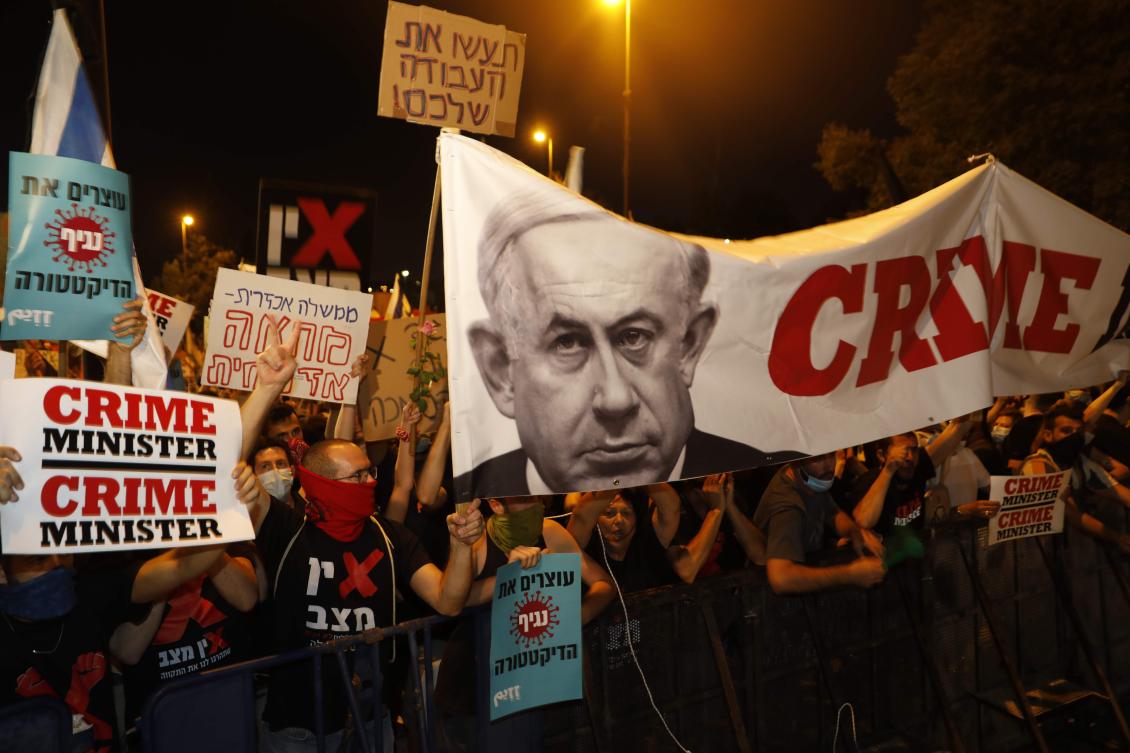
JERUSALEM: About 2,000 Israelis rallied outside Prime Minister Benjamin Netanyahu’s residence in Jerusalem on Tuesday as protests mounted against him over his handling of a worsening coronavirus crisis and alleged corruption.
Wearing protective masks, the demonstrators marched from Netanyahu’s official residence to Israel’s parliament, holding up signs that read “Crime Minister” and calling on the five-term premier to step down.
Reimposed coronavirus curbs after a rise in new COVID-19 cases have prompted Israelis demanding better state aid to take to the streets in almost daily demonstrations.
Public anger has been also been fueled by corruption alleged against Netanyahu, who went on trial in May for bribery, fraud and breach of trust — charges he denies.
Netanyahu has announced numerous economic aid packages. But frustrated by red tape and a slow pace, many Israelis say the aid is coming too little, too late.
“It’s humiliating and insulting. You pay social security and taxes for thirty years and then have to beg (the authorities) in order to make ends meet. I’m here to protest, so that this evil government quits,” said Doron, 54.
He asked not to give his full name and said he has been on unpaid leave for three months.
As part of the protest, restaurant owners set up a free buffet for the demonstrators, demanding their businesses keep open or else receive compensation.
Israel lifted in May a partial lockdown that had flattened an infection curve. But a second surge of COVID-19 cases and ensuing restrictions has seen Netanyahu’s approval ratings plunge to under 30% and employment soar to 21%.
Police did not provide a figure for the number of demonstrators. A Reuters cameraman estimated that about 2,000 people rallied. Israeli media said the protest drew thousands from across the country.
With a population of 9 million, Israel has reported more than 50,000 coronavirus cases and 422 deaths.

Main category: 

Hundreds of Israelis protest in Jerusalem against NetanyahuBenjamin Netanyahu’s graft trial resumes amid Israeli coronavirus anger