Top US general visits Israel amid heightened border tension
Author:
AFP
ID:
1595623254944520200
Fri, 2020-07-24 20:26
JERUSALEM: America’s top general made an unannounced visit to Israel on Friday for talks on “Iran and regional security challenges,” Israel’s army said as it confirmed a reinforced presence on its northern border.
General Mark Milley, the chairman of the Joint Chiefs of Staff, held talks with Israeli Prime Minister Benjamin Netanyahu, alternate premier and Defense Minister Benny Gantz and Israel’s army chief Aviv Kohavi.
Earlier on Friday, explosions on the Syrian side of the security fence in the Israeli-occupied Golan Heights caused damage to a vehicle and a civilian building on the Israeli side, an army statement said.
The army said it was investigating the incident, and it was not immediately clear if there had been an attempted attack on Israeli positions from within Syria.
On Monday, five Iran-backed fighters were killed in an Israeli missile strike south of the Syrian capital Damascus, according to the Syrian Observatory for Human Rights.
The Iran-backed Lebanese Shiite militant group Hezbollah, an ally of the Syrian regime, said one of its fighters was among the dead.
Israel has launched hundreds of strikes in Syria since the start of the country’s civil war in 2011, but rarely comments on such operations.
The Israeli army then announced an initial reinforcement of the northern border on Thursday, with Israeli media reporting the move was made in response to threats of retaliation from Hezbollah.
A further troop reinforcement on the northern border was announced on Friday, with the army saying it had “elevated its readiness against various potential enemy actions.”
“The Israel Defense Forces holds the Lebanese Government responsible for all actions emanating from Lebanon,” the statement said, without making reference to Hezbollah.
Gantz said Milley’s visit underscored the close security ties between Washington and the Jewish state and warned Israel was “ready for any scenario and any threat.”
“I do not suggest our enemies to test us,” Gantz said in the statement.
Israel reinforces Lebanon border after Hezbollah threatsHezbollah fighter killed in Israeli strike near Damascus
An opposition group presents a secular alternative to Iran’s clerical regime
Fri, 2020-07-24 23:16
LONDON: “A force capable of overthrowing the regime is lurking in the heart of Iranian cities. From all indications, the ruling theocracy is at the point of being overthrown,” the leader of the global Iranian resistance declared to an audience of thousands tuning in to the online Free Iran Global Summit on July 17.
Five years ago, this declaration might have sounded like empty rhetoric from a fringe group. Now, two years after Tehran’s failed attempt at bombing the National Council of Resistance of Iran’s (NCRI) annual rally in Paris, the words of Maryam Rajavi, a former militant commander and now the NCRI’s president-elect, look much less like an empty threat and much more like a promise.
The NCRI is an umbrella group encompassing a broad spectrum of groups opposed to the Iranian regime, and is often described as the country’s government in waiting.
With its charismatic leader at the helm and thousands of Iranian, Western and Arab supporters behind its cause, the NCRI is increasingly being recognized as the legitimate and progressive alternative to the supreme leader and the cohort currently in power.
The NCRI, also known as the Mojahedin-e Khalq (MEK) in Persian, has three aims for Iran: The demise of the clerical regime, universal suffrage and people’s sovereignty, and social freedom and justice.
Its swelling legitimacy, and the credible alternative it presents for Iran’s future, have not gone unnoticed among political and security establishments in the West.
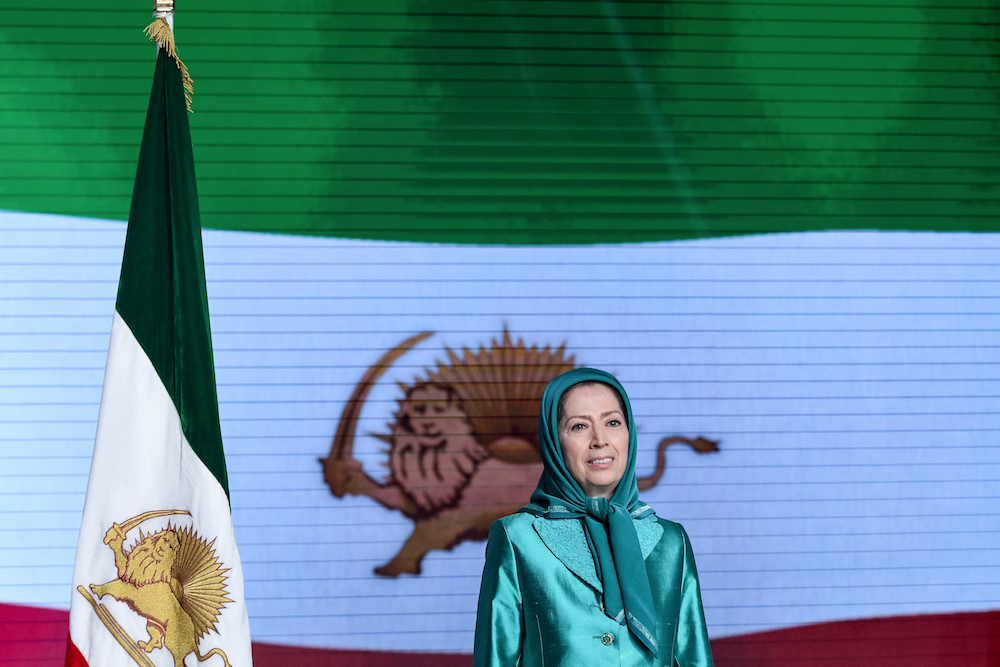
Leader of the People’s Mujahedin of Iran Maryam Rajavi speaks during a conference “120 Years of Struggle for Freedom Iran” at Ashraf-3 camp, which is a base for the People’s Mojahedin Organization of Iran (MEK) in Albanian town of Manza, on July 13, 2019. (AFP/File Photo)
One long-time supporter of the NCRI, and a speaker at the 2020 Free Iran Global Summit, is Tom Ridge, who was the first ever US secretary of homeland security after the 9/11 attacks.
He is a former governor of Pennsylvania and an outspoken advocate for an Iran “free from tyranny.”
Ridge spoke with Arab News during the summit, and explained his long-running support for the NCRI — despite its designation by the US as a terrorist organization until 2012.
While secretary of homeland security, he had never seen any credible reports that justified the group’s terrorist designation, Ridge said.
“I began every day, for several years, in the Oval Office alongside President George Bush being presented with a threat report. I never ever saw a reference to the MEK in any plot that threatened Americans or American interests,” he added.
Having been removed from the US list of terrorist organizations in 2012, the NCRI is increasingly being recognized as the most important player in the landscape of resistance to Tehran’s clerical regime — both at home and abroad.
Supporters of the People’s Mujahedeen Organisation of Iran (PMOI) also know as Mujahedeen-e-Khalq (MEK) wave the National Council of Resistance of Iran (NCRI) party flag as they rally to protest against the Iranian regime on January 10, 2020 in Brussels. (AFP/File Photo)
“Within American political circles, these days there’s growing bipartisan recognition of the NCRI’s legitimacy,” Ridge said.
He argues that this consensus and recognition of the NCRI’s legitimacy are in the best interests of not just the Iranian people, but also of regional states and the US.
“Recognizing the existence of both an internal and external opposition group that rejects terrorism and embraces principles like gender equality and, most importantly, a non-nuclear Iran seems to be in everyone’s best interest in the globe, not to mention regional states such as Saudi Arabia,” he said.
Ridge spoke at the summit to highlight and denounce Iranian support for terrorism, and many other speakers did the same.
The issue of Iranian terrorism is central to the NCRI’s campaigning, and it is an issue the group is tragically familiar with.
FASTFACT
NCRI
Was founded by Massoud Rajavi and former Iranian President Abolhassan Banisadr in 1981 after their joint escape from the country.
In 2013, Islamic Revolutionary Guard Corps (IRGC) forces and their Iraqi militia proxies attacked and killed over 50 NCRI members, and kidnapped more, from their base in Ashraf, Iraq.
This brazen attack was mortifying for the NCRI, but looking further back, the persecution that members of the Iranian opposition have experienced at the hands of the regime becomes even more egregious.
Up to 30,000 of the NCRI’s supporters and members were murdered by the regime in 1988, following a religious edict by hardline revolutionary Ruhollah Khomeini.
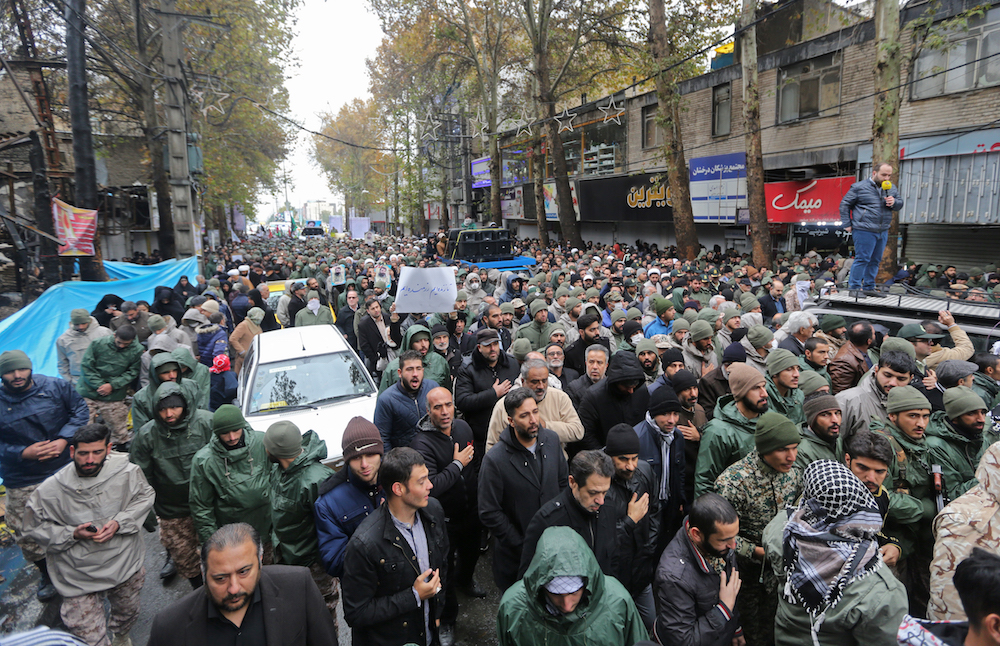
Iranian mourners attend the funeral of Morteza Ebrahimi, a commander of the Islamic Revolutionary Guard Corps, who was killed in violent demonstrations in November 2019. (AFP/File Photo)
Amnesty International has referred to these murders as “ongoing crimes against humanity.” It continues to call for justice over the killings, and has implored the UN to set up an independent inquiry into the mass murders.
The most recent assault on the Iranian resistance — a bomb plot targeting its 2018 annual summit — was organized in part by an official Iranian diplomat, who just days ago began his trial in France for his role.
After 30 years of bombings, violence and targeted attacks, it is perhaps no surprise that the NCRI is so vehemently opposed to the regime’s use of terrorism as a tool of foreign policy.
These attacks, Ridge argues, are more than illegal and unjust. He believes that Tehran’s relentless assaults on the NCRI betray its fear of the movement’s popular appeal.
Leader of the People’s Mujahedin of Iran Maryam Rajavi during an event. (Supplied)
“If an oppressive regime highlights an internal and external group as the enemy of the state, then there’s a pretty good justification to conclude that they’re fearful that their appeal is large,” he said.
NCRI members believe that Tehran is taking increasingly drastic measures against them because it knows that their appeal is increasing every year, and the West is starting to take notice of the credible, progressive alternative they present for Iran’s future.
Ali Safavi, a member of the NCRI’s foreign affairs committee, told Arab News that from the 2020 Free Iran Global Summit onward, its activities are only going to expand and intensify.
He said the group “aims to pave the way for more uprisings, like those witnessed in November 2019,” when huge anti-regime protests swept across virtually every Iranian city and town.
Former US Secretary of Homeland Security Tom Ridge gestures as he speaks during a conference “120 Years of Struggle for Freedom Iran” at Ashraf-3 camp, which is a base for the People’s Mojahedin Organization of Iran (MEK) in Albanian town of Manza, on July 13, 2019. (AFP/File Photo)
Safavi added that the NCRI will “step up its campaign to hold the regime leaders accountable for their atrocities, first and foremost the 1988 massacre of 30,000 political prisoners,” and that it will continue to work on “breaking the climate of fear and repression” that Tehran has manufactured at home and pursues abroad through terrorism.
Rajavi, Safavi and their cohort in the NCRI were on the frontlines of the 1979 revolution, and it is looking increasingly likely that they will take leading roles in the next Iranian revolution.
This time, though, they say they will not allow their vision for Iran’s future to be distorted, as it was by Khomeini and his extremist ilk in 1979.
The next Iranian revolution will truly be of the people, and if the NCRI’s predictions are correct, it could be sooner than anyone expects.
Iranian resistance: Terrorist designation of IRGC ‘long overdue’Two years after failed bomb plot, Iranian opposition rallies backers online
Six years after Gaza war, Palestinian victims lament housing crisis
Fri, 2020-07-24 23:15
BEIT LAHIA/GAZA STRIP: Six years have passed since the last bloody war on the Gaza Strip, but Palestinian Saber Abu Nahl is still moving from one house to another after he lost his home to Israeli airstrikes in the northern Al-Nada neighborhood.
Abu Nahl, who works as a taxi driver, was one of hundreds who lost their homes during the conflict.
He dreams of rebuilding his home again.
“The rent fees overwhelmed me and I dream day and night to go back to home,” said Abu Nahl, 43.
The war launched by Israel against Gaza, which lasted from July 8 till Aug. 26, 2014, destroyed 12,000 housing units and partially destroyed 160,000, of which 6,600 were uninhabitable, according to the Ministry of Works and the UN Relief and Works Agency for Palestine Refugees (UNRWA), in cooperation with the UN Development Program.
More than 1,500 housing units are yet to be rebuilt and their owners are homeless, according to the non-governmental organization People’s Committee to Face the Siege.
Abu Nahl, who supports a family of seven, lives in a modest rental home in Jabalia refugee camp in the northern Gaza Strip. The former owner of the house forced him to leave because he could not pay the estimated monthly rent of $117.
Like other homeowners ruined by the war, Abu Nahl was receiving financial aid from the UNRWA as an allowance for the value of rent until they returned to their homes after reconstruction.
However, UNRWA has stopped paying the allowance since 2018. Abu Nahl disagreed with the decision and accused Palestinian forces of breaking promises.
“The UNRWA is lying, the Palestinian factions do not care about us and we are homeless without any horizon,” he said.
“Many days I return to my children with not enough to feed them, so how do I manage their affairs and pay the rent in light of a devastating economic situation?”
Since the 2014 conflict, the Gaza Strip has endured fighting between Hamas and other factions, and Israel.
Nevin Barakat is no better off than Abu Nahl, and despite receiving a new apartment at the beginning of the year, she still feels the painful effects of the war, where she lost her home.
The Al-Nada neighborhood apartment was destroyed, and Barakat, her husband Rami, and her five children took refuge in a school shelter. But an Israeli artillery shell hit the classroom where she was staying, killing her husband and wounding her children.
Although she was happy to move her children to the new apartment, the “ghosts of war” still affect Barakat, who fears another war could displace them again.
“I lost my husband at the age of 37. I want to live in peace and raise my children.” she said.
Osama Drabieh, a member of the destroyed homeowners’ committee in the Al-Nada neighborhood, said: “It is true that most destroyed homes in the neighborhood have been rebuilt, but residents are afraid a new war will bring back the suffering.”
Drabieh, a retired civil servant, returned to his new apartment at the beginning of the year after six long years of separation from his family.
“We have suffered a lot from the burden of destroyed housing and we cannot tolerate any new war that will destroy what has been rebuilt,” he said.
“The impact of the previous war is still visible on our bodies, homes, factories and streets.”
Jamal Al-Khudari, head of the People’s Committee to Face the Siege, said that more than 1,500 housing units have still not been rebuilt after the 2014 war.
More than 500 factories were also severely damaged during the fighting, he said.
“The reality in the Gaza Strip remains difficult, exceptional and tragic,” Al-Khudari said.
Six years after the war, life on the Gaza Strip faces the growing threats of a deteriorating economy, poverty and unprecedented unemployment rates.
Social media users demand ‘Palestine’ added to Google MapsYoung Gaza amputees play soccer again after coronavirus curbs eased
International plea to save storm-hit Yemeni mud city from collapse
Fri, 2020-07-24 22:25
AL-MUKALLA: Authorities in southeastern Yemen have called for international help to save the historic mud-skyscraper city of Shibam from collapse after heavy rains damaged more than 100 homes.
Dubbed the “Manhattan of the Desert,” the 16th-century walled city in the province of Hadramout is the oldest metropolis in the world to use vertical construction.
However, torrential rain on Monday partially destroyed some of the UNESCO World Heritage Site’s 500 high-rise properties forcing many families out of their homes and to seek refuge with neighbors or relatives.
During a meeting in the city of Seiyun on Thursday, local authorities in the region agreed to set up an emergency committee to assess the damage to Shibam and surrounding areas. At the same time officials appealed for financial aid from UNESCO and other international and local funding bodies to help with repair and reconstruction costs.
Alawi Bin Sumait, a journalist and resident of Shibam, told Arab News: “The rains were huge and lasted from 5:30 p.m. to nearly 10 p.m.” He said the deluge overwhelmed streets, sewage systems, and power lines, and he and his son Abdullah posted images on social media showing huge cracks that had formed in some of the mud buildings.
He urged the Yemeni government to urgently allocate emergency funds toward repairing damaged houses before they crumbled.
BACKGROUND
Local authorities in the region agreed to set up an emergency committee to assess the damage to Shibam World Heritage site and surrounding areas, located in Wadi Hadramout, after torrential rains partially destroyed some of the properties.
Shibam has been deprived of vital maintenance since the beginning of the war in Yemen which had resulted in international NGOs and experts leaving the country. Even before the recent heavy rains, many properties in the clustered city were already on the verge of collapse, Bin Sumait said.
With meteorologists forecasting further rainstorms over the coming days in Shibam, and central and western parts of Yemen, local government official Hesham Al-Souaidi warned that current relief efforts could be hampered.
“This year’s rainstorms are consecutive and do not leave time for us to assess the actual damage and to offer assistance. As we move to fix the damage, another downpour hits the same areas and things get worse,” Al-Souaidi said.
On Thursday, local authorities in the central Yemeni province of Marib said that storms on Tuesday killed three internally displaced people and damaged the shelters of more than 5,000 families in five districts. Thousands of families there are in desperate need of food, shelter, clean drinking water, and medication.
Heavy rains have lashed many Yemeni provinces since the beginning of the year, causing dozens of deaths, flooding farms, and swamping water and electricity stations.
Yemen parliament speaker highlights importance of implementing Riyadh AgreementYemen currency crash has ‘done more damage’ than war, experts say
Yemen currency crash has ‘done more damage’ than war, experts say
Author:
Fri, 2020-07-24 01:18
AL-MUKALLA: The depreciation of the Yemeni currency has caused more damage to Yemenis than the raging conflict in the country, economists and locals have said.
The Yemeni riyal traded 752 against the US dollar on Thursday’s black market for the first time in two years, falling from 700 in recent weeks. The riyal was 623 at the beginning of the year before slowly falling to 680 over the following six months. In January 2015, the riyal was 215 to one dollar.
The impact of the currency depreciation on the Yemeni economy and the public is dramatic, experts and economists said.
“The direct violence of the war has affected some people in Yemen, but the fall of the currency affects everyone,” Spencer Osberg, chief editor at the Sanaa Center for Strategic Studies, told Arab News.
“Yemen imports the vast majority of what its people consume. The domestic currency losing value has an immediate inflationary impact, meaning the necessities of life become more expensive for everyone,” he added.
Yemen was plunged into war when Houthi rebels seized control of Sanaa and gained territory across the country in late 2014, triggering heavy fighting that ravaged vital institutions. After almost five years, the Yemeni government has liberated most of the country. The focus of the fighting has moved to rugged and uninhabited areas in northern Yemen.
The war has disrupted oil and gas exports, the primary source of hard currency for the country. The disruption is the main cause in the decline of the Yemeni currency.
“In a country where roughly half of the population was living below or near the poverty line even before the conflict when the currency was stable, the Yemeni riyal’s fall in value in recent years has made the cost of staying alive far harder to afford for millions more people,” Osberg said.
When the riyal began to fall, local authorities in several Yemeni provinces raised fuel prices. The price of food increased by 10 percent, triggering limited protests in government-controlled areas. Many local food wholesalers only accept the Saudi riyal or US dollar.
Mohammed Omer, who owns a small grocery in Al-Mukalla, told Arab News that he is forced to buy the Saudi riyal at an inflated price from local exchange companies in order to buy goods from wholesalers.
“I sometimes frantically move from one exchange company to another when the Saudi riyal is scarce,” he said, adding that he, like all local traders, raised the prices of goods to offset losses caused by the fluctuation of the currency.
Saleh Yaslem, a local journalist, said his landlord asked for rent in Saudi riyals. Yaslem is paying SR600 monthly for a new flat, compared with 50,000 Yemeni riyals (SR256) for his old flat last year.
“This is a big problem for Yemenis whose salaries are in the Yemeni riyal,” he told Arab News.
Economists said the scarcity of Yemen’s main sources of foreign currencies has also caused the depreciation.
“Remittances, international humanitarian aid and bilateral support from Saudi Arabia are all decreasing dramatically while the Yemeni government has been printing new riyals to cover its operating budget, largely to pay public sector salaries,” Osberg said, adding that high demand for hard currency from fuel and goods traders has also contributed to the problem.
Mustafa Nasr, director of the Economic Media Center, said the Yemeni government’s failure to secure a new central bank deposit from Saudi Arabia, the civil war, currency speculators and a surplus of Yemeni riyals are the main reasons behind the depreciation.
“The rapid slump in the riyal is a disastrous issue that reflects the instability in the country,” he said.
To curb depreciation, the government should reassert control of the market, inject more hard currencies into the market, convince donors to bail out the economy, and resume oil and gas exports, experts said.
“Find ways to supply the market with foreign currency. This would require the cooperation of international stakeholders however, such as donor countries and humanitarian organizations recommitting to aid financing in Yemen,” Osberg said. He advised the government to create a more stable and secure environment for the central bank in Aden to operate by ending tension with the separatist Southern Transitional Council (STC).
“Neither Saudi Arabia nor any other international donor is likely to give the central bank access to billions of dollars when its head office is surrounded by fighters and the government has lost Aden to the STC. The government badly needs to give stakeholders confidence that it can be responsible for any financial support it is given,” he added.