Sudan to deploy troops to Darfur after killings

Author: 
AFP
ID: 
1595792440285744700
Sun, 2020-07-26 19:27

KHARTOUM: Sudan’s prime minister said Sunday the country would send security forces to conflict-stricken Darfur to “protect citizens and the farming season.”
Abdalla Hamdok’s announcement came two days after gunmen in the region killed at least 20 civilians, including children, as they returned to their fields for the first time in years, the latest in a string of violent incidents.
The impoverished western region has seen years of conflict since an ethnic minority uprising prompted the government to launch a scorched-earth campaign that left 300,000 people dead and displaced 2.5 million.
“A joint security force will be deployed in the five states of the Darfur region to protect citizens during the farming season,” Hamdok’s office said in a statement after he met a delegation of women from the region.
The force will include army and police forces, it said.
Violence in Darfur has eased since Bashir’s ouster by the army amid mass protests against his rule last year, with a preliminary peace deal signed in January between the government and a coalition of nine rebel groups, including factions from the region.
Farmers displaced in the conflict have since started to return to their land under a government-sponsored deal reached two months ago, in time for the July-November planting season.
But bloodshed has continued, particularly over land rights, according to expert Adam Mohammad.
“The question of land is one cause of the conflict,” he said.
“During the war, peasants fled their lands and villages to camps, and nomads replaced them and settled there.”
On Friday, armed men drove into a village and killed 20 civilians returning to their fields for the first time in years, an eyewitness and a tribal chief told AFP.
In late June and early July, hundreds of protesters camped for days outside a government building in the Central Darfur town of Nertiti to demand that the government beef up security after multiple killings and looting incidents on farmland and properties.
Bashir is wanted by the International Criminal Court over charges of genocide and crimes against humanity in the conflict.

Main category: 

Gunmen kill at least 20 farmers in Sudan’s Darfur, says tribal chief Spike in deaths in Darfur points to coronavirus’ invisible spread


Yemen flooding kills 14, washes away houses

Author: 
Sun, 2020-07-26 21:05

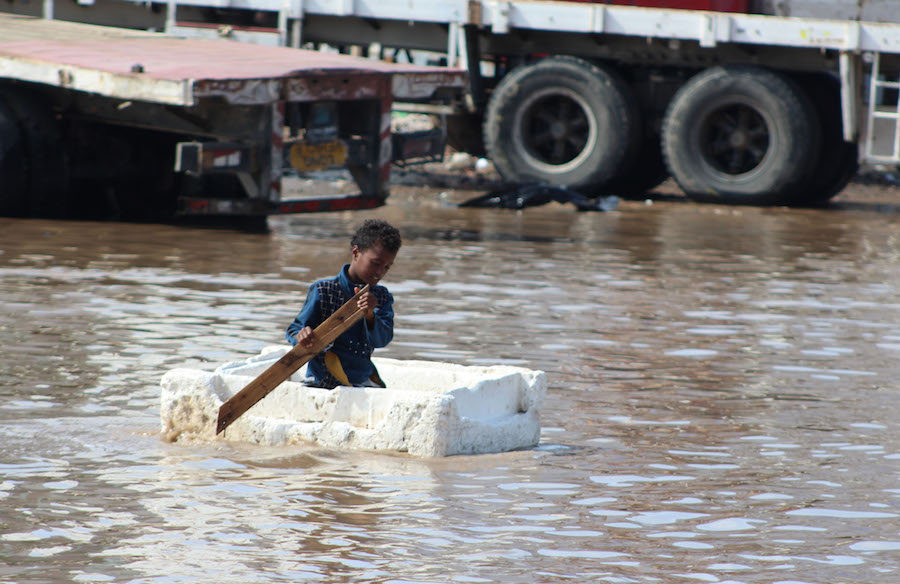
AL-MUKALLA: Heavy rains and flash flooding hit almost all Yemeni provinces in the last couple of days, killing at least 14 people and washing away dozens of houses, local media and local officials said on Sunday.

The largest death toll was recorded in the western province of Hodeidah, where 13 people died and more than 35 houses in three districts were destroyed. 

Images on social media showed floods washing away houses, farms and cars in poor districts of Hodeidah. Flooding killed one person and ruined houses and farms in the province of Ibb, local media and residents said. 

Heavy rains also hit the capital Sanaa, causing floods that affected many residential areas. “The damage in all affected areas is huge,” Salem Al-Khanbashi, Yemen’s deputy prime minister, told Arab News. 

The flooding damaged power lines in the southern province of Lahj and wiped out farms in Hadramout and Abyan, he said, adding that the National Emergency Committee had convened to discuss how to handle the damage and offer urgent assistance to the affected areas. 

“The international donors and organizations should urgently help us. We cannot handle this problem on our own.” 

On Saturday the country’s National Meteorological Center renewed its warning to the public to avoid flood courses and to avoid traveling this week, predicting a new wave of heavy rains, strong winds and flash floods in many provinces.

Last week a downpour that lasted for several hours ruined more than 90 houses in the historical city of Shibam, which is entirely made of mud, prompting residents and local officials into appealing for international help to rescue the city from collapse. Yemenis are also bracing themselves for further havoc in the form of a new locust invasion, as rainstorms create ideal breeding conditions.  

Yemen has been embroiled in conflict since late 2014, when the Iran-backed Houthis seized control of Sanaa and expanded across the country. The fighting has created the world’s worst humanitarian crisis and devastated the national economy.

Despite the torrential floods, fighting raged on the main frontline across Yemen on Saturday and Sunday in the provinces of Hodeidah, Al-Bayda and Marib. 

Yemen’s Defense Ministry said that army troops and allied tribesmen liberated a number of locations in Qania, in the central province of Al-Bayda. 

Brig. Ahmed Al-Nageh, the commander of 117 Infantry Brigade in Al-Bayda, said government forces, backed by Saudi-led coalition warplanes, engaged in heavy fighting with the Houthis in Qania, adding that the warplanes targeted Houthi military personnel and equipment in Al-Sabel and Masouda mountains. Clashes were reported in Hodeida, where government forces pushed back Houthi incursions in Durihimi and Jah districts, local media reported.

Yemen is also battling the coronavirus pandemic, which has so far killed 474 people and infected 1,674 in government-controlled areas, according to the latest figures from the Aden-based National Coronavirus Committee. 

Local and international health experts believe that the actual number of coronavirus patients is five times higher than the official figures.

Main category: 
Tags: 

Much of southern Yemen flooded by heavy rainfall; 6 deadYemen flood sweeps away wedding party


Sudan calls for ‘decisive talks’ on Ethiopia dam

Author: 
Sun, 2020-07-26 20:59

CAIRO: Sudan wants a decisive round of negotiations on the Renaissance Dam with Egypt and Ethiopia, provided the latter adheres to a timetable and agenda to address disagreements, Sudanese Minister of Water and Irrigation Yasser Abbas said on Sunday.

The minister added that Addis Ababa must also negotiate without raising issues beyond the scope of the dam and future projects.

Abbas said an African Union (AU) statement on the Renaissance Dam meetings is in line with Sudan’s proposals on the need to reach a fair and binding agreement on filling and operating the dam and other future projects.

The AU confirmed it is preparing for a new round of talks on the dam. It has invited Egypt, Sudan and Ethiopia to work on reaching an agreement.

Egypt, which relies on the Nile for 95 percent of its fresh water, fears the dam will significantly reduce the river’s flow, especially during its filling through periods of drought or in dry years. Ethiopia has said the project is key to its energy development.

Sudan, as a downstream country, also fears the dam will affect its water supply.

Ahmed Hafez, spokesman for the Egyptian Ministry of Foreign Affairs, said that the AU summit on the dam last Tuesday highlighted the need to reach an agreement that will include a mechanism to settle disputes.

The Khartoum State Water Authority announced a sudden rise in the level of the Nile, which led to a decrease in the production of clean water, especially in marine water purification stations. It suggests that work is underway to raise water platforms in the stations.

Anwar Al-Sadat Al-Haj Muhammad, the authority’s director-general, said turbidity in the water increased from 3,000 to 14,000 units, reducing the production of clean water in all stations in the state. The North Khartoum and East Khartoum neighborhoods were most affected.

“The historic achievement of the first stage of filling the Renaissance Dam is a testament to the end of the unfair use of the Nile,” the Ethiopian News Agency reported Deputy Prime Minister of Ethiopia Demeke Mekonnen as saying.

In a speech to a meeting to coordinate public participation in construction of the dam, Mekonnen said the completion of the first stage of filling the dam puts an end to the unfair use of the Nile, which has “continued for a long time.” He referred to the 1959 agreement between Egypt and Sudan that, 60 years after its application, “resulted in Ethiopia suffering.”

During the presentation of the report, Ethiopia’s Minister of Water, Irrigation and Energy Seleshi Bekele said Ethiopia uses less than 10 percent of the 15,000 gigawatt hours the dam is capable of producing from Nile water.

He added that electricity generation from water will be ready in February and April 2021, through two turbines. A further 11 new turbines will be also be installed.

Gamal Hilal, former adviser to the White House, told the Egyptian press that the US has not abandoned mediation in the dam dispute, with US Treasury Secretary Steven Mnuchin playing a mediating role.

Hilal said Mnuchin’s biggest concern other than the coronavirus pandemic is the process to steady the US economy on behalf of US President Donald Trump and Congress.

“These matters are Mnuchin’s responsibility,” Hilal said.

“All his efforts are focused on saving the economy and negotiating to approve new deals. It is difficult for anyone to imagine that Mnuchin will leave his president and economy, and focus on the Renaissance Dam.”

Hilal said the US position will be neutral, but if Egyptian diplomacy succeeds in making the US ministry of foreign affairs and the treasury make statements in favor of Egypt, then it will be a good step, even if Mnuchin has no time to enter negotiations himself.

“I do not separate the risks of the dam and the risks of the Turkish presence in Libya, because both are an existential threat to Egypt and neither is more important than the other,” Hilal added.

Main category: 

Nile dam deal ‘on the horizon’ after mini-summitNile dam dispute poses a thorny challenge for Ethiopia and Egypt


‘No collapse’ of Palestinian Authority says minister despite strong UN warning

Author: 
Sun, 2020-07-26 20:52

GAZA CITY: The Palestinian Authority (PA) is not on the verge of collapse, one of its ministers told Arab News, despite a UN official saying that its current financial and economic crisis meant it might not be able to pay people’s salaries or even carry out its duties in the future.

Khaled Al-Osaily, the PA’s national economy minister, viewed the UN official’s remarks as a reminder to the the world of its responsibilities about preventing such a collapse and as a judgement of the international community rather than the Palestinian people.

He downplayed the crisis the PA was experiencing and said that it could borrow from banks to cover necessary expenses, contrary to what observers of Palestinian economic affairs believed.

The PA could still rely on “the option of borrowing from local banks, an amount estimated at about $400 million, sufficient with internal revenues, to manage its affairs for a few months,” Al-Osaily told Arab News.

He acknowledged the difficult reality the PA was facing due to its political position in response to Israel’s West Bank annexation plans, but believed in the ability of the Palestinian people to overcome the crisis because they had succeeded in overcoming many challenges during decades of occupation.

UN Special Coordinator for the Middle East Peace Process Nikolay Mladenov gave a briefing to the Security Council last week warning that the PA was on the verge of total collapse. 

He expressed concern that the coronavirus pandemic had wiped out 80 percent of Palestinian revenues. In addition, Rammallah’s refusal to accept tax revenues from Israel meant it was unclear if there were enough resources to pay future salaries or even for the PA to continue performing its governing duties in the coming months, he said, adding that the PA had been late in paying people’s salaries since May.

Israel was trying to take advantage of the PA’s deteriorating reality and applying pressure so that it reversed its position on ending existing agreements, especially on security coordination, said Al-Osaily. He stressed that the leadership was sticking to its guns and would not be subject to any blackmail regardless of the pressure. “Our issue is political, not relief or economics,” he added.

Financial and economics expert Haitham Daraghmeh said that the PA could not improve its current economic situation especially due to the fallout from its political stance, which coincided with the coronavirus pandemic and its negative effects on the global economy.

“The PA does not have economic alternatives, is unable to manage its affairs, and has made an appeal to Arab countries for support or borrowing but without a meaningful response … even European countries are satisfied with supporting the health sector at the present time due to the deterioration of economic conditions globally,” he told Arab News. “Even borrowing from local banks is no longer available. The PA has borrowed the ceiling (maximum) available to it according to the banking system and, in the event of the current crisis (lasting) for a longer period, the conditions are likely to deteriorate.”

But he also believed that the decision to dissolve or allow the collapse of the PA was not a Palestinian option but an international decision and, therefore, whenever the situation worsened the international community would intervene with Israel to ease things.

According to Daraghmeh, the fact that this situation had been in place for a long time with no foreign intervention may lead to anger in the streets and security chaos that Israel would not be spared from. It may even suffer the most severe impact, he added.

A professor of financial and economic sciences at the College of Graduate Studies at Ramallah’s Arab American University, Nasr Abdul Karim, said that the PA faced a major dilemma. But he disliked the term “collapse” as he thought the authority was far from that point.

“Mladenov’s warning is more functional than political and the PA will not collapse except with an international desire that meets with a Fatah decision,” he told Arab News. “As for its collapse due to the current financial crisis it is unlikely (given) that it is not under popular pressure that leads it to sway and collapse which would mean its complete disappearance.”

Main category: 

Gazans defy taboos to rescue stray animalsPeople’s joy at reopened mosques in Gaza ‘a blessing’ – imam


Lebanon fights coronavirus and rotten food

Sat, 2020-07-25 23:24

BEIRUT: The government’s coronavirus follow-up committee has issued a series of recommendations to control the spread of the disease as more infections were recorded in all regions of Lebanon this week.

It has recommended closing bars, nightclubs and indoor pools, electronic games centers for children, children’s clubs, sports halls and popular markets, as well as banning beach parties and religious and social events for a week. It said that occupancy in restaurants should not exceed 50 percent of capacity in enclosed areas.

The recommendations, not yet endorsed by the relevant ministries, were formulated by specialized doctors.

The number of cases of COVID-19 infections in Lebanon on Saturday exceeded 3,400 while the death toll rose to 46.

The number of infections during the past week increased from an average of 75 cases to 166 a day.

Dr. Abdel-Rahman Bizri, a member of the national committee for infectious diseases, told Arab News: “If Lebanon continues to witness an increase in cases of infection, and as long as the Lebanese do not adhere to the preventive and precautionary measures, then we must get to this level.”

“We are currently wavering between the third and fourth phase in confronting the virus, which means that we reached the stage of societal reproduction because the virus is internally spread and not being transmitted by people coming from abroad,” he said.

Lebanon reopened its international airport on July 1 for commercial air traffic, with passengers required to be tested and proved free of the virus.

Dr. Ismail Sukkarieh, head of the health, rights and dignity commission, said that COVID-19 had regained momentum in Lebanon. “The state that is supposed to manage the health crisis lost its credibility. It did not allocate a specific hospital to receive those who have contracted COVID-19 nor did it train people on how to confront it. It is not true that government hospitals are prepared to confront the pandemic, while private hospitals have relinquished their responsibilities and the state was not able to force them to allocate special departments for people infected with COVID-19, noting that they are the biggest beneficiaries of state funds over long years.”

“The way the airport was reopened to the public was marred by chaos. There were frauds in PCR examinations, and no accountability measures were taken against the counterfeiters, and this proves that people in Lebanon are reckless in dealing with the disease,” he said.

“The state wanted to show itself as victor for reasons not related to health, but reality is different. We opened the airport, allowed weddings and gatherings, and the real situation was revealed.”

Meanwhile, the Ministry of Health, along with relevant security services, has seized tons of rotten and expired chicken and fish meat recycled in factories far from Beirut.

Dr. Zouhair Berro, president of the Consumer Protection Association, said it was “only the tip of the iceberg,” and that there were, in Lebanese warehouses, huge amounts of accumulated goods, many of which were sold to Syrian refugees. “The association had warned the Ministry of Health about the issue. What is the government waiting for to implement the laws of food safety, free competition and prohibiting monopoly?”

“There are crises of waste handling, electricity, bread and gasoline. Political parties are all warning of starvation while, at the same time, they are exchanging accusations while no one is held accountable for what has been committed.”

“Warehouses are full and there is no threat of shortage or starvation, rather there are monopolies, theft, fraud and privileged merchants, while the judiciary is absent and I do not know who would protect the citizens.”

Main category: 
Tags: 

France pledges $17 million to Lebanon’s struggling schools