Lebanon to impose two-week coronavirus lockdown

Author: 
Mon, 2020-07-27 23:57

BEIRUT: Lebanon is imposing a two-week coronavirus lockdown starting July 30, the country’s health minister said, as he slammed the “lack of community discipline and disregard” for all preventive measures and warned that the outbreak was taking a “dangerous turn.”

The number of confirmed cases on Monday reached 135 and Saturday’s cases were the highest since February at 175.

“The number is very large and indicates the seriousness of this stage,” said Health Minister Hamad Hassan, following a meeting of a COVID-19 ministerial committee headed by Prime Minister Hassan Diab.

He added that what was happening was another indication of the “rapid spread” of the virus within one week. “The infected person is now spreading the infection to 3 people.” 

The total lockdown of the country is from July 30 to August 3 and from August 6 until August 10, including the days of Eid Al-Adha. It is a measure intended to relieve pressure on hospitals that have started to get overcrowded. However, the final decision will be taken by the Council of Ministers that will meet Tuesday.

Hassan warned that the community outbreak of the disease was beginning to take a “dangerous turn” and he regretted “the lack of community discipline and disregard for all preventive measures imposed on people.”

Fears of COVID-19 have overtaken the country’s many financial and economic concerns, with politicians, parliament officials, ministry and court staff taking polymerase chain reaction (PCR) tests on Monday and entire towns shutting down.

Although the ministerial committee did not recommend closing Beirut International Airport, it decided that nobody would be allowed into Lebanon from the start of August without a negative PCR test from the departure country.

“Passengers will have to stay in quarantine for two days at their own expense in special centers, pending the results of the second PCR test at the airport,” Hassan said. “Those who have the logistical capacity for quarantine will not have to go to these centers.” 

Hassan requested hospitals to postpone receiving cold medical cases to later appointments because there were 222 cases within the health sector among doctors, nurses and employees. He called on hospitals to “completely prevent visits to patients or make them minimal.”

Lawyers in the Bar Association had to take PCR tests after one of their number was found to have the disease. Employees and judges at the Palace of Justice in Beirut were tested and it was decided to suspend trial sessions for four days.

Fear of contracting the virus has also reached politicians. The minister of defense, Zeina Aker, announced that her daughter had been infected with the virus. Parliament closed on Monday to carry out PCR tests for MPs who had mixed with George Aqis, including Speaker Nabih Berri. Aqis’ first test was positive but the second was negative.

The need for hundreds of Syrian workers to take PCR tests before entering Syrian territory has led to overcrowding in Lebanese government hospitals, with long lines of people waiting to be seen at authorized laboratories for testing.

“There was great pressure on the 50 laboratories,” Hassan said. “The number of tests increased to between seven and eight thousand daily, which caused a delay in announcing the results and affected the control of positive cases.”

Seventeen members of the Lebanese Red Cross contracted the virus from an infected volunteer who had moved one of his relatives to hospital. The relative suffered from burns at home and it was found out that he had COVID-19.

Main category: 

Lebanon ‘botched virus response’, say health advisers; return to tough lockdown urgedLebanon to re-open Beirut international airport from July 1



Yemen PM warns against bowing to Houthi bullying over tanker

Author: 
Mon, 2020-07-27 23:43

AL-MUKALLA: Yemen’s prime minister said the international community should take strong action against Houthi “blackmailing and bargaining” over a decaying oil tanker, the state news agency Saba reported, as he warned about a looming environmental disaster in the Red Sea.

The Safer tanker is carrying more than a million barrels of crude oil and is marooned off the Yemeni city of Hodeidah. Rust has eroded parts of the ship, allowing water to enter.

Prime Minister Maeen Abdul Malik Saeed, speaking to Russia’s ambassador to the country,  said that the Iran-backed Houthi group had reneged on previous promises to allow UN experts to board the tanker and that there was the risk of heavy pollution. 

The ship has not been repaired since 2014, when the Houthis seized control of Hodeidah. The militia has banned international engineers from visiting the ship and insisted on sharing the cargo’s revenues.

Saeed urged the international community, the UN, the Security Council and the Russians to put maximum pressure on the rebels in order to avoid an environmental disaster, adding that his government welcomed and would comply with all solutions that would lead to emptying the tanker.

The Yemeni government has suggested selling the oil and using the revenues to pay public servants in Hodeidah and other Yemeni provinces as it fears the Houthis might use the money to pay their fighters.

Yemeni Foreign Minister Mohammed Al-Hadrami also shared his concerns about oil leaks from the tanker in a phone call with Germany’s ambassador to Yemen, Karola Molar.

Al-Hadrami urged continued pressure on the Houthis until they allowed UN experts to see the tanker, Saba reported.

Human Rights Watch on Monday criticized the Houthis’ “reckless” denial to allow UN experts to board the ship, urging the Iranian regime to use its leverage to convince the Houthis to change their mind about the visit and prevent an environmental disaster that could contaminate the Red Sea.

“The Houthi authorities are recklessly delaying UN experts’ access to the deteriorating oil tanker that threatens to destroy entire ecosystems and demolish the livelihoods of millions of people already suffering from Yemen’s war,” Gerry Simpson, associate crisis and conflict director at Human Rights Watch, said in a statement.

“Governments concerned about Yemen’s humanitarian crisis should recognize the danger the Safer tanker poses and press to avert further tragedy. The Houthis’ continued refusal to allow UN access could result in devastating consequences for the environment and people across Yemen and the wider region,” Simpson added.

Meanwhile the Aden-based Supreme National Emergency Committee announced on Sunday that it had evacuated all Yemenis who had been stranded abroad due to global coronavirus lockdowns.

It repatriated 17,627 citizens who went back home on 114 flights and voyages from Saudi Arabia, Egypt, India, Jordan, Djibouti, the UAE, Sudan and Malaysia, the committee said.

But hundreds of stranded Yemenis also entered the country through land crossings with Oman and Saudi Arabia.

Yemen began repatriation flights in late May, despite concerns about the spread of coronavirus in the country.

The stranded citizens were first asked to supply a negative polymerase chain reaction test, before the government replaced this requirement with temperature checks at airports.

In March, Yemen’s internationally recognized government canceled flights to and from the country’s airports to prevent the spread of coronavirus. Thousands of Yemenis stranded abroad appealed to the government to arrange rescue flights for them as they had run out of money.

Main category: 

Yemen’s prime minister accuses Qatar of supporting HouthisYemeni tribes who fight Houthis ‘should not be let down,’ says army


Morocco sees travel mayhem after snap movement restrictions

Author: 
AFP
ID: 
1595875715681241500
Mon, 2020-07-27 17:49

RABAT: Morocco’s roads and transport hubs saw chaotic scenes after authorities announced snap movement restrictions affecting eight cities and towns to curb the spread of the novel coronavirus.
The measures shutting off all entry and exit to the cities, which together account for more than half of Morocco’s population, were announced on Sunday, just five hours before they came into effect at midnight (2300GMT).
A joint statement from the interior and health ministries said the new restrictions applied until further notice to economic capital Casablanca and tourist capital Marrakesh as well as port city and second economic hub Tangiers, along with Fez, Tetouan, Meknes, Berrechid and Settat.
Local media reported that there were several road accidents after the announcement, adding there were still traffic jams on the Marrakesh-Ouarzazate mountain route on Monday morning due to the high volume of traffic.
There was mayhem as people converged on Casablanca’s main bus station on Sunday evening, while the train station in nearby Mohammedia was still crowded on Monday, AFP correspondents said.
Authorities announced the restrictions after a “considerable rise” in novel coronavirus cases just days before the Muslim Eid Al-Adha holiday, when families traditionally come together.
The North African country registered record numbers of new daily infections over the weekend, with 811 cases on Saturday and 633 on Sunday.
The total number of cases in the kingdom reached 20,887 on Monday, including 316 deaths.
The decision was made “in view of the majority of citizens failing to comply with preventive measures” of social distancing and mask-wearing, the statement said.
Earlier this month, authorities had announced an easing of some restrictions imposed in March, with steps to encourage domestic tourism and facilitate travel over the Eid Al-Adha holiday.

Main category: 
Tags: 

Morocco shuts down major cities after spike in coronavirus cases


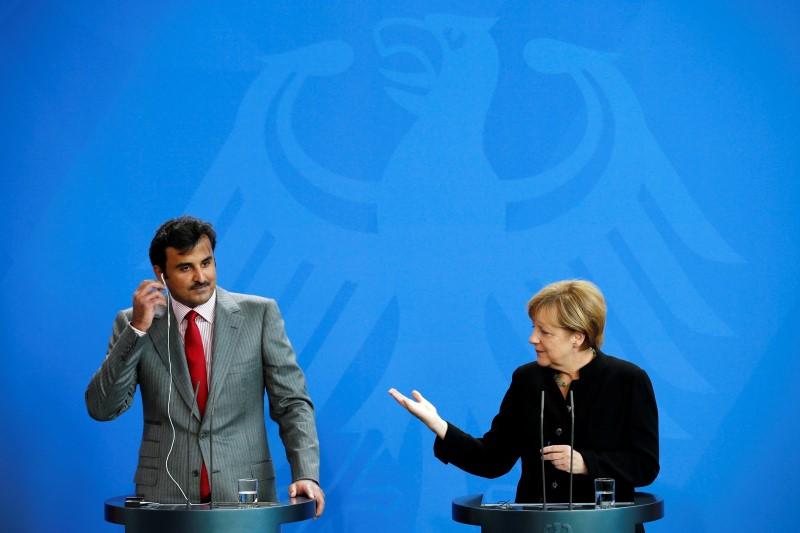
Report reveals extent of Qatari infiltration in Germany

Mon, 2020-07-27 20:28

LONDON: A new report in German media has exposed how Qatar uses its vast wealth and charities to fund and infiltrate mosques, activate Muslim Brotherhood networks and buy influence across Germany.

The newly released information is part of a horde of confidential documents delivered to a French journalist in 2016.

Central to Doha’s strategy is the Qatar Charity. One of the largest charities in the world, it has been plagued by allegations of funding extremism and anti-Semitism for years.

The leaked documents reveal that Qatar Charity has used its deep pockets to fund at least 140 mosques and Islamic centers across Germany since it began its campaign — costing an estimated €72 million ($84.69 million).

In 2016 alone, the charity spent roughly €5 million on various construction projects in major German cities, including Berlin and Munich.

The relationship between these mosques and the Qatar Charity has become so intertwined, the investigation revealed, that at various times German mosque executives wrote directly to the charity’s president to request cash payments for proposed projects.

One such example is the Arab-German Association of Ulm, which experts suspect to be Brotherhood-aligned.

The head of the association wrote directly to Qatar Charity, opening with “who builds a mosque, Allah builds a house in paradise,” before requesting funding to buy a property and build a mosque, followed by the association’s bank details.

Christian Chesnot and Georges Malbrunot, the French journalists who revealed the extent of Qatari infiltration into Germany, are clear that it is part of a wider foreign policy strategy by Doha that mobilizes Brotherhood networks at a grassroots level while using Qatar’s huge cash reserves to buy leverage at a governmental level.

They said as Qatar has found itself increasingly isolated in the Gulf — due to its terrorist financing and extremism — it is now looking further afield to spread its influence.

Viewing the European country as a potential powerful ally, Chesnot and Malbrunot said in exchange for German support, Qatari Emir Sheikh Tamim bin Hamad Al-Thani promised billions of euros of investment.

This, they said, is part of a dual strategy that has already played out in France: “Religious infiltration from Qatar, coupled with an intensification of economic and political relationships.”

Main category: 

Londoners continue protest against Qatari emir’s visit to Britain Mauritania investigates gifting of island to former Qatari Emir


Kuwaiti man arrested after slapping Egyptian cashier

Sun, 2020-07-26 23:45

CAIRO: A Kuwaiti citizen has been arrested on Sunday after slapping an Egyptian cashier three times at a supermarket in Kuwait. 

The case has been referred to a misdemeanour court, Ahram Online reported. 

Footage of the attack, captured on a surveillance camera, showed the attacker slapping a worker across the face at the Sabah Al-Ahmad cooperative supermarket. 

The video has gone viral and prompted backlash from social media users who described the attack as “racist” and “inhumane.”

A woman can be seen intervening to stop the Kuwaiti man from assaulting the cashier further. 

The supermarket’s head, Nasser Al-Otaibi, announced that he is resigning in objection to the abuse that the worker faced, according to a voice note that was circulated on his behalf.   

Al-Otaibi said he resigned in protest at the abuse that expat workers face at the hands of some Kuwaitis.

Main category: 

Hundreds of Egyptians flown home from Kuwait in latest coronavirus repatriation operation Kuwaiti actress Hayat Al-Fahad triggers uproar with call for expat ban over coronavirus