President of Algeria secures fugitive army officer with Erdogan call
Mon, 2020-08-03 01:13
ALGIERS: Algeria’s president phoned his Turkish counterpart last month to secure the return of a fugitive military official who fled Algeria days after its powerful army chief died in December, a top Algerian security source said.
Guermit Bounouira was handed over to Algerian security officials in Turkey on Thursday, accused of leaking military secrets, and will face a military judge on Monday in Blida prison southwest of Algiers, the source said.
Turkey’s surrender of Bounouira to Algerian authorities underscores the importance Ankara attaches to its relationship with Algeria, a powerful neighbor of Libya where Turkish forces have intervened in the civil war.
Algerian President Abdelmadjid Tebboune phoned Turkish President Tayyip Erdogan about a week before Eid Al-Adha holiday, which began on Friday, to request he hand Bounouira over, the source said.
Bounouira, a top aide to the late army chief Ahmed Gaed Salah, is accused of leaking a chart showing movements of army officers including their names and codes. The chart has circulated on social media, embarrassing the army, although it was unclear who posted it.
BACKGROUND
Bounouira fled to Turkey in the week after Gaed Salah died and the Algerian security source said he had subsequently leaked military secrets to activists based abroad.
Gaed Salah emerged last year as Algeria’s most powerful man when weekly mass protests succeeded in unseating the veteran president, Abdelaziz Bouteflika, and a host of other officials.
However, Gaed Salah died suddenly of a heart attack on Dec. 23, weeks after a presidential election that he had pushed for, but which the street protest movement opposed as illegitimate.
Bounouira fled to Turkey in the week after Gaed Salah died and the Algerian security source said he had subsequently leaked military secrets to activists based abroad.
“Guermit was Gaed Salah’s closest man. As such he was aware of military secrets,” the source said.
Tebboune is trying to stamp his own mark on Algeria’s government after Bouteflika’s two decades in office and appointed a new army chief in January.
Algeria president orders probe into forest firesHaftar warns Erdogan: Stay out of Libya or you face our bullets
Iran reaps the rewards of Saddam’s 1990 Kuwait invasion
Sun, 2020-08-02 23:23
LONDON: Thirty years on, we continue to endure the catastrophic reverberations of the 1990 Iraqi invasion of Kuwait. This act set in motion events that would unleash a three-headed hydra of sectarianism, terrorism and Iranian militancy.
The August 2 invasion constituted an immense psychological shock. We woke to images of utter horror and chaos: Arab soldiers assaulting and looting another Arab nation. Ordinary Kuwaiti families upended from lives of luxury — fleeing as terrified refugees into Saudi Arabia. The invasion was particularly disconcerting, given that Kuwait had been a principal ally and backer for Baghdad during the previous decade’s war with Iran.
Julius Caesar’s crossing of the Rubicon famously marked his point of no return, committing his armies to a devastating and history-changing Roman civil war. The Kuwait invasion represented Saddam Hussein’s own personal Rubicon crossing.
In 1990, Saddam was just another dictator who would have scarcely deserved a mention in the history books if he had been displaced in yet another Baathist, communist or Islamist coup a couple of years later. The Kuwait invasion saw him justifiably demonized in the global media as a savage, dictatorial monster who would have to be slain.
Within a year, hundreds of thousands of Iraqis would be dead — murdered by their own regime after the brutal suppression of uprisings which followed the Kuwait conflict. The Iraqi army was humiliated and destroyed, with tens of thousands of Iraqi soldiers dead, and many others fleeing home to join ill-fated uprisings leaving the skeletons of thousands of abandoned tanks scattered across the desert.
1990 Kuwait invasion recap
On July 18 Iraq accuses Kuwait of stealing oil and encroaching on territory.
Iraq’s President Saddam Hussein demands $2.4 billion from Kuwait.
Kuwait accuses Iraq of trying to drill oil wells on its territory.
Iraq accuses Kuwait of flooding oil market and driving down prices.
On August 1 Arab League and Saudi Arabia suspend mediation attempts.
On August 2 Radio Kuwait accuses Iraqi troops of occupying its territory.
Faced with 100,000 Iraqi troops and 300 tanks, Kuwaiti army is overwhelmed.
Kuwait City falls and Kuwait’s ruler Sheikh Jaber Al-Sabah flees to Saudi Arabia.
UN Security Council demands immediate pullout of Iraqi forces from Kuwait.
On August 6, Security Council slaps trade and military embargo on Iraq.
President George H.W. Bush announces dispatch of troops to Saudi Arabia.
On August 8, Iraq announces Kuwait’s “total and irreversible” incorporation.
Later in the month, Iraq annexes Kuwait as its 19th province.
President George H.W. Bush made the equally fateful decision not to pursue Saddam’s army to Baghdad. The rights and wrongs of Bush’s decision continue to be argued over, but this left Saddam in power — wounded and vengeful. Unquestionably in 1990, Saddam had to be forced out of Kuwait, particularly as there were fears that he might send his forces deeper into the Gulf region. Yet cutting Saddam down to size led to a fundamental destabilization of the regional balance of power.
Throughout the 1980s, the ayatollahs’ regime in Tehran had been kept at bay by means of the vicious confrontation with Iraq, costing around a million lives. When Saddam’s regime fell like a dead branch in 2003, the Islamic Republic remained as a dominant regional force, free to spread its tentacles into Iraq, Syria, Lebanon, Bahrain and beyond.
Already during the 1980s and 1990s, Tehran had been responsible for terrorist attacks, militant insurgencies and attempted coups, such as the 1996 Alkhobar bombings, which killed 19 US service personnel.
With Saddam gone, the ayatollahs desired not only to ensure that Iraq could never again exist as a threat, but to export their revolution throughout the Middle East, following the blueprint of Hezbollah in Lebanon.
Consequently, a sizable chunk of the region has been severed from the Arab sphere of influence, with Tehran today trying to knit these disparate nations together as a miserable and marginalized bloc of “resistance” states.
Yes, Saddam was a monster — a murderous threat to his own people and his neighbors. But in the years since 1990 we have discovered that there are worse things than his kind of monster.
When the hateful regimes of Saddam, Libya’s Muammar Gaddafi, Syria’s Bashar Assad and Yemen’s Ali Abdullah Saleh were challenged and upended, the result was mass civil chaos which has cost upwards of a million lives, displacing countless millions. It may be more than a generation before these nations enjoy the most elementary levels of stability, if ever.
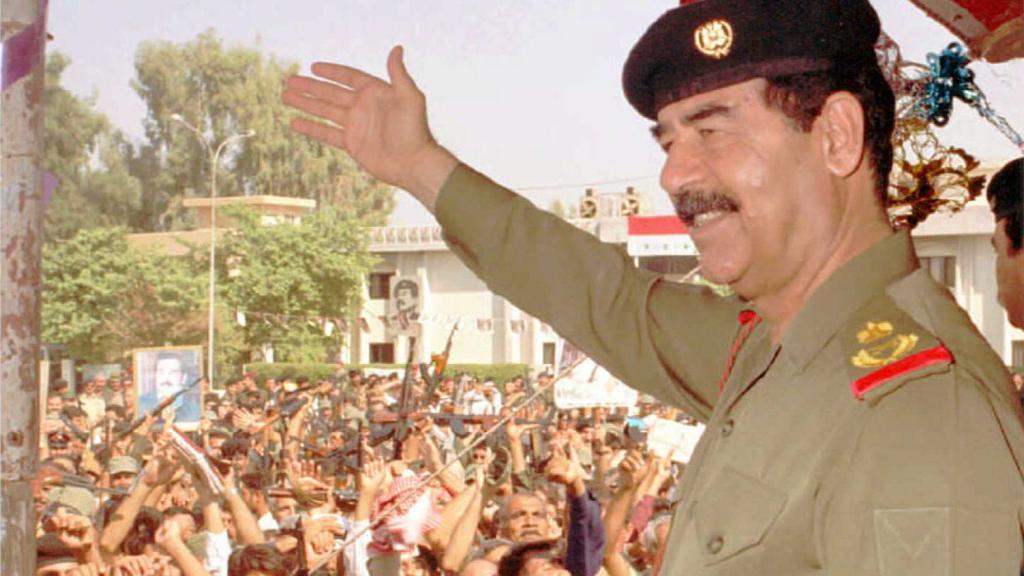
Former Iraqi president Saddam Hussein rallying his troops. (AFP photo)
I was an in-house analyst for CNN during the 2003 conflict. Anyone familiar with Iraq knew that regime change would be infinitely more challenging than President George W. Bush’s administration claimed. We shared Iraqis’ jubilation at the prospect of being rid of Saddam. Yet in our worst nightmares, few could have guessed how devastatingly far-reaching the ramifications of the invasion would be today, leaving Iraq and other nations as crippled, satellite dependencies of Tehran.
The events of 1990 and 2003 ignited the catastrophic Shia-Sunni divide, which in Iraq alone saw tens of thousands massacred in sectarian warfare as Iranian-sponsored militants bloodily erased Sunni and Christian populations from entire districts of Baghdad.
Saddam’s war helped radicalize figures like Osama bin Laden against the US, leading to Al-Qaeda and 9/11, which in turn set in motion the 2003 invasion, precipitating an explosive expansion of jihadist terrorism: Violence giving birth to violence on an ever-expanding scale.
Yes, Saddam was a monster, but in the years since 1990 we have discovered that there are infinitely worse things than monsters.
Baria Alamuddin
The White House in 2003 had neither the vision nor the desire to establish a stable, sovereign and well-governed Iraqi state. Through incompetence and malice, the US-led coalition succeeded in triggering a bloodbath, unifying Iraqis against them and handing over the keys of governance to Tehran. It all could have been so different.
During the 1980s, Saddam had been an ally of America and the West. These states conveniently turned a blind eye to his homicidal regime’s horrific crimes. Saddam’s invasion of Kuwait would change all that, while transforming himself from a necessary bulwark against Tehran to an international pariah. Overnight, he unified the entire world against him.
Today in 2020, there is plentiful evidence that Iran itself may be bringing the world to a tipping point where its terrorism, militancy and criminality become too horrific to ignore, with its suppression of the democratic aspirations of citizens throughout its “resistance bloc,” use of proxies to attack peace-loving nations, and efforts to acquire nuclear weapons to menace the world.
Just like Saddam, sabre-rattling ayatollahs risk their own Rubicon moment by taking their aggressive expansionism a step too far. And just like Saddam, the Iranian ayatollahs will eventually unite the world against them, bringing an unlamented end to their Satanic Republic.
_____________
• Baria Alamuddin is an award-winning journalist and broadcaster in the Middle East and the UK. She is editor of the Media Services Syndicate and has interviewed numerous heads of state.
Thirty years ago, Iraq invaded KuwaitUK envoy to Iraq threatened by pro-Iran militias
‘Hundreds’ of homes destroyed after Sudan dam collapse
Author:
Sun, 2020-08-02 23:48
KHARTOUM: Hundreds of homes were destroyed or flooded this week as a dam burst after heavy rain in Sudan’s Blue Nile state, a local official said.
The dam collapsed on Thursday in the district of Bout in the southeastern state, “destroying more than 600 homes and flooding others,” Nousseiba Farouk told AFP by phone. Residents successfully evacuated their homes, she said.
Local media said the dam held 5 million cubic meters of water, used for both agriculture and drinking.
“We don’t yet have an exact idea of the damage because we have not been able to reach the flooded area,” Farouk added.
Torrential rains often hit Sudan between June and October, resulting in significant flooding.
Terror listing
Sudan’s government has welcomed remarks from US Secretary of State Mike Pompeo this week that he would like to delist Sudan as a state sponsor of terrorism, local media reported.
Pompeo has repeatedly indicated that the State Department hopes to remove the designation, which severely impedes investment in Sudan, but disputes have arisen on a compensation package over the 1998 bombings of two US embassies.
The US top diplomat told the Senate Foreign Relations Committee on Thursday that legislation on a settlement should come before Congress “in the very, very near term.”
According to an English-language report by official news agency SUNA, the Sudanese transitional government on Saturday welcomed Pompeo’s statement and “promised to do its level best to meet the requirements that would help the (American) administration” take “positive action.”
Independent online news site Sudan Tribune reported the government had said in a statement that it “is ready to continue working with the US administration to remove Sudan from the list of state sponsors of terrorism and enter into a partnership relationship that benefits both countries.”
Pompeo said that the fall of longtime dictator Omar Al-Bashir following mass protests and the nearly year-old government of a civilian prime minister, Abdalla Hamdok, marked “an opportunity that doesn’t come along often.”
HIGHLIGHTS
• More than 600 homes were destroyed.
• Authorities are yet to assess the extent of damage.
• Residents were evacuated successfully from the flooded areas.
“There’s a chance not only for a democracy to begin to be built out, but perhaps regional opportunities that could flow from that as well,” he said.
“I think lifting the state sponsor of terrorism designation there if we can … take care of the victims of those tragedies would be a good thing for American foreign policy,” Pompeo said.
According to SUNA, Hamdok reaffirmed “his commitment to continue exerting efforts with all friends in the United States and abroad” to bring the issue to a close and for Sudan to fully return to “be part of the international community.”
Bashir had welcomed Al-Qaeda chief Osama bin Laden and Sudan was accused of aiding militants who blew up the embassies in Kenya and Tanzania, killing 224 people and injuring around 5,000 others.
Sudan’s new government has agreed to a compensation package but a dispute has arisen over higher payments to Americans than to Africans, who accounted for the vast majority of the casualties.
Armed group attacks village in Sudan’s Darfur: tribal chiefFamilies seek justice for Sudan’s slain anti-Bashir coup plotters
COVID-19 spreads in Lebanon despite lockdown
Sun, 2020-08-02 22:15
BEIRUT: Lebanon’s confirmed cases of coronavirus have reached 5,000 despite a five-day government lockdown that started last Thursday, as one doctor warned that the health system was “beyond its capacity.”
The Ministry of Health recorded 175 cases on Saturday evening, 155 of whom are residents while 20 were people who had returned from abroad. Two deaths were recorded, raising the death toll to 61. No new recoveries have been recorded, and the total number of people who have recovered from coronavirus remains at 1,761.
The disease spread during Eid Al-Adha at the weekend, reaching villages and towns where no cases had been previously recorded. The Internal Security Forces announced in a communiqué that, on July 31 and Aug. 1, they drew up 555 reports against violators of social distancing and preventive measures. A fresh five-day lockdown is due to start this Thursday.
“Intensive care rooms at Rafik Hariri University Hospital are now full and, if the situation remains the same during the coming days, the hospital will not be able to accommodate the cases requiring intensive care,” Dr. Osman Itani, a pulmonologist and intensive care specialist, told Arab News.
He described the situation as “difficult,” adding: “The number of cases currently exceeds 100 per day, and this is a big problem that cannot be addressed by the health system as it is beyond its capacity. There is a need to restructure hospitals, bearing in mind that hospitals are currently not receiving positive cases, but rather patients just showing symptoms.”
Electricite du Liban (EDL) announced that a number of its staff had contracted COVID-19, and that these employees had come into direct contact with customers at the company’s headquarters. Imad Kreidieh, general director of Ogero Telecom, announced that 17 of Ogero’s staff had tested positive for COVID-19 and that 600 workers had taken a polymerase chain reaction (PCR) test.
Al-Makassed Islamic Charitable Society Hospital is facing an employee shortage due to COVID-19 infections. Those who have contracted the virus have also transmitted the infection to several others, according to one of the hospital’s doctors. Those with the virus have been asked to self-isolate at home.
FASTFACT
• The disease spread during Eid Al-Adha at the weekend, reaching villages and towns where no cases had been previously recorded.
• The Ministry of Health recorded 175 cases on Saturday evening.
• Two deaths were recorded, raising the death toll to 61.
Itani said it was difficult to distinguish between people who had coronavirus and those who had other diseases, relaying a recent personal experience at the clinic.
He described how an asthma patient he had been treating for 15 years visited the clinic complaining of shortness of breath, even though she did not leave the house and was committed to anti-coronavirus measures. He said that, upon examining this patient, he learned that she had COVID-19 and that she had contracted it from her children who had visited her at home.
Dr. Firas Abiad is director-general of Rafik Hariri Hospital, which has a section especially for COVID-19 patients. “We are experiencing a health emergency,” he told Arab News. “The problem is not the number, but who needs hospitalization. Of every 100 COVID-19 patients there are 15 who need hospitalization, five of whom will later on need intensive care.”
Itani said that the state of “healthcare confusion” may affect patients who might need hospitalization for a specific symptom but hesitated going to hospital for fear of contracting coronavirus.
“We have seen deaths resulting from heart attacks or strokes, (people) who could have been saved had they come early to the emergency departments,” he added.
Former ‘Miss Lebanon’ Valerie Abou Chakra weds in DiorLebanon hit by Eid virus surge
Iraq to hold next parliamentary elections on June 6, 2021 — a year early
Author:
Sun, 2020-08-02 00:49
BAGHDAD: Iraq will hold its next parliamentary elections nearly a year early, the premier has announced, as he seeks to make good on promises he offered when he came to power.
“June 6, 2021, has been fixed as the date for the next legislative elections,” said Prime Minister Mustafa Al-Kadhimi, who took the reins in May after months of protests forced his predecessor to resign.
“Everything will be done to protect and ensure the success of these polls,” Kadhimi said in a televised speech. Elections in Iraq are sometimes marred by violence and often by fraud. The next parliamentary elections had originally been due to take place in May 2022.
But months of protests began in October, with thousands taking to the streets of Baghdad and across the south.
Demonstrators demanded that the political system be dismantled, pointing to endemic corruption and what many see as the malign influence of sectarian interests.
Kadhimi was nominated in April, months after Adel Abdul Mahdi stepped down — the first time a premier has resigned before the end of his term since the US-led invasion of 2003. Kadhimi’s government on Thursday said a total of 560 people had died in protests since October.
Nearly all were demonstrators killed at the hands of the security forces, according to an adviser to the premier.
Abdul Mahdi’s government proposed to parliament a new electoral law that was quickly passed late last year. But the section detailing voting procedures and constituency boundaries has not been finalized, according to diplomats and experts. It was not clear what role Iraq’s election commission — regularly accused of bias — would have in organizing the polls. The UN mission in Iraq welcomed Kadhimi’s announcement. “Early elections fulfil a key popular demand on the road to greater stability and democracy in Iraq,” it said in a statement.
“Everything will be done to protect and ensure the success of these polls.”
Mustafa Al-Kadhimi, Iraq’s premier
“The United Nations is ready to provide support and technical advice as requested by Iraq to ensure free, fair and credible elections that win the public’s trust.”
The 2018 election was marred by a record low turnout of 44.5 percent, according to official figures. Independent observers believe the true turnout was much lower.
Voters abandoned major political parties in favor of Shiite leader and former militia chief Moqtada Sadr, who allied with communists on an anti-corruption platform.
Iraq was earlier this year at the center of heightened tensions between Washington and Tehran, after the US killed top Iranian general Qasem Soleimani — alongside Iraqi commander Abu Mahdi Al-Muhandis — in a January drone strike in Baghdad.
Together with months of political crisis, Iraq is also grappling with a major economic downturn due to the impact of the novel coronavirus pandemic on the demand for oil, the lifeblood of the country’s economy.