Egypt fears second wave as COVID-19 cases climb

Author: 
Wed, 2020-08-12 02:09

CAIRO: Egypt has warned of a second wave of coronavirus in the country following a recent spike in infections.

The warning dashes hopes of an end to the outbreak after a promising drop in case numbers over the past week.

On Monday, the Egyptian Ministry of Health reported 174 new cases and 26 new deaths from the disease, a consecutive day-by-day increase.

Many fear a second wave, especially as health precautions and face mask guidelines are being ignored. Malls, cafes, restaurants and beaches are witnessing huge crowding across the country.

“We cannot say that we entered a second wave of the coronavirus because the current wave has not ended,” Presidential Health Adviser Muhammad Awad Tajuddin said.

“Case numbers have fallen, but there has been an increase over the past few days. We expected this because the same thing happened during Eid Al-Fitr due to large gatherings on coasts and beaches,” he added.

In an interview on TV channel Al-Mihwar, he said a second wave is expected in the fall because of lower temperatures and the disease’s similarity to seasonal influenza.

The adviser added that isolation hospitals are ready in case of an increase in intensive care cases.

On Sunday, Minister of Health and Population Hala Zayed urged Egyptians to follow preventive measures, especially after Eid Al-Adha celebrations.

The ministry recently reopened many isolation hospitals that were closed several weeks ago as part of a strategy to deal with the spike.

Khaled Mujahid, media adviser to the Ministry of Health, said the hospitals will treat moderate to severe cases of coronavirus, while people with minor cases of the illness follow self-quarantine guidelines.

He urged anyone over the age of 60 or those suffering from chronic diseases, including diabetes, high blood pressure, heart disease, chronic lung disease, cerebrovascular disease, chronic kidney disease and pregnant women to avoid gatherings.

Warnings of a second wave in Egypt were a trending topic on Twitter and “the second wave” was the most-tweeted phrase.

Hussam Hosni, head of the Scientific Committee to Combat Coronavirus at the Ministry of Health, said that the return of high case numbers was due to precautionary measures being ignored, but added that the country has yet to enter a second wave of the pandemic.

He said Egypt had the pandemic under control in the first phase and called on people to follow precautionary measures.

As of Monday, the number of coronavirus cases in the country since the beginning of the outbreak totaled 95,666, including 53,779 recoveries and 5,035 deaths.

Main category: 
Tags: 

Egypt COVID-19 cases could be ’10 times higher’ than reported figuresEgyptian doctors call for more facilities to handle pandemic



Sudan asks for delay in Renaissance Dam talks

Author: 
Wed, 2020-08-12 01:57

CAIRO: The tripartite negotiations over the Grand Ethiopian Renaissance Dam have been postponed for a week at Sudan’s request.
The Sudanese Ministry of Water Resources and Irrigation said it had asked for the postponement to consult over recent developments and the change in the negotiation agenda to include matters relating to water sharing among the Nile Basin countries.
It was agreed to push back the meeting by a week, provided that the ministers consulted over the agenda and the level of participation in the next meeting.
The Egyptian Ministry of Water Resources and Irrigation announced that Egypt participated in the last meeting on Monday to negotiate the rules for filling and operating the Grand Renaissance Dam.
It said that at the beginning of the meeting the Egyptian side expressed its readiness to resume negotiations on the basis of the mini-African summit held on July 21, as well as the ministerial meeting on Aug. 3 over a binding agreement on the rules for filling and operating the Renaissance Dam.

FASTFACT

Egypt has rejected any unilateral action by Addis Ababa and called for Ethiopia to adhere to the principles of international law.

The Ethiopian Ministry of Water Resources and Irrigation issued a statement that the negotiations were to be completed within two weeks, based on the recommendations of the African Union, but Egypt and Sudan requested a delay.
Egypt has rejected any unilateral action by Addis Ababa and called for Ethiopia to adhere to the principles of international law.
Former Egyptian Minister of Irrigation Mohamed Nasr Allam said the Ethiopian was claiming that it had completed the construction of the dam and filled its first stage, and that Egypt and Sudan must accept the Ethiopian negotiating offer or surrender. He said that the aim of these claims is to raise Ethiopian morale.
He rejected Ethiopian claims over the condition of the Ethiopian people and their lack of services and water, and its assertions that Egypt floats on reservoirs of groundwater, which are based on the statements of “Egyptian scholars.” “The whole world knows that it is not true,” he said.
Allam said that Egypt is committed to achieving a peaceful agreement that serves the interests of the three countries.

Main category: 

Sudan says Nile dam talks delayed for ‘consultations’


Hagia Sophia prayers ‘sparked Turkey’s new COVID-19 cases’

Wed, 2020-08-12 01:47

ISTANBUL: Prayers at Hagia Sophia sparked new coronavirus cases in Turkey as preventive measures were not strictly followed during the congregational worship, according to health professionals.
Around 350,000 people swarmed the Hagia Sophia on July 24 and the area around it after the Byzantine-era landmark became a mosque again after functioning for decades as a museum.
Some of the 500 guests inside the mosque, including parliamentarians and journalists, have been diagnosed with the disease. There was a lack of social distancing and mask wearing.
The number of new daily COVID-19 cases began rising and exceeding 1,000 just after the Eid Al-Adha holidays. The government’s decision to withhold figures about the number of patients in intensive care and those who are intubated has increased concern about the country’s coronavirus reality.
Health professionals contacted by Arab News said the pandemic had worsened in the last month, and that the opening of Hagia Sophia for prayers without appropriate and tough precautions in place was a reason for the surge.
“Following the opening of Hagia Sophia, we also heard of many cases among politicians,” a doctor who preferred to remain anonymous told Arab News. “But it is because they go through a regular screening every three days in order to make sure they are healthy.”
The doctor, who works in a hospital in the central Anatolian province of Sivas, added: “If ordinary citizens also get a similar test, the real case rates will be higher. If things go on like this, there will be nobody in the hospital who is not infected … There might even be a shortage of medical personnel who either resign from the job or become sick.”
A “long list” of Muslim and Christian world leaders, including Pope Francis, were invited to the inaugural prayer at the Hagia Sofia, according to Dr. Ergin Kocyildirim, who is a pediatric cardiothoracic surgeon and an assistant professor in the Department of Cardiothoracic Surgery at the University of Pittsburgh’s School of Medicine. “It seems like none of them attended the prayer, but coronavirus did,” he told Arab News.
Kocyildirim said that a visit from President Recep Tayyip Erdogan to the Hagia Sophia the following week made it look like social distancing rules were hard to uphold inside the landmark due to the large crowds who wanted to see the president or take pictures.
“I believe those images made many health care professionals feel upset, as a sudden step like this might ruin the months-long efforts to contain the virus. While trust takes time to be established, it can be lost quickly,” he added.
Health professionals warned that several Anatolian provinces were bearing the brunt of the pandemic with a sharp rise in local cases since the beginning of June, when anti-contagion measures were relaxed and intercity travel as well as crowded wedding ceremonies were permitted.
Government reports of daily cases have been disputed by some health professionals and the Turkish Medical Association (TTB), claiming that the actual daily figure is more than 3,000. The Health Ministry has also been criticized for ignoring the filiation method as a form of contact tracing among close relatives in order to artificially decrease the number of cases and open the way for tourism and the normalization of economic activity.
“When thousands of health professionals are fighting against the disease, and when dozens of citizens lose their lives because of the pandemic, everyone and especially public authorities should have been much more responsible,” Murat Emir, a parliamentarian from the main opposition Republican People’s Party and a doctor by profession, told Arab News.
“Unfortunately, during the opening of the Hagia Sophia Mosque, thousands of citizens gathered without respecting social distancing measures and wearing face masks. Various municipalities from Anatolia organized bus tours to this opening, and nobody knows whether they got an official code from the Health Ministry for domestic travel or sat with social distancing during transit.”
Emir warned that such gatherings where social distancing measures were not applied were enough to fuel the spread of COVID-19.
To date 5,858 people have died from the virus in Turkey, according to official figures, and the country is not yet on the list of safe travel countries regularly updated by the EU.

Main category: 
Tags: 

Turkey ‘re-conquers’ Hagia Sophia amid international disapprovalTurkey condemns Greek reaction to Hagia Sophia prayers


Lebanon family restless as it awaits missing ‘heroes’

Author: 
AFP
ID: 
1597167555668882100
Tue, 2020-08-11 13:35

QARTABA, Lebanon: Three firefighters. One Lebanese family. The same restless wait. Rita Hitti has not slept a wink since the Beirut port blast, when her firefighting son, nephew and son-in-law went missing.
“In one piece or several, we want our sons back,” she told AFP from the Hitti family’s home in the mountain town of Qartaba, north of Beirut.
“We have been waiting for the remains for six days,” she added, dark circles under her eyes.
Najib Hitti, 27, Charbel Hitti, 22 and Charbel Karam, 37, all relatives, left together in one firetruck to douse a port blaze believed to have sparked the August 4 mega-blast that killed 160 people and wounded at least 6,000 others across town.
They were among the first rescuers at the scene. They have not been heard of since.
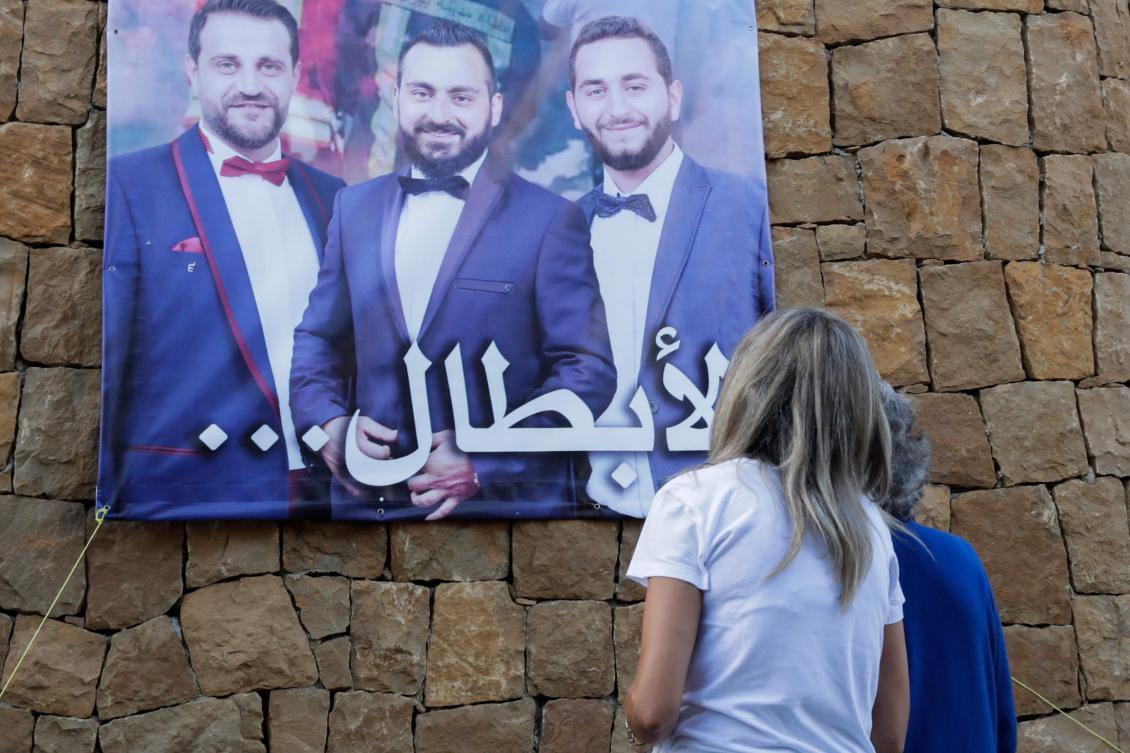
Near the entrance to their Qartaba home, the three men are praised as “heroes” in a huge banner unfurled over a wall.
The double exposure shot shows them in the foreground dressed sharply in suits.
In the background, the blast’s now-infamous pink plume rises above their heads as they try to douse a fire.
An eerie calm filled the stone-arched living room, where dozens of relatives and neighbors gathered around Rita, the mother of Najib Hitti.
The women were mum, the men whispered between themselves, the young shuffled in and out of the room, quietly.
Karlen, Rita’s daughter, looked among the most sombre, with her husband Charbel Karam, brother Najib and cousin Charbel all missing.
Sitting next to her mother on the couch, she fought back tears and did not say a single word.
The Hittis’ hopes of seeing their loved ones alive have dimmed since the army on Sunday said it had concluded search and rescue operations with little to no hope of finding survivors.
The health ministry has said the number of missing stands at less than 20, while the army announced it had lifted five corpses from beneath the rubble.
A large blaze was still ripping through the blast site when the Hittis and other relatives of port employees dashed to the disaster zone to check on their loved ones.
But they were stopped by security forces.
“I told them I would know my boys from their smell,” Rita said she told an officer who barred her from the site.
“Let me enter to search for them and when I whiff their smell I will know where they are,” the mother said she pleaded.
Ever since, her hopes have gradually dwindled, but her anger is boiling.
Lebanese authorities have pledged a swift investigation but the exact cause of the blast remains unclear.
Authorities say it was triggered by a fire of unknown origin that broke out in a port warehouse where a huge pile of highly volatile ammonium nitrate fertilizer had been left unsecured for years.
Whatever the cause of the fire was, the popular consensus is that the blame rests squarely on the shoulders of officials in charge of the port as well those who have ruled Lebanon country for decades.
“We gave them heroes and they returned them to us as ‘martyrs’,” Rita said, scoffing at the label officials have used to brand blast casualties.
“What martyrs? What were they protecting? The noxious things (authorities) were hiding in the port?” she asked rhetorically.
“They are martyrs of treachery.”
George, father of Charbel Hitti, also rushed to the blast site to look for his son and relatives after the explosion.
“I started to scream their names: Najib, Charbel… I was like a mad man,” he told AFP.
“We waited until 6 in the morning the next day for clues to what happened,” he said.
“In the end, I started crying.”
He did manage, however, to get one piece of information from a port security official close to the family who was at the scene of the blaze when the firefighting team first arrived on August 4.
The security official had told him that the firefighters were trying to break open the door to the ammonium nitrate warehouse because they could not find the keys before the explosion ripped the whole place apart.
A week has since passed and George said hopes of finding the three men alive have faded.
Assuming they are dead, George said he now wants one thing: “We just want DNA test results that are compatible with those of Charbel, Najib and Charbel,” he said.
“Imagine. This is everything we now wish for.”

Main category: 

A week on from catastrophe, Lebanon remembers Beirut victimsUN chief calls for independent inquiry into Beirut explosion


Algerian journalist who covered protests handed 3-year jail term

Author: 
Tue, 2020-08-11 02:05

ALGIERS: Algerian journalist Khaled Drareni received a three-year prison term Monday in a trial rights groups have called a test of press freedom in a country recently rocked by anti-government protests.

“It’s a very heavy verdict for Khaled Drareni. We are surprised, the case is hollow,” lawyer and president of the Algerian League for Human Rights Nouredine Benissad told AFP.
Drareni, 40, editor of the Casbah Tribune news site and correspondent for French-language channel TV5 Monde, was arrested on March 29 on charges of “inciting an unarmed gathering” and “endangering national unity” after covering demonstrations by the “Hirak” protest movement.
The Hirak protests last year swept ailing President Abdelaziz Bouteflika from power but continued afterwards, demanding the ouster of the entire state apparatus.
Weekly protests rocked Algeria for more than a year and only came to a halt in March due to the novel coronavirus crisis.
Two co-accused in the trial, Hirak protesters Samir Benlarbi and Slimane Hamitouche, were sentenced to two years’ jail each, said Benissad, a lawyer with the defense team which plans to appeal the sentences.
Press freedom watchdog Reporters Without Borders (RSF), for which Drareni also works, condemned the sentence against him as “arbitrary, absurd and violent.”
“This is clearly a judicial persecution against a journalist who is the honor of his country,” said RSF secretary-general Christophe Deloire.

FASTFACT

A gaunt-looking Khaled Drareni denied the charges when he appeared via video conference due to coronavirus measures.

The prosecutor had called for Drareni to be sentenced to four years in prison, fined and stripped of his civil rights at the opening of his trial at the Sidi M’hamed court in Algiers on August 3.
A gaunt-looking Drareni denied the charges when he appeared via video conference due to coronavirus measures.
“I just did my job as an independent journalist,” he said, according to an RSF statement, arguing he had exercised his “right to inform as a journalist and citizen.”
RSF, part of an international support committee for Drareni, had earlier said that “a prison sentence would be proof of a shift to authoritarianism” in the North African country.
The Algerian judiciary has stepped up prosecutions and convictions of journalists, Hirak activists, political opponents and bloggers in recent months.
Some journalists have been accused of sowing discord, threatening national interests and being on the payroll of “foreign parties,” with several in prison and trials under way.
In July, Ali Djamel Toubal, a correspondent for the privately owned media group Ennahar, was sentenced to 15 months in prison for, among other things, broadcasting footage showing police officers mistreating anti-regime demonstrators.

Main category: 
Tags: 

Thousands hit streets of Algiers on protest movement anniversaryNeighbours to meet in Algiers on Libya crisis