Libya’s GNA targeted by demonstrations for second day

Mon, 2020-08-24 23:10

CAIRO: Protests have resumed in Libya’s capital Tripoli against the Government of National Accord.

The demonstrations on Monday follow angry protests on Sunday against deteriorating living conditions.

Protesters in Tripoli’s Martyrs’ Square chanted for the head of the UN-backed GNA, Fayez Al-Sarraj, to stand down, Al Arabiya reported.

Earlier Monday, the UN mission to Libya called for an “immediate and thorough investigation” into the use of excessive force from pro-GNA security forces at Sunday’s protests.

Libya is divided between two rival administrations, with the GNA controlling Tripoli and the west and the House of Representatives holding sway in the east.

Main category: 
Tags: 

UN in Libya urges probe after violence at protestProtests against Libya’s GNA erupt in Tripoli over living conditions


Gaza reports first COVID-19 cases outside quarantine areas, declares lockdown

Author: 
Reuters
ID: 
1598300563497053700
Mon, 2020-08-24 20:12

GAZA: Gaza reported its first cases of COVID-19 in the general population on Monday, as authorities confirmed four infections at a refugee camp and security forces declared a full lockdown for 48 hours.
The four cases were from a single family, according to a government statement.
The closure would affect the entire Gaza Strip, according to an official from Hamas, the Islamist group that rules the territory.
Until Monday the 360 sq. km. coastal strip, which is home to two million Palestinians living in densely packed cities, towns and refugee camps, had reported no infections outside quarantine centers set up for people returning home from abroad.

Main category: 

Gaza rapper, 11, strikes chord with rhymes about war and hardshipUAE confirms 390 new coronavirus infections, 3 deaths


Houthi commanders killed during Arab coalition airstrike in north Yemen

Author: 
Mon, 2020-08-24 23:22

AL-MUKALLA: Several high-ranking Houthi military commanders were killed and numerous others injured when Arab coalition forces bombed a convoy in northern Yemen, military officials said on Monday.

Rabia Al-Qurashi, Yemeni army spokesman in Jouf province, told Arab News that militia chiefs, including Houthi minister of defense Mohammed Al-Atefi, were visiting Al-Khanjer military camp in Khab and Al-Sha’af district on Saturday when coalition warplanes struck, leaving a number of commanders dead, dozens wounded, and six vehicles destroyed.

“The fate of Houthi minister of defense is unknown. But the warplanes caused carnage among Houthi fighters,” Al-Qurashi said.

Houthi official media on Monday mourned the death of Gen. Azi Salah Mutleq Dahwa, a senior officer at the 6th Military Region, and Gen. Ruhallah Zaid Ali Musleh, a Houthi military ideologue and the son of a founding member of the Houthi movement.

Al-Qurashi said that the two commanders were killed in Jouf on Saturday and the Houthis had delayed mourning them in order to avoid undermining their fighters’ morale, predicting that the group would announce the death of other senior commanders in the coming days.

Hundreds of Houthis have been killed since early last week in fierce clashes with government forces and as a result of Saudi-led airstrikes in the provinces of Jouf, Marib, and Al-Bayda.

Despite denying suffering heavy losses, the Iran-backed Houthis have recently buried dozens of their fighters in different areas under their control in northern Yemen.

Also, in Jouf province, army troops and allied tribesmen, backed by coalition airpower, attacked Houthis in different locations east of Hazem, the capital of Jouf province.

Al-Qurashi added that loyalists liberated several areas in Al-Sabagh after killing and wounding a large number of Houthis. Local commanders said the aim of the current ground assault on the edges of Hazem was to pile military pressure on Houthis who had seized control of the strategic town.

Meanwhile, Yemen’s prime minister designate, Maeen Abdulmalik Saeed, said that all Yemeni parties had constructively engaged in continuing discussions toward the formation of a new government under the terms of the Riyadh Agreement.

According to the official Saba news agency, Saeed briefed lawmakers in Riyadh about progress on announcing a new government, stressing that the talks were also targeted at lobbying all Yemeni parties behind quick implementation of the Riyadh Agreement and supporting the return of peace and stability to Aden and other Yemeni provinces.

Also, in Riyadh, the premier on Sunday instructed the new governor of Aden, Ahmed Hamid Lamlis, and the city’s chief of security, Ahmed Mohammed Al-Hamedi, to make the revival of state bodies and the restoration of peace their top priorities, pledging his government’s full support to them.

Under the Riyadh Agreement, Aden’s governor and security chief would return to Aden as a military committee began moving military units and heavy weapons from Aden. Within a month, the PM designate will name his government and will also return to Aden.

The agreement defused tensions between the internationally recognized government and the separatist Southern Transitional Council.
 

Main category: 
Tags: 

Arab coalition destroys Houthi drone, ballistic missile launched toward Saudi Arabia OIC slams Houthi drone, missile attacks against KSA


6 dead, 10 missing as flooding hits Turkey’s Black Sea coast

Mon, 2020-08-24 00:35

ANKARA: Flooding caused by heavy rains has killed six people along Turkey’s Black Sea coast and left 10 others missing, including some rescue workers, officials said Sunday.
Television footage showed vehicles and debris being swept away by floods on the main road of the mountain town of Dereli, which lies 20 km inland from the Black Sea in Giresun province. Bridges, roads and buildings were washed away by what Agriculture and Forestry Minister Bekir Pakdemirli said was more than 5 inches of rain in less than a day.
“This is the first time I’ve seen such a natural disaster,” Pakdemirli said from Dereli. “The town’s skyline has changed.”
Interior Minister Suleyman Soylu, who traveled to Giresun to oversee rescue efforts, said 153 people had been rescued from the floods. He said 98 villages in the region were cut off and 38 were without electricity. About 20 people were stranded in a wedding hall in Dereli.
Two of the dead were police officers whose vehicle was swept away by the floods. Three of their colleagues and the operator of a mechanical digger are among the missing. Their vehicles fell into a ravine when a main road collapsed as they traveled to the disaster area.

This is the first time I’ve seen such a natural disaster … the town’s skyline has changed.

Bekir Pakdemirli, Turkish minister

Across the province, 17 buildings were destroyed and more than 360 were damaged, officials said.
Heavy rain along Turkey’s Black Sea coast on Saturday evening also saw apartment buildings evacuated after landslides in Rize province, 180 km east of Giresun.
At this time of year, the Black Sea region’s population is swollen by seasonal workers who travel to harvest tea and hazelnuts and live in flimsy camps.
Meteorologists forecast more heavy storms ahead for Giresun and the neighboring provinces of Trabzon, Rize and Artvin.
Turkish President Recep Tayyip Erdogan, speaking at an event in Istanbul, vowed to help those affected by the floods.
“As a state, we will quickly overcome the destruction and devastation here with God’s will,” Erdogan said.

Main category: 
Tags: 

Intensifying Turkish war against Kurds marks Treaty of Sevres centenaryProtests against Libya’s GNA erupt in Tripoli over living conditions


Intensifying Turkish war against Kurds marks Treaty of Sevres centenary

Author: 
Sun, 2020-08-23 22:28

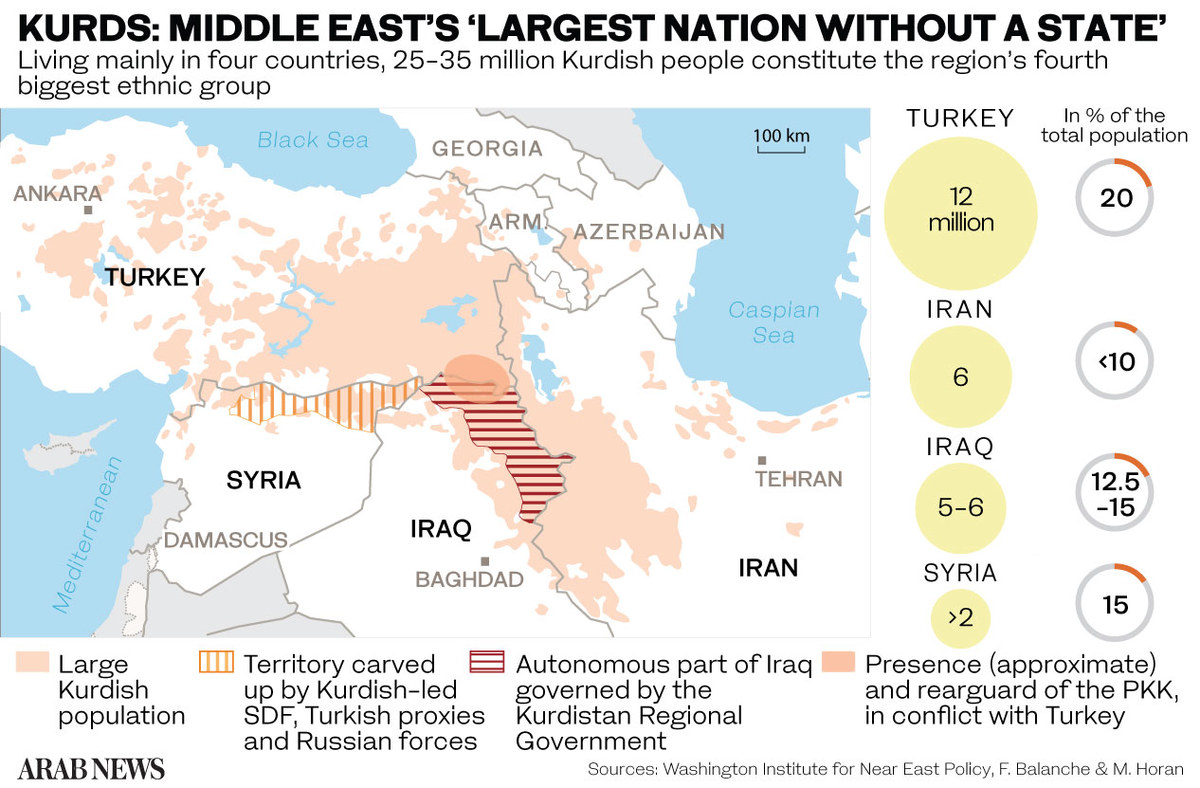
MISSOURI: As Turkey carries out almost daily attacks on impoverished Kurdish regions in neighboring Syria and Iraq, keeps its own elected ethnic Kurdish MPs indefinitely imprisoned, and coerces Iraqi Arab and Kurdish authorities to act as its local police, it is hard to remember that August marks the centenary of a pact in which provision was made for a Kurdish state.

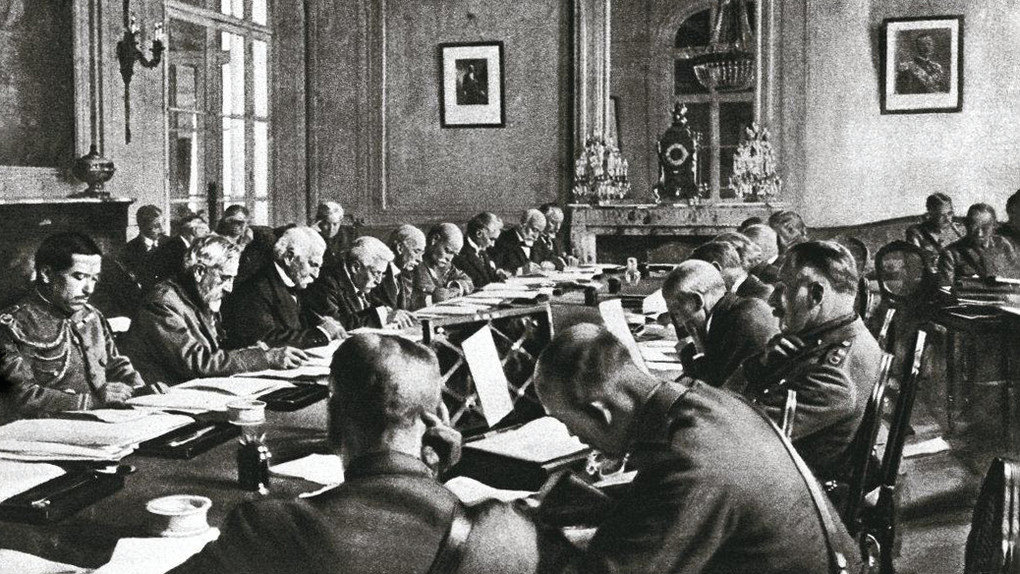
The Treaty of Sevres, signed on Aug. 10, 1920, essentially laid out the Ottoman Empire’s terms of surrender following the First World War. The treaty, which included signatories from Britain, France, Italy and the Ottoman Empire, promised religious and ethnic minorities in Turkey various safeguards to protect them and their rights.

With regard to the Kurds, the treaty stated: “If within one year from the coming into force of the present Treaty the Kurdish peoples within the areas defined in Article 62 shall address themselves to the Council of the League of Nations in such a manner as to show that a majority of the population of these areas desires independence from Turkey, and if the Council then considers that these peoples are capable of such independence and recommends that it should be granted to them, Turkey hereby agrees to execute such a recommendation, and to renounce all rights and title over these areas.” (Kurdistan Section III Article 64)

Under the leadership of Mustafa Kemal (who later came to be known as Ataturk), remnants of the Ottoman army organized military resistance to the terms of the treaty. Convinced that they were fighting to save the sultanate and caliphate, and promised recognition and self-governance in the new Turkey, most Kurdish tribes joined with Ataturk during what came to be known as Turkey’s War of Independence.
The Ataturk-led resistance to Sevres proved successful, and the treaty was replaced in 1923 by the Treaty of Lausanne.  Ataturk’s representatives in Lausanne insisted on stipulations regarding minority rights in the new treaty, however, wherein Turkey only recognized “non-Muslims” as minorities, specifically the Jewish, Greek and Armenian communities. Turkish representatives in Lausanne rejected the concept of ethnic minorities in Turkey, thereby also refusing to entertain cultural, linguistic or other minority rights for such groups.

With the loss of its holdings in Europe and Arab lands, as well as genocidal campaigns against Christians in Ottoman lands, the Kurds stood out as Turkey’s only remaining significant minority in 1923. 

The refusal of Turkish diplomats to recognize ethnic minority rights in Lausanne was thus squarely aimed at the Kurds. Their policy formed the first step in betraying earlier promises of recognition and self-governance to the Kurds who participated in Turkey’s War of Independence.

Under a Muslim sultanate and caliphate, Kurds (the large majority of whom are Sunni Muslim) could have expected an equal place. It thus made sense for Kurds to join Turks in fighting for these two institutions in 1920. But Ataturk abolished the sultanate in 1923 and the caliphate in 1924, replacing them with a secular nation-state concept imported from parts of Europe.

Taking his cue from France in particular, Ataturk then went about trying to make the Turkish state and nation completely co-terminous, meaning that only a Turkish ethnic national identity would be permitted in the new Turkey. Kurdish language, culture, music, names and any other manifestations of Kurdish identity were promptly outlawed.

The Kurds unsurprisingly revolted against the secularization and Turkification of the new state in 1925 and 1927-30. These revolts and numerous subsequent ones were all brutally suppressed. 

The 1937-38 suppression of the Kurdish revolt in Dersim (renamed Tunceli by Turkish authorities) is recognized by many as a genocide, with 10,000-30,000 killed, including civilians hiding in caves who were murdered with poison gas or burned alive by Turkish forces. 

When Kurdish unrest began manifesting itself in Turkey again in the 1960s, one right-wing Turkish nationalist periodical warned the Kurds to “remember the Armenians” — a somewhat ironic choice of rhetoric given Turkish nationalists’ refusal to admit that the Ottomans ever committed genocide against the Armenians of Anatolia, whose numbers fell from some 2 million in the Ottoman Empire on the eve of the First World War to almost nothing after 1915.

With the exception of Turkey’s 1974 intervention in Cyprus, the Turkish armed forces seemed to specialize in only one thing since the creation of the Turkish Republic: Suppressing Kurds. Apart from Cyprus and participation in the Korean War and the 1991 Desert Storm campaign in Iraq, the Turkish military’s only significant operations in the 20th century involved counterinsurgency against Kurds.

Most of the military campaigns took place in Turkey itself, but from the 1980s onward the Turkish military also frequently conducted cross-border raids into Iraq to chase after guerrillas of the Kurdistan Workers’ Party (PKK). And so it continues to this day.

Turkey’s invasion and occupation of Afrin in northern Syria in 2018 was aimed at PKK-aligned Syrian-Kurdish groups there. The October 2019 Turkish invasion and occupation of parts of northern Syria east of Afrin had the same objective.

Although no significant attacks from Kurdish forces in Syria into Turkey had occurred since the onset of the Syrian civil war in 2011, Turkey claimed a need to occupy and establish “buffer zones” in northern Syria. The Turkish invasions seriously threatened Kurdish-led operations against Daesh in Syria.

Although one might not know it from the scant media coverage, almost weekly Turkish strikes in Iraqi Kurdistan, with remarkably similar rhetoric about necessary “buffer zones,” have been ongoing for several years. The most recent series of operations (dubbed Claw-Eagle and Claw-Tiger) this year have seen Turkish ground troops deployed to the area, in addition to Turkish bases already present in Iraqi Kurdistan since the mid-1990s.

The maneuvers in the summer of 2020 also seemed to be conducted in cooperation with Iranian forces, with Turkish airstrikes against fighters of the Free Life Party of Iranian Kurdistan (PJAK), an Iranian-Kurdish party aligned with the PKK.

Recently, a Turkish drone strike killed two high-ranking officers of the Iraqi army who were meeting with PKK militants in northern Iraq after clashes between the two. Both Baghdad and Erbil, the seat of the Kurdistan Autonomous Region of Iraq, have repeatedly protested against Turkey’s violations of Iraqi sovereignty, but to little effect.

Turkey claims a right to defend itself and act against the PKK presence in Iraq or PKK-aligned Kurdish groups in Syria. If the mere presence of such groups, especially in the very mountainous and difficult-to-control territory along the border, justifies invasions and occupations of Arab territories, a similar logic could in theory be used by Israel or the US to target Palestinian Hamas leaders hosted in Ankara and Istanbul today, to say nothing of Arab countries whose Islamist critics have extensive propaganda campaigns operating from Turkish soil.

The official Turkish approach of the last 100 years seems rather like a policy of opposing Kurdish self-government “even if it’s in Alaska,” as a popular Turkish joke goes. When Turkey invaded northern Syria in 2018 and 2019, one justification offered by Turkish leaders was that they did not want “to see Syria become another northern Iraq.” By this, they meant Kurdish autonomy in Iraq, of course.

One-hundred years after the Treaty of Sevres, it looks like “le plus ça change, le plus c’est pareil.”


David Romano is Thomas G. Strong Professor of Middle East Politics at Missouri State University.

Main category: 

Turkish strikes kill three Kurds in IraqTurkey’s Kurds demand spending probe, end to military ops in Libya, Syria