UNIFIL urges Israeli, Lebanese ‘restraint’

Wed, 2020-08-26 23:01

BEIRUT: Maj. Gen. Stefano Del Col, head of mission and commander of the UN Interim Force in Lebanon (UNIFIL), on Wednesday urged Israeli and Lebanese parties “to exercise restraint and avoid any provocative act that would further escalate tensions and endanger the cessation of hostilities.”

Israeli Prime Minister Benjamin Netanyahu threatened Lebanon hours after Israeli forces fired dozens of fluorescent and phosphorous bombs at Lebanese border towns, causing fires but no human casualties.

Netanyahu warned Hezbollah “not to test the striking force of Israel.” He added: “Hezbollah exposes the Lebanese state to danger because of its aggression.”

Lebanon decided to submit a complaint to the UN Security Council (UNSC) regarding Israel’s attack.

It took place 48 hours before the UNSC approved the renewal of UNIFIL’s mandate, which expires on Aug. 31, for one year.

In 2017, Israel sent a complaint to the UNSC, accusing Hezbollah of “establishing observation posts along the southern Lebanese border under the guise of an environmental organization.”

The Lebanese Supreme Defense Council, headed by President Michel Aoun, met hours after the attack. The council was briefed on the details of what happened on the border.

UNIFIL spokesman Andrea Tenenti said it “detected the launch of many flare bombs from Israeli army positions along the Blue Line in front of the towns of Aitaroun, Aita Al-Shaab, ​​Mays Al-Jabal, Hula, Kafr Kila and Kafr Shuba in southern Lebanon. UNIFIL’s radars also detected mortar and artillery shells, most of which were smoke shells, in addition to intense drone activities over these areas.”

He added that UNIFIL “immediately … reinforced its forces along the Blue Line,” the UN border demarcation between the two countries.  

Tenenti said Del Col stressed the importance of “investigating all the facts and circumstances surrounding the dangerous developments that took place … along the Blue Line.” Both sides were urged “to fully cooperate with UNIFIL in determining the facts.”

Netanyahu tweeted that “Israel views with great gravity Hezbollah’s firing at our forces,” adding: “We will respond mightily to any attack on us.”

Israeli military spokesman Avichay Adraee said: “Military helicopters and another aircraft attacked targets belonging to Hezbollah … in the border area.” He added: “The Lebanese government is responsible for what is happening from its territory.”

Hours after the attack, Walid Sukkarieh, an MP with Hezbollah’s parliamentary bloc and a former officer in the Lebanese Army, said: “The resistance will not slide into war, because Israel will not slide into war, nor will the resistance seek war.”

Meanwhile, Lebanon’s General Directorate of the Internal Security Forces announced “the arrest of a Syrian youth belonging to Daesh who was planning to carry out terrorist operations in Lebanon.”

Main category: 

Israel strikes Hezbollah after gunfire on Lebanon borderUK envoy blames Hezbollah behavior for undermining peace in Lebanon


UK envoy blames Hezbollah behavior for undermining peace in Lebanon

Wed, 2020-08-26 22:41

CAIRO: The British ambassador to Lebanon said Wednesday that the behavior of some parties, including that of Hezbollah, undermines peace in Lebanon. 
The remarks by Chris Rampling came during his meeting with Mar Bishara Boutros Al-Rai, the Lebanese patriarch of the Maronite Catholic church.  
Rampling said he discussed the political solution proposed by Al-Rai for Lebanon, which aims to maintain the country’s characteristics of pluralism, openness, and democracy.
“I discussed with his eminence the neutrality initiative that he launched and its content, which it is clear that some parties, including Hezbollah, did not support, and this undermines the stability of Lebanon.”
The ambassador also described his meeting with the Al-Rai as “very important.” 
“We talked about the Beirut bombing, and I expressed my condolences to his eminence and the Lebanese people,” he was quoted by Lebanon’s state news agency as saying. 
“We talked about the difficult economic situation, the difficulties that Lebanon and the Lebanese are facing, the necessity for reforms at this delicate stage.”

Main category: 

Lebanon defense council denounces ‘Israeli assault’ at borderIsrael strikes Hezbollah after gunfire on Lebanon border


Campaign launched to fight dengue fever in Aden

Author: 
Thu, 2020-08-27 02:28

ADEN: A campaign to fight dengue fever in Aden has been launched by the King Salman Humanitarian Aid and Relief Center (KSRelief) in cooperation with the Al-Awn Foundation. The spraying campaign is being carried out in the city’s Buraiqa district. It will last five months and benefit more than 860,000 people.
Fahd Al-Alawi, director of the Ministry of Health’s office in Buraiqa, praised the center’s efforts and its fast response in going to targeted areas after dengue fever cases emerged in Ras Imran.
KSRelief launched an emergency response project in July to combat dengue fever. Spraying campaigns, as well as the removal of stagnant water and wetlands, are to be carried out in all of Aden’s directorates to get rid of mosquitoes.
The center has also distributed 4,500 cartons of dates to displaced and affected people from Al-Jawf to Marib governorates, benefiting 4,500 families, and distributed 920 cartons of dates in Al-Dhale governorate, benefiting 920 families.
In Hodeidah governorate, KSRelief distributed 1,494 cartons of dates to displaced and affected people, benefiting 1,494 families.
The center also continues to provide medical assistance to Syrian refugees in the Zaatari camp in Jordan.

Main category: 
Tags: 

Yemen, Djibouti talk protection of Bab al-Mandab strait, Red SeaUK ambassador to Yemen urges Houthis to cease Marib operations, take UN envoy ‘seriously’


Hamas-Israel talks failure ‘threatens escalation of border confrontations’

Author: 
Wed, 2020-08-26 01:50

GAZA CITY: The continued standoff between Hamas and Israel and the failure of international mediation attempts to bring the two sides together threatened a further escalation of border confrontations, officials warned on Tuesday.

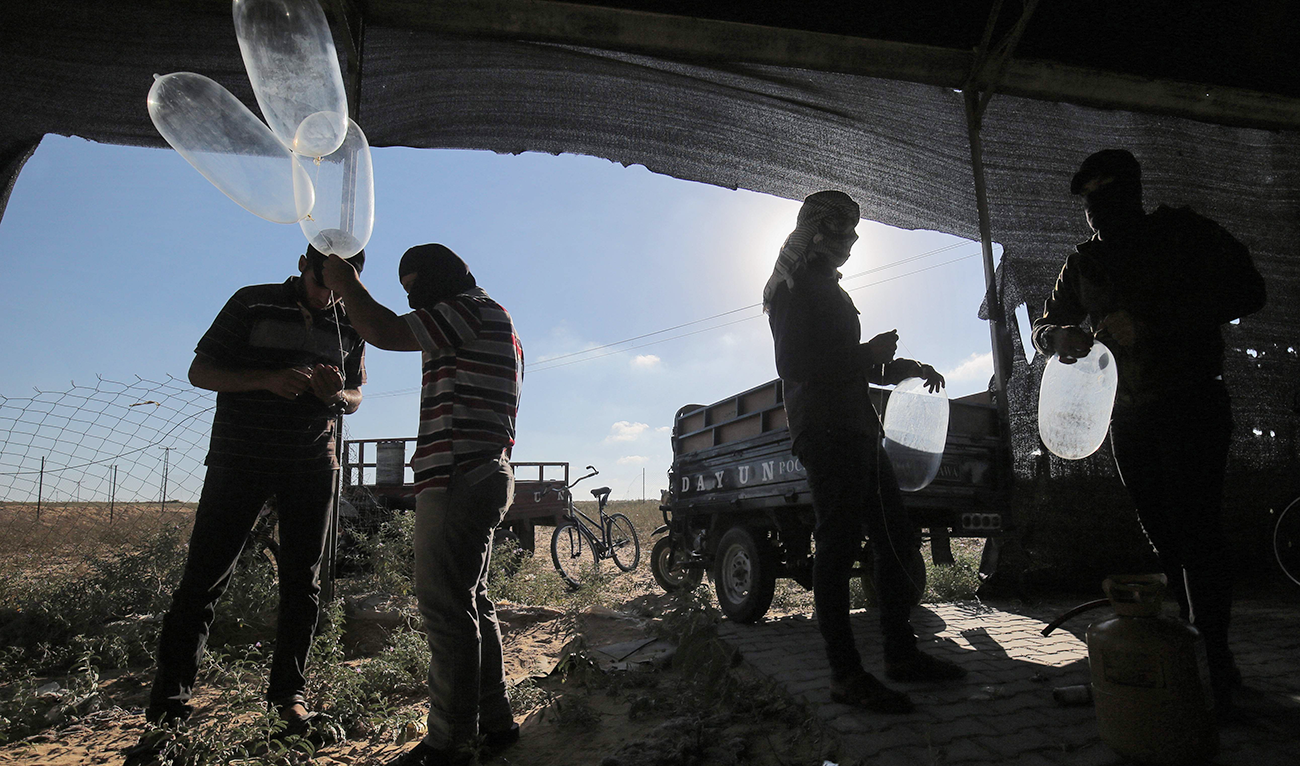
Israeli airstrikes on the Gaza Strip, and the launch of incendiary balloons and rockets from Gaza targeting Israeli communities adjacent to the border, have intensified in recent days despite ongoing efforts by Egypt, Qatar, and the UN to calm tensions.

With no sign of an imminent breakthrough in negotiations, activists are now believed to be planning a resumption of popular border protests.

A source on the Great Return March committee told Arab News that members were discussing options for a return to public activities on the border if Israel continued to flout its obligations toward “truce understandings.”

Late last year, the committee decided to limit its activities to national events before completely suspending action at the beginning of this year due to the coronavirus disease (COVID-19) pandemic.

Hamas official Ismail Radwan said that international mediation attempts, although continuing, faced severe difficulties due to what he described as Israeli intransigence.

An Egyptian-led security delegation which visited Gaza and Israel last week, conveyed messages exchanged between the two parties but returned to Cairo without securing an agreement.

A Palestinian source told Arab News that Israel had refused to positively deal with demands relayed by the Egyptian delegation after meeting with Hamas leaders in Gaza and had threatened to broaden the scope of its response.

On Tuesday, Israel strengthened its military presence along the eastern border of Gaza with Israeli media reporting that army plans had been drawn up to combat various scenarios regarding security tensions in Gaza.

Radwan said: “The threats of the occupation will not frighten us, and we will break the unjust siege with all our strength. “The resistance is ready to move forward to the farthest extent, and it is no longer possible to remain silent on the catastrophic situation in Gaza because of the blockade.”

Israel moved on Sunday to block all goods from entering the enclave through Kerem Shalom, the only commercial crossing, with the exception of food and medical supplies.

For more than a week, Israel has stopped fishing crews from heading out to sea, and it has also prevented the supply of building materials and fuel which has caused the only power station in Gaza to stop operating and electricity output to be cut off for around 20 hours a day.

Hamas has demanded that Israel stick to stated understandings reached last year under Egyptian and international auspices.

However, experts believe that Israeli Prime Minister Benjamin Netanyahu could be engineering the Gaza situation to detract attention from internal calls for his dismissal and trial on corruption charges.

Ron Ben-Yishai, military analyst for the Israeli newspaper Yediot Aharonot, said the recent exchange of threats were unlikely to result in a major confrontation in Gaza.

He questioned the seriousness of sabre rattling by Israel, attributing this to what he called “the convictions in Hamas, that Israel will not rush into a comprehensive confrontation in light of the worsening of the COVID-19 crisis and its economic and political repercussions, the fragility of the government coalition, and the possibility of heading to fourth elections in the near future.”

The military correspondent for the Israeli Walla website, Amir Bukhbout, said the Israeli army was preparing for a scenario of comprehensive escalation but could not “exclude the possibility of deterring Hamas by returning to the policy of assassinations,” despite factions warning that such action would lead to rocket attacks on Tel Aviv.

Bukhbout claimed the negotiations conducted by Egyptian intelligence between Hamas and Israel had stalled due to each party’s adherence to its position and the lack of any concessions.

Husam Al-Dajani, professor of political science at Al-Ummah University, told Arab News that both sides had more important priorities than open confrontation.

Main category: 
Tags: 

Israel bombs Gaza militants in response to fire balloonsPalestinians slam Israel for using tear gas to break up Jerusalem fight


Nightlife in ruins: Beirut blast pummels industry, destroys businesses

Author: 
Wed, 2020-08-26 01:41

BEIRUT: A cozy Beirut restaurant, Tenno once hosted a dog’s birthday party, vinyl record nights and stand-up comedians.

Those days are gone. Its doors collapsed and glass shattered in the port blast this month that killed at least 180 people and turned one of Beirut’s most popular pub streets into a disaster zone.

“We plan to rebuild … we owe it to ourselves to not let things end this way,” said Mohamed Soliman, 28, one of the owners of the cafe which opened around 2 years ago. Money for repairs has poured in through online crowdfunding.

Many others will not rebuild, however, because it no longer makes sense to invest in a country where years of work can vanish in seconds.

“We’ve been saying we’re all on the verge. I don’t know how we made it this far. We’re not going to last,” said Maya Bekhazi of the union of nightclub, cafe and restaurant owners.

It is a tired cliché that the nightlife in Beirut — billed worldwide as a party destination — stands as proof of the capital’s ability to endure one crisis after another.

So much so that Lebanese have made a joke of their fabled resilience which has portrayed them partying through wars and assassinations, when behind the glitz the reality is much grimmer.

The past year, including Lebanon’s financial meltdown and the COVID-19 pandemic, has battered the service industry, a pillar of an economy that produces little. The August warehouse explosion left over 2,000 premises in tatters, putting tens of thousands more jobs at risk in a country with soaring unemployment and poverty.

The restaurant sector alone will cost at least $1 billion to reconstruct, Bekhazi estimates.

Even before the blast, hundreds of venues had shuttered with mass layoffs in an industry that employs a big chunk of Lebanon’s workforce.

In response to a question about what the state has done, Bekhazi laughs. “Nobody cares.” With low-wage workers hit hardest, she said, the union will help provide meals for employees for a month.

Beirut’s nightlife has long attracted investor money and performers from abroad, spawning images of extravagant soirees in ranking lists around the world.

Since last year, a currency crash has eroded the purchasing power of Lebanese, including among the middle class that most of these businesses cater to. Costs skyrocketed and suppliers demanded cash as dollars grew scarce.

The owners of Cafe Em Nazih, who also run a hostel and rooftop bar, do not plan on rebuilding now.

“To start from scratch, without any trust in the state, will be a loss. We could invest again and get hit by another 20 explosions,” said manager Nazih Dirani, who suffered a dislocated shoulder when the blast ripped through the cafe. “This place is my life. I know where every screw is.”

On social media, Lebanese posted videos of bloodied faces emerging from behind bar counters. Some spoke of a sense of loss in a city with few public spaces.

For Jade, founder of the entertainment group Factory People, the focus now is on keeping his 170 employees. The blast reduced one of its clubs to a pile of twisted metal. It cost nearly $2.5 million to launch and will need millions more to fix up.

“We kept investing despite it all,” the DJ said. “But now it’s like we’re in the middle of the battlefield and we ran out of ammunition.”

Main category: 

Explosion heard north of Beirut, triggering panic among residentsLebanon judge issues two new arrest warrants over Beirut blast