From September, everyone arriving in Egypt must present negative COVID certificate
Author:
Fri, 2020-08-28 00:42
CAIRO: In mid-August, Egypt’s Ministry of Civil Aviation implemented a ruling that all foreign nationals arriving at Egyptian airports must present a negative PCR analysis taken no more than 72 hours before their arrival.
Since that time, sources at Cairo International Airport told Arab News that they have turned away 25 passengers for failing to present proof of having tested negative for novel coronavirus (COVID-19).
Earlier this week, the Egyptian government announced that, from Sept. 1, Egyptian nationals returning to the country will also be required to present the same documentation upon arrival.
The Civil Aviation Authority has sent a message to all airlines operating in Egypt outlining the new rules. Only children under the age of six are not required to present the PCR test certificate.
According to the sources, any passenger arriving without the required documentation will be deported immediately on the same plane, and legal action will be instigated against the airline that allowed the passenger to board its plane without the necessary certificate.
The negative PCR analysis is just one of the steps those arriving at Cairo Airport must undergo in order to enter Egypt, the sources said.
Smart thermal cameras inside the arrival halls also scan everyone’s temperature and anyone suspected of having COVID-19 is examined by the airport’s medical staff, led by Dr. Hazem Hussein, director of quarantine at the Cairo airport.
Optimism in Egypt despite strict virus protocolsEgypt arrests suspect in 2014 hotel gang rape case
UN official: COVID-19 cases likely far higher than Syria says
Author:
By EDITH M. LEDERER | AP
ID:
1598556801548772800
Thu, 2020-08-27 19:29
UNITED NATIONS: Reports of Syrian health care facilities filling up and increasing death notices and burials appear to indicate that actual coronavirus cases in the war-torn country “far exceed official figures” confirmed by the government, a senior UN humanitarian official said Thursday.
Syria has so far reported more than 2,500 cases of COVID-19, the illness caused by the virus, including 100 deaths.
However, UN Assistant Secretary-General for humanitarian affairs Ramesh Rajasingham told the UN Security Council that “rising patient numbers are adding pressure to the fragile health system” in Syria, now in its 10th year of war.
Many people “are reluctant to seek care at medical facilities, leading to more severe complications when they do arrive,” he said, adding that “health workers still lack sufficient personal protective equipment and associated supplies.”
Of the virus cases confirmed by the Syrian Ministry of Health, Rajasingham said, “the majority cannot be traced to a known source.” He said several health facilities briefly suspended operations this month because of capacity issues and staff becoming infected by the coronavirus.
In the Al Hol camp in northeast Syria, where 65,000 mainly women and children connected to Daesh fighters are detained, Rajasingham said “12 health facilities had to suspend operations this month due to staff becoming infected, having to self-isolate, or due to lack of personal protective equipment.”
“Both field hospitals at the camp have since resumed operations,” he said.
Germany and Belgium, who are in charge of Syrian humanitarian issues in the Security Council, said in a joint statement that “the spread of COVID-19 across the country is increasing exponentially.”
“Testing capacities remain very low, so most cases may go unnoticed,” they said. “Numbers we hear may only represent the tip of the iceberg.”
They also warned that “the destruction of health facilities and the shortage of health workers dramatically imperil any response.”
Germany and Belgium urged greater humanitarian access, sharply criticizing demands by Syrian ally Russia that led to the closing of the Al Yaroubiya crossing from Iraq to northeast Syria in January and last month’s closing of the Bab Al-Salam crossing point from Turkey to northwest Syria.
“What is needed is distribution to all people and health care facilities – and not the regime deciding who is ‘worthy of receiving aid’ and who is not,” they said. “The burden of responsibility lies on those countries that have systematically limited humanitarian access” to Syria.
US political coordinator Rodney Hunter expressed concern at reports of “a massive coronavirus outbreak in the Damascus region and elsewhere in regime-controlled areas.”
He called on Syrian authorities to grant access to the UN and international organizations to collect statistics and determine the scale of the pandemic in the country, saying so far there has been “no transparency” by the government.
“The coronavirus is absolutely exacerbating the Syrian humanitarian crisis,” he said.
Hunter said the United States is “deeply saddened” by reports from the UN children’s agency UNICEF earlier this month that eight children under the age of five died in the Al Hol camp in less than a week.
“We understand that four of those deaths were caused by malnutrition-related complications,” he said.
“These deaths were completely preventable if the thousands of camp inhabitants still received the life-saving combination” of deliveries from Damascus across conflict lines and from Iraq through the Al Yaroubiya crossing, Hunter said.
Russia’s UN Ambassador Vassily Nebenzia expressed confidence that once logistics were “adjusted,” the UN would be able to increase supplies through the one remaining border crossing from Turkey at Bab Al-Hawa.
He pointed to a recent article in the British medical journal, “The Lancet,” which said that the “Syrian health system, already fractured by years of conflict, is being further destroyed by sanctions.”
Entitled “EU guidance impedes humanitarian action to prevent COVID-19 in Syria,” it says: “Widespread cooperation to ensure efficient delivery of medicines and equipment to combat COVID-19 in Syria is lacking.”
Nebenzia also pointed to an Aug. 25 statement by three key foreign powers in the Syrian conflict — Iran and Russia, which support Syrian President Bashar Assad, and Turkey, which backs the opposition — on the sidelines of a meeting in Geneva of government and opposition figures on drafting a new constitution for the country.
Those three countries rejected all unilateral sanctions, Nebenzia said.
He denounced the “hypocrisy” and “double standards” of Security Council members that continue to support sanctions against Syria.
UN Syria talks resume after virus cases forced suspensionThree with COVID-19, Syria constitution talks ‘on hold’: UN envoy
Aden’s new governor returns to city
Author:
Thu, 2020-08-27 22:01
Al-Mukalla: Aden’s new governor, Ahmed Lamlis, has urged political parties and people in Yemen’s port city of Aden to set their differences aside and focus their efforts on helping him to revive state bodies and fix services in the city.
Shortly after arriving in Aden on Thursday, Lamlis told reporters that he would work as hard as he could to address the city’s thorny issues such as insecurity and crumbling services.
“We came to Aden to work with love and loyalty for our beloved capital, Aden. We have support from the Saudi reconstruction fund and the (Yemeni) government,” the governor said.
Under a power-sharing deal, known as the Riyadh Agreement, Yemen’s president Abed Rabbo Mansour Hadi last month appointed Lamlas, who is also the secretary general of pro-independence southern Transitional Council (STC), governor of Aden.
Aden, the second most important city in Yemen and the country’s interim capital, has become the scene of several rounds of conflicts between the internationally recognized government and the STC since early 2018. Separatists seized control of Aden, expelled the government and in June declared self-rule in the southern provinces.
Aden was declared a disaster area in June after heavy rainstorms destroyed the city, disrupting water and electricity services. In May, the government declared the city an infested area after coronavirus spread rapidly across the city, claiming the lives of dozens of people. Due to crumbling health services, COVID-19 and other diseases claimed the lives of more than 1,800 people in May, according to official figures.
Voicing their optimism about the arrival of the new governor, residents and Aden-based analysts called upon Lamlis to urgently unify military units under his command, bring back electricity and water services and restore state institutions. “The new governor is facing many serious challenges. The biggest one is the state of services, including the long power cuts,” Yasser Al-Yafae, a political analyst, told Arab News from Aden.
He said that for the new governor for succeed, he has to build harmony, restore trust between the STC and the internationally recognized government and address the teachers’ strike that has paralyzed education in the city for several months. “He will not be able to solve these problems if there is no coordination between him and the government,” Al-Yafae said.
In Riyadh, several foreign diplomats held meetings with the STC leaders, focusing on their reasons for suspending their participation in Riyadh Agreement talks. STC official media said on Thursday that its president, Aidarous Al-Zubaidi, held a virtual meeting the British Ambassador to Yemen Michael Aron and also met in person Dya-Eddine Bamakhrama, the ambassador of Djibouti to the Kingdom of Saudi Arabia. “They came to listen to our point of view and the reasons that prompted us to suspend our participation in the consultations,” Ali Al-Katheri, a senior STC member who attended the meetings, said.
The council would come back to the talks when the government halts military escalation in Abyan, pays salaries and addresses the plunge of the currency, he said.
The Djiboutian ambassador to Saudi Arabia said on Twitter that he met STC leaders to express his president’s full support for the Riyadh Agreement and for Saudi Arabia’s efforts to bring back peace and stability to Yemen.
Campaign launched to fight dengue fever in AdenSaudi committee in Aden to oversee forces withdrawal
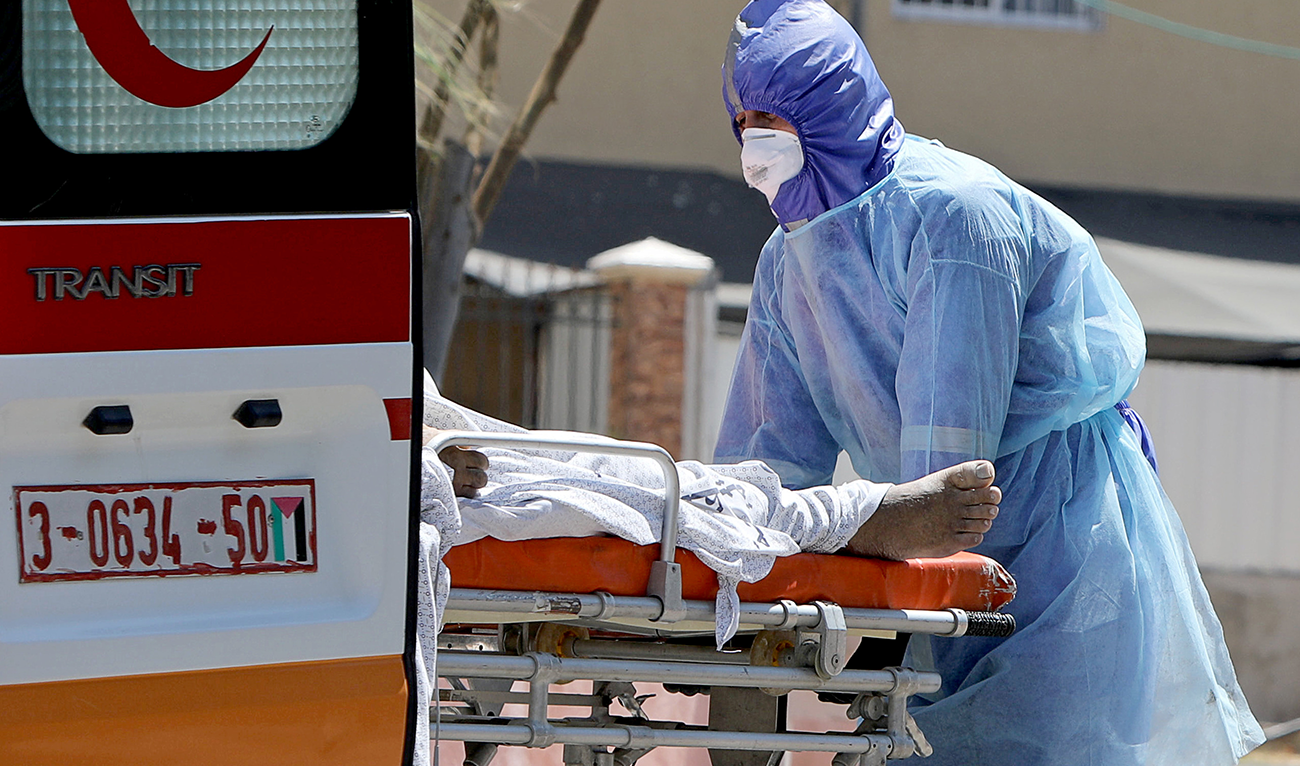
Gaza man dies of coronavirus as enclave clamps down on outbreak
Thu, 2020-08-27 01:38
GAZA: A 61-year-old man has died in the Gaza Strip after contracting the coronavirus, Palestinian authorities said on Wednesday as they clamped down on an outbreak of the pandemic in the enclave.
The man had suffered previous illnesses and had been on a respirator, the Health Ministry said. It was the first death among the general population since an infected woman died at a quarantine center in March.
Health officials said nine more cases were discovered on Wednesday. Six of them were in the isolated Maghazi refugee camp where a first four cases had been confirmed on Monday, prompting Gaza’s Hamas authorities to impose a full lockdown.
The three other cases were in northern Gaza Strip, indicating the virus has begun to spread into different areas of the enclave of 2 million people.
The outbreak outside Maghazi remains slow but it cemented concerns by local and international health organizations over the territory’s potentially disastrous combination of poverty, densely populated refugee camps and limited hospital capacity.
With local authorities maintaining a lockdown in all cities, people were instructed to stay home at all times and to wear face masks if, in cases of extreme necessity, they had to go out.
The United Nations Relief and Works Agency UNRWA, which helps over half of Gaza’s population, said it was looking into alternative plans to continue health, education and food services to beneficiaries should the lockdown be extended.
Adnan Abu Hasna, UNRWA spokesman in Gaza, said clinics remained open but physical presence was prohibited, instead staffers were providing medical consultation over the phone and some medication was delivered to patients at home.
“We are in constant consultation with the Health Ministry and we are also in discussion over the implementation of our own alternative plans in order to ensure the continuation of delivering services to refugees,” Abu Hasna said.
Monday’s cases were uncovered after a woman traveled to the Israeli-occupied West Bank, where she tested positive, the Gaza Health Ministry said. A ministry spokesman urged everyone who might have visited a supermarket outside a hospital in central Gaza to quarantine themselves and report to medics immediately.
Gaza reports first COVID-19 cases outside quarantine areas, declares lockdownIsrael bombs Gaza militants in response to fire balloons
A free supermarket offers dignity to Lebanon’s most vulnerable
Wed, 2020-08-26 23:05
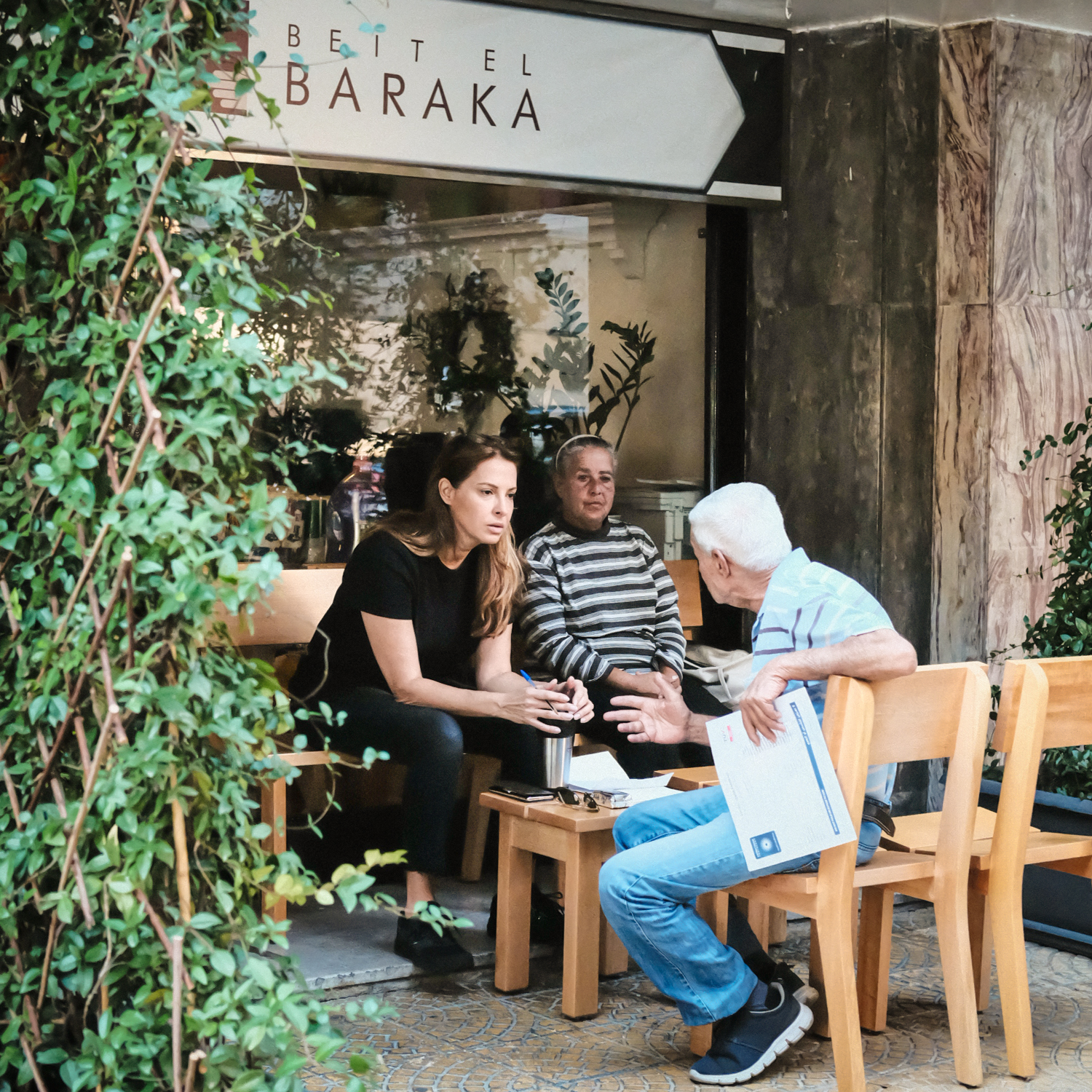
DUBAI: Beit El Baraka, which means “house of blessings” in Arabic, is a nonprofit organization in Beirut that is living up to its name in a time of crisis.
It was launched by Maya Chams Ibrahimchah last year to offer a helping hand to elderly and retired people abandoned by the state. More recently, it has been providing a lifeline to cash-strapped families struggling to survive amid Lebanon’s economic collapse.
Beit El Baraka chiefly operates through its free supermarket in the capital’s Karm El-Zeitoun neighborhood. The store provides a friendly and accessible environment for the 1,012 people it serves each day. The August 4 explosions in Beirut, while causing temporary disruptions, having not dimmed the spirit of altruism of the NGO’s founder.
“Two factors are important to us: dignity and security,” said Ibrahimchah, a graduate of the American University of Beirut. “When someone visits us, it’s like entering a person’s home. Usually, a home is a place where you feel safe. Your family is supposed to treat you with kindness, respect you as a citizen with rights, and support you.”
A communications expert and heritage-preservation activist, Ibrahimchah said the decision to set up a charitable organization was sparked by distressing daily encounters with poverty resulting from failing, bankrupt government institutions caught in a perfect storm of crises.
She recalled the day she decided to do something. She met a women who had worked as a French teacher for 40 years, who had lost her home and was sitting in the street surrounded by her few remaining possessions: some suitcases and boxes of books.
“How can someone so educated just end up on the streets?” asked Ibrahimchah. After finding shelter for the woman, she and the teacher spent time together and began to research Lebanese retirement laws and pension plans. They were dismayed to discover how little retirees receive as end-of-service benefits after many years of hard work.
An International Monetary Fund report published in 2016 found Lebanon to be the only country in the Middle East and North Africa region that lacks a social security system for retirees from the private sector, who lose their benefits and health coverage when their service ends.
The country also has the highest percentage of people still working past the age of 65 to pay their bills as the cost of living keeps rising.
Another incident that left its mark on Ibrahimchah was a visit to an apartment where a couple lived by candlelight in the evenings because they had been without electricity for eight years.
“These are things that you’re not supposed to see in the 21st century,” she said. “It’s not just shameful, it shows a lack of dignity from our leaders.
“The Lebanese people are educated, cultured and known for their resilience — they fall and rise again. We have 5,000 years of history in Lebanon and we’re one of the oldest countries in the world. How can a country that has endured so much and become all that it’s become be reduced to this level of misery?”
A woman on a mission, Ibrahimchah opened Beit El Baraka’s free supermarket in February 2019. It works on a system based on points rather than money: younger retirees are encouraged to work with Beit El Baraka, interacting with others and gaining points by cooking, delivering food to the older beneficiaries, and offering assistance in their homes.
THENUMBERS
Lebanon’s economic crisis
– 190% rise in food costs in May compared with a year earlier.
– 172% increase in clothing costs during the same period.
– 80% loss in value of the Lebanese pound in recent weeks.
“In this way we are building a community where people work,” Ibrahimchah said. “We’re trying to change the perception of poverty. The people that come to our shop look like you and me. They are not poor, they have been impoverished, which are two very different concepts.”
Many elderly people in Lebanon have been neglected, leading some to attempt suicide, a problem that Ibrahimchah said is as “taboo” in Lebanese society.
“We were able to find a lot of them and we resolved their issues,” she said. “It was very simple; they just needed to feel that their lives mattered. So, we make them work, no matter how old they are. They wake up in the morning with so much happiness because they have a task to do and other people to help.”
Thanks to contracts with some of Lebanon’s biggest corporations, the shelves of Beit El Baraka’s supermarket remain stocked with a wide range of food and products.
“What was important for me was that people have freedom of choice,” said Ibrahimchah, explaining the idea behind the store. “When you tell someone to choose what they want, you’re giving them freedom, which means you’re giving them dignity.”
The environmentally friendly store does not use plastic bags; instead shoppers are given a large, reusable jute bag. They can choose from bread, eggs, rice, dairy products, canned food, cooking oil, locally grown fruit and vegetables, meat, poultry and household products, including sanitary items for women. Select chocolates and gluten-free foods are also available.
Although the supermarket was forced to close during the coronavirus lockdown, Beit El Baraka’s volunteers ensured its beneficiaries did not go without. In partnership with the Lebanese Food Bank, they delivered boxes and bags packed with food and other items to the homes of clients. Face masks and hand sanitizers were also supplied.
As the economic crisis wreaks havoc on the lives of many in Lebanon, Ibrahimchah is focusing on helping the families in greatest need. In addition to operating the supermarket, Beit El Baraka’s team also refurbishes homes and provides replacement furniture, and arranges medical treatment for people suffering from cancer, diabetes, osteoporosis and other conditions.
Beit El Baraka has expanded its operations in response to the sharp increase in demand for emergency assistance in the wake of the Beirut blast. Volunteers have set up a relief center in the capital and fanned out to different neighborhoods. Among its targets are raising $3 million in donations and rehabilitation of more than 3,000 destroyed homes and shops.
Beit El Baraka chiefly operates through its free supermarket in Beirut’s Karm El-Zeitoun neighborhood. (Supplied)
For a relatively young organization, Beit El Baraka’s achievements are impressive: 55 homes refurbished, 356 patients treated, 93 rents paid, 128 water and electricity bills paid. This has been done with the help of 25,712 donors and 212 young volunteers. The charity has also been endorsed by Google, Benevity and the Bill & Melissa Gates Foundation.
Agriculture is at the heart of Beit El Baraka’s undertakings. Ibrahimchah said that local crop cultivation falls far below its full potential in Lebanon. The country’s soil is fertile and 64 percent of land is arable, yet studies show that agriculture contributes only 5 percent of the country’s GDP, and more than 80 percent of food and beverages are imported.
Ibrahimchah said that a “miracle” happened when a woman donated more than 250,000 square meters of land to Beit El Baraka. It is now being used as a sheep and chicken farm, producing dairy products, poultry meat and eggs that are stocked by the supermarket. Thanks to additional generous donations, the organization has been gifted more land on which to grow a wide variety of fruits and vegetables.
Beit El Baraka was launched by Maya Chams Ibrahimchah last year to offer a helping hand to elderly and retired people abandoned by the state. (Supplied)
All of Beit El Baraka’s activities are funded by donations from businesses and individuals around the world. As the organization grows and helps more people, it encounters a “vicious circle” of funding, said Ibrahimchah
“The more demand you have, the more you need funds,” she said. “The more funds you get, the greater the demand becomes. It’s important to highlight the fact that NGOs that are growing are not just growing financially; they’re growing in terms of need too.”
The work of Beit El Baraka has touched the lives of 180,000 people in 62 parts of Lebanon so far. Despite the crippling economic crisis in the country, Ibrahimchah remains hopeful for the future of her people and, most of all, grateful for the meaningful friendships she has formed in the past two years.
“The retirees that we help are our blessing,” she said. “They have changed our lives and give us so much happiness. Today, I have 100,000 new friends and they have wonderful stories. You listen to them and they take you back to a time when Lebanon was the Lebanon that I wish I knew.”
Canadian foreign minister in Beirut to show solidarityNightlife in ruins: Beirut blast pummels industry, destroys businessesItaly defense minister to visit Beirut with aidBritish music teacher to walk London Underground route to raise money for Beirut