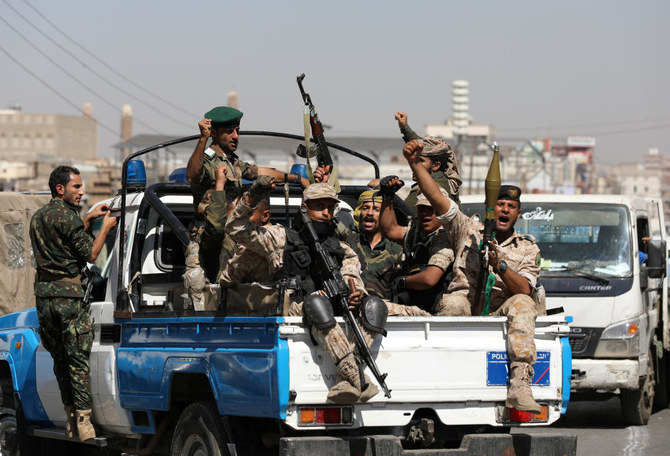
Coalition forces in Yemen foil Houthi boatbomb attack 

Author: 
Mon, 2020-08-31 00:31

RIYADH: Saudi-led coalition forces in Yemen intercepted and destroyed a remote-controlled boat rigged with explosives in Hodeidah governorate on Sunday, the alliance’s joint command said.

In a statement carried by the Saudi Press Agency (SPA), the coalition said the bomb-laden boat was launched by the Iran-backed Houthi “terrorist” militia.

The boat was destroyed before it could do any damage, coalition spokesman Col. Turki Al-Maliki said in the statement without giving details.

Al-Maliki said the Houthi militia “is using Hodeidah governorate as a place to launch ballistic missiles, drones, and explosive and remotely piloted boats, as well as the random deployment of marine mines, in a clear and explicit violation of international humanitarian law, as well as a violation of the provisions of the Stockholm ceasefire agreement in Hodeidah.”

Earlier on Sunday, the coalition said Saudi air defense forces shot down an armed drone launched by the Houthis toward Abha airport in southern Saudi Arabia.

Although some shrapnel fell on the airport as the drone was destroyed, no injuries were reported, Al-Maliki said. 

Main category: 

Arab coalition intercepts Houthi drone targeting Saudi ArabiaHouthis in constant violation of de-escalation deals, Yemeni speaker says


Lebanon president admits need to ‘change the system’

Author: 
Hashem Osseiran | AFP
ID: 
1598817901930279000
Sun, 2020-08-30 19:44

BEIRUT: Lebanese President Michel Aoun on Sunday acknowledged a need to “change the system” and called for the proclamation of a secular state on the eve of a visit by his French counterpart.
“Lebanon’s youth are calling for change,” the 85-year-old Aoun said in an address that was interspersed with footage from last year’s anti-government protests.
“Yes, there is a need to develop, modify, change the system… Call it the way you like, but Lebanon most definitely needs to be running its affairs in a new way,” he added.
Aoun offered few details but called “for the proclamation of Lebanon as a secular state” and a dialogue that could lead to constitutional amendments.
The main framework of Lebanon’s current mode of governance is the 1989 Taif accords.
They led to the end of the 1975-1990 civil war but have since become a by-word for the kind of sectarian-based politics that many want to get rid of.
Aoun’s political ally Hezbollah chief Hassan Nasrallah also said in an earlier address he was open to Emmanuel Macron’s proposal for a new political pact in Lebanon.
Meanwhile, the country’s Sunni political heavyweights agreed on a name to propose as prime minister, a move that Lebanon’s protest camp immediately rejected as exactly the opposite of change.
Less than four weeks after visiting Beirut in the aftermath of an explosion at the capital’s port that killed more than 180 people and traumatised the nation, Macron was due back on Monday to press his demands for change.
On the eve of Macron’s return, Nasrallah also adopted a conciliatory tone.
“On his latest visit to Lebanon, we heard a call from the French president for a new political pact in Lebanon… Today we are open to a constructive discussion in this regard,” Nasrallah said.
“But we have one condition: this discussion should be carried out… with the will and consent of the various Lebanese factions,” he said in a televised speech broadcast a few hours before Aoun’s address.
Nasrallah did not say what changes Hezbollah was willing to consider.
Lebanon recognises 18 official religious sects and its 128 parliamentary seats are divided equally between Muslims and Christians.
Governments born out of this system have been prone to deadlock and failed to meet popular demands to improve living conditions.
Macron, the first world leader to visit Lebanon after the Aug. 4 blast, had called for “a revamped pact with the Lebanese people in the coming weeks”.
The explosion of a massive stockpile of ammonium nitrate, left to languish for years in a warehouse at Beirut’s port, forced the government to resign on August 10.
Consultations to name a new premier are due to begin on Monday but the top political leaders of the Sunni community, who are entitled to the position under Taif, agreed on one man.
The 48-year-old Mustapha Adib is Lebanon’s ambassador in Berlin and a relative unknown on the political scene.
A group of former prime ministers, including top Sunni political figure Saad Hariri, announced they had decided on Adib after reviewing several names.
Many Lebanese have blamed the monster blast on a ruling class seen as mired in nepotism and graft since the country’s civil war.
The explosion that wounded at least 6,500 people and rendered thousands homeless without any significant government support revived the protest movement that had emerged in October to demand the wholesale removal of the political elite.
It also prompted Washington to press for political change.
US Assistant Secretary of State for Near Eastern Affairs David Schenker is expected next week in Lebanon, on the second visit by a top American official since the blast.
He will “urge Lebanese leaders to implement reforms that respond to the Lebanese people’s desire for transparency, accountability, and a government free of corruption,” the State Department said.

Main category: 

Lebanon’s Future Movement to nominate Germany ambassador Adib as PMLebanon ‘an open door’ to Syrian arms smugglers


Renovation launched for UNESCO heritage site in Yemen

Author: 
Sun, 2020-08-30 21:18

AL-MUKALLA, Yemen: Local authorities in Yemen’s southeastern province of Hadramout have announced the start of a program to renovate dozens of decaying houses in the historic city of Shibam, a UNESCO World Heritage site since 1982.

The program is funded by the EU through UNESCO and the Yemeni Social Fund for Development.

The first phase costs $509,000, and targets mud houses that have not undergone renovation for the last five years, said Hasan Ayded, director of Shibam’s office of the General Organization for the Preservation of Historic Cities in Yemen, a government body.

“The priority is for houses that have been hit hard by rains and explosions, and those overlooking the city’s main square,” Ayded told Arab News. 

Known for its ancient towering adobe houses, Shibam has been deprived of vital maintenance since late 2014, when international perseveration experts fled the city following the Houthis’ takeover of Yemen’s capital Sanaa and their subsequent military expansion.

To make things worse, heavy downpours lashed Shibam in July this year, putting dozens of mud houses at risk of collapse.

Ayded said a government committee assigned by local authorities to assess the scale of damage in Shibam found out that almost half its 500 houses are in need of urgent attention.

“If we don’t intervene now, the problem will be bigger and will require more funds,” he said, adding that his office is in urgent need of $100,000 to renovate 40 crumbling houses in the second phase of the program. He urged local authorities, aid organizations and UNESCO to mobilize funds.

“Humanitarian assistance shouldn’t be restricted to food baskets. Saving a house in Shibam and keeping a family inside it is also humanitarian assistance,” he said.

Local officials are also calling for studies on how to help UNESCO World Heritage sites in Yemen adapt to climate change and unprecedented extreme weather.

In Houthi-held Sanaa, houses in the Old City, another UNESCO World Heritage site, have been crumbling since early August due to heavy rains and torrential floods.

UNESCO said in a statement: “Along with its international partners, UNESCO has been mobilizing resources and expertise to safeguard Yemen’s cultural heritage by implementing a number of projects with a focus on urban rehabilitation of private houses and capacity building for the local authorities.”

Main category: 

Old Sanaa, an endangered UNESCO heritage siteYemen, Djibouti talk protection of Bab al-Mandab strait, Red Sea


Lebanon ‘an open door’ to Syrian arms smugglers

Author: 
Sun, 2020-08-30 00:54

BEIRUT: An attack on a Lebanese border patrol by two men trying to enter the country from Syria has raised questions about the scale of arms trafficking in Lebanon.

Four soldiers were hurt when an explosive device was thrown at the patrol during a confrontation near ​​Marj Al-Tut on the Lebanese-Syrian border late on Friday.

One man, a Syrian, was arrested after the incident, which took place on a well-known smuggling route. A search is underway for the second man.

Four boxes containing more than 2,800 rounds of ammunition were seized by the patrol.

The incident has raised concerns about the growth in illegal arms trafficking between Syria and Lebanon.

A Lebanese military source told Arab News that the arrested man is being interrogated over the arms smuggling operation.

“Military patrols usually find goods and contraband, but this is the first time that smuggled ammunition from Syria to Lebanon has been detected,” the source said.

Firearms have been involved in several recent incidents in Lebanon, such as gunfire during the funerals of Beirut port explosion victims, and armed clashes between Hezbollah supporters and authorities in Khaldeh.

The military source said that smugglers are finding ways to evade controls, and security services have warned of a growing problem in regions that lack government authority.

“Two or three months ago, we noticed that weapons are being used to address individual problems. It seems there is a demand for weapons in Lebanon, and we received information about high prices due to growing demand,” he said.

An arms dealer in the Bekaa region bordering Syria told Arab News there were open smuggling routes between Lebanon and Syria that were protected by “many parties.”

The 40-year-old dealer, who declined to be named, said: “Most of this trade is focused on individual and light weapons, but some of the firearms can be turned into medium weapons.

“There is a carrier who we refer to as ‘Hammal,’ and he is Syrian in most cases. The carriers transport the arms to Lebanese border areas and get paid in dollars, Syrian pounds or even Lebanese pounds, provided the pricing is based on the dollar value on the black market. Those who have bought the weapons display them later in their houses after customers contact them to choose what they wish to buy,” he said.

The most popular weapons are Russian-made, but there are also requests for Syrian-made bullets.

He said that an ammunition box containing about 700 rounds costs 1.4 million Lebanese pounds, though the price was 300,000 Lebanese pounds before the currency crisis.

“Ammunition prices rose slightly two days ago due to the security situation in Lebanon. The dealers keep an eye on the situation and set prices accordingly,” he added.

The dealer said the influx of weaponry into the country is unsurprising.

“People who have a million dollars at home need weapons to protect themselves and their money, and anyone who sees the tension in the street will rush to arm himself and defend his family.

“People buy individual weapons for personal protection, and Syria is open to all types of weapons. Its borders are out of control from all sides. It is easy to obtain weapons from people who want to make quick profits.

“The most wanted US weapons in Lebanon, the M16 and M4 rifles, cost $1,500. The original, which is fully made in the US, costs about $7,000. This is usually bought by drug dealers to show it off because it is excellent and has a rapid shooting speed.”

The world of arms trafficking “is like any other trade,” the Lebanese dealer said. “There are agents for arms manufacturing companies, and they don’t mind bringing the weapons from another agent in Israel or anywhere else. Syria is a chaotic country in terms of security.”


Main category: 
Tags: 

Seven still missing after Beirut blast: Lebanon armyUN extends Lebanon peace mission by one year but reduces troops


Marib will not surrender to Houthis, governor says

Author: 
Sat, 2020-08-29 22:15

AL-MUKALLA: The governor of Yemen’s central province of Marib said that it would not surrender to the Iran-backed Houthis despite their relentless attacks.

“Marib will never be governed by Houthi militia,” said the governor, Maj. Sultan Al-Aradah, adding that thousands of army troops and allied tribesmen were fighting off a Houthi ground offensive in the oil and gas-rich province.

The governor’s renewed pledge to repel rebel attacks came shortly after a ballistic missile fired by the Houthis ripped through a mosque inside a military camp in the province, killing five soldiers and several others. The governor said that the Houthi missile and drone attacks on warship sites and residential areas in the province was a testament to Houthi heavy losses on the battlefield and their failure to make significant advances toward Marib.

“This is an indication of failure and bankruptcy and evidence of (their) inability to achieve their goals and plots against Marib,” the governor said, speaking to a reporter near the shattered glass, windows and walls of the targeted mosque.

Vice-President Ali Mohsen Al-Ahmar strongly condemned the Houthi missile attack on the mosque during a telephone conversation with the governor of Marib, saying that the “bloody” Houthi movement violated morals and customs that venerated mosques and chapels. 

Early this year, Houthis attacked a mosque with drones and missiles at a military camp in Marib, killing more than 110 soldiers and triggering heavy fighting that ended months of calm on the battlefield.

Despite international calls to cease their offensive on Marib, the Houthis have escalated their shelling of the city with drones and ballistics as their ground forces push to break through the Yemen army’s lines of defense. Yemeni army commanders say that more than 1,000 Houthis, including senior field commanders, have been killed in fighting on Marib’s border with Al-Bayda and in the province’s Serwah district.

Yemen’s Defense Ministry said on Friday that 614 Houthi militants have been killed and 1,254 wounded in heavy fighting with government forces or during Arab coalition airstrikes in the provinces of Jawf, Marib and Al-Bayda since early last week. Loyalists destroyed 59 military vehicles, seized 13 others and shot down five drones during the fighting. 

Last week, British Ambassador to Yemen Michael Aron called on the Houthis to halt their military operations in Marib and heed local and international warnings that their continued push would undermine security and force thousands of people who took shelter in Marib after fleeing fighting in their home provinces to move again to safer places.  

In the southern port of Aden, the new governor of Aden, Ahmed Lamlis, said on Saturday that military and security officers in the city were working on a security plan aimed at restoring peace and security, putting an end to informal housing and reopening public institutions.

“Let’s say enough to infighting. We are all brothers and are in one court,” the governor said at a press conference in Aden, shortly after resuming his duties from his office.

Main category: 

UK ambassador to Yemen urges Houthis to cease Marib operations, take UN envoy ‘seriously’Hundreds of Houthis killed in fighting in central Yemen, officials say