Turkey’s power projection risks military clash in Mediterranean, former PM says

Author: 
Fri, 2020-09-04 02:34

ANKARA: Turkey risks military confrontation in the Eastern Mediterranean because it prizes power over diplomacy, a former prime minister who championed a less confrontational policy in the first decade of President Recep Tayyip Erdogan’s rule told Reuters.
Ahmet Davutoglu, whose “zero problems with neighbors” mantra was a hallmark of Erdogan’s early dealings with Europe and the Middle East, broke with the president’s ruling AK Party last year to set up the rival Gelecek (Future) Party.
He criticized what he described as a lurch toward authoritarianism under Turkey’s new executive presidency, and accused the government of mishandling a series of challenges including the economy, the coronavirus outbreak and the growing tensions in the Eastern Mediterranean.
Last month Turkey sent a survey vessel, escorted by frigates, to explore for oil and gas in waters claimed by Greece, a move Athens said was illegal. The two NATO allies are locked in a dispute over the extent of their continental shelves and maritime economic zones.
The European Union, backing EU members Greece and Cyprus, has imposed minor sanctions against Turkey, and a collision between Greek and Turkish warships shadowing the survey vessel last month highlighted the potential for military escalation.
Davutoglu said Ankara had genuine grievances over Greek claims to tens of thousands of square kilometers of sea extending up to Turkey’s Mediterranean coast, but added that Erdogan’s approach carried high risks.
“Unfortunately our government is not doing a proper diplomatic performance,” he said in an interview, warning that if both Greece and Turkey prefer “power projections” over diplomacy, “at any time any crisis may erupt and escalate.”
Time to talk
Turkey should say clearly to the EU: “‘Let’s come around the table and share all views’,” Davutoglu said. It should also sit down with Greece to “discuss all matters (and) deescalate the tension.”
Erdogan’s government said it was on the verge of announcing a resumption of talks with Greece last month when Athens signed a deal setting out its maritime border with Egypt — an agreement which cut across waters claimed by Turkey.
Ankara cut off the process in protest, and a visit to Greece and Turkey by Germany’s foreign minister last week appeared to make no headway. EU leaders will discuss the standoff later this month and could take further action against Turkey.
Davutoglu, who served as Erdogan’s foreign minister from 2009 to 2014 and then as prime minister for two subsequent years, worked to strengthen Turkish ties and influence in the Mediterranean and Middle East.
But years of talks with Greece were suspended in 2016, and Davutoglu’s Middle East strategy was derailed in the turmoil of the Arab uprisings, when relations with Syria and Egypt collapsed over Ankara’s support for Muslim Brotherhood groups.
Davutoglu’s Future Party is one of two which has broken away from Erdogan’s AKP. Neither has registered above low single figures in recent polls, but by eroding the AKP’s support they have made Erdogan’s quest for a majority in elections due by 2023 more challenging.

Main category: 
Tags: 


US not opposed to French initiative but it won’t adopt it

Fri, 2020-09-04 00:42

BEIRUT: On the second day of his visit to Lebanon; the last stop of his Middle Eastern tour, US Assistant Secretary for Near Eastern Affairs David Schenker met with civil society activists.

An activist who was present at a luncheon organized at one of the activists’ houses in the presence of Schenker told Arab News that the latter said: “The US will not stand against the French initiative, which will probably fail if it keeps betting on Hezbollah and covering its arms. Things do not work this way. We do not believe that Hezbollah is a legitimate political organization, but a terrorist one. A political organization certainly does not have militias.”

According to the activist, Schenker said: “The sanctions considered by the American side against Hezbollah’s allies have not yet reached an advanced stage.”

The activist, who wished to remain anonymous, said that “Schenker is living with the prospect of the US presidential elections.” According to the activist, Schenker said: “The French are leading an initiative without taking into consideration the American perspective, so let them try. They have two months before the results, which will define the US perspective, depending on whether the Trump administration returns to power or not.”

The activist said that Schenker had listened to the activists’ opinions regarding the French initiative and their demand to hold early parliamentary elections or stick to the preset date without causing any delay.

According to Arab News sources, Schenker also met academics and economics from Lebanese banks, representatives from the World Bank in Lebanon and resigned lawmakers. He also met the Lebanese Army Commander Gen. Joseph Aoun, UNIFIL officials, and the UN Special Coordinator for Lebanon Jan Kubis. He also visited the USAIDS centers which are currently providing aids to the people affected by the Beirut blast.

Middle East and North Africa Director at the Natural Resource Governance Institute (NRGI) Laury Haytayan, who took part in the meeting between Schenker and civil society representatives said the meeting aimed at “getting to know each other and sharing our views regarding what is going to happen next and the efforts of the groups that emerged from the Lebanese uprising that broke out in October 2019.”

She said: “We stressed during the meeting our readiness for the parliamentary elections.”

Talking to Annahar, Schenker said: “Hezbollah is not interested in reforms, but has taken advantage of corruption.” He said his meetings with civil society activists aimed at checking “their vision for reforms and making the government commit to reforms, transparency and fight against corruption.”

“The US remains the principal donor for Lebanon and we are currently working on a large assistance package to help the Lebanese through NGOs and the World Food Program,” he added.

During his visit to Lebanon, Schenker avoided meeting with any Lebanese officials, as he considered that “a government is being formed in Lebanon, and this is a national affair.” However, he considered that “the next government should not be like the previous one or the one before, and should focus instead on implementing reforms, combating corruption and committing to accountability and impartiality.”

Mustapha Adib, Lebanon’s new PM-designate, briefed the Lebanese President Michel Aoun on the outcome of the parliamentary consultations he conducted on Wednesday. After the meeting, Adib said he is seeking “to form a coherent action team and a government of specialists to start implementing reforms immediately.”

Adib revealed that he prefers to form a government of 14 ministers, while Aoun is pushing for 24 ministers.

The French Embassy elaborated a draft program for the next government that President Macron delivered to the representatives of Lebanese parties he had met on Tuesday at the Pine Residence. Macron considered the draft as a road map for the next cabinet.

The draft program “gives the priority to fighting the coronavirus pandemic and for the humanitarian situation, as well as addressing the repercussions of the Beirut blast, reconstructing Beirut, and facilitating the access of aids provided by the international community in an expeditious, transparent and effective manner.”

Regarding the reforms, the draft program required “the prompt resumption of negotiations with the International Monetary Fund (IMF) and expeditious approval of the preventive measures required by the IMF, including the legislation related to capital control and the auditing of Banque du Liban’s (BDL) accounts.”

The French draft program also required implementing urgent reforms in the electricity sector within one month, appointing officials in the sector, launching bidding invitations related to the gas power plants and dropping the Selaata project as presently drafted (which the Free Patriotic Movement is still holding on to).

The draft also covered “the financial, judicial and sectoral designations, in line with transparent standards based on efficiency as well as the parliament’s approval of proposing a law related to the independence of the judiciary.” It also included “appointing members of the national anti-corruption commission, supporting the commission to carry out its tasks, implementing the urgent customs’ reforms and developing and adopting a homogeneous budget for 2021 before the end of 2020, in addition to holding new legislative elections within a maximum period of one year.”
 

Main category: 
Tags: 

Lebanon leaders have promised cabinet within two weeks, says MacronMacron warns Lebanese politicians of ‘last chance’


Bahrain allows all flights to and from UAE to cross its airspace

Thu, 2020-09-03 23:37

DUBAI: Bahrain has approved a request to allow the passage of flights from all countries headed to the UAE through the Kingdom’s airspace. 

The Civil Aviation Affairs department at the Ministry of Transportation and Communications said the request came from the UAE’s General Civil Aviation Authority.

The request stated the UAE’s desire to allow flights to pass through the Kingdom’s airspace while traveling between “all countries” and the UAE.

The announcement came after Saudi Arabia released a similar statement on Wednesday.

It comes after the UAE and Israel normalized ties last month.

A joint Israeli-US delegation traveled from Tel Aviv to Abu Dhabi on Monday and returned on Tuesday.

Main category: 
Tags: 

Saudi Arabia allows all flights to and from UAE to fly over the Kingdom


Virus exposes health gap in Tunisia as doctors deplore lack of equipment

Author: 
Thu, 2020-09-03 00:45

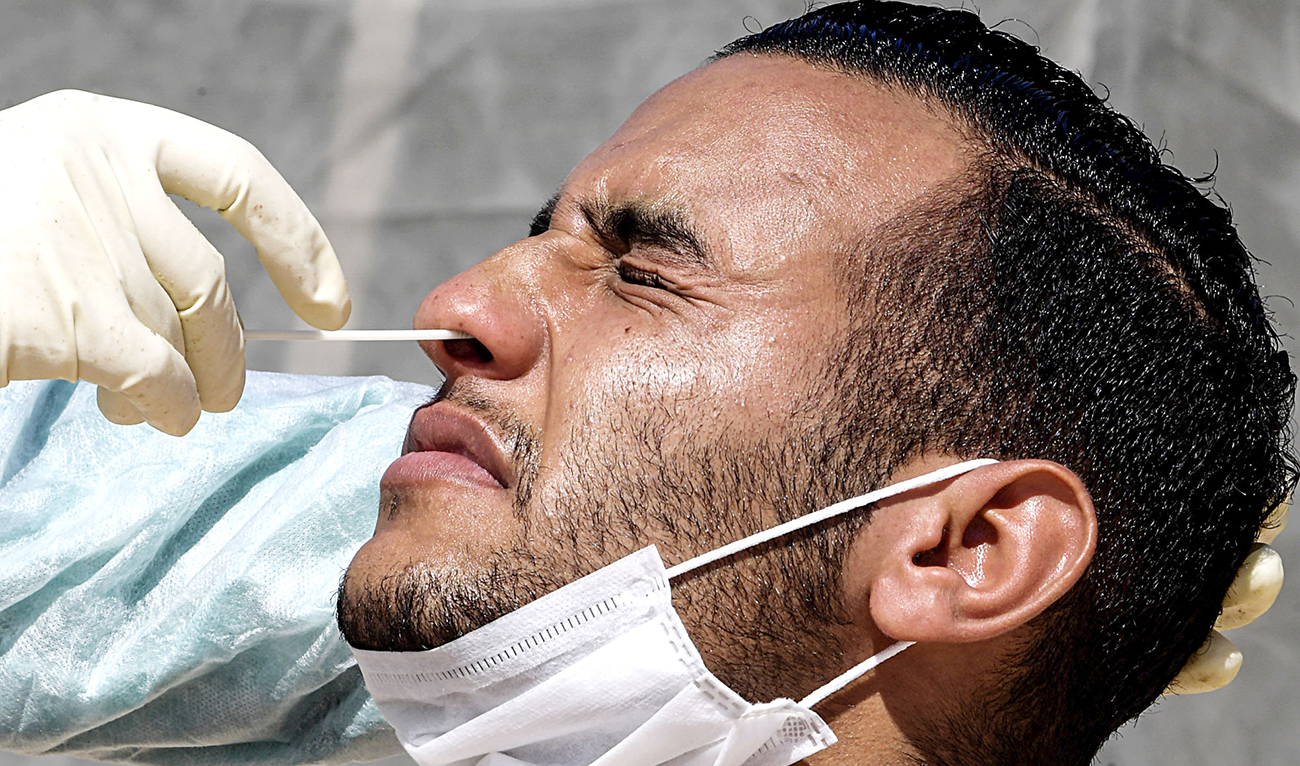
EL-HAMMA: The coronavirus pandemic has put the spotlight on struggling health services in southeast Tunisia, with residents and doctors in a COVID-19 hotspot deploring a lack of equipment and medics.

The North African country had managed to contain its outbreak by moving early and imposing strict measures in March, but cases have been on the rise since it reopened its borders on June 27.

Gabes province, and especially the town of El Hamma, some 500 km south of the capital Tunis, has become one of the country’s virus epicenters.

More than 800 of Tunisia’s almost 4,000 coronavirus cases and 11 of its 80 deaths have been recorded in Gabes region — mostly from El Hamma — in August alone, according to the Health Ministry.

Most cases have been asymptomatic, but residents of the agricultural town of some 100,000 people fear they will be unable to access treatment if needed.

“Our hospitals need to be hospitalized, urgently!” Fethi, a resident in his thirties of El Hamma, where a lockdown has been reimposed, said.

The local hospital has no intensive care beds, and the army set up a field hospital in mid-August to screen suspected cases.

Those in need of hospitalization are usually sent to regional capital Gabes, around 30 kilometers away and home to more than 400,000 people. But the situation there is only marginally better.

The main regional hospital in Gabes has just two respirators for COVID-19 patients, and two intensive care doctors for the whole hospital — but the pair only treat non-coronavirus cases.

“We have no intensive care staff for COVID patients,” said Hamida Kwas, head of respiratory medicine at Gabes regional hospital.

It has just 16 intensive care beds, and all eight beds in the regular coronavirus ward are occupied.

Hospital director Hechmi Lakhrach said he fears a “catastrophe.”

Health Ministry officials are aware of the lack of resources, equipment and staff, but “nothing has been done,” he said.

Public health has declined in Tunisia over the past two decades, faced with poor management and corruption, and eroded by an increase in private facilities. Many trained doctors go abroad to work.

Services are also unequally distributed: 13 of Tunisia’s 24 provinces have less than one intensive care bed per 100,000 inhabitants, according to a study on the marginalization of Tunisia’s central and southern regions.

Kwas said staff and equipment shortages were “exhausting us morally and physically. We are really afraid of not being able to go on.”

Donations from individuals and companies have improved some of Tunisia’s facilities, particularly since the start of the novel coronavirus outbreak.

But even hospitals that have benefited are still sometimes inadequately equipped. At the Gabes hospital, donations allowed the creation of screening rooms for suspected coronavirus cases.

But these are not in use due to lack of equipment, said Imen Rejeb, head of the emergency department.

She said suspected coronavirus cases were being hospitalized in the Covid-19 ward alongside confirmed cases, risking contamination.

“We have no oxygen supply … no respirators, no nurses. We have nothing,” Rejeb said.

Main category: 

Tunisian parliament to vote on new governmentTunisia PM designate will form a technocrat government without political parties


Syria intercepts Israeli strike on air base: state media

Author: 
Wed, 2020-09-02 23:55

DAMASCUS: Syrian air defenses on Wednesday intercepted missiles fired by an Israeli warplane at an air base in central Syria, state news agency SANA said, in the second such Israeli strike this week.
“An aircraft belonging to the Israeli enemy fired this evening a number of missiles… toward the T4 air base and our air defenses intercepted most of them,” SANA said citing a military source.
The Britain-based Syrian Observatory for Human Rights confirmed the attack on the air base in Homs province saying Israel was “likely” responsible.
Wednesday’s attack was the second this week, after Israeli strikes on Monday killed one civilian, three government troops and seven allied foreign fighters, according to the Observatory, a war monitor.
Monday’s strikes hit Syrian army positions south of Damascus as well as positions belonging to Iran-backed paramilitaries, including fighters of the Lebanese Hezbollah movement, in the southern province of Daraa, the Observatory said.
Israel has carried out hundreds of raids in Syria since the civil war broke out in 2011, targeting Iranian and Hezbollah forces as well as government troops.
The Israeli army rarely acknowledges individual strikes, but said that on Aug. 3 it had used fighter jets, attack helicopters and other warplanes to hit Syrian military targets in southern Syria.
Hezbollah’s leader Hassan Nasrallah warned on Sunday that the group would kill an Israeli soldier for each of its fighters slain by the Jewish state, after one of its combatants was killed in an Israeli strike in Syria on July 20.

Main category: 

Syria’s air defenses intercept Israeli missiles: state mediaLebanon ‘an open door’ to Syrian arms smugglers