Image of Palestinian under Israeli soldier’s knee sparks outrage

Author: 
Sat, 2020-09-05 00:42

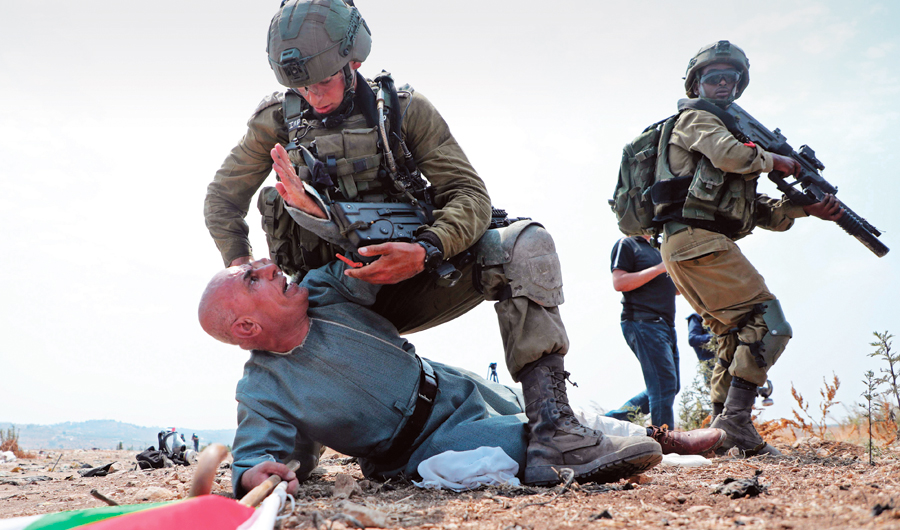
JERUSALEM: Footage of an Israeli soldier throwing a Palestinian activist to the ground and kneeling on his neck has sparked outrage in the Palestinian territories and beyond.
The protester, named as Khairi Hanoun, a man in his late 60s, took part in demonstrations on Tuesday near Tulkarm, in the north of the West Bank, against moves to extend a neighboring Israeli settlement.
Footage taken by AFP in recent weeks at different protests has shown him shouting at Israeli soldiers.
Hanoun was also involved in Tuesday’s demonstration at a road bordering the village of Shufah, between Nablus and Tulkarm.
He was seen waving a Palestinian flag, along with dozens of other protesters, and watched by several journalists.
In video footage, Hanoun appeared to touch an Israeli soldier, who then pushed him to the ground, putting his knee on his neck as he secured his hands with a plastic tie.
Edited footage of the incident has been circulating on social media and Palestinian television channels.
Several are posted with the hashtag #PalestinianLivesMatter.
They compare the image with George Floyd, an unarmed African American killed in police custody, who was photographed with police kneeling on his neck.
Saeb Erakat, secretary-general of the Palestine Liberation Organization, wrote on Twitter on Wednesday about the images condemning the “aggression.”

HIGHLIGHT

Edited footage of the incident has been circulating on social media and Palestinian television channels.

The Islamist movement Hamas, in power in the Gaza Strip, said “such acts” were among the “main causes” of tensions in the region.
However, Israel’s army said the images did not show the extent of the confrontation.
“We emphasize that the videos on social media are partial, heavily edited and do not reflect the violent riot nor the violence against IDF (Israeli) troops that happened prior to the apprehension,” the army said.
Israel’s army said “a Palestinian known as an inciter” had “shoved” a soldier “a number of times.”
According to the army, soldiers “showed restraint” but “were forced to apprehend the suspect that repeatedly assaulted them.”
Soldiers provided medical care after his arrest, the statement added.
Hamas and Israel have fought three wars since 2008.
Despite a truce last year backed by the UN, Egypt and Qatar, the two sides clash sporadically with rockets, mortar fire or incendiary balloons.
The Gaza Strip has a population of two million, more than half of whom live in poverty, according to the World Bank.
Palestinian analysts say fire from Gaza often aims to pressure Israel to give the green light for the transfer of Qatari financial aid into the strip.
Main category: 
Tags: 

An inside job: How a Jewish terror group broke hundreds out of a British jail in PalestineSaudi Arabia’s stance on Palestine ‘remains unchanged’


Artificial Intelligence helps counter COVID-19 misinformation in Arabic

Fri, 2020-09-04 23:52

CAIRO: With most credible information on COVID-19 and its symptoms supplied in English, Arabic-speaking populations have faced a significant barrier, falling prey to hysterical and inaccurate social media posts that come from questionable sources.

This urgent and potentially life-threatening problem was quickly identified by the team at DxWand, an Egyptian startup providing conversational artificial intelligence (AI) solutions — and they sought a fast and effective fix for it.

“In late February, we, as a team, were struggling to find credible information about COVID-19, and we found that one needs certain access to find credible information,” said Ahmed Mahmoud, co-founder of DxWand.

“That made us think about others who would find it challenging to make a distinction between credible and false information. Even on official websites it was sometimes hard to find an answer to a specific question. Or worse — you would get your information from social media.”

Enter Ask Nameesa, the startup’s newest conversational AI solution. The DxWand team has fed it all available databases on the precautions and symptoms around COVID-19. The databases are built on credible WHO information, as well as information and updates from local health authorities. The best part? It even answers questions using “day-to-day” language, such as Egyptian slang.

“One would only need to ask Nameesa a question via Facebook messenger or WhatsApp and it will respond within a few minutes with the most credible information it can find in its database, in Egyptian, Arabic or English,” Mahmoud said.

As an AI solution, Ask Nameesa has the ability to independently build up its knowledge based on the inquiries it receives, slowly broadening its scope and ability to answer very specific questions.

“Users make a valuable contribution to Ask Nameesa,” Mahmoud said. “It started with 22 knowledge-based items or categories; today, it has more than 200, and that comes from subcategories that people ask about, for instance, questions specific to COVID-19 and pregnant women or COVID-19 and alcohol consumption. If you try to find an answer to such questions online, you’d have to read lengthy articles, and you may or may not find the answer. Nameesa does that job for you and gets back to you with the most accurate information available.”

In a testament to its potential, Ask Nameesa was selected among the top 89 solutions out of more than 18,000 in the global #BuildforCOVID19 hackathon sponsored by the likes of Microsoft, Facebook and Google. It was only one of two regional creations to make it to the very top.

It also quickly garnered more than 50,000 followers on Facebook, which inspired the team to look into further expanding on it.

“We’re working on making Nameesa’s services sustainable and increase its reach geographically and demographically, which needs a bit of investment, so we’re looking into that,” Mahmoud said.

“It would also be of great value if we can collaborate with health care authorities so they can update the knowledge database with medication protocols for users who are reporting symptoms of COVID-19. We’re in discussion about that with authorities in the UAE and may soon launch a similar service there.”

However, it is not just tackling misinformation about COVID-19 that is on DxWand’s to-do list, Mahmoud said. The next step for the team could be building a fully fledged personalized health-care solution.

“We are looking into expanding the service beyond COVID-19 so that the platform or solution can basically build up knowledge on your medical record and then provide information about any care plan you should follow. It then follows up to make sure you’re complying with the plan or (determine) if changes are needed. The future is personalized care, not just for COVID-19,” he said.

———————

This report is being published by Arab News as a partner of the Middle East Exchange, which was launched by the Mohammed bin Rashid Al Maktoum Global Initiatives to reflect the vision of the UAE prime minister and ruler of Dubai to explore the possibility of changing the status of the Arab region.

Main category: 

Artificial Intelligence aiding fight against coronavirusSaudi Arabia to host global artificial intelligence summit in October


Sudanese government, key rebel group to restart peace talks

Sat, 2020-09-05 00:53

CAIRO:  Sudan’s transitional government and a powerful rebel group that controls large swaths of the country’s restive south said on Friday they have agreed to resume peace talks, a development that boosts hopes of ending the country’s decades-long civil wars.

The commitment comes days after the government reached a deal with other rebel groups to quell conflicts stemming from the rule of ousted ruler Omar Bashir.
The Sudan Liberation Movement-North, led by Abdel-Aziz Al-Hilu, and Sudanese Prime Minister Abdalla Hamdok signed a joint letter of intention late Thursday in the Ethiopian capital of Addis Abada, stressing the “necessity” of finding “a comprehensive and just political solution” to the conflicts. It did not specify when the talks would restart.
Negotiating an end to the rebellions in Sudan’s far-flung provinces has been a crucial goal for the transitional government, which took power after the military overthrew Bashir in April last year, following months of pro-democracy protests. Cash-strapped authorities are keen to slash military spending, which takes up 80 percent of the national budget.
Al-Hilu’s faction of the Sudan Liberation Movement-North, also known as SLPM-North, is Sudan’s single largest rebel group. It engaged in previous rounds of peace talks but remained skeptical of the country’s ruling Sovereign Council, comprised of both civilian leaders and military generals, including some from Al-Bashir’s tenure.

SPEEDREAD

Negotiating an end to the rebellions in Sudan’s far-flung provinces has been a crucial goal for the transitional government, which took power after the military overthrew Bashir in April last year.

Along with another major rebel group, the faction skipped the signing of the agreement earlier this week in South Sudan between the government and a rebel alliance known as the Sudan Revolutionary Front, dimming prospects for meaningful change on the ground.
The SLPM-North has also threatened to call for self-determination in the vast areas it controls if its demands are not met. Just days ago, Al-Hilu accused the transitional government of adopting the “evasive” tactics of Bashir’s administration throughout tortuous peace negotiations that have dragged on for nearly a year.
To lay the groundwork for a future deal, Al-Hilu and Hamdok agreed in principle on a range of political issues that have frustrated efforts to reach a deal in the past.
Sudan’s constitution “should be based on the principle of separation of religion and state,” the statement said, acknowledging a long-held demand of the ardently secularist SLPM-North. The sides also agreed to let the rebel group retain its weapons until they ink an accord calling for new security arrangements.
Al-Hilu’s movement controls large chunks of territory in the war-scarred Blue Nile and South Kordofan provinces, home to a significant Christian minority that long complained of discrimination under Bashir.
During Bashir’s 30 years in power, the Khartoum government extended Islamic rule in Sudan and fanned tensions between the Muslim majority north and mainly Christian and animizt south, precipitating brutal wars and ultimately, the secession of South Sudan in 2011.

Main category: 
Tags: 

Sudan and rebels meet to implement peace dealSudan’s Omar Bashir’s trial adjourned to Sept. 15


UN laments ‘blatant’ violations of Libya arms embargo

Author: 
Fri, 2020-09-04 02:39

NEW YORK: The interim UN envoy for Libya, Stephanie Williams, on Wednesday denounced what she called “blatant” ongoing violations of the arms embargo in effect on the war-wracked country.
Since UN Secretary-General Antonio Guterres last briefed the Security Council on July 8 about 100 resupply flights landing in Libya to help forces loyal to the Tripoli-based Government of National Accord (GNA) and its rival forces led by Khalifa Haftar in eastern Libya.
Nine cargo ships docked in western Libya, while three others reportedly arrived in the east of the country. She also accused foreign powers of “fortifying their assets” on both sides.
“The arms embargo remains totally ineffective,” according to an interim report from UN experts, who added that the violations are “extensive, blatant and with complete disregard for the sanctions.”
Williams said the activity “constitutes an alarming breach of Libya’s sovereignty, a blatant violation of the UN arms embargo.”
The UN mission in Libya, whose mandate is up for renewal in mid-September, “continues to receive reports of large-scale presence of foreign mercenaries and operatives,” she said.
Williams added that their presence complicates “chances of a future settlement.”
Russia’s UN envoy, Vassily Nebenzia, rejected any accusation of Russian interference.
“Not a single Russian serviceman is currently in Libya,” he said, while his US counterpart Kelly Craft slammed the presence of Russian mercenaries linked to the Kremlin.
“There is no place for foreign mercenaries or proxy forces in Libya, including the Russian Ministry of Defense proxy Wagner Group, which is fighting alongside” Haftar, she said.
France’s UN Ambassador Nicolas de Riviere called for a reinforcement of the world body’s mission in Libya, so that it can help shepherd an eventual cease-fire and ensure that the arms embargo is respected.
Several Council members called for a quick nomination of a permanent UN special envoy for Libya.
Ghassan Salame stepped down in March for health reasons, and bickering between the US and its partners on how the role should be defined has stalled naming a successor.
Libya has endured almost a decade of violent chaos since the 2011 NATO-backed uprising that toppled and killed veteran ruler Muammar Qaddafi.
The GNA and a Haftar-backed eastern administration are now vying for power against a backdrop of dozens of local conflicts.

Main category: 
Tags: 

US: Turkey-sent Syrian fighters generate backlash in LibyaEU top diplomat, Italian FM in Libya to push for peace talks


Turkey: Russia to hold live-fire exercises in Mediterranean

Author: 
Fri, 2020-09-04 02:36

ANKARA: Turkey has announced that Russia will hold live-fire naval exercises in the eastern Mediterranean, amid escalating tensions between Turkey and its coastal neighbors Greece and Cyprus over rights to search for energy resources in the region.
The navigational notice issued late on Wednesday said the Russian exercises will take place Sept. 8-22 and Sept. 17-25 in areas of the Mediterranean where Turkish seismic research vessels are operating.
There was no immediate comment from Russia on the exercises, which Turkey announced after the US said it was partially lifting a 33-year-old arms embargo against ethnically divided Cyprus.
It is unclear why NATO-member Turkey would announce such drills on Moscow’s behalf, but the two countries have in recent years significantly strengthened their military, political and economic ties. They are coordinating closely on their military presence in Syria, while Turkey has purchased Russia’s advanced S-400 missiles and has broken ground on a Russian-built nuclear power plant on its southern coast.
Turkey has reacted angrily to the US move that it said went against the “spirit of alliance” between Washington and Ankara. It also warned that it would harm efforts to reunify Cyprus, which is split between Turkish Cypriot and Greek Cypriot communities. Turkish officials have also vowed to take steps to guarantee the security of a self-declared Turkish state in the island’s north.
Turkey’s announcement comes at a time of increased friction between Turkey on the one side and Greece and Cyprus on the other over offshore energy exploration rights. Warships from Greece and Turkey have been shadowing each other in recent weeks as Turkish survey vessels and drill ships continue to prospect for hydrocarbons in waters where Greece and Cyprus claim exclusive economic rights.

HIGHLIGHT

The navigational notice issued late on Wednesday said the Russian exercises will take place Sept. 8-22 and Sept. 17-25 in areas of the Mediterranean where Turkish seismic research vessels are operating.

In Athens, Greek government spokesman Stelios Petsas said the planned Russian exercises were being “monitored by all the countries in the region, as well as our NATO allies and European Union partners.”
The US embargo, imposed in 1987, was designed to prevent an arms race that would hinder UN-facilitated reunification efforts for Cyprus. It was directed against the southern, Greek Cypriot part of the island, where Cyprus’ internationally recognized government is seated.
Cyprus split in 1974 when Turkey invaded following a coup by supporters of union with Greece. Turkey is the only nation to recognize a Turkish Cypriot declaration of independence and it maintains more than 35,000 troops in northern Cyprus.
Washington said it was lifting the arms embargo against Cyprus for one year — with the option of renewal — to let it procure nonlethal equipment.
Turkish Defense Minister Hulusi Akar said Thursday that the lifting of the embargo will lead to a deadlock.
“If you lift the embargo on (Greek Cypriot-administered Cyprus) and try to disrupt the balance in this way, this will bring conflict, not peace. This will create a deadlock, not a solution,” he said.
Akar also took aim at France, which joined Greece and Cyprus for military exercises in the region, accusing it of “bullying, making claims and playing the role of a guardian angel.”
US Ambassador to Cyprus Judith Garber said the embargo lifting had no connection to “valued partner and ally” Turkey, but aimed to strengthen regional security and to “counter malign actors in the region.”
Garber said Washington waived a requirement that Cyprus cease to offer refueling and other port services to Russian warships, but that it would continue to “encourage” Cypriot government authorities to deny those services.
“We believe that Russia is playing a very destabilizing role in the region, especially in Syria,” Garber said.
Russia maintains a sizable naval presence in the Eastern Mediterranean and regularly conducts naval maneuvers there. The announcement of the latest live-fire drill could clearly be a message from Moscow that it remains a major regional player whose influence won’t be diminished by Washington’s embargo move.

Main category: 
Tags: 

Turkey’s power projection risks military clash in Mediterranean, former PM says NATO: Turkey, Greece agree to talks about tensions at sea