Egypt denies exporting electricity to Europe at subsidized prices
Author:
Zaynab Khojji
ID:
1599937925849897200
Sat, 2020-09-12 22:32
CAIRO: Egypt has denied reports that it is exporting electricity to European countries at a subsidized price, lower than the local price.
The Ministry of Electricity and Renewable Energy said the reports, which appeared on some websites and social media platforms, were completely untrue. There is no electrical connection between Egypt and any European country to date.
It said in a statement that electricity exports were a result of the country’s huge energy reserves – from gas and renewable sources – that contributed to increasing national income and making Egypt an appealing market for investment in the energy field.
Studies for an electrical interconnection project between Egypt, Cyprus and Greece are being completed, which will be conducted through submarine cables of 500 kilovolts. In a DC system, the line capacities will exceed more than 2,000 megawatts.
The project will help connect Egypt with Europe’s electrical grid and turn it into an energy center and electricity supplier to the European continent.
Ayman Suleiman, CEO of Egypt’s Sovereign Fund, denied reports in Turkish and Qatari media about the country’s intention to export electricity to Europe at a price of 2.5 cents per kilowatt, which is less than the selling price to the Egyptian consumer.
In a statement to MBC Egypt, Suleiman said that recent statements regarding the country’s export of its surplus production of electricity were “half-facts.”
He added that the price mentioned in those statements referred to the competitive production that Egypt had reached after years of investing in projects to generate electricity from solar energy, such as the Benban project in Aswan.
Egypt to launch two satellitesKazakhstan resumes flights to Egypt
Egypt to launch two satellites
Author:
Sat, 2020-09-12 22:31
CAIRO: Egypt is planning to launch two satellites in cooperation with China in 2021 and 2022.
One of the satellites will have high-resolution imaging capability, Mohamed El-Qosi, CEO of the Egyptian Space Agency, said.
“China has provided Egypt with two grants, one for building a satellite collection center, and another for manufacturing a large joint satellite between the two countries. This is a result of strong political relations between Egyptian President Abdel Fattah El-Sisi and Chinese President Xi Jinping,” he said in a statement.
The project has been planned since September last year.
“We have completed the first phase of the project, after which we will manufacture a satellite in Egypt and China at the satellite collection center, and the launch will be in September 2022,” El-Qosi added.
Egypt is involved in another project to manufacture a satellite with a German company, in which the Egyptian Space Agency has a 45 percent stake. The project has so far produced an educational satellite with more than one university within the Universities Moon Project, which will launch in July 2021.
El-Qosi also revealed new details about an African space project, which aims to monitor climate change on the continent and boost community development.
He said that five countries are taking part in the project, including Uganda, Nigeria and Sudan. Egypt planned to host three space and satellite specialists, but the pandemic delayed the project.
“We will return again to the African Development Moon project after conditions get better,” El-Qosi said.
Egypt is looking to boost its space industry through several construction projects, he added.
“We have started the construction process at the Space Agency headquarters, just as there are major foreign countries seeking cooperation with Egypt in the field of space because they see it as the gateway to Africa, including the European and French space agencies. They requested help in attracting African countries to cooperate with them by establishing an African alliance in the field of space,” El-Qosi said.
Kazakhstan resumes flights to EgyptEgypt to test coronavirus vaccine
Yemen will not normalize ties with Israel without Palestinian state
Sat, 2020-09-12 22:15
AL-MUKALLA, Yemen: Yemen’s foreign minister said his country will not normalize relations with Israel until the Palestinians get their own sovereign state with Jerusalem as its capital, as envisaged under the Saudi-proposed Arab Peace Initiative.
Yemen “will always stand by” the Palestinian people “until they achieve their inalienable rights,” Mohammed Al-Hadrami tweeted shortly after Bahrain agreed to sign a peace deal with Israel.
His comments echoed those he made last month after the UAE and Israel announced the normalization of ties.
Clashes
Fighting subsided on Saturday in the northern Yemeni province of Jouf, a day after the army and allied tribesmen captured two Houthi field commanders and seized a command and communications room, army spokesman Rabia Al-Qurashi told Arab News.
Meanwhile, the Defense Ministry announced on Saturday the killing of 35 Houthis, including four high-ranking field commanders, just outside Houthi-held Sanaa after army troops and coalition warplanes targeted their locations.
******
READ MORE: Iran fuels humanitarian crisis in Yemen, says foreign minister
******
The ministry said loyalists seized a military vehicle and destroyed three others during fighting with Houthis in the areas of Al-Jafra, Al-Saleb and Najeb Al-Ateq.
Coalition warplanes on Saturday launched airstrikes on various military locations in Sanaa, residents told Arab News.
Displacement
Ongoing Houthi military operations in the provinces of Marib, Jouf and Al-Bayda have displaced 2,945 families, the government said.
It added that thousands of families have crossed into the city of Marib — which has enjoyed peace and security since early 2015 — fleeing heavy battles and Houthi incursions into their home cities and villages.
The new arrivals are in desperate need of shelter, food, drinking water and medication, the government said.
Local and international aid and right groups have warned that the Houthi military assault outside the city of Marib will exacerbate Yemen’s humanitarian crisis and displace thousands more people.
Iran fuels humanitarian crisis in Yemen, says foreign minister Yemen joint forces commander inspects military operations at Saudi southern border
UAE daily coronavirus cases surge to near peak level as 931 new cases reported
Author:
Fri, 2020-09-11 23:34
DUBAI: The UAE on Friday recorded 931 new coronavirus cases, bringing the total number to 77,842, the health ministry said, following a recent surge in infections that are near the highest since the pandemic broke out.
All the cases, who bare various nationalities, are in “stable (condition) and subject to the necessary health care,” it added in a statement on WAM.
Until last month, there had been a generally falling trend since the UAE’s new daily cases peaked at 994 in May, but numbers have surged from 164 cases on Aug. 3.
The ministry said that 517 new cases have “fully recovered from the symptoms of the virus after receiving the necessary health care upon entering hospital, bringing the total number of recovery cases to 68,462.”
The Ministry of Health and Prevention also said that no deaths have been recorded over the past 24 hours. The UAE has recorded 398 deaths from coronavirus since the pandemic began.
The ministry launched a campaign to increase the scope of examinations in the country for early detection and to be able to count the number of cases infected with Covid-19, in order to isolate them and those whom they have been in contact with.
It said that it conducted 75,177 new examinations over the past 24 hours on various groups, using the best and latest medical examination techniques.
A health ministry official on Thursday asked the public to adhere to social distancing and avoid gatherings and mixing with people known to have the virus, which she said accounted for about 88% of cases.
The UAE had earlier enforced strict measures to curb the spread of the novel coronavirus, including locking down tourism hub Dubai for a month and months-long evening curfews nationwide.
Most business and public venues have now reopened with some restrictions, and people must wear a mask outside homes.
Dubai reopened to foreign visitors in July, although airports in the rest of the country remain closed to visitors.
Abu Dhabi, the UAE capital and the largest and richest emirate, has restricted movement into the area to those with a negative Covid-19 test.
Meanwhile, Kuwait on Friday reported one death and 653 new infected cases, bringing the total number to 557 and 93,475 respectively.
The Ministry of Health said that 620 cases have recovered bringing the total to 83,660.
The ministry’s spokesperson, Dr. Abdullah Al-Sanad, renewed the call for everyone to continue adopting all preventive measures, avoiding mixing with others, implement the social distancing rule, and keep reviewing the ministry’s instructions and recommendations to contain the spread of the virus, Kuwait News Agency (KUNA) reported.
The coronavirus pandemic has affected over 28 million people globally and the death rate has topped 900,000. (With Reuters)
DUBAI: Time was when Turkey pursued a foreign policy devised by an academic turned foreign minister that came to be known as “zero problems” with neighbors.
Even though 10 years is a very short time by the standards of the rise and fall of nations, Turkey’s current diplomatic doctrine does not bear even a smidgen of similarity to what Ahmet Davutoglu had formulated in 2010.
If anything, his former boss, Recep Tayyip Erdogan, is pursuing a policy that has been described variously as “zero friends” and “nothing but problems.”
It is a policy that has now brought US Secretary of State Mike Pompeo to the divided Mediterranean island of Cyprus in an attempt to solve some of Turkey’s proliferating problems with its neighbors.
“We hope there will be real conversations and we hope the military assets that are there will be withdrawn so that these conversations can take place,” Pompeo told reporters on the flight to Qatar.
The military assets he referred to belong mainly to Ankara and Athens, but in fact a number of countries are ranged against Turkey over what they view as unchecked energy piracy coupled with gunboat diplomacy.
Turkey has occupied and controls one-third of Cyprus since 1974, when it invaded the north in response to a coup engineered by military leaders in Athens. Now it is embroiled in simultaneous disputes with Greece and Cyprus – a fellow NATO member – over maritime borders and gas-drilling rights.
Fueling Turkey’s great-power ambitions are investments in a domestic arms industry geared to the production needs of everything from warships to submarines, frigates to attack helicopters, and armed drones to light aircraft carriers.
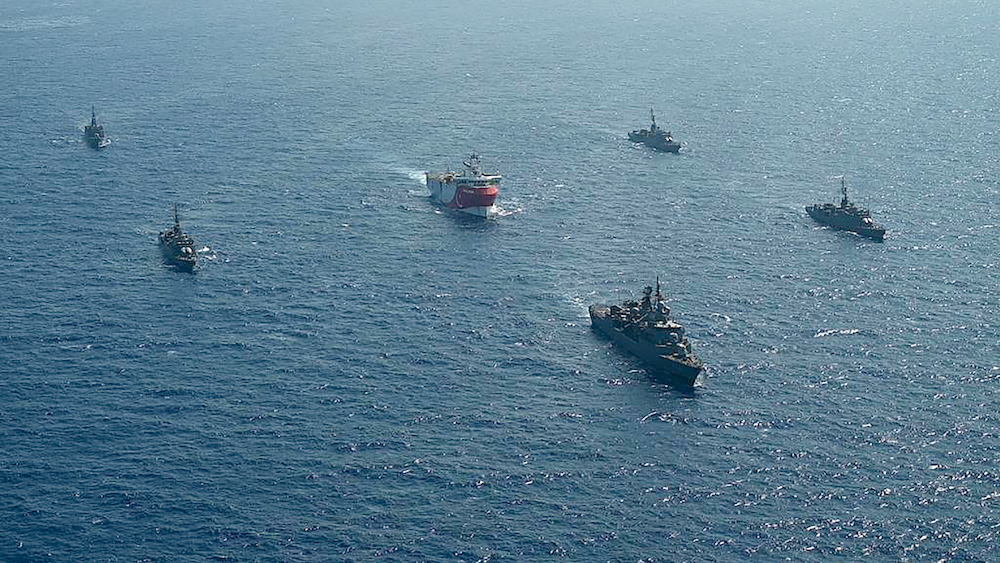
For months now, Turkey has been prospecting for gas and oil reserves in eastern Mediterranean waters claimed by Greece. When it deployed a research ship accompanied by military frigates in August, Greece fired a warning shot by staging naval exercises.
Opinion
This section contains relevant reference points, placed in (Opinion field)
The same month, a minor collision between a Turkish military ship and a Greek navy vessel ratcheted up tensions to a level not seen since a war almost broke out over two Aegean Sea islands in 1996.
As both countries use naval drills in the Mediterranean to reinforce their sovereign claims, the EU has asked Ankara to de-escalate or face sanctions.
US President Donald Trump’s administration has upped the ante by temporarily lifting a decades-old arms embargo on Cyprus. The US embargo had been imposed in 1987 with the aim of facilitating the reunification of Cyprus, but its strategic impact was viewed by many as counterproductive. From Oct. 1, the US will remove blocks for one year on the sale or transfer of “non-lethal defense articles and defense services” to Cyprus.
Karol Wasilewski, an analyst with the Polish Institute of International Affairs, told Arab News that the US decision had hurt its standing as an honest broker from the Turkish perspective.
“As for Greece, the US cannot provide the carrots that might coax it to start negotiations with Turkey without preconditions. Obviously, it is a good thing that Pompeo has supported peaceful resolution and praised Germany for its de-escalation efforts. But the problem is, the US does not have much leverage,” he said.
Many analysts believe the mounting geopolitical tensions give Erdogan yet another tool with which to counter eroding support for his government among rightwing nationalist voters, particularly young conservatives.
More specifically, they say, the authoritarian leader is insisting on an iron-fist approach to Turkey’s disputes with Cyprus and Greece in order to divert attention away from flagging economic growth, high unemployment, a volatile currency, and the coronavirus disease (COVID-19) pandemic.
Regardless of the rationale, Erdogan’s pan-Islamist zeal and neo-Ottoman world view have put Turkey on a collision course with Sunni Arab powers.
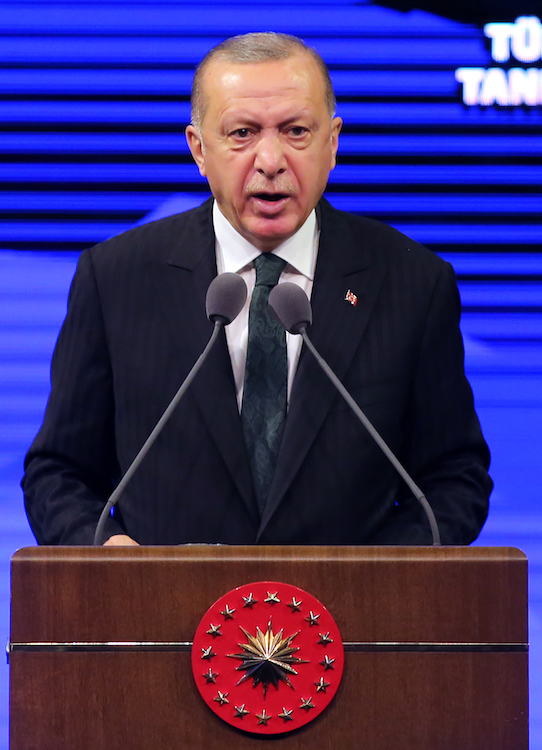
Turkish President Recep Tayyip Erdogan speaks during an introductory ceremony for Turkey Insurance at Bestepe People’s Convention and Culture Center in Ankara on September 7, 2020. (AFP)
Addressing a recent Arab League ministerial committee meeting, Sameh Shoukry, Egypt’s foreign minister, described Turkey’s military involvement in Libya, Syria, and Iraq as a threat to regional security and stability and appealed for a unified stance.
Reports indicate that in July, Turkey deployed in Libya 25,000 mercenaries, who included 17,000 Syrian militants besides 2,500 fighters of Tunisian, Sudanese, and other nationalities.
More broadly, Turkey’s actions have drawn international attention to the hunt for natural gas fields in the eastern Mediterranean. Along with Turkey, Cyprus, Egypt, Greece, and Israel have staked their claims to the deposits in the seabed.
Recent discoveries off the coasts of Israel, Cyprus, and Egypt have underscored the potential of the area, especially since the announcement of a massive gas field off Egypt’s coast in 2015 boosted these countries’ hopes of becoming energy exporters to Europe.
The newly discovered energy reserves have spawned regional alliances shaped by Turkey’s increasingly antagonistic relations with the EU, Egypt, Israel, and the UAE, not to mention Greece and Cyprus.
An initial agreement involving Greece, Cyprus, Italy, and Israel on the East-Med Pipeline Project morphed into the East-Med Gas Forum with the entry of Egypt, Jordan, and Palestine. Together with Lebanon and Syria, Turkey, a nation of 83 million people led by an authoritarian leader, found itself isolated.
In an apparent bid to reassert its authority, Turkey signed in late July a “delimitation of maritime jurisdiction” agreement with the Government of National Accord (GNA), the Libyan faction in control of Tripoli, and claimed the right to conduct research activities in the disputed waters between Cyprus and Crete.
However, Greece, Cyprus, Egypt, together with France and the UAE, have voiced their objections, saying the Turkey-Libya maritime deal “cannot produce any legal consequences for third states.”
Athens insists that islands must be taken into account in measuring a country’s continental shelf, in line with the UN Law of the Sea, to which Turkey is not a signatory. Ankara believes that a country’s continental shelf should be measured from its mainland, rejecting the argument that offshore islands should supersede mainland claims to as many as 150,000 square kilometers of continental shelf.
For its part, the Cyprus government says its policy of “actively promoting close cooperation” between the region’s countries and “creating synergies for the benefit of all” has resulted in “establishing an attractive environment based on the rule of law.” As evidence, Nicosia has cited the presence of oil majors such as Eni, Total, and Exxon in Cyprus’ Exclusive Economic Zone.
“Turkey on the other hand is the instigator of the current crisis and instability in the eastern Mediterranean,” according to an informal diplomatic note. “Not only does it refuse to engage in negotiations with Cyprus in order to reach an agreement on their respective maritime boundaries, but it persistently violates the sovereignty and sovereign rights of Cyprus, using the protection of the rights of the Turkish Cypriot community … as a pretext.”
What Greece and Cyprus might lack in military heft, they make up for with diplomatic backing. In the run-up to a special summit of EU leaders on Sept. 24 to 25 to discuss the Cyprus-Turkey crisis, Athens has called for “severe” economic sanctions to be slapped on Ankara for a limited time if it does not remove its military vessels and gas-drilling ships from waters off Cyprus.
In a statement on Sept. 10, the heads of state and government of the southern countries of the EU (Med7), said: “We reiterate our full support and solidarity with Cyprus and Greece in the face of the repeated infringements on their sovereignty and sovereign rights, as well as confrontational actions by Turkey.”
So, what might Davutoglu, the architect of the “zero problems” doctrine, make of Turkey’s “confrontational actions?”
Having broken away from Erdogan’s Justice and Development Party to set up his own party and position himself as a potential political challenger, he recently warned that Turkey risks military confrontation in the eastern Mediterranean because it prizes power over diplomacy. “Unfortunately, our government is not doing a proper diplomatic performance,” Davutoglu told Reuters.
Turkey says EU Mediterranean statement biased, open to talks with GreeceEU must consider ‘severe’ sanctions on Turkey, Greece saysNATO sets up talks in search for solution to Turkey-Greece conflictPompeo to visit Cyprus, calls on Turkey to withdraw forces from Mediterranean